Physiological changes in pregnancy
 Call Kai
 Learn
 Practice Test
 Spaced Repetition
 Match
 Flashcards
 Knowt Play
1/44

There's no tags or description
Looks like no tags are added yet.
45 Terms
What hormones does the anterior pituitary gland increase production of during pregnancy?
ACTH
prolactin
melanocyte stimulating hormone
What does increased levels of circulating ACTH result in?
Cause a rise in steroid hormones, particularly cortisol and aldosterone.
.
What does higher levels of circulating steroid hormones mean?
Higher steroid levels lead to an improvement in most autoimmune conditions and a susceptibility to diabetes and infections
What is the impact of increased circulating prolactin?
Acts to suppress FSH and LH (reduced levels of these hormones)
What does and increase in melanocyte circulating hormone cause?
Causes increased pigmentation of the skin during pregnancy, resulting in skin changes such as linea nigra and melasma.
How do levels of TSH change during pregnancy?
Remains normal, but T3 and T4 levels rise
Describe progesterone levels throughout pregnancy
Progesterone levels rise throughout pregnancy.
What is the role of rising progesterone during pregnancy?
Progesterone acts to maintain the pregnancy, prevent contractions and suppress the mother’s immune reaction to fetal antigens.
When does the corpus luteum stop producing progesterone?
Until 10 weeks gestation, it is produced by the placenta the remainder of pregnancy
Describe HCG levels throughout pregnancy
levels rise, roughly doubling every 48 hours until they plateau around 8 – 12 weeks, then gradually start to fall.
Where is oestrogen produced during pregnancy?
By the placenta
How much does the uterus increase in size during pregnancy?
from 100g to 1.1kg
There is hypertrophy of the myometrium and the blood vessels in the uterus
What effect does increased oestrogen have on the cervix?
May cause cervical ectropion and increased cervical discharge.
What effect does increased oestrogen have on the vagina, what is a clinical side effect of this?
Oestrogen also causes hypertrophy of the vaginal muscles and increased vaginal discharge.
The changes in the vagina prepare it for delivery, however they make bacterial and candidal infection (thrush) more common.
What cardiovascular factors increase in preganacy?
Increased blood volume
Increased plasma volume
Increased cardiac output, with increased stroke volume and heart rate (20%)
Which cardiovascular factors decrease in pregnancy?
Decreased peripheral vascular resistance
Decreased blood pressure in early and middle pregnancy, returning to normal by term
Why can varicose veins occur during pregnancy?
Can occur due to peripheral vasodilation and obstruction of the inferior vena cava by the uterus
What pregnancy symptom can peripheral vasodilation cause?
Can cause flushing and hot sweats
Why do tidal volume and respiratory rate increase in later pregnancy?
To meet increased o2 demands
How does the blood flow to the kidneys change during preganacy?
Blood flow to kidneys increases
How does GFR change during pregnancy?
GFR increases
What impact does increased aldosterone during pregnancy have?
Leads to increased salt and water reabsorption and retention = oedema (ankle swelling)
What happens to levels of proteins excreted by the kidneys during pregnancy?
Protein excretion increases (normal up to 0.3g/24hrs)
What does dilatation of the ureters and collecting ducts lead to?
Physiological hydronephrosis
also an increased risk of UTIs as a result
There is increased red blood cell production in pregnancy, what does this lead to?
Leading to higher iron, folate and B12 requirements
Why is anaemia common in pregnancy?
Plasma volume increases more than red blood cell volume, leading to a lower concentration of red blood cells.
High plasma volume means the haemoglobin concentration and red cell concentration (haematocrit) fall in pregnancy, resulting in anaemia.
why does the risk of VTE increase during pregnancy
Clotting factors such as fibrinogen and factor VII, VIII and X increase in pregnancy, making women hyper-coagulable
What other changes might you find on a pregnant blood result?
Increased white blood cells
Decreased platelet count
Increased ESR and D-dimer
Increased alkaline phosphatase (ALP), up to 4 times normal, due to secretion by the placenta
Reduced albumin due to loss of proteins in the kidneys
Calcium requirements increase, but so does gut absorption of calcium, meaning calcium levels remain stable
What conditions can arise due to increased melanocyte stimulating hormone?
Increased pigmentation = linea nigra and melasma

What are striae gravidarum?
(stretch marks on the expanding abdomen)

What can excessive itching indicate?
obstetric cholestasis - liver condition in pregnancy where bile flow slows, causing bile acids to build up and leading to severe itching—typically after 24–28 weeks and often worse at night, especially on the hands and feet.
How long is a normal human pregnancy?
37-42 weeks
first trimester
1-12 weeks
second trimester
13-26 weeks
third trimester
27-40 weeks
What fetus changes are occurring in the 1st trimester?
Fertilisation
Implantation
Initial development
Placentation
What changes are happening to the mother during the 1st trimester?
weight gain
nausea
What changes are happening to the fetus during the 2nd trimester?
Nervous system
Hair
Spine straightens
Pain
Proportions change
What changes are happening to the mother during the 2nd trimester?
Placental growth
Uterus rises
Hypervolaemia
Cardiac remodelling
Breast remodelling
What changes are happening to the fetus during the 3rd trimester?
Growth
Fat deposition
Brain growth
Blood cells
Lung development
What changes are happening to the mother during the 3rd trimester?
Braxton-Hicks
Tiredness
Restricted breathing
Lactation
When do we measure pregnancy from?
from the last day of the LMP
What date is conception and implantation?
Conception = 3 weeks
Implantation = 4 weeks
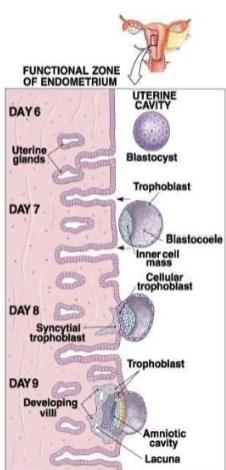
Describe implantation
Villous TE cells interdigitate with villi on uterine epithelium
Zona Pellucida and glycocalyx lost.
-Note: epithelial nuclei assume basal position and stromal tissue changes shapeTE cells invade and destroy primary decidua
Fragments of the maternal capillaries are engulfed by the syncytial trophoblast
Trophoblastic lacunae fill with maternal blood & are precursors of the intervillous spaces
Maternal capillaries expand & form sinusoids that
anastomose with the lacunae