Hematuria and Nephritic Syndrome
 Call Kai
 Learn
 Practice Test
 Spaced Repetition
 Match
 Flashcards
 Knowt Play
1/27

There's no tags or description
Looks like no tags are added yet.
28 Terms
Clinical features of nephritic syndrome
Hematuria, hypertension, decreased GFR/azotemia, oliguria.

Why nephritic syndrome causes hematuria
Subendothelial immune complex inflammation → capillary wall damage → RBC leakage.

Why nephritic syndrome causes hypertension
Reduced GFR → sodium/water retention → RAAS activation.

How to distinguish hematuria from pigmenturia
Spin urine: red sediment = hematuria; supernatant red=pigmenturia

Dipstick heme positive but no RBCs
Myoglobinuria or hemoglobinuria (rhabdomyolysis or hemolysis).

Transient hematuria causes
Exercise, fever, sexual activity, menses contamination, infection, trauma, instrumentation.

Risk factors requiring hematuria workup
Age >50, smoking, analgesic abuse, pelvic radiation, cyclophosphamide(hemorrhagic cystitis), occupational exposures.

Glomerular hematuria clues
Dysmorphic RBCs, RBC casts, proteinuria.

Non‑glomerular hematuria clues
Normal RBC morphology, clots present, no casts.

Nephritic immune complex location
Subendothelial deposits → inflammation → nephritic syndrome.

Mesangial immune complex location of damage
Mixed hematuria + mild proteinuria
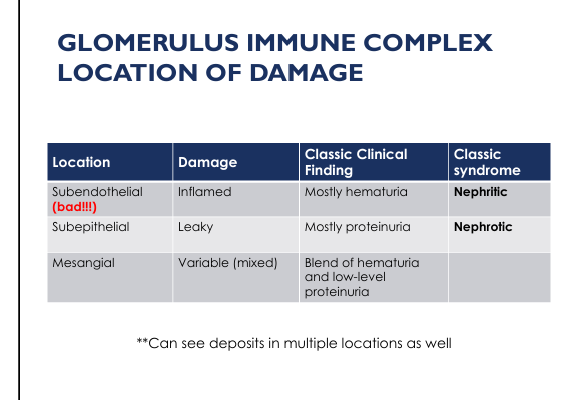
Subepithelial immune complex location
Nephrotic syndrome (not nephritic).

Post‑infectious GN hallmark (LM, IF, EM)
Hypercellularity with neutrophils, subendothelial + mesangial deposits, Immune complexes: Granular IgG + C3, Subepithelial “hump” deposits.
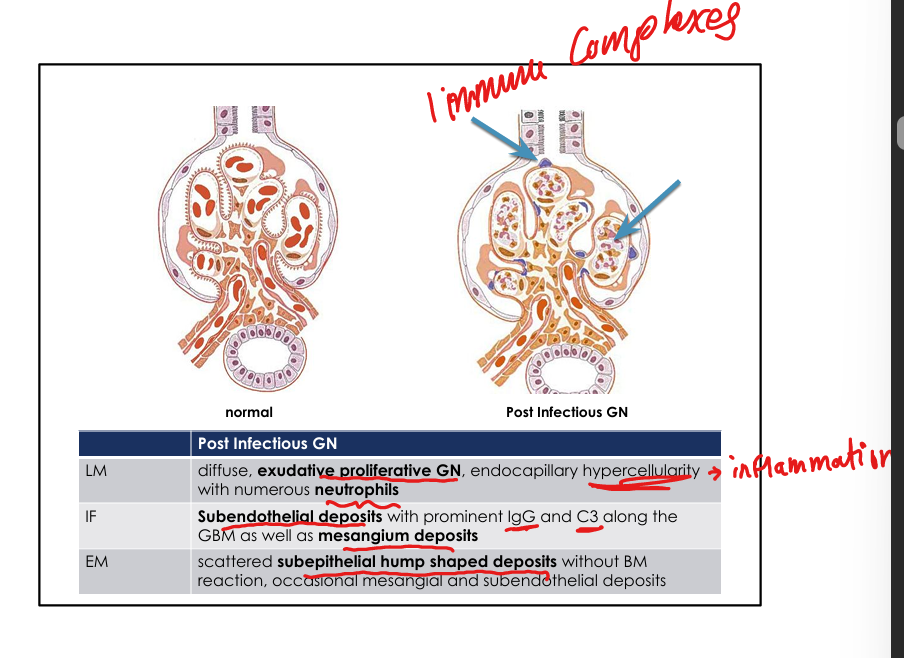


Post‑infectious Glomerulonephritis (Cause, Presentation, Complement patterin, Tx)
Immune complex deposition causing hypercellularity, Occurs 2–3 weeks after strep pharyngitis or cellulitis (POST INFECTIOUS),
Sx: Sudden onset edema, hematuria, HTN, azotemia after infection weeks prior, Low C3
Tx: Supportive


Membranoproliferative Glomerulonephritis (MPGN) hallmark (LM, IF, EM)
Endocapillary hypercellularity + “tram‑track” GBM splitting, Subendothelial immune complexes


Membranoproliferative Glomerulonephritis (MPGN) (Cause, Presentation, Complement, Tx)
Immune complex deposition in subendothelial and mesangial areas»inc proliferation.
2ndary Causes: Hepatitis B or C(usually with cryoglobulinemia), endocarditis, chronic abscess, Lupus, lymphoma.
Low C3 and Low C4=classic
Tx: Treat underlying condition if there is one, otherwise steroids + immunosuppression


C3 glomerulopathy definition + 2 Types
Complement dysregulation with dominant C3 staining. Glomerulonephritis with dominant C3(C3GN) and Dense Deposit Disease (DDD)


Dense Deposit Disease (Microscopy, Presentation, Complement, Tx)
Disorder of complement activation» On Microscopy: Ribbon‑like electron‑dense deposits in GBM, tram track in GBM
Sx: Presents as variabel mixed nephrotic/nephritic syndrome
Complement: Low C3 levels, normal C4
Tx: Eculizumab(inhibits C5), immunosuppression
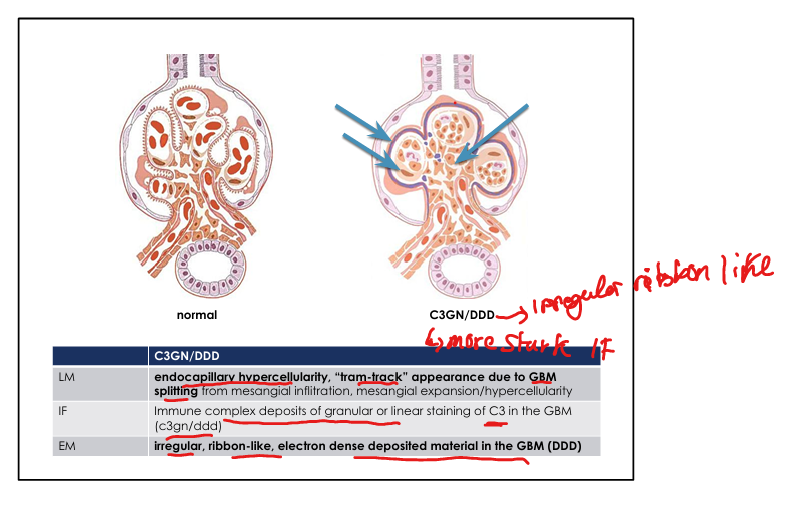
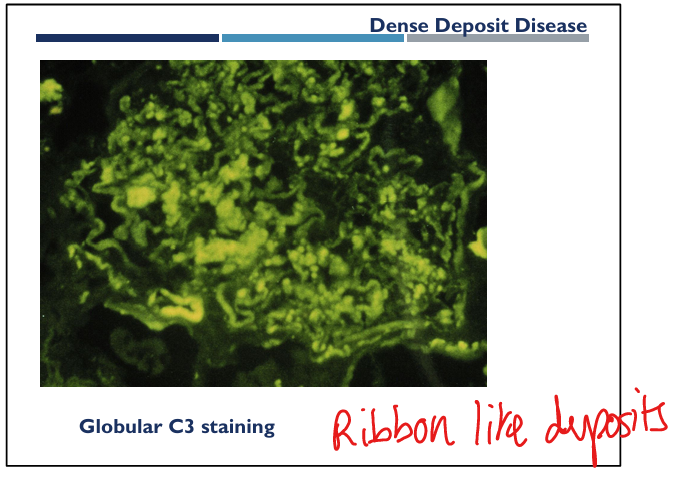


Dense deposit disease pathogenesis + Tx
C3 nephritic factor stabilizes C3 convertase → uncontrolled complement activation due to no degradation of C3 convertase. Eculizumab inhibits C5 which gets overactivated


IgA nephropathy hallmark (LM,IF,EM)
Mesangial IgA diffusely, + C3, hypercellular
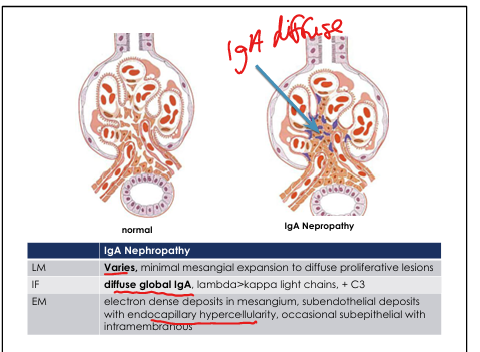

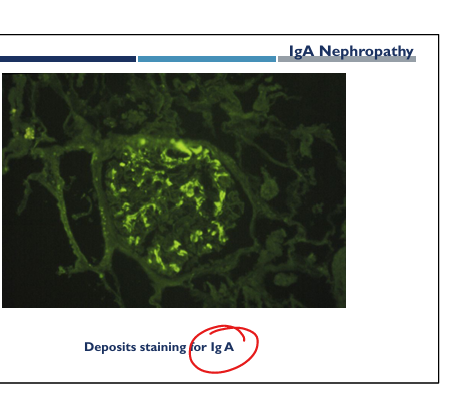
IgA nephropathy (Cause, Presentation, Tx)
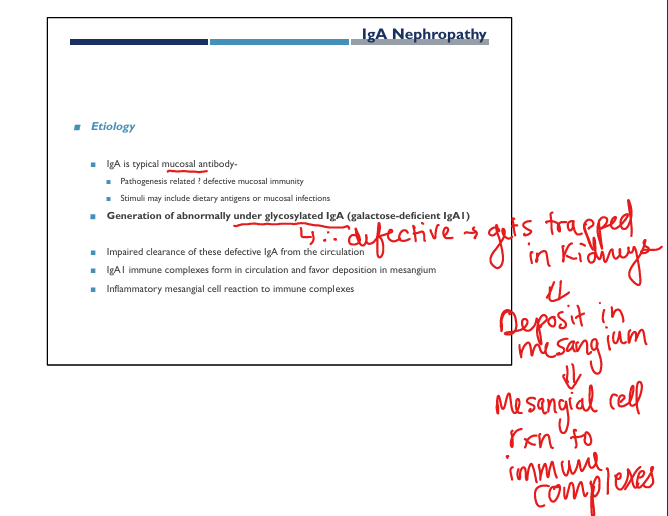
Generation of abnormally underglycosylated IgA→defective and get deposited in the mesangium→causes immune complex inflammatory reaction
Sx: Hematuria during mucosal infection (“syn‑pharyngitic”)
Tx: ACE/ARBs, SGLT2i, maybe immunosuppresion

IgA nephropathy associated conditions
Henoch-Schonlein Purpura (HSP)=IgA Vasculitis systemically, IBD, celiac disease, ankylosing spondylitis.

Alport syndrome (Cause, Inheritance, Presentation, Tx)
Type IV collagen X linked(of a5) mutation (α3/α4/α5). Hematuria, hearing loss, ocular abnormalities(bc type IV collagen also present in these systems)
Tx: ACE/ARBs, supportive care


Alport syndrome hallmark (LM, IF, EM)
GBM thickening with “basket‑weave” appearance, look for alpha 5 Type IV collagen mutation

Thin basement membrane disease hallmark (LM, IF, EM)
GBM thinning <250 nm.
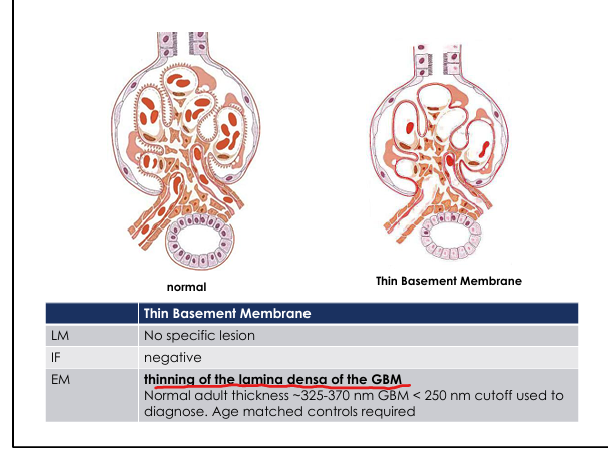

Thin basement membrane disease (Clinical presentation, Tx, Prognosis)
Persistent microscopic hematuria with normal renal function. Monitor. Tends to be just lifelong hematuria


Why subendothelial deposits cause nephritis
Close to circulation → intense inflammation → capillary injury.
Differential fo Nephritic Syndrome (3)
Post Infectious Glomerulonephritis, Membrano-proliferative Glomerulonephritis, IgA Nephropathy
