Psychology 1101 Chapter 15, Disorders Flashcards
 Call Kai
 Learn
 Practice Test
 Spaced Repetition
 Match
 Flashcards
 Knowt Play
1/107

There's no tags or description
Looks like no tags are added yet.
108 Terms
A clinically significant disturbance in thinking, emotion regulation, or behavior that is maladaptive (APA, 2013).
Psychological Disorder
Thoughts, emotions, or behaviors that are disturbed or dysfunctional and get in the way of normal functioning.
Maladaptive
-Unusual, faulty view of reality (hallucinations, persecution ideas)
-Severely distressing, self-defeating, dangerous, and/or socially unacceptable
these are criteria for labeling behavior as a ___.
Disorder
Old belief (common in the 17th-18th centuries) that disorders were caused by demons or possession by the Devil.
Demonological Model
Stone Age practice of drilling holes in the skull, possibly to release evil spirits and 'cure' mental disorders.
Trephination
Disorders develop from a genetic predisposition (diathesis) PLUS environmental stressors that trigger it.
Ex: genetic vulnerability to schizophrenia + major stress.
Diathesis-Stress Model
Disorders come from a mix of: biological (genes, brain), psychological (conditioning, stress, negative thoughts), and sociocultural factors (family, unemployment, culture).
Biopsychosocial Model
By classifying/diagnosing disorders, we are able to ___ the disorder's future course, suggest treatment, and prompt research into causes.
Predict
-Diagnostic and Statistical Manual of Mental Disorders, published by the American Psychiatric Association (first published 1952).
-The main classification system used by mental health professionals.
DSM-5
DSM-5 categories/describes disorders through:
-Diagnostic Features (overview)
-Diagnostic Criteria (symptoms required)
-Prevalence
-__ Factors
-Comorbidity info.
Risk
When two disorders occur together in the same person.
Comorbidity
Listed as a disorder in the first two DSM editions; removed in 1973.
Homosexuality
Text Revision of the DSM-5 (2022). Describes disorders and estimates how often they occur.
DSM-5-TR
DSM-5-TR helps mental health professionals ___ with each other and is useful for research.
Communication
DSM-5-TR ___ everyday life (turns normal struggles into 'disorders'), and labels reflect society's value judgments.
Pathologizes
In ___:
-Depressive/bipolar 9.5%
-> specific phobia 8.7%
-> social anxiety 6.8%
-> ADHD 4.1%
-> PTSD 3.5%
-> GAD 3.1%
-> schizophrenia 1.1%
- > OCD 1%.
America
Distressing, persistent anxiety OR maladaptive behaviors that reduce anxiety.
Anxiety Disorders
-Normal anxiety = response to a real threat.
-It becomes ___ when it appears out of nowhere and/or stops you from doing important things.
Abnormal
Worrying, fear of the worst happening, fear of losing control, nervousness, inability to relax.
These are all ___ symptoms of anxiety disorders
Pscyhological
Sympathetic nervous system arousal: trembling, sweating, pounding heart, high blood pressure, faintness.
These are all ___ symptoms of anxiety disorders.
Physical
-Constant tension and apprehension with autonomic arousal
-Free-floating anxiety NOT tied to a specific object or situation
Symptoms: motor tension, autonomic overarousal, excessive vigilance.
Generalized Anxiety Disorder (GAD)
Sudden attacks of intense dread with NO specific trigger; person lives in fear of the next attack.
Panic Disorder
-Shortness of Breath/Fear of Suffocation/Choking Sensations
-Heavy Sweating
-Tremors
-Pounding Heart
-Nausea
-Numbness
-Fear of Going Crazy/Losing Control (Can Last Hours)
These are all symptoms of a ___ ___
Panic Attack
Persistent, irrational fear and avoidance of a specific object, activity, or situation.
Phobic Disorder
Excessive, irrational fear of a specific object or situation. Ex: heights, tight spaces.
Specific Phobia
Persistent fear of being scrutinized, embarrassed, or humiliated in public.
Ex: stage fright, crowds, meeting new people, eating in public. Equally common in males and females.
*aka social anxiety
Social Phobia
Agoraphobia
Fear of open, busy places.
Phobia of heights.
Acrophobia
Phobia of closed/enclosed spaces.
Claustrophobia
Phobia of blood.
Hemophobia
Persistent, repetitive thoughts (___), actions (___), or both that interfere with daily life and cause distress.
*More common in teens/young adults than older people.
Obsessive-Compulsive Disorder (OCD)
Recurrent, anxiety-provoking thoughts or images that seem irrational and disrupt daily life.
Obsessions
Seemingly irresistible urges to do behaviors that reduce the anxiety from obsessions.
Ex: repeated hand washing to ease fear of germs.
Compulsions
Symptoms lasting 4+ weeks after a traumatic event:
-Haunting Memories/Nightmares/Flashbacks
-Social Withdrawal
-Jumpy Anxiety
-Emotional Numbness
-Insomnia.
Posttraumatic Stress Disorder (PTSD)
7.6% of combatants vs. 1.4% of noncombatants.
PTSD rates are ___ in combatants than noncombatants.
Higher
Phobias = childhood conflicts.
GAD = trouble repressing primitive impulses.
Obsessions = unconscious impulses 'leaking' out.
Compulsions = attempts to keep those impulses __.
Repressed
A fear of one event spreads to similar events.
Ex. Kid with the white rat and loud sounds now being afraid of white things
Stimulus Generalization
Avoiding the feared object reduces anxiety (negative reinforcement), which maintains the phobia.
Operant Conditioning
Fears are learned by watching others.
Ex: when parents show fear, children learn fear (Olsson's wild monkey research).
Observational Learning
Cognitive explanation of anxiety
Anxiety is maintained by thinking you're in a terrible situation and helpless to change it. Panic-prone people misread bodily cues as threats; obsessions/compulsions may distract from scarier questions like 'What am I doing with my life?'
Anxiety runs in families; twin studies show higher concordance in identical than fraternal twins.
___ linked to anxiety, OCD, and PTSD.
Genes
Biological explanation of anxiety: ___
*Humans are genetically predisposed to fear things that threatened our ancestors.
Evolution
-___ Releases Too Many Stress Hormones
-The brain may not be sensitive enough to GABA
-Trauma creates new fear pathways and hyperactive danger detection.
Hypothalamus
Disturbances in expressed emotion, usually sadness (or elation). Include depressive disorders and bipolar disorder.
Mood Disorders
Major ___ disorders affect 5-7% of people in any year; about 1 in 7 over a lifetime.
Depressive
Emotional:
-Sadness/Hopelessness
-Guilt
-Turning Away from Others.
Behavioral:
-Tearfulness/Dejected Face
-Loss of Interest/Social Withdrawal
-Slowed Movement
Major Depression (EB)
Cognitive:
-Trouble Thinking/Concentrating
-Global Negativity
-Preoccupation with Death/Suicide.
Physical:
-Appetite/Weight Changes
-Too Much or Too Little Sleep/Low Energy/Restlessness.
Major Depression (CP)
Formerly manic-depressive disorder.
*Mood swings between ecstatic elation (mania) and deep depression.
Bipolar Disorder
-Excessive Excitement
-Poor Judgment/Racing Thoughts (flight of ideas)
-Argumentativeness
-Oversexed Behavior
-Pressured Speech
*May Destroy Property/Give Away Expensive Things
Manic Phase
-Sleeping More
-Lethargy
-Withdrawal from Activities
-Irritability
*May Attempt Suicide.
these are symptoms of a __ __ of bipolar disorder.
Depressed Phase
A psychoanalytic view of depression sees anger turned inward.
Bipolar = personality dominated by the ___, then by the id.
Superego
Depressed people act as if they can't get reinforcement.
They have an external locus of control, and depression is linked to learned ___.
Helplessness
Depressed people ruminate, make irrational demands on themselves, and view self and world negatively. They are powerless to ___.
Change
Depressed people see bad events as:
INTERNAL (my fault),
STABLE (permanent), and
GLOBAL (affects everything).
___ explanatory style plays a major role.
Negative
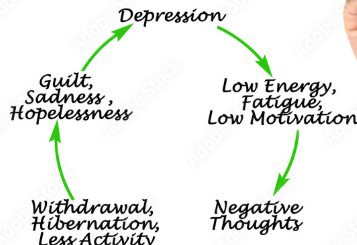
This image represents depressions vicious ___.
Cycle
-Feeling Powerless After Repeated Bad Events
-Linked to Self-Defeating Beliefs
-Rumination
-Self-Blame
-Pessimistic Explanatory Style
Learned Helplessness
-Low Norepinephrine and Serotonin
-Depressed People Respond to SSRIs
-Mania May Involve Heightened Dopamine Activity.
Biological view of depression involving ___.
Neurotransmitters
-Risk rises if a family member has it.
-___ of major depression is about 37% (twin studies).
-Many Genes Each Add Small Effects.
Heritability
Bipolar, schizophrenia, and anorexia nervosa have ___ heritability than major depression and generalized anxiety disorder.
Higher (2)
-About 1 million Deaths Worldwide per year
-About 33,000 per year in the U.S. 3rd leading cause of death for ages 15-24
-Elderly people have even higher rates.
Suicide
When people feel depressed, disconnected from others, or like a burden to others, suicide is __ likely.
More
-Confusion About Self
-Impulsiveness/Emotional Instability
-Interpersonal Problems
-Inappropriate Comparisons to Others
-Poor Problem-Solving
-Family History
-Minimal Social Support
-Terminal Medical Condition
___ that put people more at risk for suicide.
Characteristics
-More Common in College Students Than Non-College Peers
-Older and Unmarried People at Higher risk.
-Native Americans Have the Most Attempts
-African Americans the Fewest
-Females Attempt More
-Males are more likely to die.
Sociocultural ___ for Suicide.
Statistics
*Behavior Changes:
-Eating/Sleeping
-Trouble Concentrating
-Drop in School Performance/Attendance
-Losing Interest in Activities
-Giving Away Prized Possessions
-Withdrawal
-Unexplained Physical Complaints
these are all __ __ of suicide.
Warning Signs
-Personality/Mood Changes
-Talking or Writing About Death
-Drug/Alcohol Abuse
-Past Attempt
-Access to a Handgun
-A Triggering Event (breakup, job loss, trouble with the law)
-Cluster Suicides (knowing a teen who died by suicide)
-Direct threats.
these are all __ warning signs of suicide.
Other
Disorder Marked By:
-Delusions
-Hallucinations
-Disorganized Speech
-Diminished or Inappropriate Emotion
*Disturbs:
-Thought/Language
-Perception/Attention
-Motor Activity
-Mood.
Schizophrenia
Inappropriate behaviors that are PRESENT (added):
-Hallucinations
-Delusions
-Jumbled Speech
These are __ symptoms of schizophrenia
Positive
Appropriate behaviors that are ABSENT (missing):
-Flat/Diminished Emotion
-Slowed Movement/Stupor
-Little Speech
These are __ symptoms of schizophrenia
Negative
Believing you are famous or very important is referred to as a delusion of ___.
Grandeur
Believing others are out to get you is referred to as a delusion of ___.
Persecution
Believing others are talking about or referring to you is referred to as a delusion of ___.
Reference
Systematized delusions (usually grandeur, persecution, jealousy) and often auditory hallucinations.
*Kind of Schizophrenia
Paranoid Schizophrenia
*Type of Schizophrenia
-Major motor impairment: stupor that can suddenly switch to agitation, waxy flexibility (holding positions others place you in), possible mutism.
*Nervous System Freezes
Catatonic Schizophrenia
*Type of Schizophrenia
-Incoherence
-Loose Associations
-Disorganized Behavior/Delusions
-Flat or Inappropriate Emotion
-Neglected Appearance
-Extreme Social Impairment.
Disorganized Schizophrenia
*Type of Schizophrenia
Varied symptoms drawn from the major types.
Undifferentiated Schizophrenia
*Type of Schizophrenia
Social Withdrawal that remains after delusions and hallucinations have faded.
Residual Schizophrenia
-Ego is Overwhelmed by Sexual/Aggressive Impulses from the __
-The Person Regresses to an Early Oral Stage and Confuses Fantasy with Reality.
Id
-Inner ___ Become More Rewarding than Social Reality
-Patients Learn Behavior by Watching Others and May Get More Staff Attention for Misbehaving.
Fantasies
-Smaller Brain and Prefrontal Cortex
-Less Prefrontal Activity
-Loss of Synapses
-Larger Fluid-Filled Ventricles
-Abnormal Activity in Frontal Cortex, Thalamus, and Amygdala
-Faster Brain Tissue Loss
These characteristics are among the ___ of a typical brain and schizophrenic brain.
Differences
People with schizophrenia overuse ___ and may have more ___ receptors.
Dopamine
Heredity and schizophrenia: key numbers
General population: about 1 in 100. Parent has it: about 6% for child. Family member diagnosed: about 1 in 10. Identical twin concordance: 48%.
Schizophrenia and adoption studies
Adopted children's risk resembles their BIOLOGICAL parents, not adoptive parents.
Other biological factors in schizophrenia
Pregnancy complications, atypical central nervous system development, many genes, and epigenetic factors affecting gene expression.
Biopsychosocial model of schizophrenia
Genetic vulnerability + triggers (viral infections, birth complications, stress, poor parenting) = increased risk. Without the genetic vulnerability, those triggers would not cause it.
Dissociative disorders
A separation of mental processes such as thoughts, emotions, identity, memory, or consciousness. Types: dissociative amnesia, dissociative fugue, dissociative identity disorder.
Dissociative amnesia
Suddenly unable to recall important personal information; NOT caused by injury.
Dissociative fugue
Abruptly leaving home or work, traveling elsewhere, and losing all memory of your past. The new personality is often more outgoing.
Dissociative identity disorder (DID)
Formerly multiple personality disorder. Two or more identities, each with distinct traits and memories, in one person; identities may or may not know about each other.
Personality disorders
Enduring, inflexible, maladaptive patterns of behavior that impair social/personal functioning and cause distress. Three clusters: anxious, odd/eccentric, dramatic/impulsive.
Paranoid personality disorder
Interprets others' behavior as threatening or demeaning; mistrustful. NO disorganized thinking (unlike paranoid schizophrenia).
Schizotypal personality disorder
Peculiar thoughts, perceptions, or behavior (excess fantasy, suspiciousness, feeling unreal, odd word use). NO complex delusions, hallucinations, or unusual motor activity.
Schizoid personality disorder
Indifference to relationships, flat emotion, 'loner,' no warm feelings, few friends. No hallucinations or delusions.
Borderline personality disorder
Instability in relationships, self-image, and mood, plus poor impulse control. Swings from adoration to loathing depending on feeling abandoned; trouble managing anger.
Antisocial personality disorder
Persistently violates others' rights and conflicts with the law; superficial charm, average+ intelligence, doesn't learn from punishment, no meaningful bonds. More common in men.
Avoidant personality disorder
Unwilling to start relationships without assurance of acceptance because of fear of rejection/criticism. Unlike schizoid, they DO feel warmth toward others.
Narcissistic personality disorder
Inflated, unjustified sense of self-importance; fantasies of success; feels entitled; arrogant; takes advantage of others.
Schizoid vs. avoidant personality disorder
Schizoid = doesn't WANT relationships. Avoidant = wants them but fears rejection.
Gender differences in disorders
Women are more likely to have anxiety and depressive disorders; men are more likely to have antisocial personality disorder.
Psychodynamic and cognitive views of personality disorders
Psychodynamic: problems with the Oedipus complex; superego doesn't develop. Cognitive: antisocial teens interpret others' behavior as threatening even when it isn't.
Biological view of personality disorders
Traits are partly heritable; antisocial personality disorder shows less gray matter in the prefrontal cortex, and a related gene may also be linked to antisocial behavior.