11.6 Valence Bond Theory: Orbital Overlap as a Chemical Bond
 Call Kai
 Learn
 Practice Test
 Spaced Repetition
 Match
 Flashcards
 Knowt Play
1/14

There's no tags or description
Looks like no tags are added yet.
15 Terms
valence bond theory
advanced model of chemical bonding in which electrons reside in quantum-mechanical orbitals localized on individual atoms that are a hybridized blend of standard atomic orbitals; chemical bonds result. from an overlap of these orbitals
hybridized atomic orbitals
blend or combination of two or more standard atomic orbitals
interaction energy
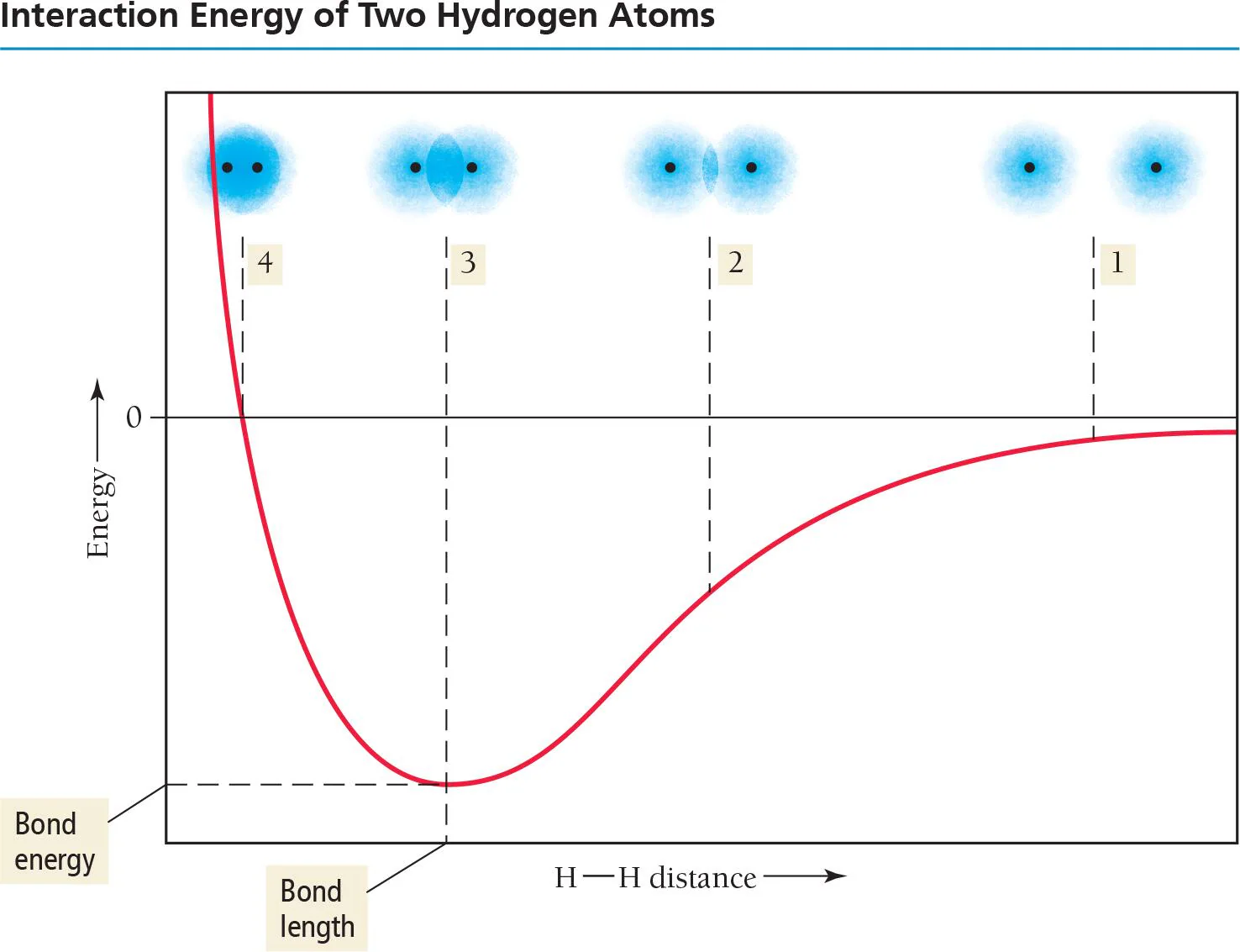
energy usually calculated as a function of the internuclear distance between the two bonding atoms

potential energy
interaction energy y axis
internuclear distance
interaction energy x axis

0
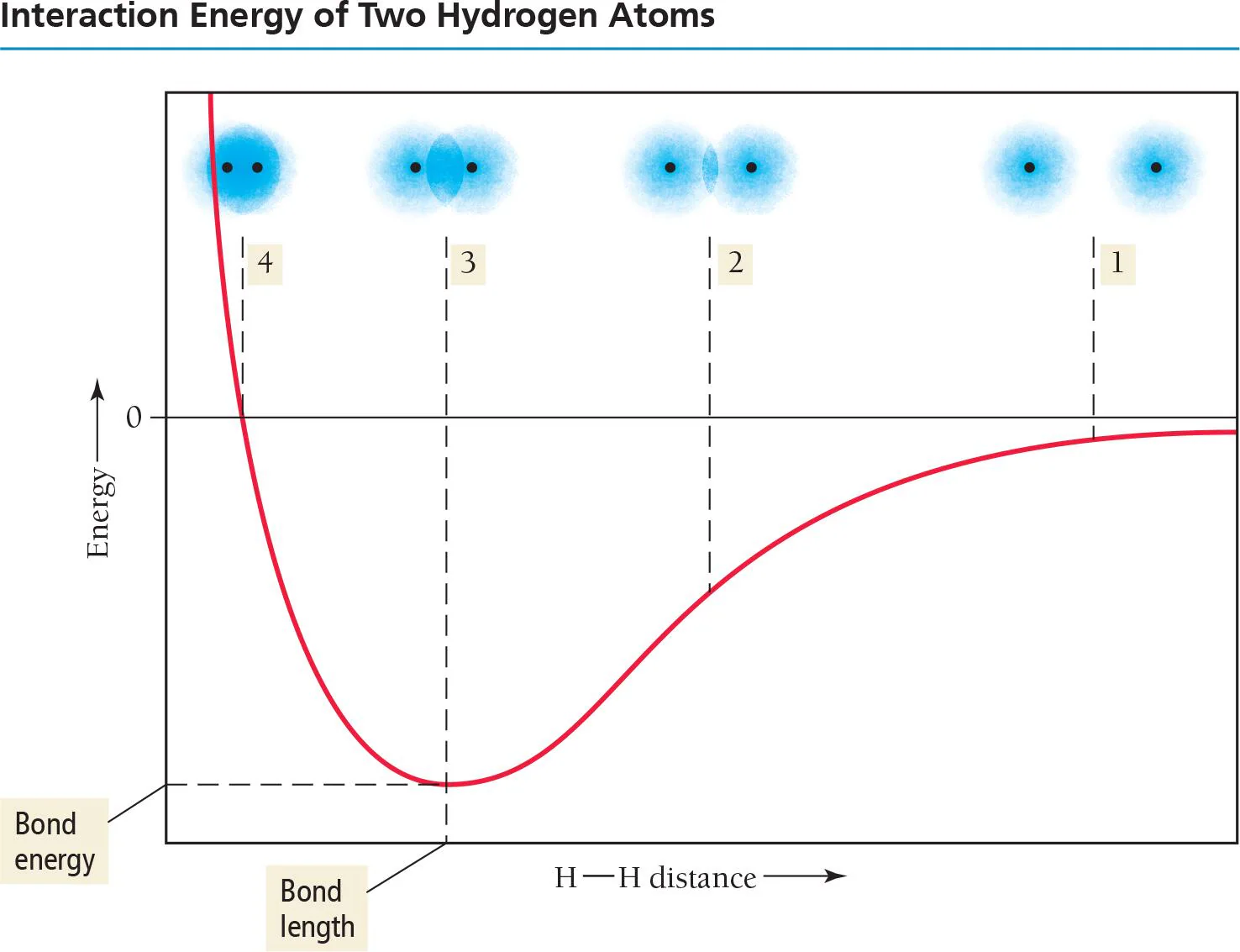
When atoms are far apart, the interaction energy is nearly _ because the 2 atoms do not interact to any significant extent.
more
As the atoms get closer, the interaction energy becomes ____ (more/less) negative due to net stabilization that attracts one hydrogen atom to the other.

increase
If atoms are too close together, the interaction energy begins to ___________ (increase/decrease) due to the mutual repulsion of positively charged nuclei.

minimum
The most stable point on the curve occurs at the __________ (minimum/maximum) of the interaction energy, where x is equilibrium bond length.

equilibrium bond length
most stable internuclear distance with minimum interaction energy where hydrogen’s 2 atomic 1s orbitals have a significant amount of overlap and electrons spend time in nuclear region where they can interact with both nuclei

bond energy
value of the interaction energy at the equilibrium bond length

negative
The interaction energy is usually __________ (positive/negative) or stabilizing when the interacting atomic orbitals contain a total of 2 electrons that can spin-pair (orient with opposing spins).
chemical bond
A ________________ results from the overlap of two half-filled orbitals with spin-pairing of the two valence electrons.

orbitals
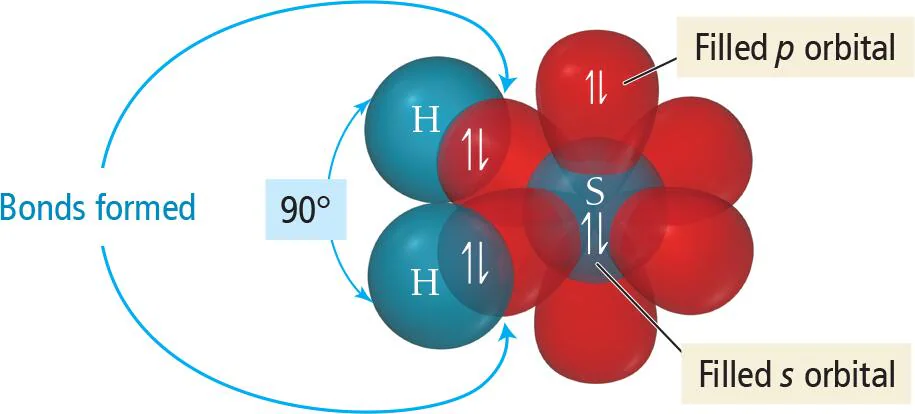
The geometry of overlapping _________ determines the shape of the molecule.
90
Hydrogen sulfide H2S has a predicted bond angle of ___ degrees because p orbitals are oriented at __ degrees to one another.
