Geotechnical Midterm Review
 Call Kai
 Learn
 Practice Test
 Spaced Repetition
 Match
 Flashcards
 Knowt Play
1/82

Earn XP
Description and Tags
Comprehensive vocabulary flashcards covering Geotechnical Mechanics lectures: soil origins, three-phase relationships, particle-size distribution, Atterberg limits and clay mineralogy, USCS classification, field and laboratory compaction methods, and fluid flow in soil.
83 Terms
Physical Weathering
The mechanical disintegration of parent rock into smaller particles (angular, subangular, or rounded) through natural processes such as erosion by wind, water, or glaciers, freezing and thawing cycles, and exfoliation (unloading), occurring with no change in mineral composition.
Chemical Weathering
The breakdown and alteration of rock mass through chemical processes such as hydration, oxidation, and carbonation, causing both a reduction in particle size and a transformation in mineral composition to form fine particles (<0.002mm).
Residual Soil
Soil formed directly by the in-situ weathering of parent bedrock that remains in its original geographic position of formation over long periods of time.
Alluvial Soil
A transported soil deposited by running water in rivers, streams, and floodplains.
Colluvial Soil (Colluvium)
A heterogeneous deposit composed of sharp, angular rock fragments across a wide distribution of particle sizes that has moved downslope under the direct influence of gravity and accumulated at the base of steep slopes.
Aeolian Soil
Soil transported and deposited by wind action, including wind-blown formations such as sand dunes and loess deposits.
Lacustrine Soil
Fine-grained sediment formed by the quiet, slow deposition and sedimentation of mineral particles in freshwater lakes.

Three-Phase System
An engineering model representing soil mass as three distinct, coexisting constituents: the solid phase (soil mineral grains), the liquid phase (pore water), and the gaseous phase (pore air).
Void Ratio (e)
The volumetric ratio of the total volume of void space (Vv) to the volume of solid soil particles (Vs), defined mathematically as e=VsVv.
Porosity (n)
The volumetric ratio of the volume of voids (Vv) to the total volume (V) of a soil mass, expressed as a percentage: n=VVv×100%.
Degree of Saturation (S)
The ratio of the volume of water (Vw) to the total volume of void space (Vv) in a soil mass, expressed as S=VvVw×100%, where S=0% represents completely dry soil and S=100% represents fully saturated soil.
Gravimetric Water Content (w)
The ratio of the mass of pore water (Mw) to the mass of dry soil solids (Ms), expressed as w=MsMw×100%, determined in accordance with ASTM D2216 by oven-drying at 110±5∘C for 24 hours.
Specific Gravity of Soil Solids (Gs)
The dimensionless ratio of the density (or unit weight) of soil solids to the density (or unit weight) of distilled water at 4∘C, expressed as Gs=ρwρs=γwγs, commonly ranging from 2.60 to 2.80.
Relative Density (Dr)
An index quantifying the degree of packing of a coarse-grained cohesionless soil between its loosest possible state (emax) and densest possible state (emin), given by Dr=emax−eminemax−e×100%.
Effective Particle Size (D10)
The particle diameter corresponding to 10% passing by weight on a cumulative grain-size distribution curve, which strongly governs the drainage, permeability, and filtration characteristics of soils.
Coefficient of Uniformity (Cu)
A parameter measuring the particle size range and uniformity of a soil, defined mathematically as the ratio of the diameter corresponding to 60% passing to that corresponding to 10% passing: Cu=D10D60.
Coefficient of Curvature (Cc)
A numerical coefficient indicating the smoothness and shape of the grain-size distribution curve between D60 and D10, given by the expression Cc=D60×D10(D30)2.
Well-Graded Soil
A soil exhibiting a broad, smooth, and continuous distribution of particle sizes across all fractions without gaps or deficiencies, characterized by a flatter cumulative gradation curve.
poorly graded soil
same size but unifrom: vertical curve
Gap-Graded Soil
A soil lacking or deficient in one or more intermediate particle sizes, appearing on the cumulative grain-size distribution curve as a pronounced horizontal plateau or step.
Sieve Analysis
A laboratory method used to establish the particle-size distribution of coarse-grained soil fractions (>75μm or opening retained on a No. 200 sieve) by vibrating the soil through a stacked series of wire mesh sieves with sequentially smaller openings.
Hydrometer Analysis
A laboratory sedimentation procedure based on Stokes' Law used to determine the particle-size distribution of fine-grained soil fractions (<75μm) by measuring density changes over time as particles settle out of a uniform aqueous suspension.

Stokes' Law
The hydrodynamic principle stating that the terminal settling velocity (v) of spherical particles in a viscous fluid is directly proportional to the square of their diameter (D): v=18ηρs−ρwD2.
Atterberg Limits
A standard set of critical boundary water contents (shrinkage limit, plastic limit, and liquid limit) established to define the four consistency states (solid, semi-solid, plastic, and liquid) of fine-grained cohesive soils.

Liquid Limit (LL or wLL)
The moisture content at which a fine-grained soil shifts between a plastic state and a viscous liquid state, standardized as the water content at which a 2mm-wide groove cut in a soil pat closes over a distance of 0.5in (13mm) after 25 standard drops in a Casagrande cup.
Plastic Limit (PL or wPL)
The lowest moisture content within the plastic range at which a fine-grained soil can be rolled by hand into a continuous thread of 1/8in (3.2mm) diameter before it begins to crack and crumble.
Shrinkage Limit (SL)
The water content below which further loss of moisture does not produce any reduction in the total volume of the soil mass.
Plasticity Index (PI)
The numerical range of moisture contents over which a soil behaves in a plastic manner, computed as the difference between the liquid limit and plastic limit: PI=LL−PL.
Liquidity Index (LI)
A relative consistency index evaluating the natural in-situ water content (w) of a soil against its consistency boundaries, formulated as LI=PIw−PL.
Activity (A)
An index indicating the swelling and shrinkage potential of a clay soil, defined as the ratio of the plasticity index to the percentage of clay-sized particles by weight: A=% finer than 2μm by weightPI.
Kaolinite
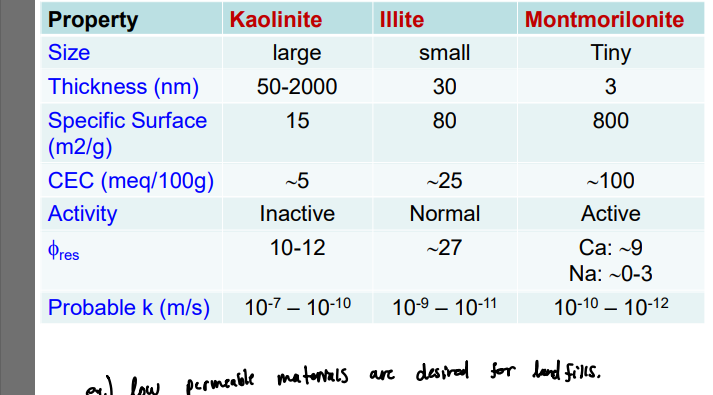
A 1:1 clay mineral consisting of alternating single silica tetrahedral sheets and gibbsite (alumina) octahedral sheets bonded tightly by hydrogen bonds, resulting in fixed interlayer spacing, minimal swelling, low cation exchange capacity (∼5meq/100g), and relatively high hydraulic conductivity.

Illite
A 2:1 clay mineral formed by an alumina octahedral sheet sandwiched between two silica tetrahedral sheets, bound non-expandably by fixed, non-exchangeable potassium (K+) ions residing within hexagonal sheet cavities, having a cation exchange capacity of approximately 25meq/100g.

Montmorillonite (Smectite)
An expandable 2:1 clay mineral where an octahedral sheet is bounded by two tetrahedral sheets joined solely by weak van der Waals forces, allowing water molecules and exchangeable cations to enter the interlayer spaces and produce severe swelling, high specific surface area (∼800m2/g), and high CEC (∼100–250meq/100g).
Isomorphous Substitution
The replacement of one coordinating cation by another of similar ionic radius during clay mineral formation (e.g., Al3+ replacing Si4+ in tetrahedral sheets, or Mg2+ replacing Al3+ in octahedral sheets) without disrupting the crystal geometry, generating a persistent net negative surface charge.
what is waters negative effect on clay soil

double layer water vs absorved water

Na-Montmorillite vs Ca-Montromorilite

Cation Exchange Capacity (CEC)
The total capacity of a clay mineral to attract, hold, and exchange cations from pore solution on its negatively charged surfaces, measured in milliequivalents of charge per 100 grams of dry soil (meq/100g).
Flocculated Fabric
A structural arrangement in fine-grained cohesive soils where clay platelets are oriented primarily in an edge-to-face contact configuration due to prevailing electrostatic attractive forces.
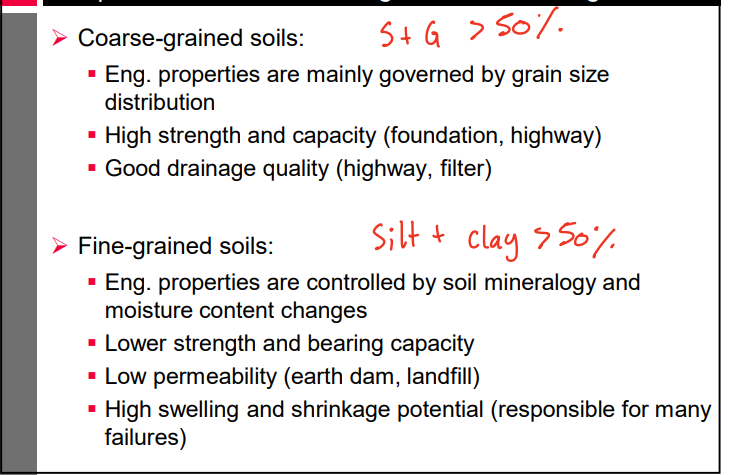
Comparison of coarse and fine made up of and eng use
Dispersed Fabric
A structural arrangement in fine-grained cohesive soils where clay platelets assume an aligned, parallel face-to-face configuration, commonly resulting from compaction wet of optimum or high repulsive interparticle forces.
Chart comparsion for 3 clay minearls
flocculated vs dispersed clay fabric

identifucation of clay minerals methods

Unified Soil Classification System (USCS)
A standardized geotechnical soil classification framework (ASTM D 2487) proposed by Arthur Casagrande (1948) that categorizes soils using two-letter group symbols reflecting dominant particle size, gradation, and plasticity characteristics.
Well-Graded Gravel (GW)
A USCS soil group symbol representing coarse-grained gravel containing less than 5% fines, having more than 50% of its coarse fraction retained on the No. 4 sieve, and fulfilling the criteria Cu≥4 and 1≤Cc≤3.
Well-Graded Sand (SW)
A USCS soil group symbol representing coarse-grained sand containing less than 5% fines, having 50% or more of its coarse fraction passing the No. 4 sieve, and fulfilling the criteria Cu≥6 and 1≤Cc≤3.
A-Line
The boundary line on Casagrande's plasticity chart represented by the equation PI=0.73(LL−20) that delineates inorganic clays (plotting on or above the line) from inorganic silts and organic soils (plotting below the line).
basic structural units for clay

compaction density testing methods
destrucvtive and nuclear
5 rollers and their uses
smooth: thin soil layers smooth - coarse soil
Rubber tire: coarse or fine - pressure and kneading aciton
Sheepfoot: fine soils ( m,ixes it)

Compaction methods
static rollers, vibrations, ramming
3 Compaction applications

+- of opt water content and dry and wet optium meanings

Compaction
A mechanical soil improvement process in which dry density is increased by forcing soil particles closer together and reducing void air volume through the application of dynamic or static compactive effort.
Optimum Water Content (wopt)
The moisture content at which a soil attains its greatest possible dry density (ρd(max)) when subjected to a given mechanical compactive energy.

Standard Proctor Test
A standardized laboratory compaction procedure (ASTM D-698 / AASHTO T-99) in which soil is compacted in 3 layers with 25 blows per layer using a 5.5lb (2.5kg) hammer dropped from a height of 12in (30.5cm) inside a 944cm3 mold, providing an input compaction energy of 594kN⋅m/m3.
Modified Proctor Test
A heavy-energy compaction procedure (ASTM D-1557 / AASHTO T-180) designed for high-load applications like airfields, using a 10lb (4.54kg / 44.5N) hammer dropped from 18in (45.72cm) over 5 layers at 25 blows per layer, imparting approximately 4.5 times more energy (2696kN⋅m/m3) than the Standard Proctor test.
Zero Air Void (ZAV) Curve
The theoretical maximum dry unit weight or density boundary curve representing a fully saturated soil condition containing no air in the void space (S=100%), governed by the relationship ρd=1+wGsGsρw.
How does compaction proccess change with soils at low vs high water content

Objectives of Compaction

Granular A
A well-graded crushed sand and gravel material with a maximum particle size of 1in (26.5mm) designed to be uniformly sized for enhanced drainage, commonly used in pavement bases, granular shouldering, and foundation backfill.
Granular B
A well-graded aggregate blend of sand, gravel, and stone with a maximum particle size of 6in (150mm) used for pavement subbases and engineered backfill, classified as Type I (natural), Type II (crushed rock), or Type III (recycled concrete).

Sheepsfoot Roller
A compaction drum equipped with numerous projecting steel feet (200–250mm long) that kneads and compacts fine-grained soils from the bottom of the lift upward while providing a rough, well-bonded interface for overlying layers.

Dynamic Compaction
A ground improvement technique involving the systematic dropping of a heavy steel or concrete pounder (tamper) weighing 5 to 30 tonnes from a height of 10 to 30 meters to densify deep granular deposits, with maximum depth of influence given by Dmax=nWH.
Relative Compaction (R)
The ratio of the dry unit weight achieved in the field to the maximum dry unit weight obtained in the laboratory under a specified Proctor test, expressed as R=γd,max,labγd,field×100%.

Nuclear Density Gauge
A field instrument that nondestructively measures the bulk density of compacted soil via gamma radiation scatter and attenuation, and measures moisture content using neutron or alpha particle thermalization and scattering.
Ground Water Table
The subsurface phreatic surface in an unconfined aquifer or confining stratum at which the pore water pressure is exactly zero (equal to atmospheric pressure).
Aquifer
A water-bearing underground geological stratum possessing sufficiently high permeability to permit the extraction of economically useful quantities of water.
Aquitard
A geological formation of low hydraulic conductivity situated adjacent to an aquifer that retards the transmission and drainage of groundwater.
Total Head (H)
The measure of total mechanical energy per unit weight of fluid flowing through soil, comprising elevation head (hz=Z) and pressure head (hp=γwu), given as H=Z+γwu, with velocity head neglected due to low flow speeds.
Hydraulic Gradient (i)
The driving head loss per unit length of seepage path through a soil medium, formulated as i=LΔh.
Darcy's Law
The fundamental empirical relationship for laminar fluid flow through saturated porous media stating that discharge velocity (v) is directly proportional to hydraulic gradient (i) and hydraulic conductivity (k): v=ki.
testing methods for hydraulic conductivity
constand and falling head
Seepage Velocity (vs)
The actual interstitial velocity at which water molecules travel through the interconnected pore channels of a soil, calculated by dividing Darcy discharge velocity (v) by the porosity (n): vs=nv.
Constant-Head Test
A laboratory permeability testing method tailored for coarse-grained soils (sands and gravels) where a constant total head difference (h) is maintained across a specimen of area A and length L, with conductivity calculated as k=tAhQL.
Falling-Head Test
A laboratory permeability testing method applied to fine-grained soils (silts and clays) where water in a standpipe tube of area a drops from initial height h1 to final height h2 over time interval t2−t1, calculated as k=A(t2−t1)aLln(h2h1).
Flow Net, and criteria with steps
A graphical solution of the two-dimensional Laplace equation for steady seepage through isotropic soil, consisting of mutually orthogonal flow lines and equipotential lines that define flow channels and equipotential drops.

Capillary Fringe
The zone directly above the groundwater table that remains saturated with water held under negative pore water pressure (suction) due to surface tension forces acting within the soil pores.
Water lecture definitinos

Frost Heave
The upward displacement and lifting of the ground surface caused by the freezing of pore water and subsequent growth of segregated ice lenses at the freezing front during sustained sub-zero temperatures.
Shrinkage causes and problems
Potential Problems excavate for the structure exposing the foundation soil the moist soil shrinks and dries due to evaporation place the foundation the water is replaced with time and swelling occurs

Froist action and thawing
