Human Bio Unit 3 Chp 7 Bones, Muscles and Joints
 Call Kai
 Learn
 Practice Test
 Spaced Repetition
 Match
 Flashcards
 Knowt Play
1/29

There's no tags or description
Looks like no tags are added yet.
30 Terms
What is the central axis comprising?
Vertebral column or backbone
OBJQ
What are 3 types of muscles, and explain the voluntary (skeletal) muscle?
Voluntary (skeletal) muscle
Striated
Attached to bones of the skeleton
Stimulated to contract by the nervous system under conscious control by the brain
Involuntary
Smooth muscle
Cardiac (heart) muscle
Striated
OBJR
How do muscles move?
By contracting and pulling the bone
Muscles always pull the bone, never push
OBJQ
What are 5 functions of bones
Protection (cranium→brain, eye, ear)
(vertebrae→spinal cord)
(ribcage→heart and lungs)
Support
Movement
Reservoir (store calcium and phosphate)
Produce blood cells (RBC, plasma)
OBJQ + FAQ
What are bones consist in axial system?
Vertebral column, cranium, ribcage, sternum
OBJQ
Define bone in terms of components, what it results in when force is applied, and what cells it is made of and their functions.
Contains salts mainly calcium and phosphate
Results in a rigid material that can resist bending and compression forces.
Made of cells called osteocytes, protein fibre (prevents bonefrom being easily broken and brittle), living cells and blood vessels (repair themselves when broken)
OBJQ
What does middle of bone consist off?
Spongy bone and fewer calcium salts. Spaces like sponge that are less hard and filled with bone marrow
OBJR
What are types of bone marrow
Red→blood cells
Yellow→store fats

OBJQ + FAQ
Label the bones in the human body?

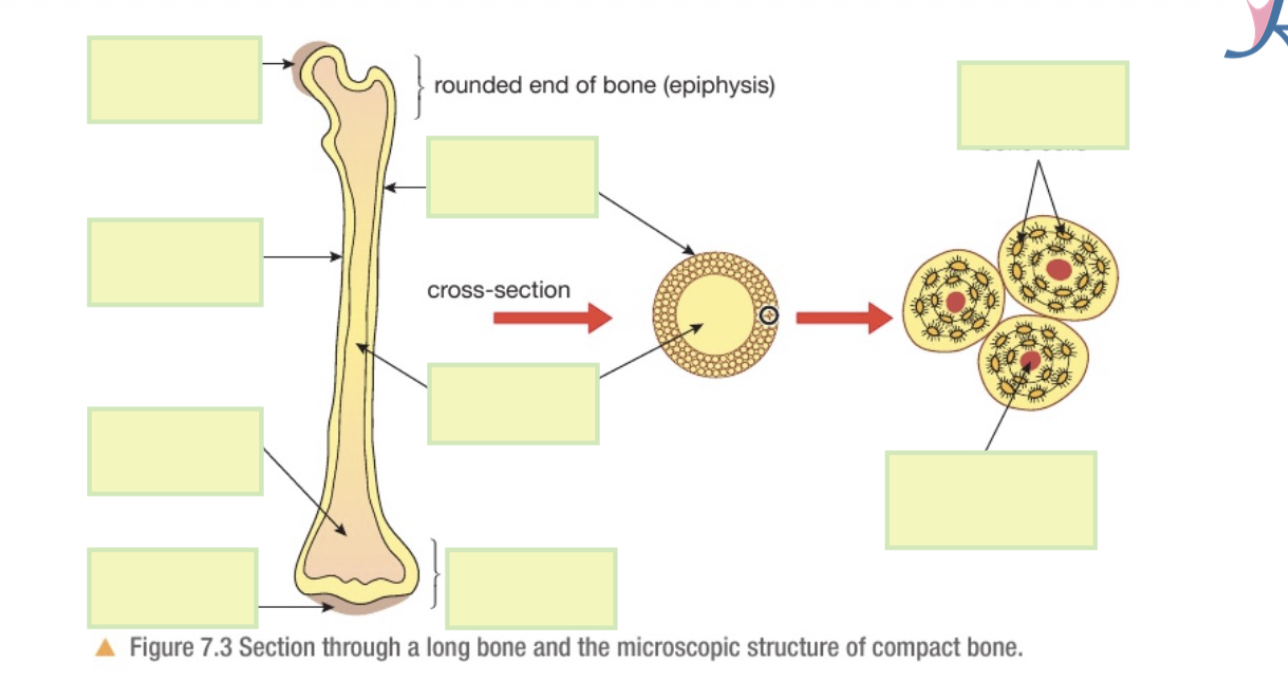
OBJQ
Label the bone

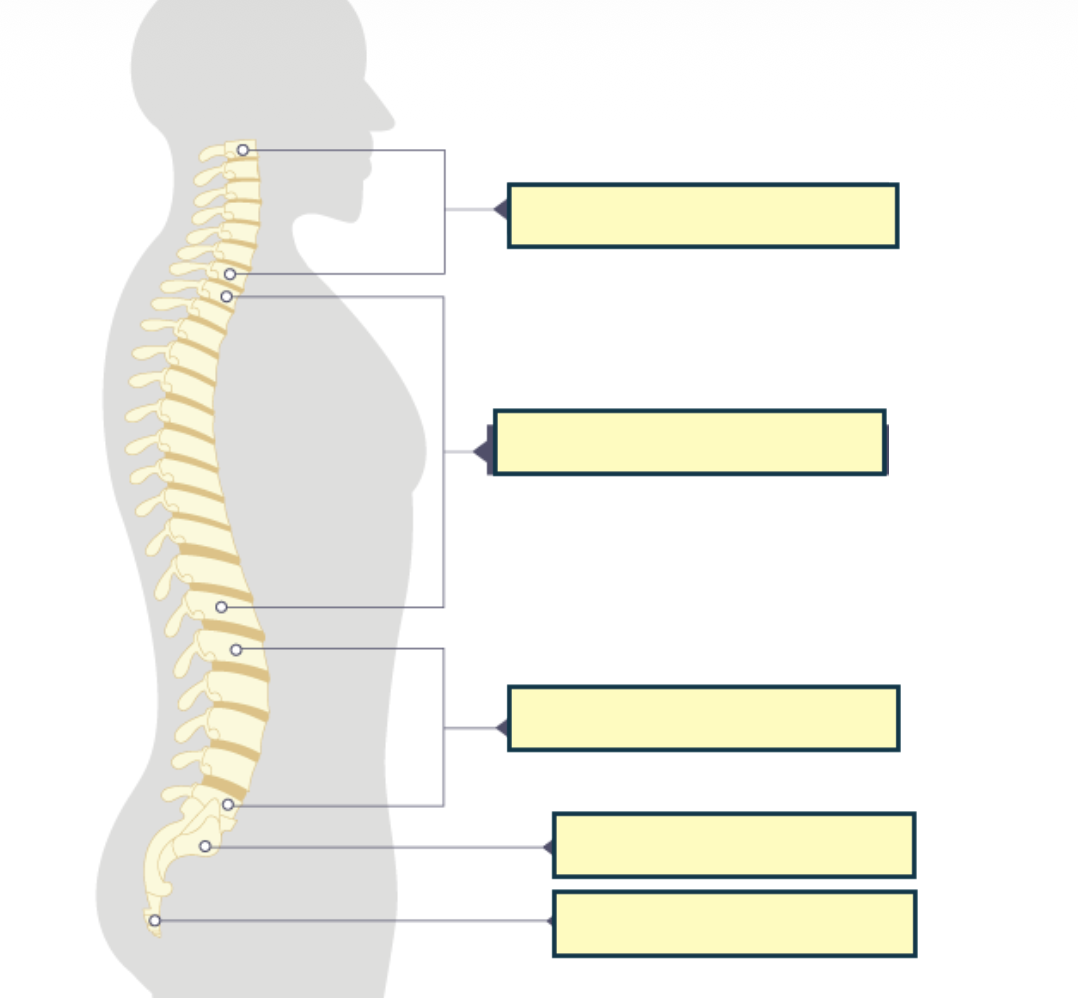
FYI
Name the vertebrae and the number of each type of vertebra.

OBJR
What is compact bone?
Outside of bone, made of hard material
OBJR
Define ossification?
As the embryo grows, cartilage is gradually replaced by bone.
OBJR
What is cartilage?
Tough but flexible tissue containing chondrocytes that is present at the end of long bones and acts as a cushion between 2 bones at a joint.
OBJQ
What are the cells that are in cartilage and their function?
Chondrocytes. They secrete a matrix containing various types of protein fibres
What is the Haversian system?
Osteocytes are arranged in a ring around the canals containing blood vessels and nerves
OBJR
What is periosteum?
Tough membrane that covers the outer surface of bone.
What is the function of vitamin D and calcium? And the biological consequences of deficiency of vitamin D and calcium
Vitamin D→to absorb calcium and phosphate into the body
Calcium→for calcium salts in bone
Deficiency: Rickets
FYI: However, rickets is still under influence of hormones, diet, exercises and general health.
Explain the bone growth (grow longer) process in 2 points.
Bones don’t grow in length at their ends; instead, they get longer because regions of cartilage grow and become ossified.
OBJQ
Explain the cause of osteoporosis and how it can be helped
Bones lose calcium salts and become porous and less dense→can break easily.supplements,
Bones lose calcium salts and become porous and less dense→can break easily.
No cure for osteoporosis, but it can be helped by a good diet, vitamin D and calcium supplements and treatment with hormones (oestrogen)

Label the structures

OBJQ
State what is meant by joint?
Point where two bones meet.
OBJQ
What are 3 features that moveable joints need in order and description and functions of each 3 features.
Ligaments
Composed of fibres that make them very tight, and they have tensile strength (to resist stretching) and some elasticity. Function: allow movement but prevent the joint from dislocating.
(bone to bone)
Synovial fluid
In a synovial joint, the synovial membrane secretes synovial fluid. It is oily and acts as a lubricant to reduce friction between the ends of the bones.
Cartilage
Tough but flexible tissue containing chondrocytes that is present at the end of long bones and acts as a cushion between 2 bones at a joint. It acts as a shock absorber between the ends of the bone.
FAQ
Label the structure

OBJQ
What are 3 groups of joints and their degrees of movement
Ball-and-socket joint (freely movable joint)
Moves 360 degrees (shoulder, hip)
Hinge joint (partially movable joint)
Moves 180 degrees (elbow, knee)
Fixed joint (immovable)
Moves 0 degrees (skull)
OBJQ
What is a tendon?
Attaches muscle to bone
Has very high tensile strength like ligaments however, not as elastic as ligaments
FAQ + OBJR
How do muscles work?
Muscles work together antagonistically. While one muscle contracts, the other relaxes and vice versa.
What is a place where a muscle is attached to a stationary bone and a moving bone?
Stationary bone→origin
Moving bone→insertion
How does insertion move?
It moves toward the origin
Label the structure
