UNF General Biology II Lab- Scientific Methods and Phylogenetics
 Call Kai
 Learn
Learn Practice Test
 Spaced Repetition
 Match
Match Flashcards
 Knowt Play
1/69

There's no tags or description
Looks like no tags are added yet.
Name | Mastery | Learn | Test | Matching | Spaced | Call with Kai | Chat |
|---|
No analytics yet
Send a link to your students to track their progress
70 Terms
Define Science
is a body knowledge that is used to answer questions about our surroundings and explain how things work.
Define the Scientific Methods
an organized set of investigative procedures
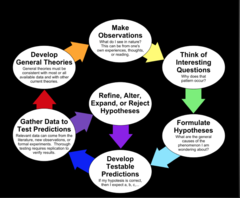
What are the "steps" of the scientific method?
1. Problem
2. Hypothesis
3. Procedure/ experimentation
4. Analyze data and form conclusion
5. Communicate Results
Why is gathering background information an important step before forming a hypothesis?
helps ensure the hypothesis is specific and testable by grounding it in what is already known about the topic.
True or False. A hypothesis can be proven true.
False. A hypothesis can never be proven true. It can only be supported by experimental evidence. However, an experiment can show a hypothesis to be false.
Explain the difference between a hypothesis and a scientific theory.
A hypothesis is a specific, testable prediction that can be investigated through experiments or observations.
A scientific theory is a well-supported explanation based on a large body of evidence from many studies and repeated testing over time.
Put the following examples in the correct order according to the scientific method:
A) Share the findings at a conference by presenting a poster
B) Ask whether increasing light exposure causes plants to grow taller
C) Grow plants under different light levels and record their heights
D) Examine the measurements to determine if growth differed among groups
E) Predict that plants receiving more light will grow taller
Order: B → E → C → D → A
Put the following examples in the correct order according to the scientific method:
A) Publish the results in a lab report or journal article
B) Notice that bacteria grow more quickly at warmer temperatures
C) Predict that bacteria grown at higher temperatures will reproduce faster
D) Culture bacteria at several temperatures and record growth rates
E) Compare growth measurements to decide whether temperature affected growth
Order: B → C → D → E → A
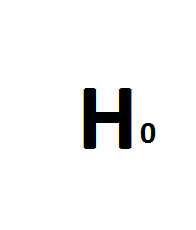
What is a null hypothesis?
The null hypothesis predicts what will happen if the hypothesis is incorrect. It states that there is no effect, no difference, or no relationship between variables.
**Remember in GB1 Lab: when we counted corn phenotypes, if the critical χ² value was greater than the calculated χ², we failed to reject the null hypothesis, meaning there was no significant difference and the corn phenotypes followed Mendelian genetics.
What is the independent variable?
is an item in the experiment that is tested or manipulated.
What is the dependent variable?
is involved in the response to changes in independent variable. THE VARIABLE YOU MEASURE!
Identify the independent and dependent variables. An experiment tests how different amounts of light affect the height of bean plants after four weeks.
Independent variable: Amount of light
Dependent variable: Height of bean plants
Identify the independent and dependent variables. An experiment measures how running at different speeds affects a person's heart rate.
Independent variable: Running speed Dependent variable: Heart rate
Identify the independent and dependent variables. An experiment examines how growing bacteria at different temperatures affects the number of colonies formed.
Independent variable: Temperature
Dependent variable: Number of bacterial colonies
Identify the independent and dependent variables. An experiment investigates how changing the pH of a solution affects the rate of an enzyme-catalyzed reaction.
Independent variable: pH level
Dependent variable: Rate of enzyme activity
Identify the independent and dependent variables. An experiment tests how different amounts of sleep affect performance on a memory test.
Independent variable: Amount of sleep
Dependent variable: Memory test performance
What is a control variable (AKA the constants)?
is any factor in an experiment that is kept constant or standardized while the independent variable is tested. Keeping these conditions the same reduces the probability that the results of the experiment are influenced by variables other than the independent variable being tested.
Explain the difference between the experimental group and the control group.
The experimental group is composed of subjects that are exposed to the same independent variable being tested. In contrast, the control group is exposed to all the same conditions (constants) except the independent variable. The control group provides a comparison that allows scientists to determine whether any observed effects are due to the independent variable.

In a study testing the effect of fertilizer on plant growth, one group of plants receives fertilizer while another group does not. Which group is the experimental group and which is the control group?
Experimental group: Plants that receive fertilizer
Control group: Plants that do not receive fertilizer
A researcher tests whether a new drug lowers blood pressure. One group of patients receives the drug, and another group receives a placebo.Which group is the experimental group and which is the control group?
Experimental group: Patients who receive the drug
Control group: Patients who receive the placebo
What is the purpose of a chi-square (χ²) test?
A chi-square test is used to determine whether there is a significant difference between observed and expected values in two or more groups.
What type of data is required to use a chi-square test?
The data must be discrete and nominal.
What does discrete data mean?
consist of countable values, such as numbers of individuals or phenotypes, rather than continuous measurements.
What does nominal data mean?
are categories with no numerical order, such as color, phenotype, or genotype classes.
What condition when using a chi-square test must be met when there are only two categories?
No expected value may be less than 5, meaning each category must be expected to have at least five observations for the test to be valid.
What condition when using a chi-square test must be met when there are more than two categories?
No more than 20% of expected values may be less than 5, and no expected value may be less than 1 (values below 1 are statistically meaningless for chi-square)
What is the chi-square (χ²) formula?
χ² = Σ (Observed − Expected)² / Expected
What does a large chi-square value indicate?
suggests a greater difference between observed and expected values, increasing the likelihood of rejecting the null hypothesis.
Why would a chi-square test NOT be appropriate for measuring plant height in centimeters?
Plant height is continuous data, not discrete or nominal.
You count corn kernel phenotypes and compare them to expected Mendelian ratios. Which statistical test should you use and why?
Use a chi-square test because the data are discrete, nominal, and categorical.
What happens if the critical value is greater than the calculated chi-square (χ²) value?
you FAIL to reject the null hypothesis, meaning the difference between observed and expected results is SMALL enough to be explained by chance alone. NOT SIGNIFICANTLY DIFFERENT.
What happens if the calculated chi-square (χ²) value is greater than the critical value?
you reject the null hypothesis, meaning the difference between observed and expected results is GREATER than what would be expected by chance alone. IS SIGNIFICANTLY DIFFERENT.
What is the formula for degrees of freedom in a chi-square test?
df = number of categories − 1
What do degrees of freedom represent in a chi-square test?
represent the number of values that are free to vary after accounting for constraints, and they are used to determine the appropriate critical value from the chi-square table.
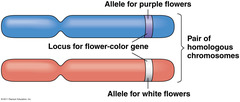
What is the Law of Segregation?
states that the two alleles of a gene separate during meiosis, so each gamete receives only one allele. Each offspring therefore inherits one allele from each parent.
What cellular process explains the Law of Segregation?
Homologous chromosomes separate during gamete formation, causing allele pairs to separate.

What is a Punnett square used for?
is used to determine the probability of possible offspring inheriting specific traits from their parents.

What is the difference between a dominant and a recessive trait?
is expressed when at least one dominant allele is present, while a recessive trait is expressed only when two recessive alleles are present.
What is the difference between phenotype and genotype ratios?
genotype ratio describes the genetic makeup of offspring, while a phenotype ratio describes the observable traits/ biochemical attributes.
What phenotypic ratio is expected from a monohybrid cross of two heterozygous parents (Aa × Aa)?
A 3:1 phenotypic ratio (dominant : recessive).
What genotype ratio results from crossing two heterozygous parents (Aa × Aa)?
A 1:2:1 genotype ratio (AA : Aa : aa).

What is the Law of Independent Assortment?
states that alleles of different genes on different chromosomes separate independently during gamete formation, so traits are inherited independently of one another.
What is taxonomy?
The system used to name and classify organisms.
What naming system uses a two-part name consisting of genus and species?
Binomial nomenclature.
True or False: In a scientific name, the genus is capitalized and the species is lowercase.
True.
The scientific name for modern humans is homo sapiens. Which part is capitalized, and which parts are italicized?
Homo is capitalized; sapiens is lowercase; both Homo and sapiens are italicized.
Write the correct scientific name for the gray wolf (canis lupus) and indicate formatting.
Canis capitalized, lupus lowercase, both italicized.
What is biological classification?
The arrangement of organisms into hierarchical categories based on shared characteristics.

List the levels of biological classification from broadest to most specific.
Domain → Kingdom → Phylum → Class → Order → Family → Genus → Species
What is phylogeny?
is the study of the evolutionary history and relationships of an organism or group of organisms, often represented using a phylogenetic tree.
What are homologous characteristics?
are similar traits shared by different organisms because they were inherited from a common ancestor.
Give an example of homologous structures in vertebrates.
The limbs of vertebrates, such as a human arm, bat wing, and whale flipper.

Why are the limbs of vertebrates considered homologous?
They contain the same basic bone structure inherited from a common ancestor.
Do homologous structures serve the same function?
No, they serve different functions despite having a similar structure.
What are analogous structures?
are body parts in different organisms that are similar in function or appearance but do not share a common evolutionary ancestor.

How do analogous structures occur?
It occurs when distantly related organisms live in similar environments and independently evolve similar traits as adaptations (AKA convergent evolution).
What is convergent evolution?
is the process by which unrelated or distantly related organisms evolve similar characteristics due to similar environmental pressures, not shared ancestry.
Give an example of analogous structures.
The fins and tails of sharks and dolphins. They serve similar functions for swimming, but sharks are fish and dolphins are mammals, and they do not share a recent common ancestor for these traits.
What is a phylogenetic tree?
is a diagram that shows the evolutionary relationships among organisms or groups of organisms.
In a phylogenetic tree, what do the following terms represent: taxon, root, nodes, branches, and tips?
Taxon: A group of organisms being studied (such as a species or genus) represented on the tree
Root: The base of the tree that represents the common ancestor of all taxa in the tree
Nodes: Branching points that represent common ancestors where lineages diverge
Branches: Lines that show evolutionary relationships and the passage of time or change
Tips: The ends of the branches that represent the current organisms or taxa being compared
What are the parts of a phylogenetic tree?
root, node, branch, tip
If two organisms share a more recent node than a third organism on a phylogenetic tree, what does this mean?
The two organisms are more closely related to each other and share a more recent common ancestor than either does with the third organism.

What is a clade (monophyletic group)?
is a group of organisms that includes a common ancestor and all of its descendants.

What are derived characteristics?
are traits that appear later in evolution and are not present in distant ancestors.
What is a synapomorphy?
is a shared derived characteristic found in two or more taxa that was present in their most recent common ancestor but absent in more distant ancestors.

What is an outgroup and why is it used?
is a species or group that is less closely related to the group of interest and is used as a reference point to identify ancestral versus derived traits.
In lab, corn kernels were analyzed for two traits:
Color: purple (dominant) vs. yellow (recessive)
Texture: smooth (dominant) vs. wrinkled (recessive)
If both parents are heterozygous for both traits, what is the expected phenotypic ratio?
The expected phenotypic ratio is 9 : 3 : 3 : 1
In lab, corn kernels were analyzed for two traits:
Color: purple (dominant) vs. yellow (recessive)
Texture: smooth (dominant) vs. wrinkled (recessive)
Observed values were:
Purple & smooth = 140
Purple & wrinkled = 70
Yellow & smooth = 70
Yellow & wrinkled = 40
a) What is the χ² calculated?
b) What is the χ² critical value (α = 0.05)?
c) What is the result?
a) χ² calculated ≈ 32.2
b) χ² critical value (df = 3, α = 0.05): 7.815 ***Use table***
c) Since χ² calculated > χ² critical, we reject the null hypothesis.The observed data do not follow Mendelian expectations.
In Exercise 2, you constructed a phylogenetic tree. How do you determine whether a trait is ancestral or derived?
A trait is ancestral if it is shared with the outgroup. A trait is derived if it appears only within the ingroup and was absent in the outgroup.
If fur is present in mammals but not in reptiles (outgroup), is fur ancestral or derived?
Fur is a derived trait because it appears in mammals and is absent in the outgroup.