PSYCH Exam 3 Review
 Call Kai
 Learn
 Practice Test
 Spaced Repetition
 Match
 Flashcards
 Knowt Play
1/237

Earn XP
Description and Tags
Covers: Sensation and Preception, Consciousness, Lifespan Development, Abnormal Psychology & Therapy
238 Terms
Sensation
The process by which sensory receptors detect physical stimuli from the environment and transmit this information to the nervous system.
Key Components of Sensation
Sensory Receptors: Specialized neurons that respond to specific types of stimuli, such as light, sound, and temperature.
Transduction: The conversion of physical stimuli into neural impulses that the brain can interpret.
Types of Sensation
Sensory System | Description |
|---|---|
Vision | Detection of light through the eyes |
Hearing | Detection of sound waves through the ears |
Touch | Detection of pressure, temperature, and pain through the skin |
Taste | Detection of flavors through taste buds |
Smell | Detection of odor molecules through the nose |
Perception
The psychological process of organizing, interpreting, and consciously experiencing sensory information (Sensation + Interpretation).
Allows individuals to make sense of their surroundings and respond appropriately.
Key Principles of Perception
Gestalt Psychology: This framework emphasizes that humans tend to perceive whole patterns rather than just the sum of individual parts. It suggests that our minds naturally organize visual elements to create a coherent understanding of complex stimuli.
Gestalt Principles: These include concepts such as:
Figure/Ground: Distinguishing an object (figure) from its background (ground).
Similarity: Grouping similar items together.
Proximity: Perceiving objects that are close together as part of a group.
The Role of Gestalt Psychology
Gestalt psychology originated in the early twentieth century with German psychologists. It explains how we often perceive things that are not merely based on simple sensations. For example, when observing rapidly flashing lights, we perceive motion instead of seeing individual lights turning on and off.
Models of Perception
Template-Matching Model: This model describes perception as recognizing patterns or templates. For instance, when reading, individuals identify letters by matching them to known templates of the alphabet.
Bottom-Up Processing
Perception is driven directly by incoming sensory data. This means that the brain interprets stimuli based solely on their inherent properties, without relying on prior knowledge or experiences.
Key Characteristics
Data-Driven: Perception is initiated by the external stimulus itself.
Real-Time Interpretation: Sensory information is processed as it arrives, allowing for immediate reactions.
No Prior Learning Required: This process does not depend on previously acquired knowledge.
How It Works
Sensation: Sensory receptors detect stimuli from the environment.
Transmission: Information travels from the senses to the brain.
Perception Formation: The brain constructs perceptions based on the raw sensory input.
Examples
Pain Response: Stubbing a toe sends immediate pain signals to the brain, which are processed without any prior context.
Visual Recognition: Noticing a bright color in a painting before recognizing other elements is a result of bottom-up processing
Top-Down Processing
Processing driven by previous experience, knowledge, and expectations to recognize stimuli
Psychophysics
How our brains utilize prior knowledge, experiences, and contextual information to interpret sensory data. This method allows individuals to make quick decisions and fill in gaps in information based on what they already know.
Key Features of Top-Down Processing
Guided by Prior Knowledge: The brain draws on existing memories and experiences to form interpretations of new information.
Hypothesis-Driven: This processing style relies on expectations and beliefs, allowing individuals to make educated guesses about sensory input.
Schemas: We create mental frameworks (schemas) from past experiences, which help us understand and interpret new stimuli.
Influences on Top-Down Processing
Expectations: What we anticipate can shape our perceptions significantly.
Emotions: Our emotional state can influence how we interpret sensory information.
Motivation: Personal needs and desires can drive our focus and perception.
Cultural Context: Cultural background can also play a role in shaping our interpretations.
Real-World Applications
Reading: We can often understand misspelled words because our brain fills in gaps based on context and prior knowledge.
Visual Perception: Optical illusions demonstrate how our expectations can alter our perception of images.
Learning Environments: Understanding how top-down processing works can enhance instructional design, making learning materials more effective by aligning with learners' existing knowledge and experiences.
Absolute Threshold
The absolute threshold refers to the minimum intensity of a stimulus that can be detected at least 50% of the time. This concept is crucial in understanding how we perceive sensory information across different modalities, such as:
Light
Sound
Taste
Touch
Temperature
Factors Influencing Absolute Threshold
Attention: Increased focus can lower the threshold, making it easier to detect stimuli.
Background Noise: Higher levels of noise can raise the threshold, making detection more difficult.
Expectations: What a person anticipates can influence their ability to perceive stimuli.
Historical Context
Ernst Heinrich Weber: Known for his studies on sensory perception.
Gustav Fechner: Developed methods to quantify sensory experiences.
Importance in Psychology
Psychological Research: Helps in studying sensory perception and its limits.
Practical Applications: Used in designing products, such as audio systems, to ensure they are audible to most users.
Subliminal Messages
Subliminal messages are stimuli presented below the threshold of conscious awareness.
They are not consciously perceived but can still influence brain activity and behavior.
Can be in the form of words or images that flash quickly, often for less than one-tenth of a second, making them undetectable to the conscious mind.
Effects on Behavior
Research indicates that subliminal messages can have a slight impact on choices, particularly when they align with a person's existing goals.
For example, if someone is thirsty and sees a subliminal message for a beverage, they may be more likely to choose that drink.
However, if the individual is not already inclined to perform a specific action, such as buying a drink, the subliminal message is unlikely to have any effect.
Controversy and Limitations
The effectiveness of subliminal messaging remains a topic of debate. While some studies suggest that these messages can influence behavior, the effects are generally minimal and context-dependent.
Many researchers agree that subliminal messages cannot reliably control behavior or "brainwash" individuals.
This has led to ethical concerns regarding their use in advertising, resulting in bans in several countries.
Aspect | Details |
|---|---|
Definition | Messages below conscious awareness that can influence behavior. |
Mechanism | Presented quickly, making them undetectable to the conscious mind. |
Behavioral Influence | Can affect choices if aligned with existing goals (e.g., thirst). |
Effectiveness | Generally minimal; cannot reliably control behavior. |
Ethical Concerns | Banned in several countries due to manipulation fears. |
Difference Threshold / Just Noticeable Difference (JND)
The minimum change in a stimulus that can be detected at least 50% of the time. This concept is crucial in understanding human perception and sensitivity to changes in various stimuli.
Key Characteristics of JND
Measurement and Sensitivity
Detection Rate: The JND is determined based on the ability to notice changes in stimuli during experimental trials, specifically at a detection rate of 50%.
Variability: The JND can vary from person to person and is influenced by factors such as the original intensity of the stimulus and the context in which it is presented.
Applications of JND
Psychophysics: JND is a fundamental concept in psychophysics, which studies the relationship between physical stimuli and sensory perception.
Marketing: Understanding JND helps marketers determine how much a product must change for consumers to notice improvements or price increases.
Weber's Law
Weber's Law quantifies the JND, stating that the ratio of the change needed to the original stimulus intensity is constant. This means that as the intensity of the original stimulus increases, a larger change is required for the difference to be noticed.
Concept | Definition | Key Detail |
|---|---|---|
Difference Threshold | Minimum change detectable 50% of the time | Varies based on original stimulus intensity |
Weber's Law | JND is a constant proportion of the original stimulus | More intense original → bigger change needed |
Weber-Fechner Law
The Weber-Fechner law encompasses two key principles in psychophysics that explain how humans perceive changes in physical stimuli. These principles are known as Weber's Law and Fechner's Law.
Weber's Law
Definition: The smallest noticeable change in a stimulus is a constant proportion of the original stimulus.
Example: If you have a 100-gram weight, you might need to add 2 grams to notice a difference. However, if you have a 1,000-gram weight, you would need to add 20 grams to perceive the same change.
Implication: This law indicates that our ability to detect changes depends on the initial intensity of the stimulus.
Fechner's Law
Definition: The perceived intensity of a stimulus increases logarithmically as the actual intensity increases.
Relation to Weber's Law: Fechner's Law builds on Weber's findings by suggesting that the relationship between stimulus intensity and perception is not linear but logarithmic.
Example: If the intensity of a light increases, the perceived brightness does not increase at the same rate; instead, it grows more slowly as the intensity rises.
Applications of the Weber-Fechner Law
Field | Application |
|---|---|
Psychology | Understanding sensory perception and thresholds |
Marketing | Designing products that align with consumer perception |
Cognitive Neuroscience | Studying how the brain processes sensory information |
The Weber-Fechner law is fundamental in understanding how we perceive changes in our environment. It highlights the proportional nature of perception and its logarithmic relationship with stimulus intensity, providing insights into human sensory experiences.
Sensory Adaptation
Sensory adaptation is a psychological and physiological process where sensory receptor cells become less responsive to constant or unchanging stimuli over time.
This phenomenon allows individuals to focus on new or changing stimuli that may be more relevant for survival.
Examples of Sensory Adaptation
Olfactory Adaptation: A common example is becoming unaware of a strong smell after being in a room for an extended period. Initially, the scent may be noticeable, but over time, the receptors in the nose adapt, and the smell fades from conscious perception.
Visual Adaptation: When entering a dark room after being outside in bright light, it takes time for the eyes to adjust. Initially, vision is impaired, but as the photoreceptor cells adapt, visibility improves.
Importance of Sensory Adaptation
Survival: By reducing sensitivity to constant stimuli, it helps individuals detect changes in their environment that could indicate danger or opportunity.
Focus: It allows the brain to prioritize important sensory information, enhancing attention to relevant stimuli while filtering out background noise.
Mechanisms of Sensory Adaptation
Neuronal Adaptation: This occurs at various stages of sensory processing, where neurons adjust their sensitivity based on recent stimulus history.
Behavioral Relevance: Adaptation is significant in various sensory modalities, including vision, hearing, and touch, influencing how organisms interact with their environment.
Inattentional Blindness
A psychological phenomenon where individuals do not perceive unexpected objects or events in their visual field because their attention is directed elsewhere.
This can happen even when the object is clearly visible, demonstrating the limitations of human attention and perception.
Demonstrated by the Simons & Chabris gorilla study
Key Characteristics
The observer fails to notice a visual object or event.
The object or event is fully visible.
The observer can identify the object if they are consciously perceiving it.
The event is unexpected, and the failure to see it is due to attention being focused on other aspects of the visual scene.
Factors Influencing Inattentional Blindness
Perceptual Load: Higher cognitive demands can lead to more significant inattentional blindness.
Attention Focus: When attention is concentrated on a specific task, unexpected stimuli are more likely to be missed.
Working Memory: The relationship between working memory capacity and inattentional blindness is complex and still under investigation.
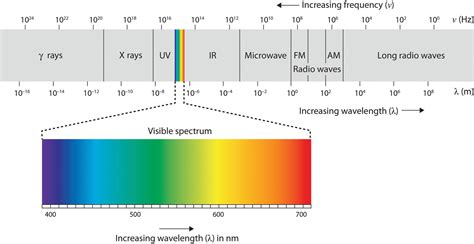
Visible Spectrum
The visible spectrum is the part of the electromagnetic spectrum that humans can see, roughly 380–700 nanometers in wavelength. Red light has longer wavelengths, while violet light has shorter wavelengths.
Accommodation (Lens)
Visual accommodation is the process by which the eye adjusts the shape of its lens to focus on objects at different distances. This reflexive action allows for clear images on the retina, similar to how a camera lens focuses on various points.
Mechanism of Accommodation
Ciliary Muscle: This muscle contracts or relaxes to change the lens shape.
Lens Shape:
Nearby objects - lens curves (increasing refractive power)
Distant objects - lens flattens (reducing refraction)
Zonules: These fibers connect the ciliary muscle to the lens, helping to control its shape during accommodation.
Age-Related Changes
As individuals age, the lens loses flexibility, leading to a condition known as presbyopia. This condition typically begins around the age of 40 to 45, making it difficult to focus on close objects.
The ability to accommodate decreases progressively, with significant changes often observed by age 55.

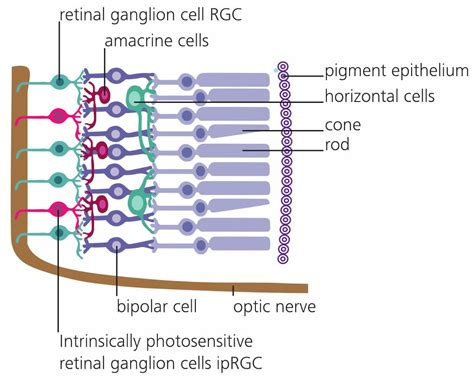
Retina
Located at the back, and responsible for converting light into nerve signals.
These signals are then transmitted to the brain, where they are processed into visual images.
The retina contains specialized cells known as photoreceptors, which include:
Rods: Sensitive to low light, enabling night vision.
Cones: Responsible for color vision and detail in bright light.
Importance of the Retina in Vision
The retina plays a vital role in the initial stages of visual processing. When light enters the eye, it is focused onto the retina, where the photoreceptors detect it and convert it into electrical signals. These signals travel through the optic nerve to the brain, allowing us to perceive our surroundings.
Psychological Implications
The retina's health can significantly impact vision, and conditions affecting it can lead to various visual impairments. Some common retinal disorders include:
Age-related macular degeneration
Diabetic retinopathy
Retinal detachment
Fovea
In psychology, the fovea is a small area at the center of the retina that provides the sharpest central vision. It is densely packed with cone cells, which detect fine detail and color.
Key Characteristics
Location: Center of the retina
Composition: Densely packed with cone photoreceptors
Function: Provides the sharpest central vision
Importance in Visual Perception
Detecting Fine Detail: The high concentration of cone cells allows for acute vision, making it easier to see small details.
Color Vision: Cones are responsible for color detection, which is vital for recognizing objects and faces.
Cognitive Processes: Sharp vision from the fovea supports activities like reading and face recognition, linking visual perception to cognitive functions.
Comparison with Other Parts of the Retina
Feature | Fovea | Macula | Retina |
|---|---|---|---|
Type of Cells | Only cones | Contains both cones and rods | Contains rods and cones |
Vision Sharpness | Sharpest | Sharper than the retina | General vision |
Primary Function | Detail and color vision | Central vision | Overall light detection |

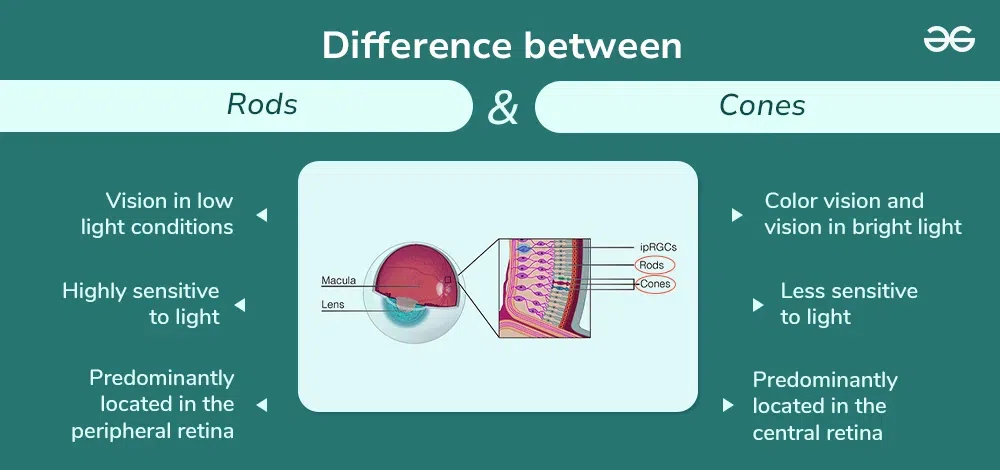
Rods
Photoreceptors responsible for light and motion detection in dim light; high concentration in the periphery and none in the fovea (120 million).
Key Characteristics of Rods
Highly sensitive to light
Allowing them to function well in dim environments
Black-and-white vision
Essential for night vision and help detect movement in low-light situations
Function of Rods
Scotopic Vision: This is the vision that occurs in low-light environments, where rods dominate.
Peripheral Vision: Rods are distributed throughout the retina, aiding in the detection of movement at the edges of our visual field.

Cones
Photoreceptors responsible for color vision and high-detail central vision; highest concentration in the fovea (6 million).
Types of Cones
There are three types of cones, each sensitive to different wavelengths of light:
Cone Type | Sensitivity | Color Perceived |
|---|---|---|
S-cones | Short | Blue |
M-cones | Medium | Green |
L-cones | Long | Red |
Function of Cones
Color Detection: Cones are responsible for detecting colors by responding to specific wavelengths of light.
Visual Acuity: They are concentrated in the fovea, the central part of the retina, which allows for sharp vision and high spatial resolution.
Bright Light Conditions: Cones function optimally in well-lit environments, unlike rods, which are more effective in low light.
Importance in Vision
Cones enable us to see a wide range of colors and fine details, making them essential for tasks that require visual precision, such as reading and recognizing faces. Their distribution and functionality are vital for normal color vision and overall visual performance.
Blind Spot
The eye’s blind spot is the small area on the retina where the optic nerve exits, leaving no light-sensitive cells to detect images there. We usually do not notice it because the brain fills in the gap using nearby visual information and input from the other eye.
Why Don't We Notice the Blind Spot?
Most people are unaware of their blind spot due to the brain's remarkable ability to fill in the missing information. It uses visual data from surrounding areas and input from the other eye to create a seamless perception of the visual field.
Characteristics of the Blind Spot
Location: The blind spot is located about 12–15 degrees temporally (to the side) and 1.5 degrees below the horizontal line of sight.
Size: It measures approximately 7.5 degrees high and 5.5 degrees wide.
Function: The brain compensates for the blind spot by interpolating the missing information, allowing us to perceive a continuous visual field.
Young-Helmholtz Trichromatic Theory
The Young-Helmholtz trichromatic theory explains how humans perceive color through three types of cone cells in the retina. Each type of cone is sensitive to different wavelengths of light, specifically blue, green, and red.
Key Components of the Theory
Cone Type | Wavelength Sensitivity | Color Perception |
|---|---|---|
Short (S-cones) | Blue | Blue |
Medium (M-cones) | Green | Green |
Long (L-cones) | Red | Red |
Cone Functionality: Each cone type responds to specific wavelengths of light. The brain interprets the combined signals from these cones to create the perception of various colors.
Color Mixing: By varying the intensity of light that stimulates these cones, the brain can perceive a wide range of colors. For example, yellow is perceived when both red and green cones are stimulated.
Implications of the Theory
Color Blindness: The theory helps explain color blindness, which occurs when one or more types of cones are absent or malfunctioning. This condition affects the ability to perceive certain colors.
Color Perception: Normal color vision allows individuals to distinguish up to one million different colors due to the interaction of the three cone types.
Historical Context
Thomas Young: Proposed the existence of three types of photoreceptors in 1802.
Hermann von Helmholtz: Expanded on Young's work in the mid-1800s, detailing how the brain interprets signals from these cones to perceive color.
Opponent-Process Theory
Opponent-process theory explains how the visual system codes color using opposing channels. It helps account for why we do not normally perceive reddish-green or yellowish-blue, and why staring at one color can lead to seeing its opposite in an afterimage.
Channel | Opposing colors |
|---|---|
Red–green | Red and green |
Blue–yellow | Blue and yellow |
Black–white | Black and white |
Cells in these channels respond more to one side of a pair and less to the other. Because the two sides oppose each other, the system does not signal both at once.
How afterimages happen
After looking steadily at a color, the relevant visual channel adapts. When you then look at a neutral background, the balance in that channel shifts, so you may see the opposite color. For example, after staring at red, you may see green; after staring at green, you may see red.
How it fits with trichromatic theory
Trichromatic theory describes the first stage: three types of cones respond preferentially to different ranges of light wavelengths.
Opponent-process theory describes how later visual pathways, including retinal ganglion cells, organize cone signals into opposing color channels.
Together, the theories explain color vision more fully than either one alone.
Gestalt Psychology & Figure-Ground
Gestalt psychology explains how the mind organizes sensory information into meaningful patterns and wholes, rather than interpreting each part in isolation. A key idea is figure–ground perception: we distinguish what we focus on from its surrounding background.
What “figure” and “ground” mean
Term | Meaning | Example |
|---|---|---|
Figure | The object or area that stands out as the focus | A word printed on a page |
Ground | The background against which the figure is seen | The page around the word |
How figure–ground perception works
The visual system assigns shared borders to one side or the other. That choice helps determine the shape we perceive.
The figure usually seems more prominent, while the ground appears behind it.
The same image can be interpreted in more than one way, depending on which area becomes the figure.
Rubin’s vase
Rubin’s vase is an example of an ambiguous image. You may see a vase in the center, or two faces looking toward each other. The image stays the same, but the figure and ground switch: the central area can look like the vase, while the surrounding areas look like faces—or the reverse.
Other Gestalt grouping principles
Gestalt psychology also describes ways we organize visual information:
Proximity: nearby items tend to be perceived as a group.
Similarity: items that look alike tend to be grouped together.
Good continuation: we tend to see smooth, continuous lines.
Closure: we often perceive incomplete shapes as whole objects.
Figure-Ground Relationship
The figure–ground relationship is how we organize a visual scene into a focal object—the figure—and the surrounding area—the ground. This helps us distinguish objects from their backgrounds.
How it works
The figure usually appears to have a clear shape and stands out.
The ground is perceived as the background behind or around the figure.
Which part is seen as the figure can change, especially in ambiguous images.
Classic example
In the Rubin vase illusion, one image can be seen in two ways:
What you focus on | What you perceive |
|---|---|
The central white area | A vase |
The black areas on either side | Two faces looking at each other |
The shared border between the white and black areas seems to belong to whichever shape you focus on. This change in how the border is assigned changes what you see.
Why it matters
Figure–ground organization is an important part of visual perception: it helps us pick out meaningful objects from a busy scene. The brain uses visual cues to decide what stands out, and experience or expectations can also influence how an unclear image is interpreted.
Gestalt Grouping Principle: Proximity
In Gestalt psychology, proximity means that elements near one another tend to be perceived as belonging together. The brain organizes nearby visual information into groups, even when the elements differ in shape or size.
How it works
A cluster of closely spaced dots may look like one group.
If gaps between some dots are larger, those dots may appear to form separate groups or columns.
In text, letters close together are read as words, while spaces help distinguish one word from another.
Why it matters in perception
Proximity is one of several Gestalt principles that explain how people organize sensory information into meaningful patterns. It illustrates the broader idea that perception is not simply a collection of separate details: the mind tends to organize those details into wholes.
Gestalt Grouping Principle: Similarity
The tendency to group like or similar objects together.
Gestalt Grouping Principle: Continuity
The tendency to perceive smoothly flowing or continuous forms rather than disrupted or discontinuous ones.
Gestalt Grouping Principle: Closure
The tendency to perceive smoothly flowing or continuous forms rather than disrupted or discontinuous ones.
Gestalt Grouping Principle: Connectedness
The tendency to perceive spots, lines, or areas as a single unit when they are physically linked.
Binocular Cues
(Depth Perception)
Depth cues requiring both eyes, including binocular disparity (the slightly different view each eye receives) and convergence (eyes turning inward for close objects).
Binocular Convergence
A binocular depth cue where your two eyes turn inward as objects approach you (closer objects require stronger muscle/neural signals).
Retinal Disparity
A binocular depth cue based on the differing images each eye sends to the brain (less disparity = further away).
Monocular Depth Cues
Depth cues requiring only one eye, including relative size, interposition, relative height, linear perspective, aerial perspective, motion parallax, and light/shadow.
Perceptual Constancy
The ability to maintain a perception of an object's underlying physical characteristics (size, shape, color) despite changes in sensory manifestations.
Signal Detection Theory
Explains how motivation and expectations shift our ability to identify a meaningful stimulus (signal) embedded in distracting background noise.
Wavelength & Frequency (Light/Sound)
Wavelength is the distance from peak to peak; frequency is the number of waves per second (measured in Hertz). Longer wavelengths = lower frequencies; shorter wavelengths = higher frequencies.
Amplitude (Light/Sound)
The height of a wave from center to crest/trough. In vision, it relates to brightness; in audition, it relates to loudness (measured in decibels).
Cornea
Pupil
Lens
Visual pathway to the brain
Receptors connect to ganglion cells forming the optic nerve → optic chiasm (where visual field info crosses to opposite brain hemispheres) → thalamus → occipital lobe (processed via "what" and "where/how" pathways).
Outer, Middle, and Inner Ear Anatomy
Outer ear includes the pinna, auditory canal, and tympanic membrane (eardrum). Middle ear contains the ossicles (malleus, incus, stapes). Inner ear contains the cochlea and vestibular system.
Transduction in Hearing
Sound waves vibrate the eardrum → ossicles move → stapes presses the oval window of the fluid-filled cochlea → stimulates hair cells on the basilar membrane to fire neural impulses.
Place Theory vs. Temporal Theory of Pitch
Place theory states different parts of the basilar membrane respond to different frequencies (high at the base, low at the tip); temporal theory states frequency is coded by the activity/firing rate of sensory neurons.
Sound Localization (Monaural vs. Binaural Cues)
Monaural cues (via the pinna) help locate sounds above, below, in front, or behind; binaural cues (interaural level and timing differences) locate sounds along a horizontal axis.
Conductive vs. Sensorineural Hearing Loss
Conductive hearing loss is caused by a failure delivering sound energy to the cochlea (e.g., damaged eardrum/ossicles); sensorineural hearing loss involves a failure to transmit neural signals from the cochlea to the brain (e.g., aging, noise exposure).
Chemical Senses
(Gustation & Olfaction)
Taste (gustation) and smell (olfaction) are chemical senses because receptors respond to molecules in food (sweet, salty, sour, bitter, umami, fat) or air (detected by olfactory receptors in the nasal cavity).
Somatosensory Receptors in Skin
Includes Meissner's corpuscles (pressure/low frequency), Pacinian corpuscles (transient pressure/high frequency), Merkel's disks (light pressure), and Ruffini corpuscles (stretch).
Thermoception, Nociception, & Pain
Free nerve endings serve as receptors for thermoception (temperature) and nociception (signals indicating potential harm/pain, which can be inflammatory or neuropathic).
Vestibular Sense, Proprioception, & Kinesthesia
The vestibular sense (using fluid-filled semicircular canals, utricle, and saccule in the inner ear) controls balance and equilibrium; proprioception perceives body position, and kinesthesia perceives body movement through space.
Perceptual Constancy
The ability to maintain a perception of an object's underlying physical characteristics (size, shape, color) despite changes in sensory manifestations.
Consciousness
Our awareness of ourselves and our environments.
Selective Attention
The focusing of conscious awareness on a particular stimulus.
Inattentional Blindness
Failing to see visible objects when our attention is directed elsewhere (e.g., missing a gorilla in a basketball video).
Change Blindness
Failing to notice changes in the environment (e.g., half of participants failing to notice when a person asking for directions was swapped behind a panel).
Circadian Rhythm
The biological clock; regular bodily rhythms (such as wakefulness and body temperature) that occur on a 24-hour cycle.
Suprachiasmatic Nucleus (SCN)
A small brain structure in the hypothalamus that controls circadian rhythms using light input from the eyes via the optic nerve.
Melatonin
A sleep-inducing hormone released by the pineal gland, peaking in blood concentration between 1:00 A.M. and 3:00 A.M.
Sleep
A periodic, natural, reversible loss of consciousness.
Alpha Waves
Relatively slow brain waves of a relaxed, drowsy state just before falling asleep.
Beta Waves
Fast, high-frequency brain waves associated with being awake, alert, and active.
Theta Waves
Slower brain waves characteristic of Stage 1 and Stage 2 NREM sleep.
Delta Waves
Large, slow brain waves associated with deep NREM sleep (Stages 3 and 4).
Stage 2 NREM Sleep Characteristics
Features sleep spindles (sudden bursts of brain activity) and K complexes.
REM Sleep
Rapid Eye Movement sleep; a recurring sleep stage featuring vivid dreams, fast brain waves, and "paradoxical sleep" (muscles are relaxed while internal body systems are active).
REM Rebound
The tendency for REM sleep to increase following REM sleep deprivation.
Insomnia
Persistent problems in falling or staying asleep.
Narcolepsy
Uncontrollable sleep attacks, sometimes dropping directly into REM sleep.
Sleep Apnea
Temporary cessations of breathing during sleep causing momentary re-awakenings.
Night Terrors
A sleep disorder occurring during Stage 4 sleep within 2-3 hours of falling asleep, marked by high arousal, terror, and rarely being remembered.
Sleep Paralysis
A disorder where a person wakes up while the body is still under brain-induced REM paralysis, often accompanied by frightening sensory hallucinations.
Manifest Content
According to Sigmund Freud, the remembered storyline of a dream.
Latent Content
According to Sigmund Freud, the underlying, hidden meaning and unconscious wishes of a dream.
Activation-Synthesis Theory
Allan Hobson’s theory that dreams are the brain's attempt to synthesize and make sense of random neural activity originating from the brainstem during REM sleep.
Information-Processing (Dream Theory)
The theory that dreams help facilitate and consolidate memories of daily experiences.
Hypnosis
A social interaction in which one person (the hypnotist) suggests to another that certain perceptions, feelings, thoughts, or behaviors will spontaneously occur.
Posthypnotic Amnesia
A supposed inability to recall what one experienced during hypnosis, induced by the hypnotist's suggestion.
Psychoactive Drug
A chemical substance that alters perceptions and mood.
Tolerance
The diminishing effect with regular use of the same drug dose, requiring larger doses to experience the same effect.
Withdrawal
The physical discomfort and emotional distress that follow discontinuing an addictive drug.
Depressants & the GABA System
Drugs (such as alcohol, barbiturates, and opiates) that reduce neural activity and slow body functions.
Stimulants & Dopamine
Drugs (such as caffeine, nicotine, amphetamines, cocaine, and Ecstasy) that excite neural activity and speed up body functions.
Hallucinogens
Psychedelic drugs (such as LSD and THC) that distort perceptions and evoke sensory images in the absence of sensory input.
Continuum of Consciousness
The range of states of consciousness from full awareness/wakefulness down to deep sleep, daydreaming, intoxication, and unconsciousness under anesthesia.
Chronotype
Individual differences in circadian patterns of activity (e.g., morning people vs. night owls).
Jet Lag
A collection of symptoms (fatigue, sluggishness, irritability, insomnia) resulting from a mismatch between internal circadian cycles and a new environment after traveling across multiple time zones.
Bright Light Therapy
Exposure to bright light during work shifts and darkness during rest to help realign biological clocks, combat insomnia, and alleviate shift work or jet lag symptoms
Sleep Debt
The cumulative effect of not getting sufficient sleep on a chronic basis, leading to decreased alertness and mental efficiency.
Sleep Regulation
The brain's control of switching between sleep and wakefulness and coordinating this cycle with the outside environment.
Physiological & Psychological Consequences of Sleep Deprivation
Irritability, memory lapses, impaired moral judgment, depression-like symptoms, reduced immune function, increased blood pressure, risk of obesity, risk of Type 2 diabetes, and hallucinations after 48+ hours awake
Impairment Comparison (Sleep Deprivation vs. Alcohol)
Research suggests that severe sleep deprivation affects cognitive and motor function as much as, or more than, alcohol intoxication.
Brain Areas Involved in Sleep
Thalamus
Hypothalamus (Sleep regulation)
Pons
Hormone Secretions During Sleep
Endocrine Glands & Sleep Hormones
FSH and LH
Growth Hormone
Theories of Why We Sleep
Evolutionary Psychology Perspective on Sleep
Back: The theory that sleep evolved as a response to make individuals successful in passing on genes, through either conserving energy or minimizing predatory risk during darkness.
Evolutionary Critique / Complexity
Back: Research shows mixed or equivocal links; energy demands could theoretically be met by quiet rest, and some high-predation species actually sleep fewer hours.
Cognitive Function & Memory Theory of Sleep
Back: The theory that sleep is essential for cognitive function, memory formation, slow-wave sleep consolidation of new tasks, creative thinking, and language learning.
requency vs. Amplitude (EEG)
Stage 1 NREM Sleep
Stage 2 NREM Sleep
Stage 3 NREM Sleep
Sleep Spindle
K-Complex
Carl Jung's Collective Unconscious & Dreams
Rosalind Cartwright's Theory of Dreams