Biochem Oct. 22nd
 Note
Note Call Kai
 Learn
Learn Practice Test
 Spaced Repetition
 Match
Match Flashcards
 Knowt Play
1/16

Earn XP
Description and Tags
Topic 12
Name | Mastery | Learn | Test | Matching | Spaced | Call with Kai | Chat |
|---|
No analytics yet
Send a link to your students to track their progress
17 Terms
When would muscle cells utilize fatty acids for energy?
When blood glucose levels are low, muscle cells will utilize fatty acids through a process called beta-oxidation
What is beta-oxidation?
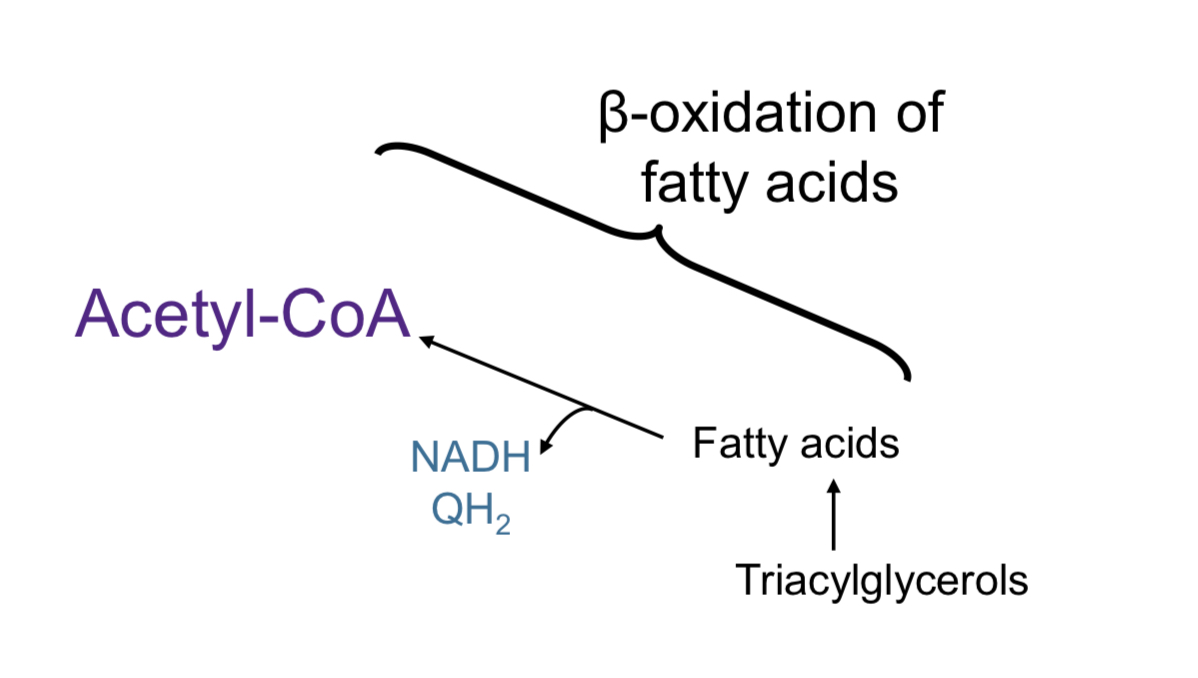
A metabolic process that occurs in the mitochondria, where fatty acids are broken down into 2-carbon units of acetyl-CoA
Doesn’t generate ATP
Generates NADH and FADH2 (QH2, the mobile form of FADH2)
(ATP is generated indirectly from beta -oxidation)
What is triacylglycerol?
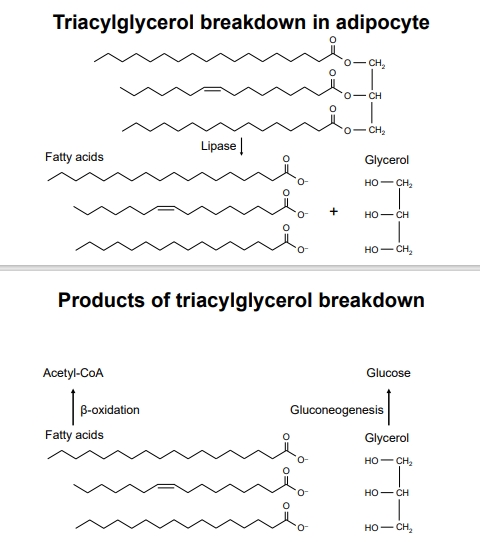
A type of lipid composed of three fatty acids esterified to a glycerol backbone, serving as a major form of energy storage in the body
they can be broken down into glycerol and fatty acids, with glycerol potentially converted back into glucose through gluconeogenesis
How does glycerol play a role in metabolism?
Glycerol, once in the liver, can be phosphorylated to glycerol-3-phosphate and then oxidized to dihydroxyacetone phosphate (DHAP), which enters the gluconeogenesis pathway to produce glucose.
The brain predominantly uses glucose as its primary fuel source. While fatty acids can be used by other tissues, they are not directly taken up or metabolized by the brain due to their inability to cross the blood-brain barrier effectively.
When triacylglycerol is broken down, what happens to it?
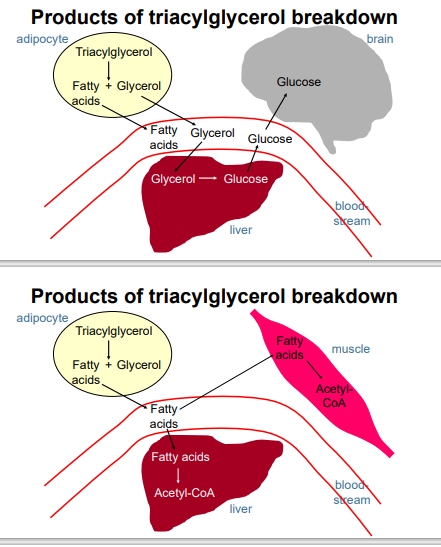
What kind of tissues efficiently uptake fatty acids from the bloodstream?
muscle and liver tissues efficiently do this
What happens to fatty acids one inside the cells of these tissues?
Once inside the mitochondrial matrix of these cells, fatty acids undergo beta-oxidation, a catabolic process that converts them into two-carbon units of acetyl CoA.
This acetyl CoA then enters the citric acid cycle, leading to the production of reduced cofactors (NADH and QH2) that subsequently fuel ATP generation through oxidative phosphorylation
What does a hormone sensitive lipase do?
key enzyme responsible for hydrolyzing triacylglycerols into fatty acids and glycerol
How can it be regulated?
Hormone-sensitive lipase can be regulated by:
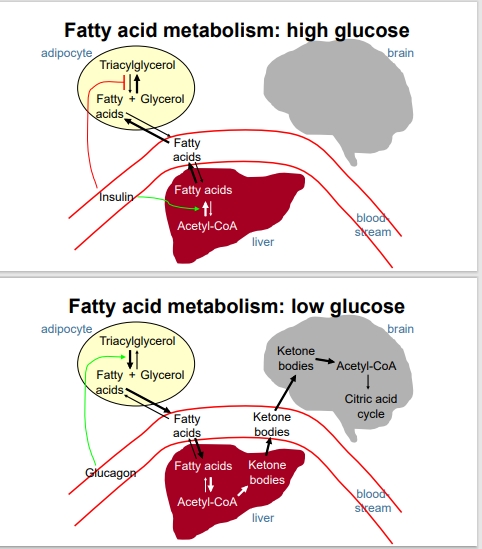
Insulin, as insulin signals energy abundance and primarily inhibits hormone-sensitive lipase activity, thus promoting fat storage.
Glucagon, which is promoted when glucose levels are low, so it’d promote the activation of hormone-sensitive lipase through a cAMP-dependent phosphorylation cascade, promoting the breakdown of triacylglycerols and the release of fatty acids for energy extraction
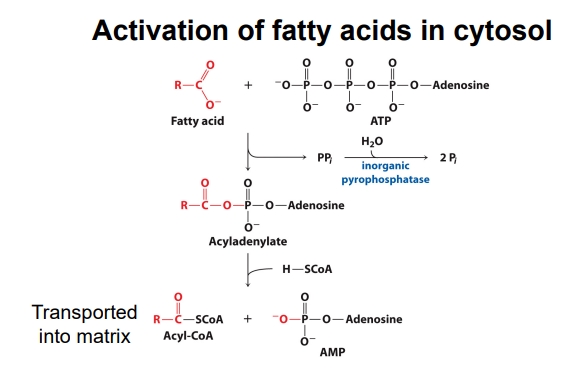
What has to happen before fatty acids can be catabolized?
They must be activated
This occurs in the outer mitochondrial membrane and cytosol where fatty acids are converted to acyl-CoA by acyl-CoA synthetase (also known as fatty acyl-CoA ligase)
This reaction requires ATP, which is hydrolyzed to AMP and PPi
Acyl-CoA and AMP are then transported to the matrix
Explain the beta oxidation process
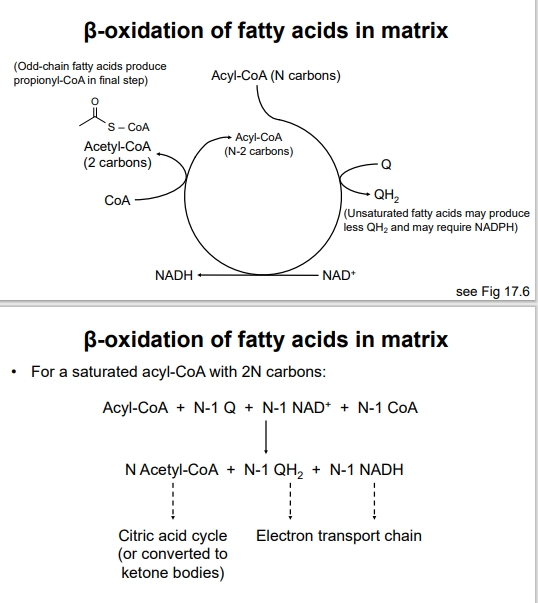
Beta-oxidation consists of a repeating sequence of four enzymatic reactions:
Dehydrogenation (forms a double bond and produces FADH2)
Hydration (adds water across the double bond)
Dehydrogenation (forms a keto group and produces NADH)
Thiolysis (cleaves off acetyl CoA)
Each cycle results in the cleaving of two carbon molecules from the acyl-CoA chain, yielding one molecule of acetyl CoA and a shortened acyl-CoA molecule that re-enters the cycle.
What are the two main outputs in beta-oxidation?
Acetyl CoA, which proceeds to the citric acid cycle.
Reduced cofactors (NADH and QH2), which donate electrons to the electron transport chain for ATP synthesis.
What is the Citrate Transport System?
Since acetyl-coa is made in the mitochondrial matrix and fatty acid synthesis occurs in the cytosol, a shuttle system is required
It’s required because acetyl-coa can’t cross the membrane, so citrate acts as a shuttle to aid in moving it across the membrane
Explain the process of processing unsaturated fatty acids
Specific auxiliary enzymes are required for unsaturated fatty acids due to the presence of double bonds.
Unsaturated fats sometimes produce less QH2
What are ketone bodies?
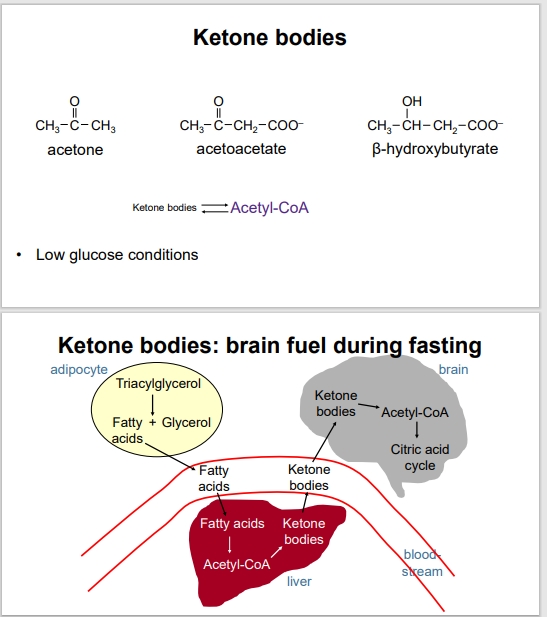
Ketone bodies are water-soluble molecules produced by the liver from fatty acids during periods of low carbohydrate intake or fasting.
Examples of ketone bodies include acetoacetate, beta-hydroxybutyrate and acetone
They serve as an alternative energy source for tissues, especially the brain, when glucose levels are low.
The liver synthesizes ketone bodies from fatty acids.
The liver is the primary site of ketone body synthesis
These ketone bodies are released into the bloodstream and serve as an alternate source of energy, especially for the brain in terms of fasting when glucose is scarce
What is fatty acid biosynthesis?
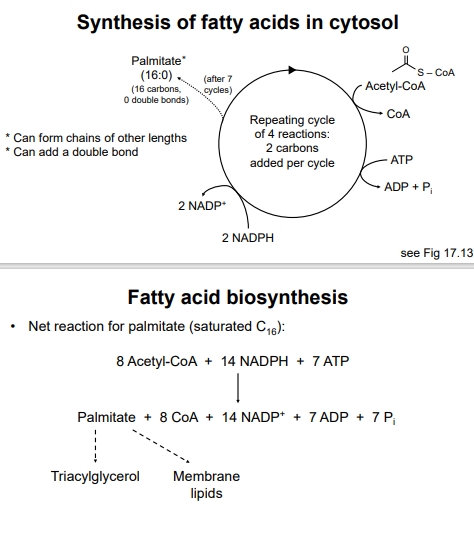
Fatty acid synthesis occurs in the cytosol
This process requires ATP for energy and NADPH as the reducing power
This process is carried out by an enzyme called fatty acid synthase, which catalyzes a repeating cycle of 4 reactions
Each cycle adds 2 carbons to the growing fatty acid chain via malonyl-CoA (what delivers the 2 carbons from acetyl-CoA
2 NADPH are used to finally synthesize palmitate (16C) after 7 cycles
(the acetyl-CoA already has 2 carbons)
How is fatty acid metabolism regulated?
During insulin-spiked states, the body prioritizes glucose utilization, and excess energy (including fatty acids) is channeled into storage as triacylglycerols in adipose tissue rather than being mobilized for immediate energy production
Glucagon, acting in low glucose states, promotes lipid mobilization and fatty acid oxidation for energy retrieval.
This re-emphasizes the coordinated partnership between glucagon and insulin in regulating fatty acid metabolism to maintain energy homeostasis.