Energy and Enzymes
 Call Kai
 Learn
 Practice Test
 Spaced Repetition
 Match
 Flashcards
 Knowt Play
1/81

There's no tags or description
Looks like no tags are added yet.
82 Terms
Free Energy
The portion of a system’s energy that can do work when temperature and pressure are uniform throughout the system
Change in free energy formula
Gfinal - Ginitial = ΔG
What does it mean when ΔG is negative?
The reaction is exergonic and spontaneous—it does not require energy input
Downhill reaction… think of riding a bike down a hill; you don’t need to pedal
(T/F) — Spontaneous, exergonic reactions are energetically favorable
True
Energy in an exergonic reaction (leaves/enters) the system
Leaves
What does it mean when ΔG is positive?
The reaction is endergonic and non-spontaneous—it requires energy input
Uphill reaction… think of riding a bike up a hill; you need to pedal
(T/F) — Non-spontaneous, endergonic reactions are energetically favorable
False
Energy in an endergonic reaction (leaves/enters) the system
Enters
Cellular Respiration: Formula and ΔG value
Glucose + Oxygen → Carbon Dioxide + Water
ΔG = -686 Kcal/mol
Exergonic reaction
Photosynthesis: Formula and ΔG value
Carbon Dioxide + Water → Glucose + Oxygen
ΔG = 686 Kcal/mol
Endergonic reaction
Where does energy come from to power photosynthesis?
Sunlight
How does ATP power cellular work?
By coupling exergonic and endergonic reactions
3 main kinds of work in a cell
Chemical work
Transport work
Mechanical work
Chemical Work
Pushing endergonic reactions that would not occur spontaneously
Transport Work
Pumping substances across membranes against the direction of spontaneous movement
Aka, against the concentration gradient
Mechanical Work
Muscle contraction, beating of cilia/flagella movement of chromosomes
Energy coupling
The use of an exergonic process to drive an endergonic process
____ is responsible for mediating most energy coupling and powers cellular work
ATP
ATP and its composition
Adenosine Triphosphate
1 Adenine
1 5-carbon sugar (ribose)
3 Phosphate groups
What are the reactants of ATP hydrolysis?
ATP + H2O
What are the products of ATP hydrolysis?
ADP + Pi + Energy
(T/F) — ATP hydrolysis is exergonic
True—it releases energy
What would happen if you placed 1 mol of ATP into a beaker of water?
It will spontaneously hydrolyze
How is ATP regenerated from ADP?
Adding an inorganic phosphate to ADP
Endergonic reaction
ADP + Pi + Energy → ATP + H2O
What do enzymes do?
Speed up metabolic activity by lowering the activation energy (lowering energy barriers)
Enzymes “lower the hill” so the rxn can go downhill sooner

Activation Energy
The amount of energy needed to push reactants up a hill
What do enzymes act on?
Substrates
(T/F) — Enzymes show great specificity with substrates
True
Sucrase
Binds to sucrose to catalyze the hydrolysis into two monosaccharides: glucose and fructose
(T/F) — Sucrase can bind to maltose
False
What leads to the shape of proteins?
Arrangement and binding of amino acids within the protein
The specificity of enzyme/substrate interactions depends on what?
The shape of the enzyme
What region on the enzyme do substrates bind?
The active site
What complex is formed when an enzyme and substrate bind?
Enzyme-substrate complex
Lock and Key Model
Old model that described enzymes as having a solid shape to which substrates would bind to, like that of a key fitting into a specific lock
Did not explain why some enzymes can catalyze substrates that are similar but not exact in shape
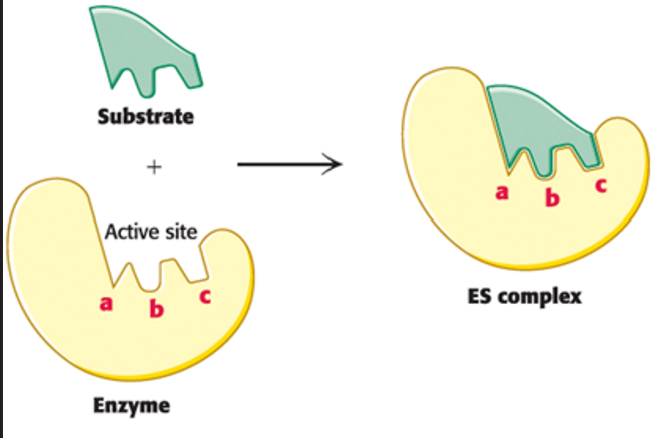
Induced Fit
Actual model utilized to explain the way enzymes and substrates interact.
Enzymes and substrates come into contact, making subtle adjustments as they bind

How is the substrate held to the enzyme?
Via 2 weak bonds (particularly weak in aqueous environment):
Hydrogen bonds
Ionic bonds
Conversion of substrate to product happens (slowly/quickly)
Quickly. A single enzyme can act on 1,000 substrate molecules per second
The more substrate there is in a reaction, the (faster/slower) the reaction goes
Faster
Point of Saturation
Point at which the reaction cannot go any faster as all enzymes are saturated by substrates
How can the point of saturation be combated?
Adding more enzyme to the reaction
(T/F) — Enzymes are not used up in reactions
True
What factors influence enzyme activity?
Temperature and pH
Cofactors or Coenzymes
What analogy was used to describe how pH and Temperature affect enzyme activity?
Making beer
Cofactors and Coenzymes
Non-protein helpers that influence enzyme activity
Cofactors
Typically ions; influence enzyme activity
Coenzyme
Organic molecules; influence enzyme activity
Competitive inhibition
A method of enzyme activity inhibition where a molecule directly competes with the substrate for the active site, blocking it from entering and binding.
Noncompetitive inhibition
A method of enzyme activity inhibition where a molecule does not directly compete for the active site, but rather binds elsewhere on the enzyme to change the shape of the active site
Allosteric
“Other site” or “different shape”
(T/F) — Most enzymes are known to be allosterically regulated
True
Enzymes are constructed from __ or more subunits
2
Allosteric activators
Stabilizes the catalytically active state, enhancing substrate binding
Allosteric inhibitors
Stabilizes the catalytically inactive state, preventing substrate binding
What types of cellular respiration did we speak about?
Fermentation
Aerobic respiration
Redox Reactions - Oxidation
The loss of an electron
An atom that oxidizes is a reducing agent
Electron donator
Redox Reactions - Reduction
The gain of an electron
An atom that reduces is an oxidizing agent
Electron acceptor
OIL RIG
Oxidization is Loss, Reduction is Gain
(T/F) — Oxidation and reduction go hand-in-hand
True
What are the products of the reaction Glucose + Oxygen?
Energy (ATP), CO2, Water
How do cells convert food into useable energy?
Via cellular respiration
In order, what are the steps of cellular respiration?
Glycolysis
Citric Acid Cycle
Electron Transport Chain
Glycolysis
Lysis of glycogen/sugar splitting
Where does Glycolysis occur?
The cytoplasm outside of the mitochondria
What occurs during glycolysis?
Glucose (6 carbon) is split into 2 pyruvate molecules (3 carbon each)
What is inputted into glycolysis?
Glucose
What is the output of glycolysis?
Net of 2 ATP
2 Pyruvate molecules
(T/F) — Oxygen is required for glycolysis
False
Where does the Citric Acid Cycle occur?
Within the mitochondria
What happens during the Citric Acid Cycle?
Pyruvate molecules are completely dismantled to save electrons
What is inputted into the Citric Acid Cycle?
2 pyruvate molecules
What is the output of the Citric Acid Cycle?
CO2
4 ATP
10 NADH
2 FADH2
Where does the Electron Transport Chain take place?
Inner membrane of the mitochondria
What occurs during ETC?
Electron carriers drop off their electrons
(T/F) — Oxygen is required for ETC
True. Oxygen serves as the final electron acceptor at the bottom of the chain.
What is the input for ETC?
10 NADH
2 FADH2
O2
What is the output of the ETC?
26-28 ATP
H2O
What are the two electron carriers we spoke of?
NADH and FADH2
Anaerobic respiration
Used by some prokaryotes when an alternative electron acceptor (like O2) is unavailable; utilize a sulfate ion instead (SO4)
How come marshes and wetlands are described as smelling like “rotten eggs?”
The bacteria there is producing hydrogen sulfide gas due to anaerobic respiration
Alcohol fermentation
Two step process that starts with glycolysis and makes 2 pyruvates, but the resulting pyruvates are broken down by pyruvate decarboxylase into acetaldehyde and CO2
Acetaldehyde and CO2 then react with NADH to from ethanol (EtOH) and NAD+

Lactic Acid Fermentation
One step process where pyruvate from glycolysis is converted directly into lactic acid and NAD+
