Liquid Dosage Forms: Part 1 (Suspensions, Emulsions and Solutions)
 Call Kai
 Learn
Learn Practice Test
 Spaced Repetition
 Match
Match Flashcards
 Knowt Play
1/41

There's no tags or description
Looks like no tags are added yet.
Name | Mastery | Learn | Test | Matching | Spaced | Call with Kai | Chat |
|---|
No analytics yet
Send a link to your students to track their progress
42 Terms
Suspension
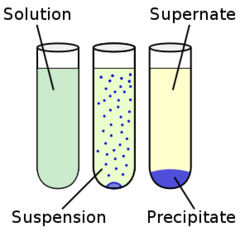
A coarse dispersion in which insoluble solid particles are dispersed in a liquid medium
What is the Internal phase of a Suspension?
- Consists of insoluble solid particles
- Maintained uniformly throughout the suspending vehicle with the aid of a single or a combination of suspending agents
What is the External phase of a Suspension?
- Suspending medium
- Generally aqueous (water)
- In some instances, it may be an organic or oily liquid for non-oral use.
What are the advantages of Suspensions?
- Hydrophobic drugs
- Patient compliance vs tablets/capsules
- Suspension can improve the chemical stability of certain drugs. (E.g., Procaine penicillin G)
- Drug in suspension exhibits a higher rate of bioavailability than other solid dosage forms
- Suspension can mask the unpleasant/ bitter taste of a drug (E.g., Chloramphenicol)
Bioavailability
The ability and quickness of a drug to be absorbed and used by the body
What is the order of bioavailability within different drug forms?
Solution (Most bioavailable) > Suspension > Capsule > Compressed tablet > Coated tablet (Least bioavailable)
What are the disadvantages of Suspensions?
- A uniform and accurate dose can not be achieved unless suspensions are packed in a unit dosage form
- It is difficult to formulate because they are thermodynamically unstable (maintain their physical form)
- Physical instability and sedimentation can cause problems
What are the desired features of a Suspension?
- Should NOT settle rapidly
- MUST be easily resuspended by the use of a moderate amount of shaking
- Should be easy to pour yet NOT watery and NO grittiness
- Should have a PLEASING odor, color, and palatability
- Should be physically, chemically, and microbiologically stable
- Parenteral/Ophthalmic suspension should be sterilizable
What is the function of a Wetting agent?
*Reduces the surface tension of a liquid by displacing air in the crevices of the particles
- Such liquids are mixed with powders using a mortar and pestle
What are some examples of Wetting agents?
Alcohol, propylene glycol, glycerin, or any other hygroscopic liquid
What is the function of a Suspending agent?
*Viscosity (thickness) inducing agents that are used to reduce the sedimentation rate of particles in a vehicle
What are some examples of Suspending agents?
Agar, Bentonite, Methyl cellulose, Hydroxypropyl cellulose, Carbomer
Polymer
A macromolecule composed of repeating structural units (monomers) typically connected by covalent chemical bonds in a regular or irregular pattern
In this formula, H-(O-CH2-CH2-)n -OH, when n=2, what is the molecular weight?
> Calculate the repeating unit: (O-CH2-CH2-) = C2 + H4 + O1 = 24 + 4 + 16 = 44
> Calculate the front end and back end: H + OH = 1 + 17 = 18
> Multiply 44 by n=2 and add 18: 44 x 2 + 18 = 88 + 18 = 106 g/mol
Surfactants
*Substances that absorb onto surfaces or interfaces to reduce surface tension. May be used as a wetting agent, detergent, or emulsifying agent
What are the 2 important examples of Surfactants?
- Polysorbate 80 (Tween 80)
- Sorbitan monooleate 20 (Span 20)
What are the 2 ways that particles in a liquid stay stable and don't clump together?
- Steric barrier on the surface
- Charge repulsion
Stabilization: Steric barrier on the surface
Polymers with PEG (little hairs) physically block other particles from getting close, so they don't stick together
Stabilization: Charge repulsion
If particles all carry the same electrical charge, they repel each other, keeping them spread out instead of clumping (like magnets with the same pole)
What are the 3 classifications of Suspensions based on application?
- Oral suspension (e.g., Aluminum Hydroxide)
- Externally applied suspension (e.g., lotion)
- Parenteral suspension (e.g., Cholera and Tetanus vaccines)
What are the 2 classifications of Suspensions based on the electrokinetic nature of solid particles?
- Flocculated suspension
- Deflocculated suspension
Flocculation
A process that clumps small suspended particles in a liquid into larger, settleable masses called "flocs"
What are the Mechanisms of "Action" for Flocculating Agents?
> Lowers particle surface charge, resulting in flocs (loose aggregates) (E.g., Electrolytes such as KCl, NaCl, Calcium salts, citrates, phosphate salts)
> Build a gel-like network (polymer with a proper cross-linker)
> Viscosity modifications: Polysaccharides (alginates, starch), water-soluble cellulose, Synthetic polymers
Why might Suspension be thermodynamically unstable?
- Particle size uneven or too small
- Incorrect charges
- Density too high
What are the signs of instability for Suspension?
- Inability to suspend the particles
- Change in color
Pharmaceutical Excipients for Suspension: Excipients for Maintaining the Appearance
> Color
> Preservatives
> Viscosity agents
> Flocculating agents
Pharmaceutical Excipients for Suspension: Excipients for Protecting the active species
> Buffer pH
> Antioxidant
Pharmaceutical Excipients for Suspension: Excipients for Disguising the unpleasant taste/smell
> Sugar
> Flavoring agents
Pharmaceutical Excipients for Suspension: Excipients for Changing the dissolution rates of active species
> Different salt forms
> Different particle size
> Different solvent compositions
Emulsion
One liquid is uniformly dispersed as globules (dispersed) in the other liquid phase (continuous)
The dispersed phase can be stabilised by the presence of a WHAT?
Presence of an Emulsifier
What are the different stages of Emulsions?
*Two phases (oil and water) are agitated together, thermodynamically unstable
- Dispersed system
- Intermediate stage
- Separate bulk phases
Emulsion Composition
Immiscible phases
> Non-aqueous = oil
> Aqueous = water (emulsifier)
What are the types of emulsions used in pharmacy?
- Oral emulsions, injectables, topicals (O/W)
- Topicals, rectals (W/O)
O/W emulsion
> oil-in-water
W/O emulsion
> water-in-oil
What are the forms of Complex/multiple emulsion systems?
- w/o/w
- o/w/o
W/O/W emulsion
> Water-in-oil-in water
> Internal phase = water
> Dispersed phase = oil
> Continuous phase = water
O/W/O emulsion
> Oil-in-water-in-oil
> Internal phase = oil
> Dispersed phase = water
> Continuous phase = oil
W/O/W emulsion has a 3-phase action
1) The outermost water phase ensures an immediate moisturizing of the upper skin layers.
2) In the second phase, the oil droplets merge to form a layer.
3) In the third phase, the innermost water is continually released - in the manner of timed-release capsules - and ensures a long-lasting skin moisturization
What are the basic components of Dermatologic preparations?
- Powder
- Water
- Oil
- Emulsifier
What is the Intention of Use for Dermatologic preparations?
> The majority of these preparations are used for the effects of the therapeutic agents they contain.
> Non-medicated ones are used for physical effects such as protectants or lubricants.