Angina, A-Fib, Direct VD, MI, HF
 Call Kai
 Learn
 Practice Test
 Spaced Repetition
 Match
 Flashcards
 Knowt Play
1/28

There's no tags or description
Looks like no tags are added yet.
29 Terms
what is angina pectoris + list drugs?
-Pain due to insufficient oxygenation of myocardial cells
•exercise, stress, blood clot or spasm, VC
-Drugs
•Beta-blockers
•Calcium channel blockers
•Nitrates
Beta-blockers
*talked previously
-decrease HR and contractility
-Use: stable anhinga

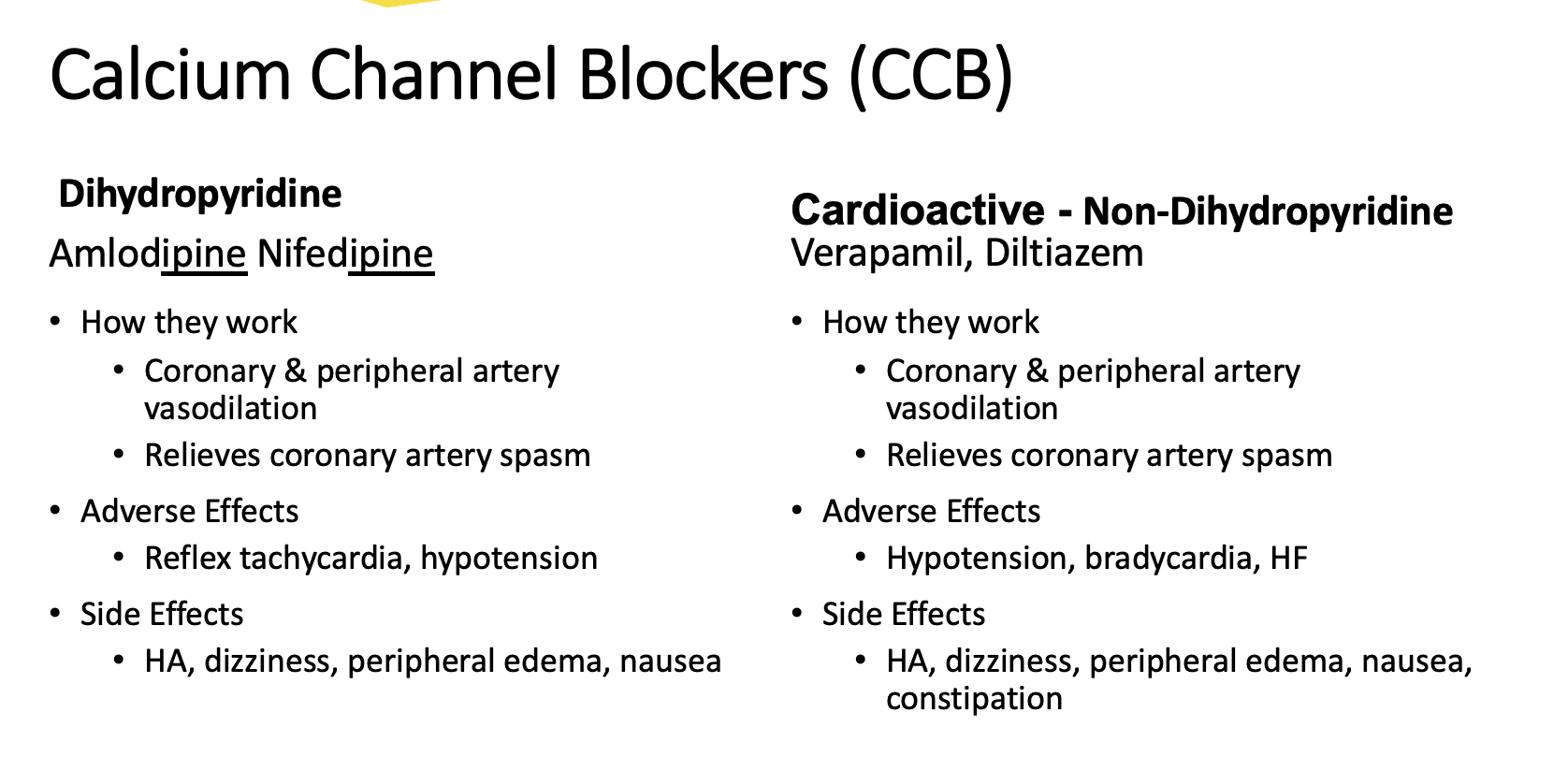
Calcium Channel Blockers (CCB)
*talked previously
-diaretic
Organic Nitrates: Nitroglycerian
-Fast acting
-How they work: Vasodilation of large veins and coronary arteries; Decreased cardiac work/decrease O2 demand
-Adverse effects: HA, hypotension, flushing, reflex tachycardia, dizziness, nausea, falls risk*
-Route of administration: Sublingual/under tonuge (skips first pass/right into blood), patches
Important things to remember/therapy implications
-should have on self when exercising
-1 minute onset; Immediate relief for exercise, stress induced angina
-Sublingual
Cause vasodilation therefore should be sitting when taking to prevent falling
Heat will also cause vasodilation and may lead to excessive vasodilation [ie hot tub]
*take couple times before call 911
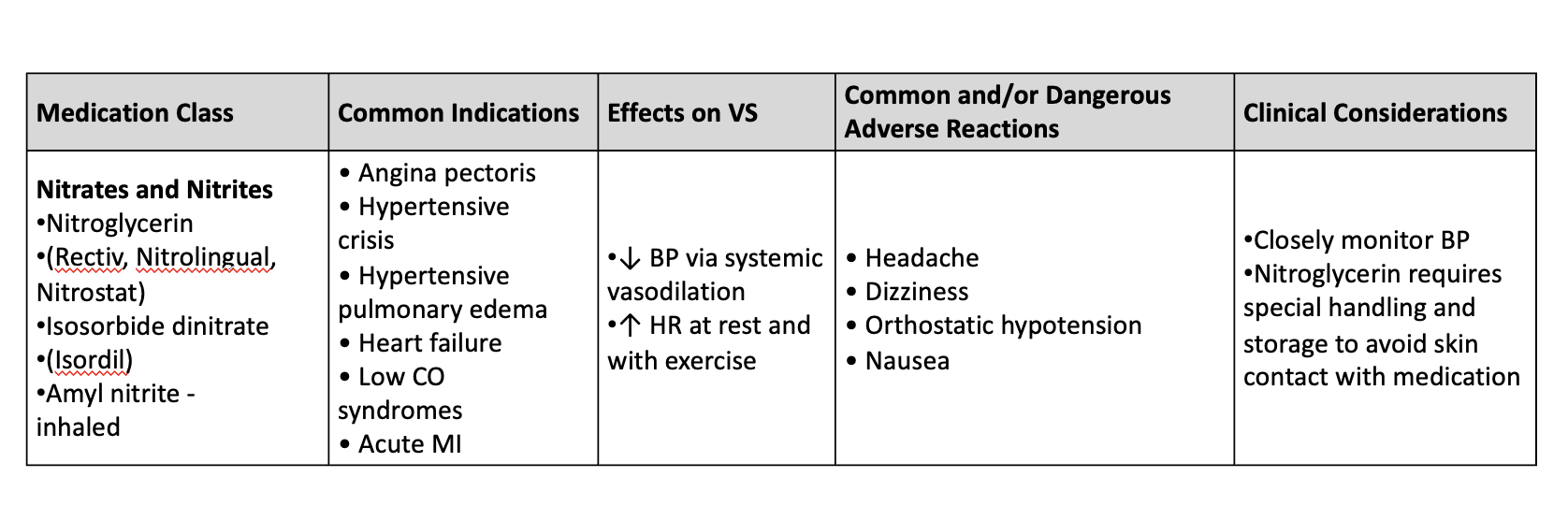
Organic Nitrates: Isosorbide minonitrate + dinitrate
-How they work: Vasodilation of large veins and coronary arteries; Decreased cardiac work/ decrease O2 demand
-Adverse effects: HA, hypotension, flushing, reflex tachycardia, dizziness, nausea; Falls Risk*
-Route of administration: Oral (prevention)
-long acting with 30 minute onset
Nitrates APTA vital signs
*closely monitor BP
*avoid skin contact
Knwoledge check
-Patient in clinic has diagnosis of stable angina. What medication should they always have during therapy? Why?
-Patient in SNF reports being dizzy when standing…what medication could cause dizziness and why?
-Patient will history of angina, develops chest pain while using stationary bike during PT session. Next steps?
-Nitroglycerian. Increased activity during therapy can be overtaxing to the heart causing increased oxygen demand
-Any medication affecting BP – causes orthostatic hypotension increasing patient’s risk for falls
-Have patient end session, take their nitro per directions if not resolved may need to active EMS and inform the provider
A-Fib: management and goal of therapy
-Goal of Therapy: multimodal approach for symptom control & thromboembolism prevention

Heart Rate Control
-Used in acute & chronic settings
-Promotes hemodynamic function
↓ ventricular response
↓ myocardial oxygen demand
Improved coronary perfusion & mechanical function
-Beta Blockers [previously discussed]: Atenolol, Carvedilol, Esmolol, Metoprolol
-Calcium Channel Blockers [previously discussed]; Diltiazem, Verapamil
-K+ channel blockers: Amiodarone
-Cardiac Glycosides: Digoxin
Amiodarone
-K+ Channel Blocker
-Most widely used
-Rate and rhythmic control
-Adverse Effects: Ventricular tachycardia, pulmonary toxicity, thyroid issues & liver damage
Cardiac glycosides/Digitalis
“Diagoxin is a toxin”;older med w/ a lot of SE
-Example: digoxin (Lanoxin)
-Physiological effect:
•negative chronotropic effect - slows the heart rate
•positive inotropic effect- increase strength of contraction
-Used to treat heart failure and atrial arrhythmias, including atrial fibrillation and atrial flutter
Digitalis Toxicity
Serious and frequent adverse effect
-Low therapeutic index
•narrow margin between therapeutic dose and toxic dose
-Long half-life (~30 hours)
•consider the elderly patient with decreased kidney function
-Symptoms
•pulse rate <60bpm
•confusion
•restlessness
•N/V
•diarrhea
•yellow-green halos around lights
•hallucinations
-Blood tests to ensure drug level is therapeutic
rhythm control 4 classifications + AE
Adverse Effects
Class 1(Na+ channel blocker): Increase rhythm disturbances
Class 2(Beta-blocker): Bronchoconstriction
Class 3 (K+ channel blocker): Increase arrhythmias, ventricular tachycardia
Class 4 (Ca2+ channel blocker): bradycardia, dizziness, HA

timing of rate control vs rhythm control
Rate control is done before rhythm control drugs
Anti-Arrytmias APTA acute care vital signs
-increased fall risk
-increase risk heart block
-assess BP

Direct Vasodilators
*not for normal world, in ER; take them off once BP lowers
Drugs: Hydralazine (Apresoline), Minoxidil
-Clinical Use: HTN, hypertensive crisis, severe preeclampsia, malignant HTN, heart failure
-Side effects: reflex tachycardia, ↑ blood volume
-Adverse effects: systemic lupus erythematosus
Drug: Sodium Nitroprusside (Nipride, Nitropress):
-Clinical Use: Hypertensive Crisis, ARDS, severe HF
-Adverse effects: dizziness, orthostatic hypotension, weakness, nausea, fluid retention
MI: what is it, effect ACE inhibitors, drugs effects on secondary MI
-Myocardial ischemia progresses to myocardial infarction, i.e. cell death
-Certain ACE inhibitors can increase survival rate if given within 24 hours of an MI
•example: quinapril (Accupril)
-Long-term studies have shown that some drugs prevent occurrence of a second MI
•Aspirin
•Beta-blockers: atenolol (Tenormin), metoprolol (Lopressor, Toprol-XL), propranolol (Inderal), timolol (Blocadren)
acture treatment of MI: ST-segment elevation vs non-ST segment elevation
*do while getting preped and ready for surgery

long-term management of STEMI
•Goal is to promote survival and prevent a 2nd MI
•Aspirin
•Clopidogrel
•Beta-blocker
•Statin
•ACE inhibitor/ARB
•Revascularization (stent, bypass) or ICD
•Risk factor reduction
SSRI’s and MI
-Certain antidepressants have been found to reduce the risk of a 2nd MI
-Depression is a risk factor for heart disease but these drugs work by preventing platelet aggregation and blood clot formation
-Examples: Prozac, Paxil, Luvox, Zoloft
what is heart failure?
Heart muscle is weakened and is unable to adequately fill with or pump blood
-Right versus left sided heart failure
-Systolic heart failure
•Heart failure with reduced EF (HFrEF)
•LVEF ≤ 40%
-Diastolic heart failure
•Heart failure with preserved EF (HFpEF)
•LVEF > 40%
*heart only pumps 30% blood so “saggy and baggy” bad
pharmacologic management for HF
-HFrEF
•Loop diuretics
•ACE inhibitor/ARB
•Beta-blocker
•Digoxin
-HFpEF
•Mineralocorticoid receptor antagonist
•Diuretic (*K+ sparing diaretic)
heart failure 4 pillars medications
-Betablocker “lol”
-Angiotensin Receptor Neprilysin Inhibitor (ARNI). RAAS Medications
•OR: ACE Inhibitors "prils"; ARB "sartans"
-MRA - potassium sparing diuretic
-SGLT-2 Inhibitors "flozin"
what med use for acute heart failure?
-direct vasodilators
last resort medications (chart)
*if acute crisis adminsiter via IV; cause dysrhtmias

summary special concerns PT
Know signs and symptoms of
-Acute HF
•Cough, SOB, dyspnea, abnormal lung sounds, sputum
-BB SE
•Bradycardia – RPE/MBORG
-Digitalis Toxicity [digoxin]
•Dizziness, confusion, nausea, arrythmias, visual disturbance
-Diuretic SE
•Hypotension, electrolyte imbalance [*hypokalemia/*hyperkalemia], excessive fatigue/weakness
-Vasodilators
•Hypotension
Knowledge check
-Patient with heart failure complains of SOB and reports difficulty fastening her pants today. Which medication(s) may NOT be at an effective dose? (4 answer choices=Lasix (diuretic), Atenolol (BB), Hydrochlorothiazide (diuretic), Lisinopril (ACEi))
-Patient has HF and is taking Metoprolol, Lasix, Lisinopril, Jardiance. During your PT session, the patient c/o muscle cramping
•Which medication could be the issue and why?
•How do you determine if it is from the medication or MS issue?
-Patient has HF and is taking Metoprolol, Lasix, Lisinopril, Jardiance. During your PT session, you take their vitals [HR, BP, RR]
•Which sign would be inaccurate and why?
•What can you use to assess the patient instead?
-Patient has HF and is taking Metoprolol, Lasix, Lisinopril, Jardiance. During your PT session, the patient has on a mask and tells you they have a dry cough.
•Which medication could be the issue?
•How can you tell if it is a potential illness or the medication?
•What is your next step?
•What would the provider potential change the medication to?
-Patient has HF and has been taking Digoxin for a long time. During your PT session, the patient tells you the lights look funny and they feel nauseated and weak.
•What is your next step?
-The patient reports they haven’t gotten the blood test for digoxin in months
•Why does this medication need a blood test?
-Diuretic: Lasix or Hydrocholorthiazide
-(cramping=electrolytes off) Lasiz. Ask questions, all over body or just specific muscle
-HR. Bc beta-blocker blunts HR. RPE, MBorg, Talk Test
-ACE inhibitor. Ask questions when start, type of cough. Notify provider. Off ACE → onto ABB (angiotension blocker)
-911 (if HR 50 and irregular= call the provider)
-narrow theraputic window
Summary therapy implications CV medications
-Potential side effects: Hypotension
-Vasodilation should be avoided: Heat, whirlpool
-Betablockers blunt HR: Use RPE, Mborg, or talk test
-Being active can lower BP
CV picture summary
