PSYCH 372 - Chapter 7: Molecular Genetics of Schizophrenia
 Call Kai
 Learn
 Practice Test
 Spaced Repetition
 Match
 Flashcards
 Knowt Play
1/57

Earn XP
Description and Tags
lectures from Dr. Kathleen Munley; set in progress
58 Terms
How do we calculate statistical power needed to detect an effect?

What is an odds ratio (OR)?
The statistical measure of association between an “exposure” and an “outcome”
What does an odds ratio (OR) represent?
The odds that outcome (e.g., disease) will occur with a particular exposure (e.g., risk locus) compared to odds of outcome occurring in the absence of an exposure
Eg. OR = 2 at risk locus indicates twofold increase in risk of disease
What is the median OR for GWAS?
1.18
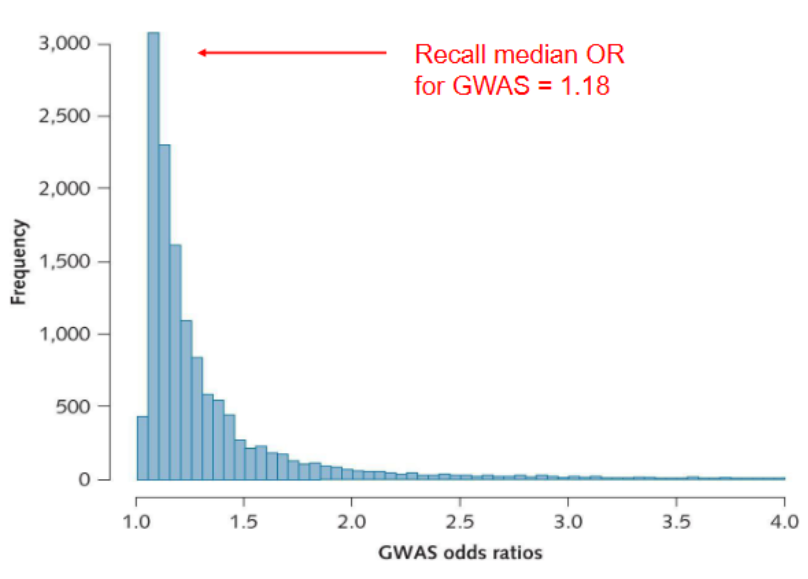
How can determine how large of a sample size is needed to detect risk loci? What is the ideal sample size using these standard values?
Combine statistical power to detect an effect with odds ratio data from GWAS
To achieve 80% power with median OR for GWAS, we would need ~30,000 individuals

What is a consortium?
Associations of two or more individuals (or groups) formed to pool resources and expertise to achieve a common goal beyond the capacity of any single member
Why were consortia so effective?
This change in the “sociology of science,” rather than the methods, led to the first successful genetic dissection of a psychiatric disease
Motivated to pool samples by genuine altruism and pragmatic calculations
How were consortia beneficial for studying schizophrenia?
Three different consortia published GWAS studies on schizophrenia in 2009, but none of these groups found loci that exceeded genome-wide significance threshold
Combined sample size of 8,008 cases + 19,077 controls yielded significant locus on chromosome 6
What is the chromosome 6p22.1 locus?
Located on 3 Mb stretch of p (short) arm of chromosome 6 in European-ancestry samples
4-7 Mbp long, >200 genes
In region of genome called major histocompatibility complex
Include human leukocyte antigen (HLA) genes
What is the major histocompatibility complex?
Set of highly polymorphic genes on chromosome 6 involved in immune function
What are human leukocyte antigen (HLA) genes?
Genes that encode group of cell surface proteins that act as markers to help the immune system identify pathogens
Who was Dr. Petter Visscher? What his main contribution to the field?
Australian geneticist, member of the International Schizophrenia Consortium
Used principles of agricultural genetics, in which genotypes are used to predict phenotypes instead of genome-wide significance measures
Why was Dr. Peter Visscher’s approach useful?
Many variants which fail to meet genome-wide significance could still influence a trait
What are polygenic risk scores?
Statistical calculations of individual’s inherited susceptibility to specific disease or trait based on aggregating effects of thousands of SNPs

What are the assumptions made by polygenic risk scores?
Disease/trait has polygenic basis of inheritance
Effects of variants in one population predicts disease in another

How do we calculate polygenic risk scores?
Requires a training sample and test sample:
Using training sample, choose set of genetic variants (“markers”) for analysis based on cut-off
Typically based on P-values from a GWAS (e.g., P < 0.50)
Increasing number of markers generally leads to increase in prediction accuracy of PRS
For each genetic marker, determine:
Magnitude of association with disorder
Identity of variant that increases risk
Sum effects of each variant and determine how well score predicts disease in test sample
What did polygenic risk scores first tell us about schizophrenia?
PRSs predicted 3% of variance in risk for schizophrenia in test sample from Molecular Genetics of Schizophrenia cohort
But, PRSs did not predict risk in six other disorders from the WTCCC (consortium)

What were the lessons we learned from first using PRSs to study schizophrenia?
Maximum predictive power included genetic markers with PT < 0.50
Significant cross-disorder predictions with bipolar disorder

What do modern day polygenic risk scores look like?
PRSs have become a standard tool in behavioral genetics
Significant effects can be obtained using relatively small sample sizes (< 100 individuals)
Can calculate SNP-based genetic risk score for each individual person
Also commonly used in social sciences
What are some cautions/limitations of polygenic risk scores?
Accurate and unbiased estimations of all SNPs are difficult to obtain in structured population when environment differences cannot be controlled
Avoid the notion of genetic determinism:
What is genetic determinism?
The belief that genes invariably determine traits and diseases, with little or no influence of environmental factors or individual experiences
What is the difference between genotype relative risk and polygenic risk scores?
GRR - ratio of disease risk in individuals with a single, specific genotype compared to those without it
Best suited for studying monogenic traits or highly penetrant genetic variants
PRS - statistical calculation of an individual’s inherited susceptibility to a specific disease or trait based on the cumulative effects of thousands of SNPs
Best suited for studying complex, polygenic diseases
How do genotype relative risk and polygenic risk score relate/interact?
GRRs are the building blocks of PRSs
In GWAS, GRRs are calculated for each individual SNP
PRSs are the sum of the GRRs of all risk alleles
What was the psychiatric genomics consortium (PGC)?
Group of researchers that grew out of Genetic Association Information Network (GAIN) initiative at NIH
What were the 3 core principles of the PGC?
Open, inclusive, participatory, and democratic science
Use of rigorous methodology and commitment to producing robust, replicable, and secure findings
Meta-analysis framework: all members share raw genotype data to ensure samples are processed using uniform quality control, imputation, and analysis pipeline
What was a critical limitation to the meta-analysis framework of the PGC?
Collaboration was established after component studies were performed
What were the 6 working groups of the PGC?
Major depression
Attention deficit hyperactivity disorder (ADHD)
Schizophrenia
Bipolar disorder
Autism
Cross-diagnostic group
How did PGC help with the study of schizophrenia?
PGC continued to grow and data analysis became more complex
Introduced “data freezes”
What are data freezes?
Researchers waited to standardize samples until sample size increased
What is the sign test?
Statistical test for comparing two related samples that uses direction of change between paired observations, rather than numerical differences
Used to assess agreement of individual markers across samples
For schizophrenia, ~70-80% agreement across moderately significant sets of markers
What were the findings of the first data freeze in 2013?
108 significant, independent loci identified
Chromosome 6 locus first identified in 2009
Locus is absent in East Asians, suggesting that genetic basis of schizophrenia is not entirely conserved among different populations
Results are consistent with Fisherian polygenic model: of many potential risk loci, only some fraction may be needed to cause disorder

What were the findings of 3C and TWAS on schizophrenia?
Chromosome conformation capture (3C) identified 500 genes associated with schizophrenia in regulatory regions of cerebral cortex in fetal brain tissue
TWAS identified 157 unique genes, most of which were associated with splicing variants of chromatin phenotypes
Of the 108 loci from the PGC GWAS, 47 were located near at least one of these genes
What conclusions were drawn about schizophrenia from all the research that was done with the help with PGC?
Schizophrenia is a disorder of the developing brain
One SNP from 3C study lies in regulatory region of a dopamine receptor, DRD2
Other genes involved in synapse function, gene regulation, and developmental processes
What was the issue with the discovery of the 108 loci?
They explained the polygenic nature of schizophrenia, but they only explain 3% of the heritability
What is the missing heritability problem?
The difference between heritability estimates obtained from twin/family studies and the lower phenotypic variance explained by significant GWAS loci
Eg. twin/family studies have shown human height is 80% heritable, but 180 significant GWAS loci explain less than 10% of heritability
What is heritability?
The proportion of variation in a phenotype due to genetic differences among individuals in a population
Heritability is a population (not individual) concept
Is dependent on environment and can change over time
Why does the missing heritability problem arise?
SNP heritability is ~50% less than that of twin/family studies
Twin and family studies capture all contributions to heritability, regardless of allele frequency
Microarrays only capture common SNPs
Suggests that less than half of heritability is explained by common variants
How did we solve the missing heritability problem?
Researchers combined quantitative and molecular genetic techniques to assess SNP heritability
What are the 2 primary methods for estimating SNP-based heritability?
Genomic relatedness matrix restricted maximum likelihood (GREML)
Linkage disequilibrium score regression (LDSC)
What is GREML?
Genomic relatedness matrix restricted maximum likelihood - statistical method for estimating SNP-based heritability based on principle that everyone with a heritable disease will share more of their genome than a cohort of people without the disease
Detects and estimates extent of this shared component to calculate how heritable a disease is
Uses all genetic markers, regardless of significance
What is LDSC?
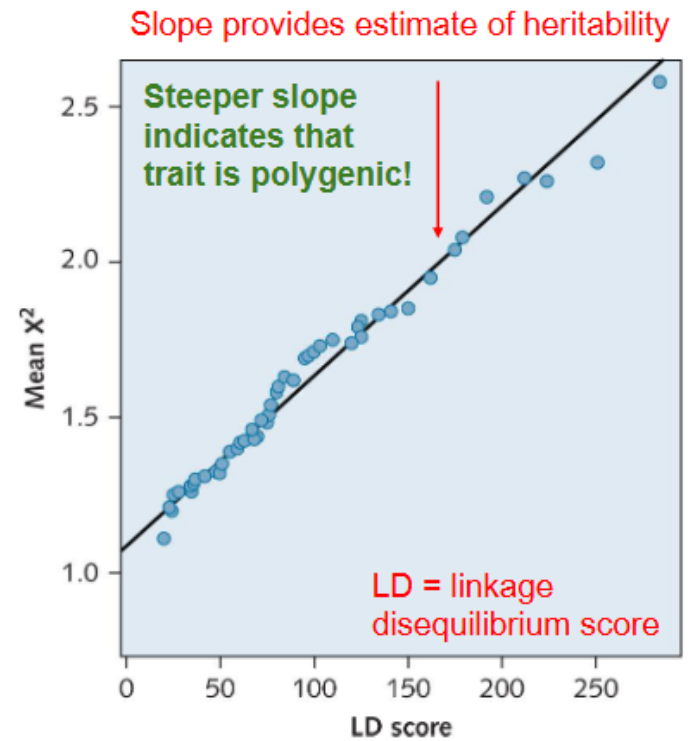
Linkage disequilibrium score regression - statistical method for estimating SNP-based heritability that measures extent to which genetic markers are in linkage disequilibrium (LD) with their neighbors
Similar principle to GWAS QQ plots
For a genetic marker, the amount of inflation (deviation from expected value) depends on the extent of LD with the causal variant
Estimate LD score for each genetic marker and compare with association statistic (χ2) from GWAS
What are some extensions to SNP heritability methods?
Genetic correlations
Estimating heritability attributable to regions of the genome
How are genetic corrections used to extend SNP heritability methods?
GREML used to determine genetic relationships between psychiatric disorders
How does estimating heritability attributable to regions of the genome extend SNP heritability methods?
Allows researchers to answer questions about relative contributions of different functional parts (cell types and tissues) to risk of developing disease
How are polygenic risk scores related to SNP heritabiltiy?
PRS ≠ SNP heritability!
PRSs estimate how much of disease risk can be predicted from known risk factors in individuals
Genetic relationship matrices (SNP heritability) assess contribution of heritability (genetic correlation) of a disease within a group
What is the most likely explanation for the missing heritability problem?
Most parsimonious explanation is missing heritability is hidden in lower frequency variants of relatively small effect
“Schizophrenia is highly polygenic: the genetic architecture consists of risk loci with allele frequencies from across the entire spectrum, from very common to very rare”
How do structural variations impact an individual?
Suggested that structural variants can contribute to risk of psychiatric disease
What structural variations are seen in individuals with schizophrenia?
2% of patients with schizophrenia have deletion on chromosome 22 (22q11.21-q11.23)
~2 Mb deletion, contains 30-40 genes (not well-characterized functionally)
Flanked by copy-number variants
What are copy-number variants?
Large repetitive regions that cause misalignment during recombination
What were the key findings about schizophrenia relating to copy-numbe variants?
Excess of CNVs found in schizophrenia cases vs. controls
Effects of deletions on schizophrenia risk much stronger than duplications
8 individual CNVs increased risk of developing schizophrenia
All CNVs were rare (~0.3% of cases)
Individuals with CNVs had higher rates of learning disabilities and seizures

What is exome sequencing?
Approach that sequences all protein-coding regions (exons) of genes in the genome
What were the findings of the family trio study of schizophrenia?
53 family trios (2 unaffected parents + affected child)
51% of cases had at least one de novo mutation
What are 2 key problems in studying schizophrenia using rare variants?
Deleterious mutations occur in normal population more frequently than expected
Mutations in candidate genes are rare
Why does deleterious mutations being more prevalent than expected create a challenge?
Everyone has ~100 deleterious mutations and 20 inactivated genes
Finding an inactivating mutation does not prove causation
Why does mutations being rare in candidate genes create a challenge?
Variants that impact function of important genes are often selected against due to tendency to reduce evolutionary fitness
Requires screening tens of thousands of individuals
What is whole-genome sequencing?
Comprehensive method for analyzing entire genomes
Includes coding and non-coding regions
Captures large and small (and common and rare) variants: SNPs, insertions/deletions, CNVs, and other structural variants
What are the 2 major obstacles to whole-genome sequencing?
Expensive
Challenging data analysis
What does ongoing schizophrenia research look like?
For every 1000 new subjects, 3-4 new loci are found
