BISC205 Topic 3 - part 1
 Call Kai
 Learn
 Practice Test
 Spaced Repetition
 Match
 Flashcards
 Knowt Play
1/27

There's no tags or description
Looks like no tags are added yet.
Name | Mastery | Learn | Test | Matching | Spaced | Call with Kai | Chat |
|---|
No analytics yet
Send a link to your students to track their progress
28 Terms
Unit for osmolarity
Osmolarity of a solute is expressed as molarity, which can be described as moles of solute per liter of solution: mOsm/L

osmolarity of human blood
The osmolarity of human blood is 300 mOsm/L.

net flow of water: iso-osmotic, hyper-osmotic, hypo-osmotic
both solutions are iso-osmotic: water flows equally in both directions to net movement is zero
both each solution has a different osmolarity: net flow of water is from hypo-osmotic to hyper-osmotic

osmoconformer vs osmoregulator
osmoconformer: internal osmolarity nears that of their external environment. if external osmotic conditions change, internal osmolarity changes in parallel. This means their internal osmolarity is iso-osmotic with their external surroundings and they do not regulate their osmolarity.
osmoregulator: maintains internal osmolarity within a narrow range regardless of their environment. this means the animal could have an osmolarity lower or higher than their environment, as they expend energy to control water uptake and loss depending on their surroundings. this controls internal water and solute concentration

examples of osmoconformers
1.) sea squirts/tunicates: spend most of their life attached to a solid surface
2.) marine mollusks: clams, scallops, mussels
3.) star fish
4.) barnacles
5.) mussels
6.) jellyfish
7.) sharks
8.) crabs and lobsters

examples of osmoregulators
1.) mammals
2.) reptiles
3.) salmon
4.) trout and bass
5.) birds

stenohaline vs euryhaline
stenohaline: animals that can tolerate only a narrow range of external osmolarities
euryhaline: animals that can tolerate a wider range of external osmolarities


label the following as: euryhaline osmoregulator, stenohaline osmoconformer, euryhaline osmoconformer, or stenohaline osmoregulator
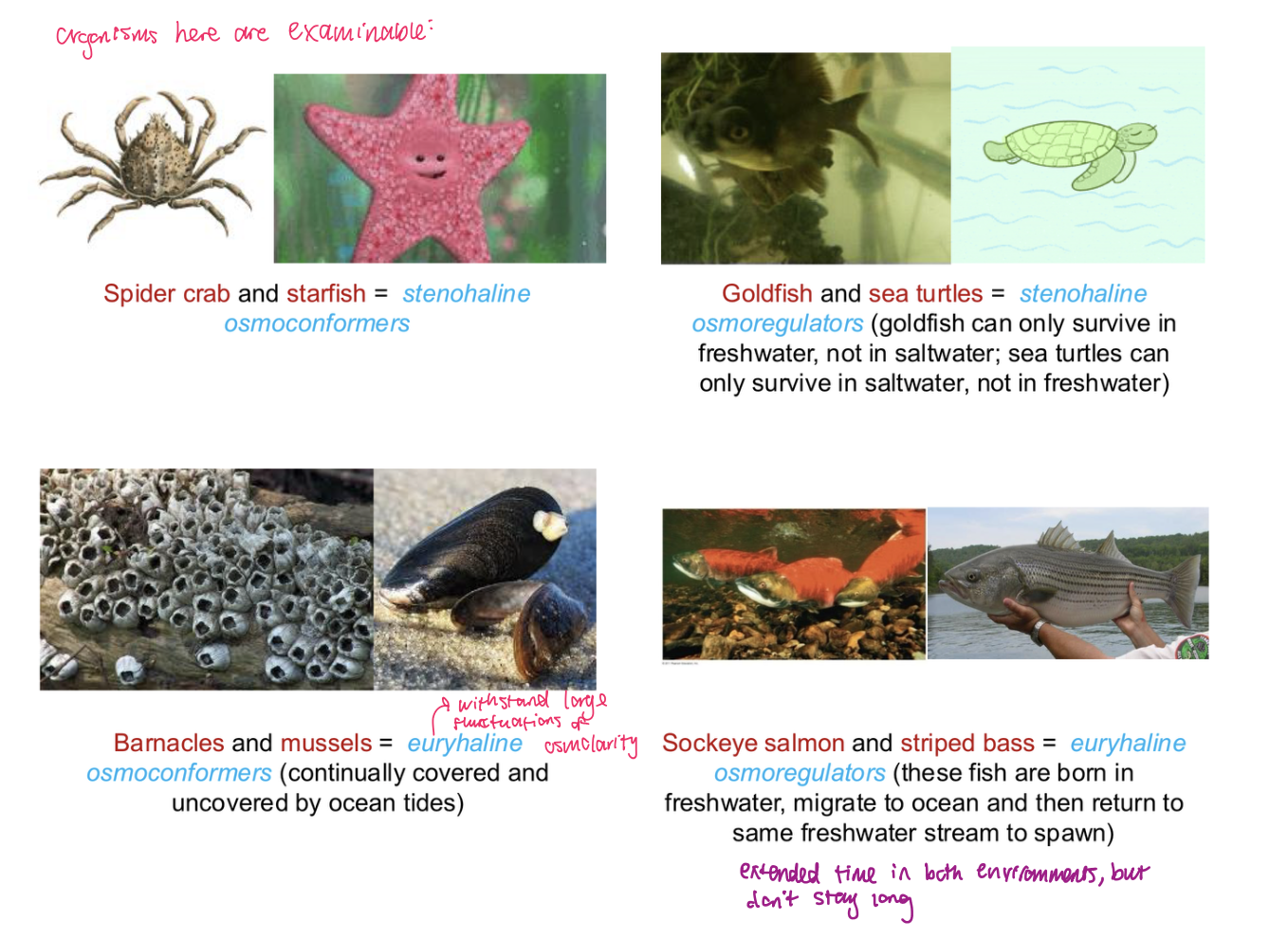
marine fish: are they hypo-osmotic or hyper-osmotic to sea water? what challenges do they face because of this?
they are hypo-osmotic. this means they lose water (through the gill epithelium and other parts of the body surface) and gain salt ions (through drinking seawater/food intake as well as diffusion through gill epithelium)

marine fish: how do they combat water loss?
1.) marine fish gain water from incessant drinking seawater and from food intake.
2.) the kidney excrete highly concentrated urine (this assists in minimizing water loss)

marine fish: how do they combat salt gain?
1.) the kidneys get rid of divalent ions such as Ca2+, Mg2+, and SO4 2-.
2.) the gills actively pump out mainly monovalent ions such as Na+ and Cl- and the bulk of its nitrogenous wastes in the form of NH4+ (ammonium ion)

fresh water fish: are they hypo-osmotic or hyper-osmotic to sea water? what challenges do they face because of this?
they are hyper-osmotic to sea water. this means they need to constantly gain water by osmosis through gill epithelium and other parts of the body surface (as well as food intake) and lose salts (by diffusion across gill epithelium)

freshwater fish: how do they combat water gain?
freshwater do not drink much water and will excrete very dilute urine

freshwater fish: how do they combat salt loss?
these fish can gain salt ions from food intake and by active (needs energy) uptake across gill epithelium

adaptations of water conservation in land animals
1.) body covering that helps prevent dehydration:
waxy layers in insect exoskeletons,
the shells of land snails,
layers of dead keratinized skin cells of most terrestrial vertebrates
2.) being nocturnal
reduces evaporative water loss from the sun
3.) (not really an adaptation) drinking and eating moist foods or recovering metabolic water

transport epithelia (understand for the next card)
specialized epithelial cells that are joined by impermeable tight junctions. these cells regulate solute movement. they are an important part of osmotic regulation and metabolic waste disposal

are seabirds osmoregulators or osmoconformers? how does the salt gland in sea birds use a countercurrent system for excretion of excess salts
sea birds are osmoregulators.
their salt glands contain many secretory tubules which are lined by transport epithelia (regulates salt movement). a counter-current system is set up in which blood flow in the capillaries moves in the opposite direction compared to flow within the secretory tubules. this helps drive the movement of Na+ and Cl- ions from the blood into the secretory fluid within the tubule.

three types of nitrogenous wastes
1) ammonia (most toxic, very water soluble, no energy needed)
2) urea (less toxic, lots of energy needed)
3) uric acid (non-toxic, not soluble, most energy needed)

what are ammonioteles
organisms that excrete ammonium ions (NH4+). Because ammonia can be tolerated at only very low concentrations, they can only be transported and excreted through very dilute solutions (like water). aquatic species are common ammonioteles because they have access to sufficient water for this dilution.

examples of ammonioteles
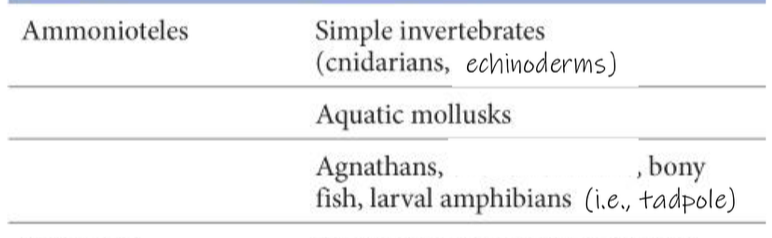
1) simple invertebrates like cnidarians and echinoderms (jellyfish, sea anemones, starfish, sea urchins)
2) aquatic mollusks (mussels, clams, squid, octopus)
3) agnathans (jawless fish) and larval amphibians (tadpole)
what are ureoteles
organisms that excrete nitrogenous waste as urea, which is excreted at the kidneys. these animals need to convert ammonia to urea because it is very toxic, but this is energetically expensive. fortunately, it is not as expensive as uric acid

examples of ureoteles
1) all mammals
2) adult amphibians
3) cartilaginous fish

what are uricoteles
organisms that excrete uric acid or its salts. uric acid can be excreted as paste because it is insoluble in water. it is the MOST energetically expensive to produce from the toxic ammonia, but uses less water to do so.

examples of uricoteles
1) terrestrial mollusks (snails, slugs)
2) terrestrial arthropods (insects)
3) reptiles
4) birds

what are excretory systems
systems which regulate solute movement between internal fluids and the external environment. most produce urine by refining a filtrate derived from body fluids. functions include: filtration, reabsorption, secretion, and excretion

How does the protonephridia filtration system work? this is the excretory system of flatworms
tubes leading outside the body are capped on the inside of the body by a flame bulb, which contains cilia. The beating motion of the cilia provides a pumping action that pulls interstitial fluid through the perforations of the flame bulb. this provides filtration.
these perforations are large enough for small molecules to pass, but larger proteins are retained within the animal

how does the metanephridia filtration system work? this is the excretory system of earthworms
it is a tubular structure inside the worm’s coelom (internal body cavities filled with fluid).
1) the nephrostome (a funnel shaped structure with cilia) draw coelomic fluid and waste products into the tubule.
2) the tubules is surrounded by a network of capillaries that reabsorb useful solutes (sugars and amino acids) from the filtered fluid.
3) the rest of the filtered fluid exits the body through an external pore

how does the Malpighian tubules work? this is the excretory system of insects
they are long thin tubular extensions of the insect gut wall that is surrounded by hemolymph.
1) the transport epithelium that lines a tubule pumps certain solutes, including salts and nitrogenous wastes, from the hemolymph into the lumen of the tubule.
2) the fluid accumulates in the tubules and then passes into the hindgut, where it is dehydrated.
3) this material moves into the rectu* and gets excreted as concentrated urine through bum hole.
