Money and interest rates
 Call Kai
 Learn
 Practice Test
 Spaced Repetition
 Match
 Flashcards
 Knowt Play
1/26

Earn XP
Description and Tags
L8 ECON127
27 Terms
What are the four main functions of money?
Medium of exchange
Means of evaluation - Unit of account
Means of storing wealth - maintain purchasing power for the future
Means of establishing value of future claims and payments
What is the narrow definition of money?
The physical cash that you have.
What is the broad definition of money?
The deposits in your bank account, money in a current account where it is your money but u just withdraw
What is the monetary base?
Cash in circulation plus central bank reserves.
What is broad money?
Cash plus deposits.
What are central bank reserves?
Deposits held by commercial banks at the central bank, used for settling payments and maintaining liquidity. They form part of the monetary base. They control the money supply.
How can retail banks influence the money supply?
By expanding deposits through credit creation.
What is a liquidity ratio?
The proportion of a bank's total assets held in liquid form.
What is the bank multiplier?
Bank multiplier = 1/L, where L is the liquidity ratio.
What happens to £10bn deposited into a banking system with a 10% liquidity ratio?
It can ultimately create up to £100bn of deposits through multiple rounds of lending.
What is the money multiplier?
m = deltaMs/deltaMb = (deltaD + delataC)/(deltaR + deltaC)
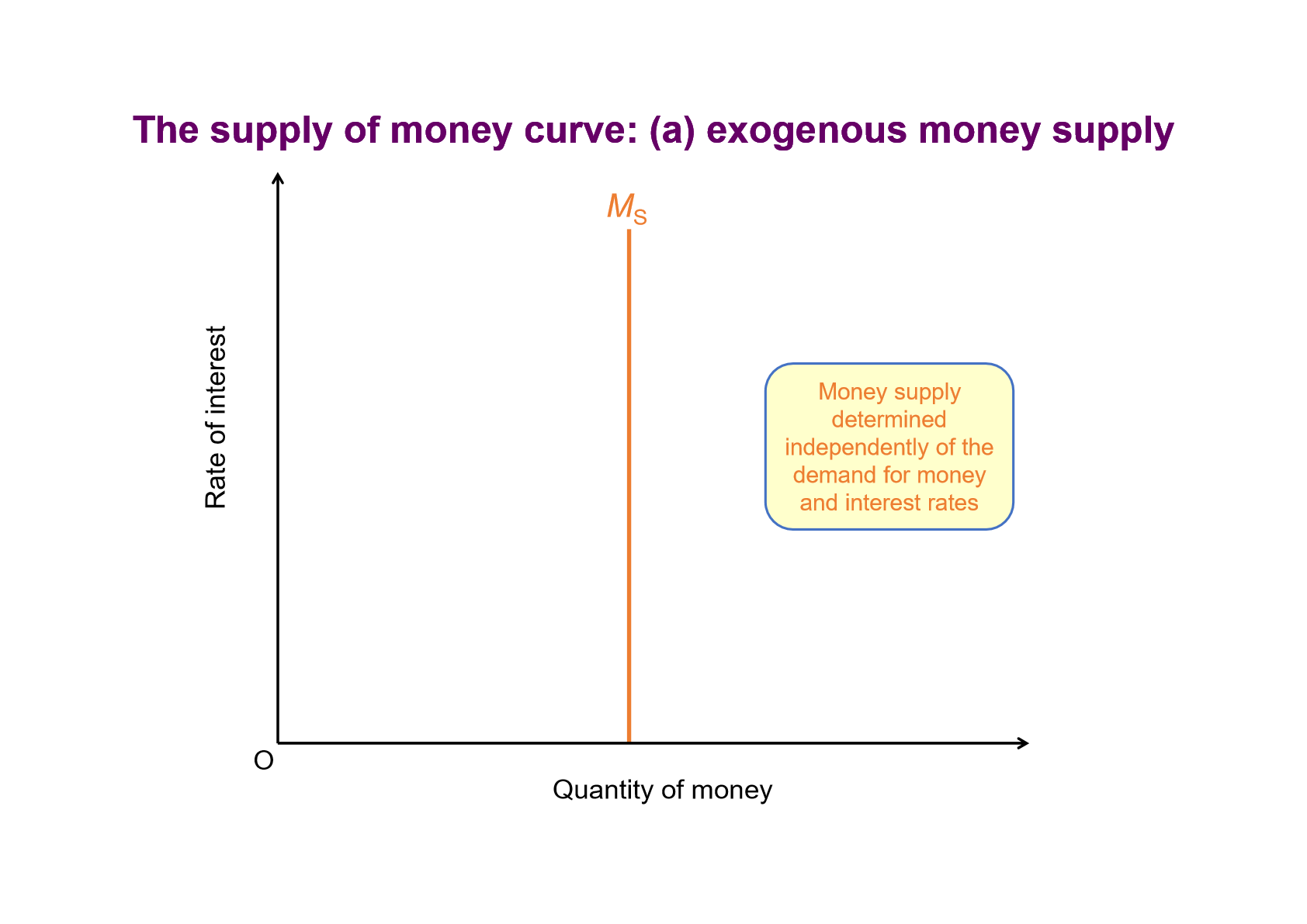
What is an exogenous money supply?
A money supply determined independently of money demand and interest rates. Represented by a vertical money supply curve.
What is an endogenous money supply?
A money supply that depends partly on the demand for money and interest rates.

Give three reasons why the money supply may increase under an endogenous system.
Banks accommodate higher credit demand
Depositors switch to less liquid assets
Inflows of funds from abroad
What are the three motives for holding money?
Transactions motive - just so that you can make these.
Precautionary motive
Asset/speculative motive
What factors determine the demand for money?
National income
Frequency of payment
Financial innovations
Expectations about future asset returns
Interest rate
The demand for money curve when high interest rates and low interest rates.
Rate of interest is low - keep most money in more liquid form
Higher interest rate - put in to a savings account.
They are inversely related; as interest rates rise, demand for money falls.

What is monetary equilibrium?
The point where money demand equals money supply, determining the equilibrium interest rate.

What happens when there is a surplus of money?
Interest rates tend to fall until equilibrium is restored.

Describe the interest-rate transmission mechanism. - effect of interest rates of the rise in money supply
Money supply ↑ → Interest rate ↓ → Investment ↑ and Saving ↓ → National income ↑.
(shifting the Ms to the right) so lower interest rate.
Describe the exchange-rate transmission mechanism.
Money supply ↑ → Interest rate ↓ → Exchange rate ↓ → Exports ↑ and Imports ↓ → National income ↑.
Expenses increase, lower savings so, injections are higher, lower withdrawals, so Y increase therefore more put back into firms. So therefore higher national income.
Lower saving so more consumption, more into firm, more orders, higher income, therefore increase.
What effect does an increase in money supply have on aggregate demand through the interest-rate channel? - effects of changes in investment and saving on national income
Money supply ↑ → Interest rate ↓ → Investment ↑, Saving ↓ → Aggregate demand ↑.
Will spend more money on buying things as cheaper, wont save as much as interest rates are low, also loans pay back will be lower. So make sense in buying at this time.
Cheaper to borrow when rates are low
What effect can an increase in money supply have on GDP and prices?
It can increase aggregate demand, GDP, and prices.

learn this
.
What is the equation of exchange?
MV=PY
M = Money Supply
C = Velocity of circulation
P = Price level
Y = Real value of output at base-year prices
What is the quantity theory of money? And when does it hold?
The theory that links the money supply to the value of output and prices through the equation of exchange.
When velocity of circulation (V) and real output (Y) are determined independently of the money supply (M)
What are the two monetary transmission mechanisms?
Interest-rate transmission mechanism
Exchange-rate transmission mechanism