Salivary glands and ducts - lecture
 Call Kai
 Learn
 Practice Test
 Spaced Repetition
 Match
 Flashcards
 Knowt Play
1/30

There's no tags or description
Looks like no tags are added yet.
31 Terms
What is the only way to tell the difference between the salivary gland and the pancreas histologically
Only ther islets of langerhan, same secretions, they look the same and exocrine in the same way. just have a diff structire..
What ate the 4 key salivary glands to note in the dog and cat
Parotid
zygomatic (carnivore)
mandibular
subllingual glands
Major glands will exit vua one large duct, smaller glands may have multiple shorter openings…

What is the structure that produces saliva and what type of cells are present.
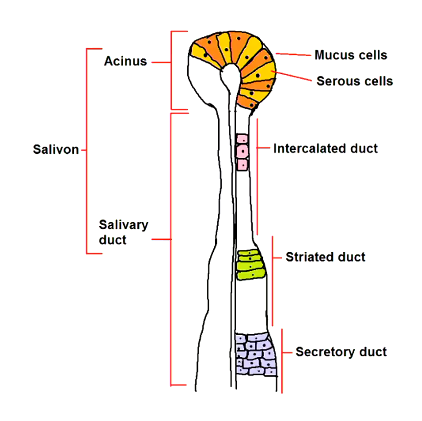
A salivon will produce saliva
contains serous cells - watery serum and mucus cells - mucus
Ratio of serous to mucus glands varies by gladna nd species, therefore producing different consistencies of saliva…
(the bulb at the top = the acinus)

What are the key cells which make up the salivon …
Serous cells - watery secretio
mucus cells - mucus secretion
Plasma cells -- produce IgA
Myoepithelial cells — envelop each acinus - squeeze os saliva comes out prior too eating/ smelling favourite food etc
intercalated ducts - secrete HCo3- and absord cl-
striated ducts — Secrete K+ and HCo3- and absorb Na +
secretory — convey saliva to the mouth
What is in the contents of the slavia once it is produced
high bicarbonate and high potassium
small amounts of electrolytes, proteins, amatlase, lymphocytes and mycin.
primary secretion - from epithelial cells in the acini
hypotonic - electrolystes move in via osmosis..

What can happen with faster flow rates of saliva
LEss time between primary secretion and excreteion, therefore less modification..
slower the flo = more hypotonic as more carbonate has been activly moved in, therfore has the function to remove acidity, this process also increases the potassium concentration. Due to potassiums relationship with sodium, the sodium concentration will then decrease

What are the variations in salivary secretions
e/g/ carnivores havemore of a mucus secretion, e.g. need a coating for bones etrc..

What is the composition and function of saliva..
Water —> mositen food and dissolves food eases mastication and swallowing
lubrication —> mucose _ removes food debris and microbones ,, IgA antivoides help destroy pathogens
AMylase — chem digestions…
BICARBONATE —> buffering, stops ph becoming too acididc. AT ph 6.5 dentine will dissolve..

what are the biochemial pasts compostion and functions of saliva…
Phosphate buffer — aids healthy microbial growth
Hydroxyapatite — contains calcium ions to maintain the enamel (+ this mineralised dental plaque causing calculus)
Salivary mucoproteins act with other agent + increases the surface tension
Saliva can form a peroxide based antibiotic to limit bacterial ingestion.

How much saliva does a cow produce per day…
approx 150 litres
a human will produce 1.5 l/ day
Ptyalism = the production of more than normal slaiva for that species
(can also get it stuk….)
What responses will the salivary glands have to parasympatheteic vs sympathetic stimulation….
sympathetic — viscouse amylase and more protien - dry
Parasympathetic — Watery and highervolume - increased response too taste, visual + olfactory stimuli…
Reflex— autonomic = taste and smell and can also have indirect conditioned responses…
Why is it important too block the parasympathetic nervouse system in aneathetic
can use atropine, this will lower saliva production. If this does not happen then the saliva production will be too high it may block theur own airways..
What is the autonomic nerve supply to the salivary glands…
Supply reaches via arterial supplies..
travel allong trigeminal nerves thi will include the mandibular and the parotid glands.. e.g… ‘Hitching a ride’ on the trigeminal nerve. There is no endocrine controle of the salivary gands.


what are the key salviaary glands
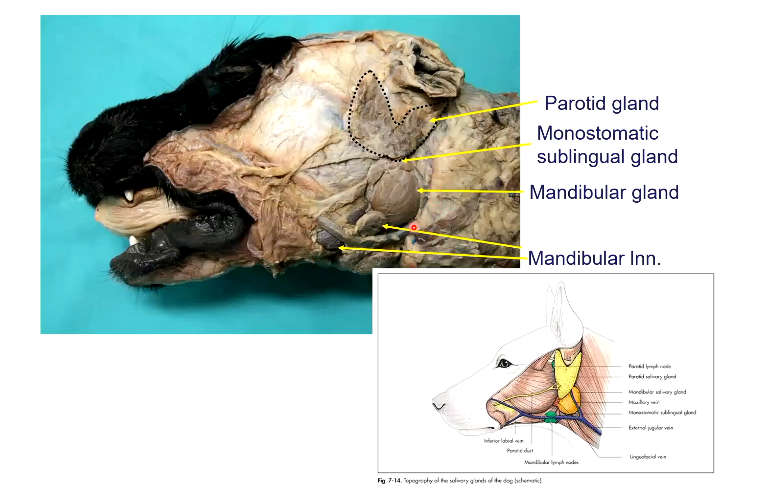
What is the structure of the parotid gland
Salivary glands + ducts

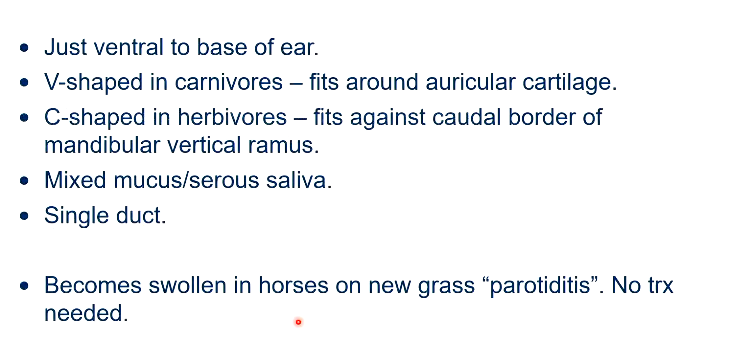
Parotid gland + duct


PArotid duct
What is parotiditis
Beginine mass in theh parotid gland - shows visibly.. Can be extensive, no issue too horses.
OCcours form a CHANGE in grazing..

Zygomatic gland
only in carnivores
Duct opens in upper buccal mucosa opposite the first molar tooth
duct = caudal to the parotid duct
1-4 ducts twhich come out…

Mandibular and Sublingual glands
has multiple ducts leading from the primary gland.. Monostomatic part of SLG nect too MG and has a long duct
many ducts under the tongue - sublinguial galnd, THERE is 2 part sof the sub lingual gland - monosomatic duct AND the monosomatic u

Mandibular glands..
The monosomatic part of the sublingual gland is attatched to the mandibular gland

What is a caruncle
fusion of salviary ducts where slavia is released under the tongue

Monor salivary glands
Buccal and palatine glands - tiny salivons thorugout the mucosa - respond in the same way….
What is prehension
food into mouth, different methods, e.g. suction beak dipping + active prehension
HOw to mammels swallow
impossible for them too swallow and breath at the same time..
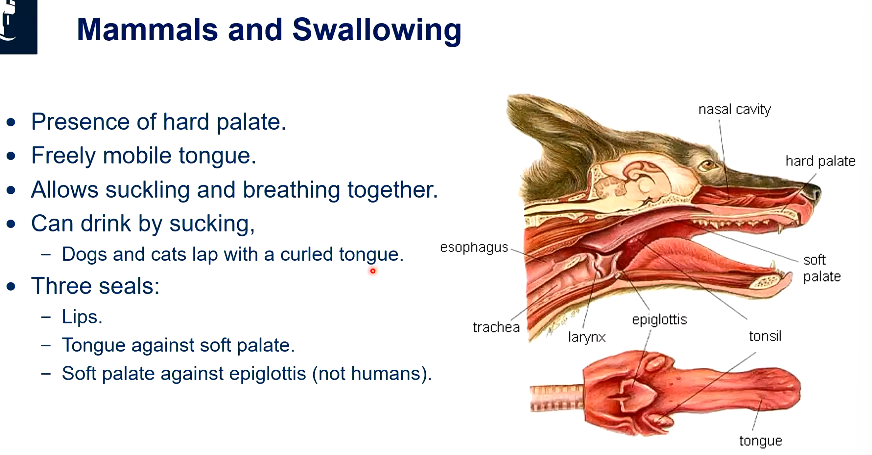
What is the process of swallowing…
food, mouth pharynz , oesophagus stomch
registered in the medulla oblongata
can become a natural reflex
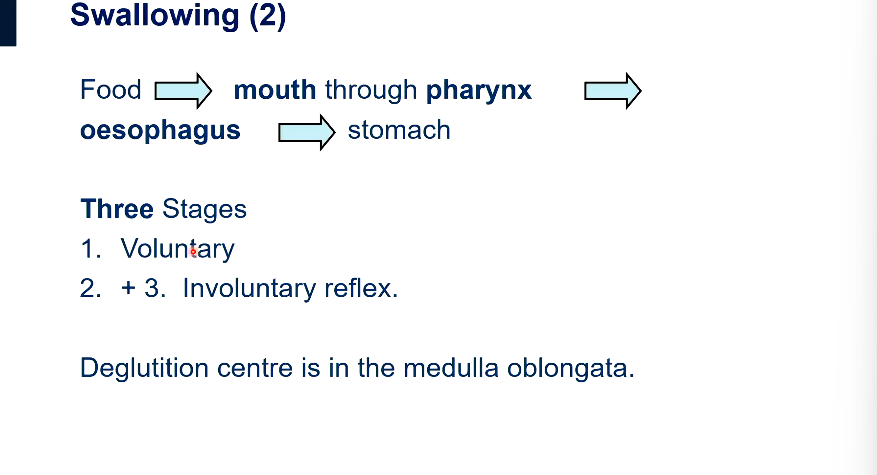
STAGES of SWalloing —- LEARN!!

STiomach tubing importatn info..
tap tube on pharynz then horse will swallow and horse will swallow the tube..

What is a palatal ostium
soft palate seals off the oropharny from the laryngopharanx…
Therefore intubation can be very difficuft ar cannot push down
intubation impossible
What is teh difference betweeen regurigtation and vommiting
regurgitation is a passive process (less activate than vommiting
this is normal for many ruminants, dogs feeding weaned pups and birds deeding young..