Bio 210 Exam 3 prep
 Call Kai
 Learn
 Practice Test
 Spaced Repetition
 Match
 Flashcards
 Knowt Play
1/228

Earn XP
Description and Tags
Prof. Greg Tyson CSUMB
229 Terms

At what part of the cell cycle would you see a chromsome that looks like this?
M
It is difficult to observe individual chromosomes with a light microscope during interphase because___
They have relaxed to form long, thin strands

Which phase of the cell cycle is this?
Prophase

Which phase of the cell cycle is this?
Anaphase
In some organisms such as certain fungi and algae, cells undergo the cell cycle repeatedly WITHOUT cytokinesis. What would result from this?
Large cells containing many nuclei
Which of the following correctly matches a phase of the cell cycle with its description?
G1: Follows cell division
Mitosis results in the formation of ___ ; meiosis results in the formation of ___ .
Two diploid cells; four haploid cells

What phase of meiosis is this?
Anaphase two
Which process is unique to eukaryotes, without an analogue in prokaryotes?
Meiosis
A cell in G2 has 4.8 pg of nuclear DNA. In G1, this cell had ___ pg of nuclear DNA.
2.4
Imagine that there are mutations in the CDK genes such that their gene products are nonfunctional. What effect would this mutation have on an immature unspecialized blood cell precursor found in the bone marrow?
The cell would not be able to reproduce itself
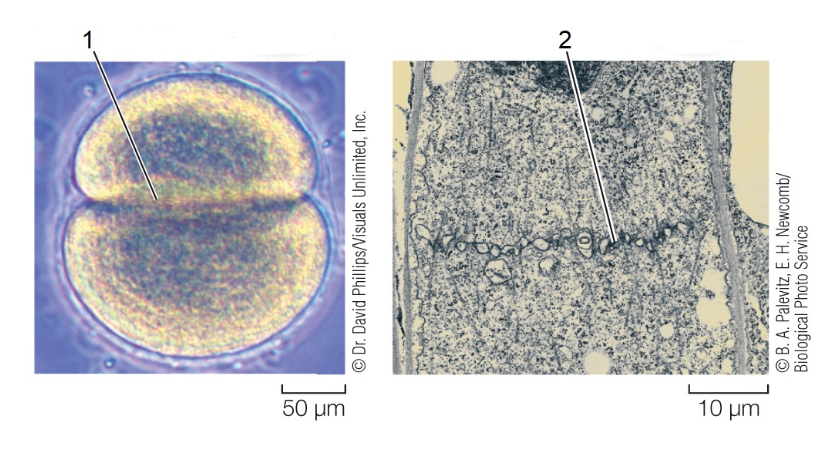
Image 1 could be of (a) dividing___, and image 2 could be of (a) ___. A major difference between the process shown in the images is that ___.
sand dollar egg; dividing cells in a lily plant; the plant cell does not have a ring of actin and myosin pinching the cell inward
A cell in G2 contains 36 sister chromatids. This same cell in G1 would have
18 sister chromatids
In most sexually reproducing organisms, the diploid phase of the life cycle begins at
fertilization
If the haploid number of a mammalian cell is 32, there will be ___ sister chromatids during metaphase of mitosis
128

what is this showing?
a cell in meiosis 1 after crossing over has occured, and this will result in genetic diversity in the daughter cells that form
In meiosis 2,
sister chromotids are seperated
Necrosis is
a form of cell death that occur due to an enviromental insult
assume that blending inheritance, not particulate Mendelian inheritance, is operating in a life form. An individual with a tail that is 10 cm long is crossed with an individual that has a tail 2cm long. Assuming that tail length is inherited and there is no environmental input, what would the expected tail length be in the F2 progeny?
All individuals would have tails that are 6 cm long
suppose white and brown fur in a species of rodent were due to different alleles at the same gene. An F1 cross between true bleeding brown and white lines is set up. What evidence would best support white fur being dominant to brown?
the F1 offspring are all white
the cross AaBb x AaBb is an example of a___ cross. That segregation of what are now called alleles at the A locus are not affected by the segregation of alleles at the B locus led Mendel to propose what we now call the law of ___.
dihybrid; independent assortment
What fraction of offspring of the cross AaBb x AaBb would be homozygous for both the dominant alleles, assumign that they are on different chromosomes?
1/16

What inheritance pattern is most likely, and why?
The trait is autosomal recessive because unaffected individuals have affected progeny
What distinguishes pleitropy from dominance, codominance, and incomplete dominance?
Pleiotropy involves more than one character, while the others do not
A woman has B blood type of the ABO system. Her mother is type O. From this, we can infer that her father
could not have O blood type
you have chosen to study the genetics of snapdragon flower color. True- breeding red-flowered plants crossed with true-bleeding hite-flowered plants generate all pink-flowered F1 offspring. When the F1 offspring are crossed, you get the following numbers of F2 offspring: 24 red, 54 pink, and 22 white. You interpret this inheritance pattern as
incomplete dominance
Genes located on mitochondrial DNA are usually inherited
from the mother
If bacteria could not undergo conjugation, they
would not be able to generate as much diversity
Cell
The smallest unit of life
Mitosis
Cell division that produces two genetically identical daughter cells
Somatic Cells
Non- reproductive body cells
Gametes
Reproductive cells, such as eggs and sperm
Ploidy
The number of complete chromosome sets in a cell
Diploid (2n)
Having two sets of chromosomes, one from each parent
Haploid (n)
Having one set of chromosomes
Genome
All of an organisms genetic material
Chromosome
A single DNA molecule
Chromatin
DNA and associated proteins
Interphase
The period when a cell grows, performs normal functions, and replicates DNA before division
Mitotic (M) phase
The part of the cell cycle that includes mitosis and cytokin
G1
The first growth phase of interphase
S
The phase in which DNA is replicated (during interphase)
G2
The second growth phase, when the cell prepares for division
Centromere
The chromosome region where sister chromatids are attached and spindle fibers connect
Based on a particular genotype, you expected that a flower would be orange, but instead it is white. Which is NOT a special situation that can impact phenotypes?
Law of dominance
Relaxed chromosome
A loosely packed chromosome that is accesible for gene expression and DNA replication (together looks like a bowl of spaghetti)
Condensed chromosome
A tightly coiled chromosome visible during cell division
Unreplicated chromosome
A chromosome made of one DNA molecule and one chromatid
Replicated chromosome
A chromosome made of two identical sister chromatids
G0
A nondividing state where a cell leaves the cell cycle
Cyclin- dependent kinases (CDKs)
Enzymes that regulate cell-cycle progression when activated by cyclins
Growth factors
External signaling molecules that stimulate cells to grow or divide
Spindle fibers
Microtubules that move and seperate chromosomes during cell division (the “ropes” that pull chromosomes apart)
Centrosome
A microtubule-organizing center that helps form the spindle
Prophase
Mitosis stage when chromosomes condense, nucleus dissolves, and the spindle begins to form
Metaphase
Mitosis stage when chromosomes line up at the cells equator
Anaphase
Mitosis stage when sister chromatids seperate and move to opposite poles
Telophase
Mitosis stage when new nuclear envelopes form around seperated chromosomes and the cell is almost split into two
Cytokinesis
Division of the cytoplasm to form seperate daughter cells
Cleavage furrow
An indentation that pinches an animal cell into two during cytokinesis
Cell plate
A structure that forms a new cell wall between daughter cells in plant cytokinesis
Binary fission
Cell division in prokaryotes that produce two genetically identical cells
Checkpoints
Control points that verify whether conditions are suitable for the cell cycle to continue
Cancer
A disease in which cells divide uncontrollably and may invade other tissues
Meiosis
Two rounds of cell division that produce four genetically distinct haploid cells
Autosome
Any chromosome that is not a sex chromsome
Sex chromosome
A chromosome involved in determining biological sex, such as X or Y in humans
Gene
A DNA sequence that contains instructions for a specific protein
Allele
An alternative version of a gene
Sister chromatids
Identical copies of a replicated chromosome joined at the centromere
Homologous chromosmes
Chromosome pairs witht he saem genes in the same locations, one inherited from each parent
Independent assortment
The random orientation of homologous chromosome pairs in meiosis 1, creating varied gametes
Crossing over
Exchange of DNA between homologous chromosomes during prophase 1 of meiosis
Random fertilization
Random union of one egg and one sperm, increasing genetic variation
Nondisjunction
Failure of chromsomes or sister chromatids to seperate correctly durign cell division, resulting in aneuploidy
Aneuploidy
An abnormal number of individual chromsomes in a cell
Necrosis
Uncontrolled cell death caused by injury or damage
Apoptosis
Programmedm controlled cell death

Which is true about these rabbits?
The albino allele is recessive and Dark grey rabbits have more possible genotypes than albino rabbits
A childs parents both have heart disease. What can this tell us about the childs risk?
The child has an increased risk but may not develop it
What determines sex in humans?
sperm
When two genes are on the same chromosome, progeny sometimes do not exhibit the phenotypes that would be predicted by the law of independent assortment. This outcome can be explained by the phenomenom of…
linkage
Heredity
The passing of traits from the parents to offspring
Blending inheritance
The incorrect idea that parental traits permanently mix in offspring
Particulate inheritance
The idea that hereditary units, now called genes, remain distinct across generations
Genotype
An organisms genetic makeup or allele combination
Phenotype
An organisms observable traits, typically as encoded by a genotype
Locus
The specific location of a gene on a chromosome
P generation
The parental generation in a genetic cross
F1 generation
The first generation of offspring from the parental cross
F2 generation
The offspring produced by crossing or self fertilizing F1 individuals
Law of dominance
One allele may mask the visible effect of another allele
Law of segregation
The two alleles for a gene seperate during gamete formation
Dominant
An allele expressed in the phenotype when at least one copy is present
Recessive
An allele expressed in the phenotype only when two copies are present in simple dominance
Homozygous dominant
Having two dominant alleles for a gene
Homozygous recessive
Having two recessive alleles for a gene
Heterozygous
Having two different alleles for a gene (Typically one dominant and one recessive)
Punnett square
A diagram used to predict possible offspring genotypes and phenotypes
Law of independent assortment
Alleles of different genes assort independently into gametes whent he genes are unlinked (on different chromosomes)