Forest management and conservation
 Call Kai
 Learn
 Practice Test
 Spaced Repetition
 Match
 Flashcards
 Knowt Play
1/24

There's no tags or description
Looks like no tags are added yet.
25 Terms
Which forest management style dominates in Western, Northern, and Southern/Eastern Europe?
Western Europe uses close-to-nature and combined objective forestry. Northern Europe uses intensive forestry. Southern and Eastern Europe are mixed, with combined objective forestry the most common.
What share of Earth's land do forests cover, and how much terrestrial biomass and biodiversity do they hold?
They cover about 30% of land, store about 75% of terrestrial biomass, and host about 80% of terrestrial biodiversity
Name the nine forest management types.
These include silvicultural, conservation-oriented, ecosystem-based, community-based, recreational/aesthetic, fire management, agroforestry, adaptive, and carbon/biodiversity-oriented approaches.
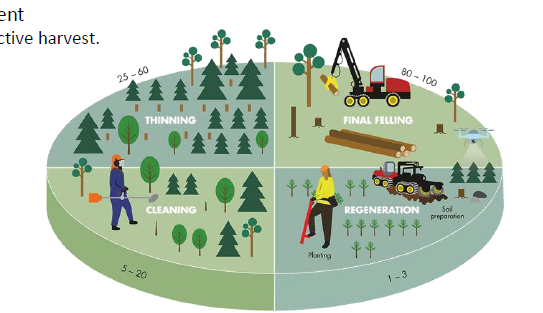
What is silvicultural management?
Planting, thinning, and selective harvest.
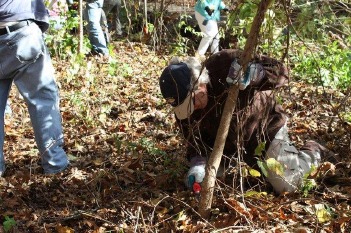
What is conservation-oriented management?
Management that preserves biodiversity and habitats, for example by removing invasive species
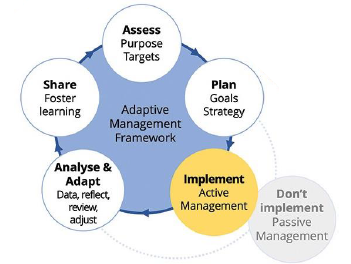
What is adaptive management?
Continuous monitoring and adjusting of management.
Ecosystem-Based Management
Considers the entire ecosystem

Community-Based Forest Management
Involves local communities

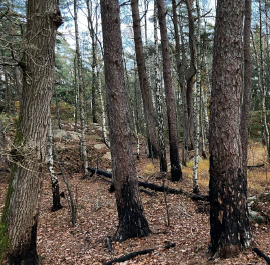
Fire Management
to reduce wildfire risks
Agroforestry Management
trees combined with crops or livestock (€)

Carbon/Biodiversity-Oriented managment
maximize carbon sequestration and storage
What are the key ecological processes behind conservation-oriented management
Succession and disturbance

What are nature-based solutions (NbS)?
Approaches that aim to solve the climate and biodiversity crises while providing benefits to people and biodiversity.

What are the two main types of NbS in forests?
(1) Forest protection (avoidance/reduction of carbon release or biodiversity loss).
REDD+ (Reducing Emissions from Deforestation and Forest Degradation)
Improved Forest Management
(2) Forest restoration (removal/sequestration of carbon from the atmosphare or restoring biodiversity).
Afforestation
Reforestation
What does REDD+ stand for, and which type of NbS is it?
Reducing Emissions from Deforestation and Forest Degradation. It is a forest protection NbS, like Improved Forest Management.
What is afforestation and what are the risks of afforestation?
Establishing forests in areas that were not previously forested.
the consequances are monocultures, trees planted where they shouldn't be, and unintended consequences.
an unintended consequance of afforestation can also be that high-latitude tree planting decreases albedo and disturbs soil carbon pools.

What is reforestation, and what are its pros and cons?
Restoring forests on degraded or previously forested land. It is less uncertain, ecologically informed, and has global potential. However, about half of projects are monocultures, and some use non-native species.

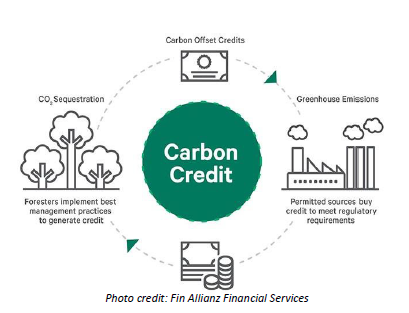
what are carbon markets and what is the aim of them?
Carbon markets are trading systems that put a price on greenhouse gas emissions so governments, companies, and individuals can buy and sell permits or credits to cut pollution cost-effectively
the aim of carbon markets is to reduce greenhouse gas emissions by charging pollutants.
What is a compliance (regulated) carbon market?
A market set up by governments to meet legally binding emission reduction targets. The EU Emissions Trading System is an example.

What is a voluntary carbon market (VCM)?
A market where organizations or individuals voluntarily offset their emissions. Its credits can't be used to meet legal caps unless the regulator explicitly approves them.

What are the three main steps of a forest carbon project?
Delimit and describe the area, quantify and demonstrate baseline, additionality, permanence and leakage, and register the project.
Define baseline and additionality in a carbon project.
Baseline is what would happen in the area if the project didn't exist. Additionality means proving the carbon offset wouldn't occur without the project.
Define permanence and leakage in a carbon project.
Permanence means ensuring the carbon stays sequestered over time. Leakage means deforestation shifting to other areas.
What are the three steps in estimating forest carbon?
Sampling design, tree-level carbon estimates, and forest dynamics (fluxes). Sampling design should balance cost, statistical accuracy, and precision
How is tree biomass estimated?
Biomass is volume times wood density. Because volume is hard to measure, allometric equations estimate biomass from diameter, height, and wood density.