CH 12: Mixed Methods & Other Types of Research
 Call Kai
 Learn
 Practice Test
 Spaced Repetition
 Match
 Flashcards
 Knowt Play
1/43

There's no tags or description
Looks like no tags are added yet.
44 Terms
What is mixed-methods research?
Integrates qualitative and quantitative data and strategies
Can involve a single study or a coordinated set of studies
What type of research question requires mixed methods?
Questions that need both qualitative and quantitative data
Example: Relationship between graduate students' reading comprehension and their perceived barriers to reading research articles
What are the benefits of mixed-methods research?
Complementarity
Practicality
Incrementality
Enhanced validity
What are the purposes and applications of mixed-methods research?
Developmental work
Hypothesis generation and testing
Explication (idea building)
Theory building, testing, and refinement
What are the options for collecting data in mixed-methods designs?
Qualitative data collected first
Quantitative data collected first
Both collected simultaneously (concurrent design)
What is Morse's notation system?
Uses ALL CAPS to show the dominant method
Example:
QUAL/quan
QUAN/qual
QUAL/QUAN
What does the plus sign (+) mean in mixed-methods research?
Data collection occurs at the same time (simultaneously)
What does the equal sign (=) mean in mixed-methods research?
Sequential data collection
Data is collected in phases
One phase informs the next
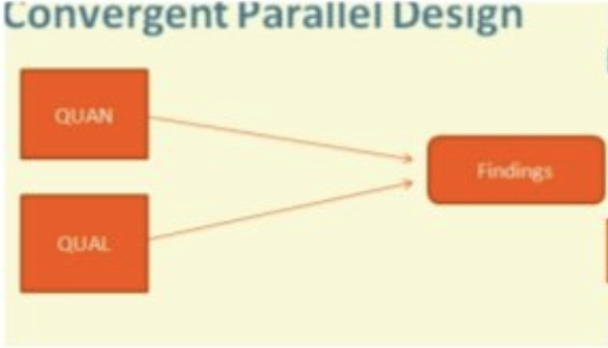
What is a convergent parallel design?
QUAL + QUAN
Both types of data are collected simultaneously
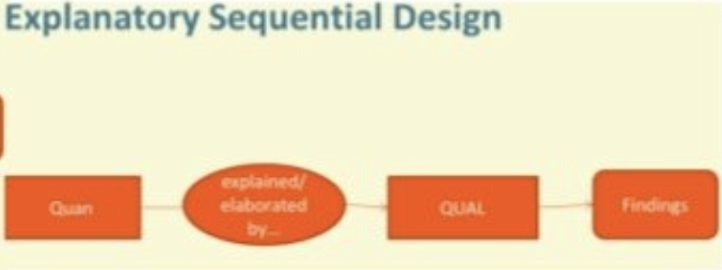
What is an explanatory sequential design?
QUAN → qual
Quantitative data is collected first, followed by qualitative data
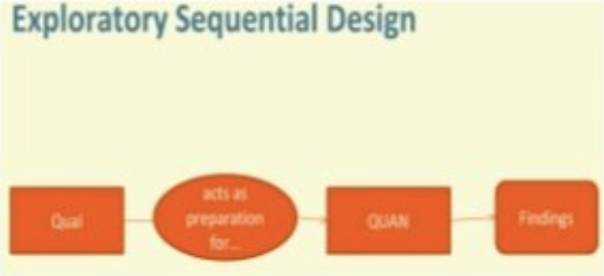
What is an exploratory sequential design?
QUAL → quan
Qualitative data is collected first, followed by quantitative data
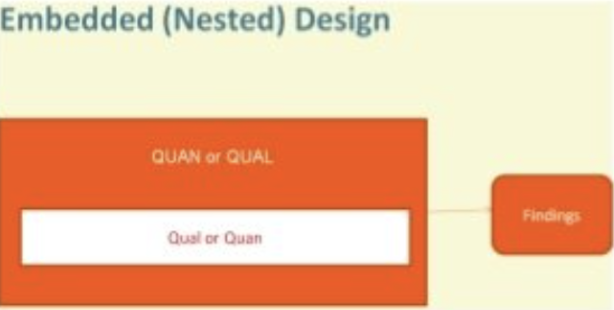
What is an embedded (nested) design?
One research method is placed within another method to support the main study
What is interventional research?
Involves clinical trials
Develops clinical interventions
Tests efficacy and effectiveness
4 phases
What is the purpose of Phase I clinical trials?
Establishes safety
Tests tolerance and dosage
What is the purpose of Phase II clinical trials?
Looks for evidence of effectiveness
Often uses a pilot test with a quasi-experimental design
What is the purpose of Phase III clinical trials?
Fully tests treatment efficacy
Uses a randomized clinical trial (RCT)
Often conducted at multiple sites
Also called an efficacy study
What is the purpose of Phase IV clinical trials?
Focuses on external validity
Tests the intervention in the general population
Emphasizes generalizability
What is evaluation research?
Examines how well a specific program, practice, procedure, or policy is working
What is process analysis?
Gains information about the process
What is impact analysis?
Examines who or what is affected
What is economic analysis?
Determines whether the benefits outweigh the costs
What is nursing intervention research?
Research approach for planning, developing, testing, and sharing interventions
What are the phases of nursing intervention research?
Basic developmental research
Pilot research
Efficacy research
Effectiveness research
What is health services and outcomes research (QA/PI)?
Documents the quality and effectiveness of healthcare and nursing services
What are the three key concepts of healthcare quality?
Structure of care (e.g., nursing skill mix)
Processes (e.g., clinical decision-making)
Outcomes (end results of patient care)
What are nurse-sensitive indicators?
Measures of nursing quality using structure, process, and outcomes
Does QA/PI research typically require IRB approval or consent?
No
Why are QA/PI results not always generalizable?
Uses looser or weaker research methods
What are the characteristics of QA/PI?
Produces fast results
Ongoing process
What is root cause analysis (RCA)?
Tool used to identify the underlying cause of a problem
What is PDSA?
Plan, Do, Study, Act
A method used for process improvement
What is survey research?
Obtains information through self-reports
Examines the prevalence, distribution, and relationships of variables in a population
What information can survey research collect?
People's actions and intentions
Knowledge and characteristics
Opinions and attitudes
What are the two types of survey research?
Cross-sectional
Longitudinal
What are the modes of collecting survey data?
Personal interviews
Telephone
Self-administered
Which survey method tends to produce the highest quality data?
Personal interviews
However, they are very expensive
What is secondary analysis?
Uses previously collected data to answer new research questions
Example: Existing patient medical history
Can secondary analysis use qualitative and quantitative data?
Yes
Why is secondary analysis cost-effective?
Data collection is expensive and time-consuming
Uses existing data instead of collecting new data
What are potential limitations of secondary analysis?
Researcher may not know about data quality problems
May face "if only" issues
What are "if only" issues in secondary analysis?
When the existing dataset is missing information needed for the study
Example: "If only there was a measure of X in the dataset"
What is methodologic research?
Focuses on developing, validating, and evaluating research tools and instruments
Can methodologic research involve qualitative and quantitative data?
Yes
What are examples of methodologic research?
Developing and testing a new data collection instrument
Testing the effectiveness of stipends in improving participant recruitment