Nasal Cavities
 Call Kai
 Learn
 Practice Test
 Spaced Repetition
 Match
 Flashcards
 Knowt Play
1/298

There's no tags or description
Looks like no tags are added yet.
Name | Mastery | Learn | Test | Matching | Spaced | Call with Kai | Chat |
|---|
No analytics yet
Send a link to your students to track their progress
299 Terms
Which bone forms the roof of the nasal cavity, and what passes through it?
Cribriform plate of the ethmoid; olfactory nerves (CN I)
Which bones form the floor of the nasal cavity?
Palatine process of the maxilla and horizontal plate of the palatine bone (the hard palate)
Which part of the septum is formed by the perpendicular plate of the ethmoid?
The superior/anterior bony part
Which part of the septum is formed by the vomer?
The posterior-inferior bony part
Which part of the septum is formed by septal cartilage?
The anterior (flexible) part
Mnemonic for the nasal septum
Perpendicular plate + Vomer + Cartilage (+ small maxillary and palatine crests along the floor)
Which nasal concha is a separate bone, not part of the ethmoid?
Inferior nasal concha
Causes of a deviated septum
Congenital or nasal trauma
Why can a deviated septum cause sinus infections?
It can block sinus drainage
Why do the turbinates increase surface area?
To warm, humidify, and filter inspired air
What forms the ethmoid bulla?
Middle ethmoidal air cells
What opens into the semilunar hiatus?
The frontonasal duct (anteriorly), anterior ethmoidal cells, and the maxillary ostium (posteriorly)
What is the osteomeatal complex, and why does it matter?
The semilunar hiatus/ethmoidal infundibulum region; a blockage here can cause multi-sinus infection
Where does the auditory (pharyngotympanic) tube open?
Lateral wall of the nasopharynx
How do upper respiratory infections reach the middle ear?
Through the auditory tube, causing otitis media
How can enlarged adenoids affect the ear?
They can block the opening of the auditory tube
General sensation to the anterior/superior septum
Medial internal nasal n. (from the anterior ethmoidal n., V1)
General sensation to the anterior/superior lateral wall
Lateral internal nasal n. (from the anterior ethmoidal n., V1)
General sensation to the posterior/inferior septum
Nasopalatine n. (V2)
Function of the parasympathetic fibers to the nasal mucosa
Mucous secretion
Function of the sympathetic fibers to the nasal mucosa
Vasoconstriction
Only preganglionic parasympathetics (greater petrosal) synapse; sympathetic (already postganglionic) and V2 sensory fibers pass through
Which fibers synapse in the pterygopalatine ganglion, and which pass through?
Sphenopalatine foramen
Through what opening do PPG branches enter the nasal cavity?
What can a cribriform plate fracture cause?
Anosmia (torn olfactory filaments) and possibly CSF rhinorrhea
Besides fractures, what else impairs smell?
Inflammation of the nasal mucosa (lateral wall or septum)
Which artery supplies most of the nasal cavity?
Sphenopalatine artery (terminal branch of the maxillary a., from the external carotid)
3 overall arterial sources of the nasal cavity
Sphenopalatine a. (maxillary, ECA), ethmoidal aa. (ophthalmic, ICA), and facial a. (ECA)
4 arteries that anastomose at Kiesselbach's area
Sphenopalatine, anterior ethmoidal, septal branch of the superior labial (facial), and greater palatine
Purpose of Kiesselbach's dense vascular plexus
Cartilage health and warming inhaled air
Anterior epistaxis: source, frequency, treatment
Kiesselbach's area; most common; usually controlled with external pressure
Posterior epistaxis: frequency and treatment
Less common, more blood, harder to stop; usually needs packing
Where does blood from a posterior nosebleed go?
Down the throat (nasopharynx -> oropharynx -> laryngopharynx), where it's swallowed or aspirated
2 functions of the paranasal sinuses
Lighten the skull and provide voice/sound resonance
Memory aid for what drains into the middle meatus
FAMM: Frontal, Anterior ethmoid, Middle ethmoid, Maxillary
Drainage map: superior meatus, sphenoethmoidal recess, inferior meatus
Superior meatus: posterior ethmoidal cells; sphenoethmoidal recess: sphenoid sinus; inferior meatus: nasolacrimal duct
Why does the maxillary sinus drain poorly?
Its ostium is high on the medial wall, so gravity doesn't help
Which sinuses does V1 supply?
Frontal sinus and ethmoid air cells (via anterior and posterior ethmoidal nn.)
Which sinuses does V2 supply?
Maxillary sinus (superior alveolar nn., infraorbital n.) and sphenoid sinus
What is sinusitis, and what causes it?
Inflammation of the sinus mucosa; caused by unresolved rhinitis (colds, allergies) or obstruction (polyps, deviated septum)
Why can maxillary sinusitis mimic a maxillary toothache?
The maxillary sinus and maxillary teeth share V2 innervation (superior alveolar nerves), so pain is referred
Where is frontal or ethmoid sinus pain felt?
Forehead and orbit region (V1)
What is the transsphenoidal approach?
A route through the nasal cavity and sphenoid sinus to reach the pituitary (sella turcica), usually to remove pituitary adenomas
• Beginning of the airway
• Smell
• Filtration
• Humidification and warming inspired air
• Decreasing weight of skull (sinuses)
Function of the Nose, Nasal Cavity and Sinuses:
Nasal bones
Identify the structure at #1

Anterior nasal spine
Identify the structure at #2

Nasal aperture
Identify the structure at #3
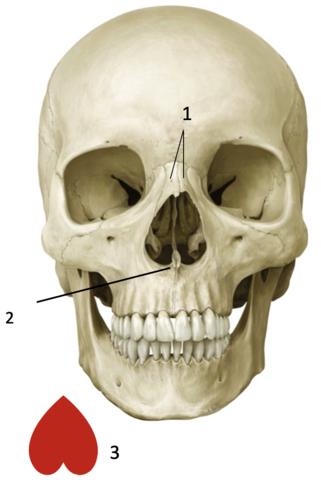
Fibroareolar tissue
Identify the structure:

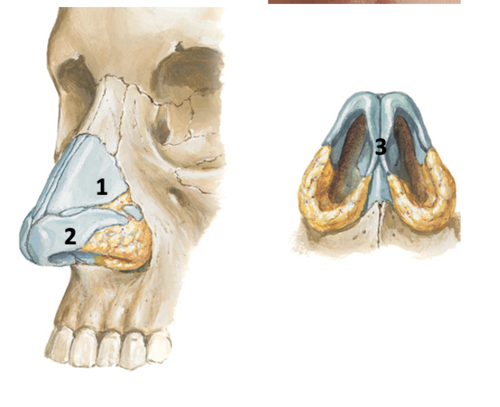
Lateral
Identify the type of cartilage at #1
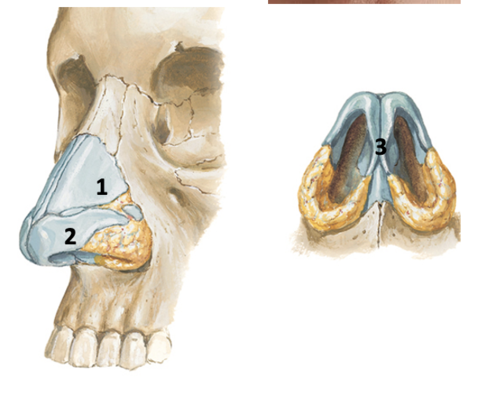
Alar
Identify the type of cartilage at #2

Septal
Identify the type of cartilage at #3
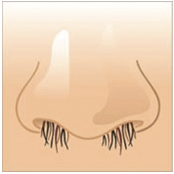
Vibrissae
Identify the structure:
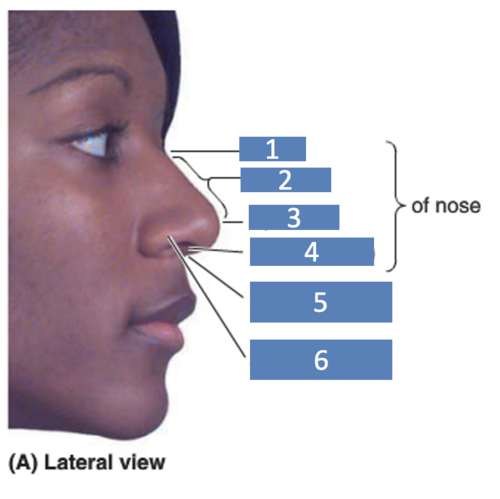
Root of nose
Identify the structure at #1

Dorsum of nose
Identify the structure at #2

Apex of nose
Identify the structure at #3

Naris (nostril) of nose
Identify the structure at #4
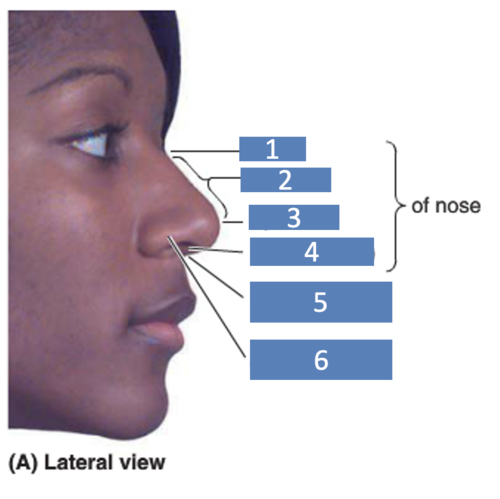
Nasal septum
Identify the structure at #5

Ala of nose (wing)
Identify the structure at #6
Open at nares
Anterior boundary of nasal cavity
Choanae open to nasopharynx
Posterior boundary of nasal cavity
Many bones with conchae
Lateral wall of nasal cavity
Hard palate
Floor of nasal cavity
roof of nasal cavity
separates nasal cavity from anterior cranial fossa
hard palate
separates nasal cavity from oral cavity
Superior, middle and inferior nasal conchae
Identify the structures

Choanae
Identify the structure
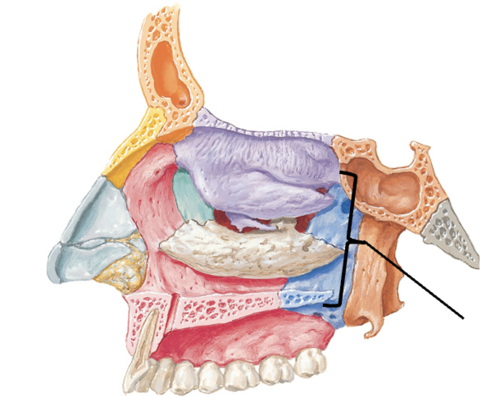
Meatus
Space below each concha is called a...
superior nasal turbinate
identify the structure:

middle nasal turbinate
identify the structure:

inferior nasal turbinate
identify the structure:

Middle meatus
Identify the structure at #1
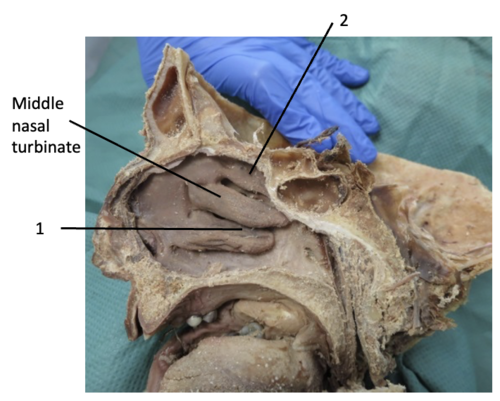
Superior ethmoidal recess
Identify the structure at #2

Olfactory mucosa
Identify the structure at #1

superior ethmoidal recess
space above superior conchae
Turbinate
Concha lined with mucosa
The ethmoidal portion of the roof, where it is olfactory mucosa
Nasal cavity is lined with respiratory mucosa, except in...
middle turbinate
which turbinate is a part of the ethmoid bone?
nasal septum
divides nasal cavity into right and left nasal cavities
Bone and cartilage covered by mucosa
The nasal septum consists of...
Deviated septum
Identify the pathology in the image on the left:
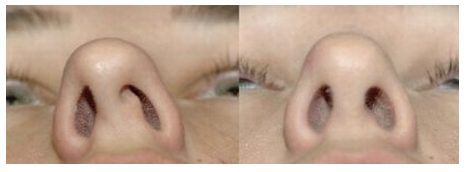
Deviated septum
Identify the pathology:

Difficulty breathing, nose bleeds
If a deviated septum is severe, what can it cause?
• Air filled-spaces lined with respiratory mucosa
• Drain into nasal cavity
• Named for the bone they are in
What are paranasal sinuses?
superior turbinate
which turbinate is the smallest?
Middle concha (cut)
Identify the structure at #1

Semilunar hiatus
Identify the structure at #2

Middle meatus
Identify the structure at #3

Opening of lacrimal duct
Identify the structure at #4

Inferior meatus
Identify the structure at #5
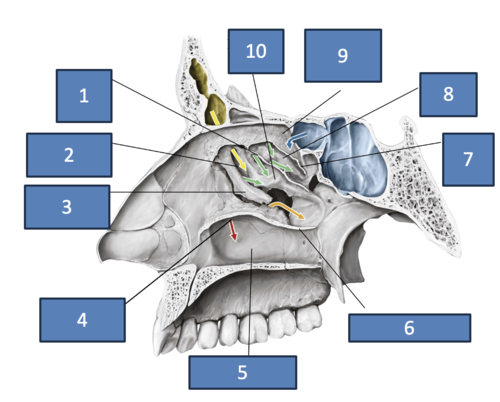
Inferior concha (cut)
Identify the structure at #6
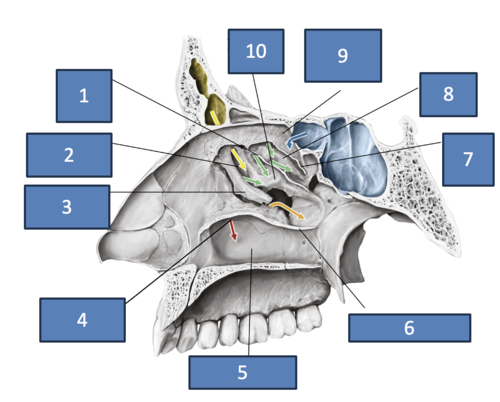
Superior concha (cut)
Identify the structure at #7

Superior meatus
Identify the structure at #8

Sphenoethmoidal recess
Identify the structure at #9
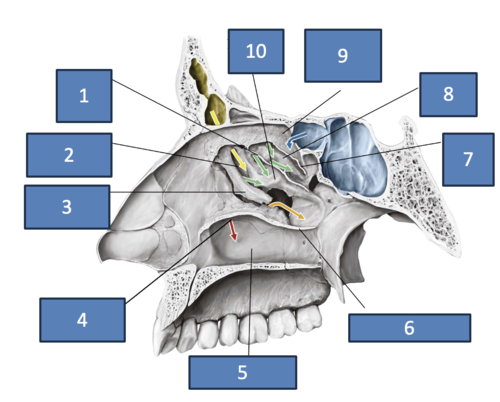
Ethmoid bulla
Identify the structure at #10

In sphenoid ostia
Where is the probe?

Frontal sinus
Identify the structure at #1

Ethmoid cells
Identify the structure at #2

Maxillary sinus
Identify the structure at #3
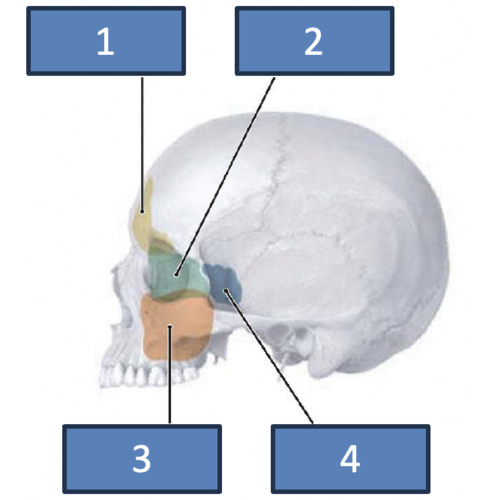
Sphenoid sinus
Identify the structure at #4

ethmoidal air cells (sinus)
what sinuses sit directly medially to the orbit?
maxillary sinus
what sinuses sit inferiorly to the orbit?