PETE 310-Lecture 4
 Call Kai
 Learn
Learn Practice Test
 Spaced Repetition
 Match
Match Flashcards
 Knowt Play
1/13

There's no tags or description
Looks like no tags are added yet.
Name | Mastery | Learn | Test | Matching | Spaced | Call with Kai | Chat |
|---|
No analytics yet
Send a link to your students to track their progress
14 Terms
Fluids which are deficient in intermediate components have critical points to the ________-hand side of the envelope
right
Larger Comoponent's critical points are __________ than smaller component's critical points
larger
The Five Reservoir Fluids
Black oil, volatile oil, retrograde gas, wet gas, and dry gas
Black Oils
Initial producing GOR < 2000 scf/STB
When the reservoir pressure falls below the bubble point pressure, the producing GOR increase
Stock-tank oil gravity < 45 API
often very dark (often black), indicating the presence of heavy hydrocarbons
Laboratory analysis indicate an initial oil formation volume factor (FVF) < 2.0 res bbl/STB (oil FVF is the volume of reservoir liquid in barrels to produce one stock-tank barrel)
Consist of a wide variety of chemical species. Contains higher than 20% (mole/mole) heptanes plus (C7+) which indicates large quantity of heavy, nonvolatile hydrocarbons
Phase Diagram of Typical Black Oil
phase diagram covers a wide temperature range
critical point is well up the slope of the phase envelope
iso-vols are spaced evenly within the envelope
When reservoir pressure lies along line 12, the oil is called "undersaturated"
When the reservoir pressure lies along line 23, the oil is called "saturated"
Additional gas evolves from the oil as it moves from the reservoir to the surface separator. This causes some oil shrinkage. The volume of oil at point 2 shrinks by one-half or less on its trip to the stock-tank

Undersaturated Oil
used to indicate that oil could have dissolved more, if more gas had been present in the reservoir
Saturated Oil
During oil production, when the reservoir reaches its bubble point pressure, the oil contains as much dissolved gas as it can hold
Further reduction in pressure will release gas to form a free gas phase in the reservoir
Volatile Oil
2000 < initial producing GOR < 3300 scf/STB
Stock-tank oil > 40 API and it increases during the production, as reservoir pressure falls below the bubble point
Contains relatively fewer heavy oil molecules and more intermediates (C2-C6) in comparison to black oil
Gas associated with the volatile oil is very rich and releases large quantity of liquid as it moves to the surface
The material balance equations have intolerable inaccuracy
Laboratory analysis indicate an initial oil formation volume factor (FVF) > 2.0 res bbl/STB. They are high-shrinkage crude oils; the produced oil shrinks by more than one-half on the trip to stock-tank
Contains 12.5-20% hepatnes plus
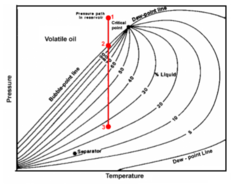
Phase Diagram of Typical Volatile Oil
covered temperature range is somewhat smaller than the black oil case
iso-vols are not as evenly spaced
critical temperature is much lower (to the left) than for a black oil: and is close to the reservoir temperature
Retrograde Gases
are also called gas condensates or condensates
initial producing GOR>3300 scf/STB. An initial GOR ratio less than 5000 scf/STB indicates a very rich retrograde gas, one which will condense sufficient liquid to fill 35% or more of the reservoir volume. However, the liquid would seldome flow in the reservoir; therefore, the retrograde liquids cannot be easly produced
60 API stock-tank oil gravity (>> 40 API) and it increases during the production, as reservoir pressure falls below the dew point pressure
Phase Diagram of Typical Retrograde Gas
phase diagram is smaller than that for oils
contains fewer heavy hydrocarbons relative to oils, hence the critical point is further down the left-hand side of the envelope
phase diagram has a critical temperature which is less than the reservoir temperature, and a cricondentherm which is greater than the reservoir temperature

Wet Gases
the word "wet" does not mean that the gas is wet with water; it refers to the hydrocarbon liquid which condenses at surface conditions
Wet gases produce stock-tank liquids with the same range of gravities as the liquids from retrograde gases. The stock-tank liquid usually looks like water
producing GOR is very high (more than 50000 scf/STB) and remain constant during the life of the wet gas reservoir
Phase Diagram of Typical Wet Gases
Entire phase diagram lies below the reservoir temperature. The reservoir pressure path, during the production, does not enter the phase envelope, therefore no liquid is formed in the reservoir. However notice that the separator conditions lie within the phase envelope, causing some liquid to be formed as the surface

Dry Gases
primarily methane with some intermediates
the word "dry" indicates that the gas does not contain enough of the heavier molecules to form hydrocarbon liquid at the surface
