Week 6 -- PFR -- Void effects + Voidable marriages
 Call Kai
 Learn
 Practice Test
 Spaced Repetition
 Match
 Flashcards
 Knowt Play
1/50

There's no tags or description
Looks like no tags are added yet.
51 Terms
What does Art 43 say about marriages done after a spouse is absent?
Art 43. The termination of the subsequent marriage referred to in the preceding Article shall produce the following effects:
(1) The children of the subsequent marriage conceived prior to its termination shall be considered legitimate;
(2) The absolute community of property or the conjugal partnership, as the case may be, shall be dissolved and liquidated, but if either spouse contracted said marriage in bad faith, his or her share of the net profits of the community property or conjugal partnership property shall be forfeited in favor of the common children or, if there are none, the children of the guilty spouse by a previous marriage or in default of children, the innocent spouse;
(3) Donations by reason of marriage shall remain valid, except that if the donee contracted the marriage in bad faith, such donations made to said donee are revoked by operation of law;
(4) The innocent spouse may revoke the designation of the other spouse who acted in bad faith as beneficiary in any insurance policy, even if such designation be stipulated as irrevocable; and
(5) The spouse who contracted the subsequent marriage in bad faith shall be disqualified to inherit from the innocent spouse by testate and intestate succession. (n)
Give the general effects of Article 43
LADIS
Legitimate Children if conceived prior to termination
ACP or CPG is dissolved and liquidated
Spouse in bad faith forfeits his/her share in net profits in favor of: (in order)
Common children
Children of the guilty spouse in previous marriage
Innocent Spouse
Donations by reason of marriage remains valid
XPN: If a donee entered into the marriage in bad faith, such donations made to the donee is revoked by operation of law.
Insurance — Irrevocable designation as beneficiary may be revoked
GR: Irrevocable designation of a beneficiary of an insurance policy cannot be changed. (Insurance Code)
XPN: Art. 43 (4), FC expressly allows the innocent spouse to revoke the guilty spouse's designation even if the designation was irrevocable.
Reason being, the provision of the FC is a more specific one compared to the general provision of the PD 612.
Succession of the guilty spouse is disqualified
GR: The guilty spouse is disqualified from inheriting from the testate or intestate estate of the innocent spouse.
XPN: Innocent spouse voluntarily provides for the guilty spouse in a will, subject to the rules on succession.
What is Art 44 of the Family Code?
Bad faith clause of the entirety of absent spouses — exists only in contrast to 43
Art 44. If both spouses of the subsequent marriage acted in bad faith, said marriage shall be void ab initio and all donations by reason of marriage and testamentary dispositions made by one in favor of the other are revoked by operation of law. (n)
» Art 44 only talks about effects 4 and 5 of the preceeding article
What is article 50 of the Family code?
Outlines the effects of a void/voidable marriage vis a vis property
Outlines that Article 43 (2-3-4-5), alongside article 44 (both spouses acted in bad faith marriages, hence all donations are revoked by operation of the law, and guilty spouses are disqualified from inheriting)
Final judgement will provide for the liquidation-partition and distribution of the property of spouses, the custody and support of the children, and delivery of third party presumption legitimes
Creditors and debtors are informed of the procedings
(P-C-L)—CD)
What is art 51? What is it in essence?
Tie — The “Dammit, give the kids smth” clause
Art. 51. In said partition, the value of the presumptive legitimes of all common children, computed as of the date of the final judgment of the trial court, shall be delivered in cash, property or sound securities, unless the parties, by mutual agreement judicially approved, had already provided for such matters.
The children or their guardian or the trustee of their property may ask for the enforcement of the judgment.
The delivery of the presumptive legitimes herein prescribed shall in no way prejudice the ultimate successional rights of the children accruing upon the death of either of both of the parents; but the value of the properties already received under the decree of annulment or absolute nullity shall be considered as advances on their legitime.
PROPERTY — ENFORCEMENT — SUCCESIONAL RIGHTS
PES — Pes, you dispense with the effects of a void marriage
The common children will be given their presumptive legitimes either in cash, in security, or in property. The children or their guardians may file for enforcement of this judgment.
What is Article 53?
Art. 53. Either of the former spouses may marry again after compliance with the requirements of the immediately preceding Article; otherwise, the subsequent marriage shall be null and void.
What doctrine in Domingo v. CA
Facts: The wife filed a petition to declare the nullity of her marriage to the husband on the ground that he had a subsisting marriage and had been cohabiting with another woman. The wife prayed for the issuance of a TRO to enjoin the husband from exercising any act of administration and ownership over her properties and that she be declared as the sole and exclusive owner of their conjugal properties. Issue: W/N a petition for judicial declaration of a void marriage is necessary when asked for the purpose of recovering real and personal properties belonging to another. Ruling: Yes. The spouses should not determine for themselves the nullity of the marriage. The Court held that separation of properties is one of the necessary consequences of the judicial declaration of absolute nullity of marriage. As such, there was no further need to file an ordinary civil action for separation of powers. Doctrine:
|
What is the doctrine of Nicdao v. Yee-Carino
Facts:
Santiago contracted two marriages with two Susans: first with Susan Nicdao and second with Susan Yee. When he passed away, he was under the care of Yee who spent for his medical and burial expenses. Both however filed for monetary benefits and financial assistance pertaining to the deceased from various government agencies. Yee contends that Nicdao’s marriage was void ab initio for lack of marriage license.
Issue:
W/N Nicdao’s marriage was void for wanting a marriage license.
Ruling:
Nicdao’s marriage was void ab initio but requires judicial declaration of nullity before Santiago was legally capacitated to marry Yee. Hence, both marriages are void governed by the rules on co-ownership.
Nicdao’s marriage is governed by Art. 147 because Santiago did not have legal impediment at the time of marriage while Yee’s marriage is governed by Art. 148 because Santiago had legal impediment to enter into the second marriage without obtaining a judicial declaration of nullity first.
Art. 147 entitles Nicdao to half of the death benefits.
Art. 148 applies to Yee, for bigamous unions, properties acquired by parties through their actual joint contribution shall belong to the co-ownership. Yee made no contribution to properties, and therefore is not entitled to claim benefits.
Art. 148 also provides that the rest of the benefits go to Santiago’s heirs, which are his children with Nicdao, as he had no children with Yee.
Doctrine:
If two marriages are void ab initio, the applicable property regime would not be absolute community or conjugal property, but rather, be governed by the provisions of Articles 147 and 148 of the Family Code on “Property Regime of Unions Without Marriage.”
What type of ownership structure is applicable in a marriage wanting of a marriage license?
Art 147
Highlights
Wages and salaries are owned by them in equal shares
Property acquired through hard work or industry is ruled by co-ownership
A presumption that every property acquired over time of marriage was done through joint effort.
If a person in a void marriage is in bad faith, then
Art. 147. When a man and a woman who are capacitated to marry each other, live exclusively with each other as husband and wife without the benefit of marriage or under a void marriage, their wages and salaries shall be owned by them in equal shares and the property acquired by both of them through their work or industry shall be governed by the rules on co-ownership.
In the absence of proof to the contrary, properties acquired while they lived together shall be presumed to have been obtained by their joint efforts, work or industry, and shall be owned by them in equal shares. For purposes of this Article, a party who did not participate in the acquisition by the other party of any property shall be deemed to have contributed jointly in the acquisition thereof if the former's efforts consisted in the care and maintenance of the family and of the household.
Neither party can encumber or dispose by acts inter vivos of his or her share in the property acquired during cohabitation and owned in common, without the consent of the other, until after the termination of their cohabitation.
When only one of the parties to a void marriage is in good faith, the share of the party in bad faith in the co-ownership shall be forfeited in favor of their common children. In case of default of or waiver by any or all of the common children or their descendants, each vacant share shall belong to the respective surviving descendants. In the absence of descendants, such share shall belong to the innocent party. In all cases, the forfeiture shall take place upon termination of the cohabitation. (144a)
What governs a bigamous marriage?
Art. 148. In cases of cohabitation not falling under the preceding Article, only the properties acquired by both of the parties through their actual joint contribution of money, property, or industry shall be owned by them in common in proportion to their respective contributions. In the absence of proof to the contrary, their contributions and corresponding shares are presumed to be equal. The same rule and presumption shall apply to joint deposits of money and evidences of credit.
If one of the parties is validly married to another, his or her share in the co-ownership shall accrue to the absolute community or conjugal partnership existing in such valid marriage. If the party who acted in bad faith is not validly married to another, his or her shall be forfeited in the manner provided in the last paragraph of the preceding Article.
The foregoing rules on forfeiture shall likewise apply even if both parties are in both faith.
Valdes v. RTC 💼
Valdes from Percy Jackson never actually got married to Calypso, so he’s under co-ownership rules. In this case, they were under Rule 147 because they were there by psychological incapacity. Facts: The RTC granted Husband’s petition for nullity of marriage on the grounds of mutual psychological incapacity, declaring it void ab initio. Included in the decision is the spouses’ custodial rights and the liquidation of common properties as defined by Art. 147, FC on rules of co-ownership. Wife contends that the rules on ACP/CPG on Art. 102/129 should apply instead. Issue: W/N Art. 147 of the Family Code should govern the liquidation proceedings? Ruling: Yes. The marriage between the ex-spouses qualifies under Art. 147 for couples cohabiting under a void marriage without legal impediment. Any marriage settlement made prior is irrelevant to the liquidation of co-ownership that exists between common-law spouses. Doctrine:
|
Diño v. Diño 💼
Dino v Dino — This partition will be done by the time we turn into dinosaurs, so might as well let it be done. Make sure you refer only to 147-148
Facts:
Spouses are childhood sweethearts who cohabited together and later got married. The husband then files for a petition for declaration of nullity of marriage on the ground of the wife’s psychological incapacity for being unfaithful, irresponsible, abusive, and failure in her marital obligation to give love and support after the wife was granted divorce by the SC of California and remarried. The trial court decreed that a decree of absolute nullity will only be issued after liquidation, partition, and distribution of the parties’ properties under Art. 147, FC.
Issue:
W/N a decree of absolute nullity of marriage shall only be issued after liquidation, partition, and distribution of the parties’ properties under Art. 147?
Ruling:
No. The marriage was void on the ground of psychological incapacity, hence, the rules of Co-ownership under Art. 147 governs. There is no requirement of separation of property relations before a declaration for nullity is decreed. Marriage voided under Art. 36 is not part of the scope of Art. 50’s requirements.
Doctrine:
When psychological incapacity is invoked as a basis for declaring a marriage void, the provisions of the Civil Code on co-ownership of properties will take precedence. It is therefore not necessary that the liquidation of properties be done before a decree of nullity of marriage is issued.
What happens to the children in cases of a void marriage?
General rule — they are illegitimate
Exception — Art 36 and Art 53 marriages
Art 54. Children conceived or born before the judgment of annulment or absolute nullity of the marriage under Article 36 has become final and executory shall be considered legitimate. Children conceived or born of the subsequent marriage under Article 53 shall likewise be legitimate.
What happens to a child in a voidable marriage?
Art. 43 (1) provides that children conceived prior to the termination of the subsequent marriage that was entered by the spouse present after the absent spouse has been declared presumptively dead shall be considered legitimate. (When spouse is absent)
Otherwise, they’re still legitimate insofar as that voidable marriage still had legal effect while it was subsisting.
Republic v. Tangarorang 💼
Tang-ina naman the courts
Facts:
The spouses had a daughter born before their marriage in 2007. The husband was physically, emotionally, and verbally abusive toward his wife and daughter and was allegedly an alcoholic, gambler, and involved in illicit affairs. The wife filed a VAWC case against him, and after they separated in 2018, she sought the declaration of nullity of their marriage on the ground of psychological incapacity. The marriage was declared void ab initio, and the daughter was consequently declared illegitimate.
Issue:
W/N the trial court erred in declaring the daughter illegitimate.
Ruling:
Yes. The Court held that the daughter should not have been declared illegitimate. Although a child born outside a valid marriage is generally illegitimate under Article 165, a child may be legitimated by the subsequent marriage of the parents under Articles 177 and 178. Article 54 provides that children born out of void marriage due to psychological incapacity under Art. 36 are considered legitimate.
The Family Code, however, provides no mechanism by which a child who has already been legitimated can revert to illegitimate status merely because the parents' marriage is later declared void. Moreover, legitimacy is presumed to be more favorable to the child.
Enumerate the grounds for a voidable marriage under Art 45
Art. 45. A marriage may be annulled for any of the following causes, existing at the time of the marriage:
Minority - Insanity - Fraud - Force - Impotency — STD
MIFFIS
(1) That the party in whose behalf it is sought to have the marriage annulled was eighteen years of age or over but below twenty-one, and the marriage was solemnized without the consent of the parents, guardian or person having substitute parental authority over the party, in that order, unless after attaining the age of twenty-one, such party freely cohabited with the other and both lived together as husband and wife;
(2) That either party was of unsound mind, unless such party after coming to reason, freely cohabited with the other as husband and wife;
(3) That the consent of either party was obtained by fraud, unless such party afterwards, with full knowledge of the facts constituting the fraud, freely cohabited with the other as husband and wife;
(4) That the consent of either party was obtained by force, intimidation or undue influence, unless the same having disappeared or ceased, such party thereafter freely cohabited with the other as husband and wife;
(5) That either party was physically incapable of consummating the marriage with the other, and such incapacity continues and appears to be incurable; or
(6) That either party was afflicted with a sexually-transmissible disease found to be serious and appears to be incurable.
Art 46, what constitutus fraud?
Art. 46. Any of the following circumstances shall constitute fraud referred to in Number 3 of the preceding Article:
(1) Non-disclosure of a previous conviction by final judgment of the other party of a crime involving moral turpitude;
(2) Concealment by the wife of the fact that at the time of the marriage, she was pregnant by a man other than her husband;
(3) Concealment of sexually transmissible disease, regardless of its nature, existing at the time of the marriage; or
(4) Concealment of drug addiction, habitual alcoholism or homosexuality or lesbianism existing at the time of the marriage.
No other misrepresentation or deceit as to character, health, rank, fortune or chastity shall constitute such fraud as will give grounds for action for the annulment of marriage.
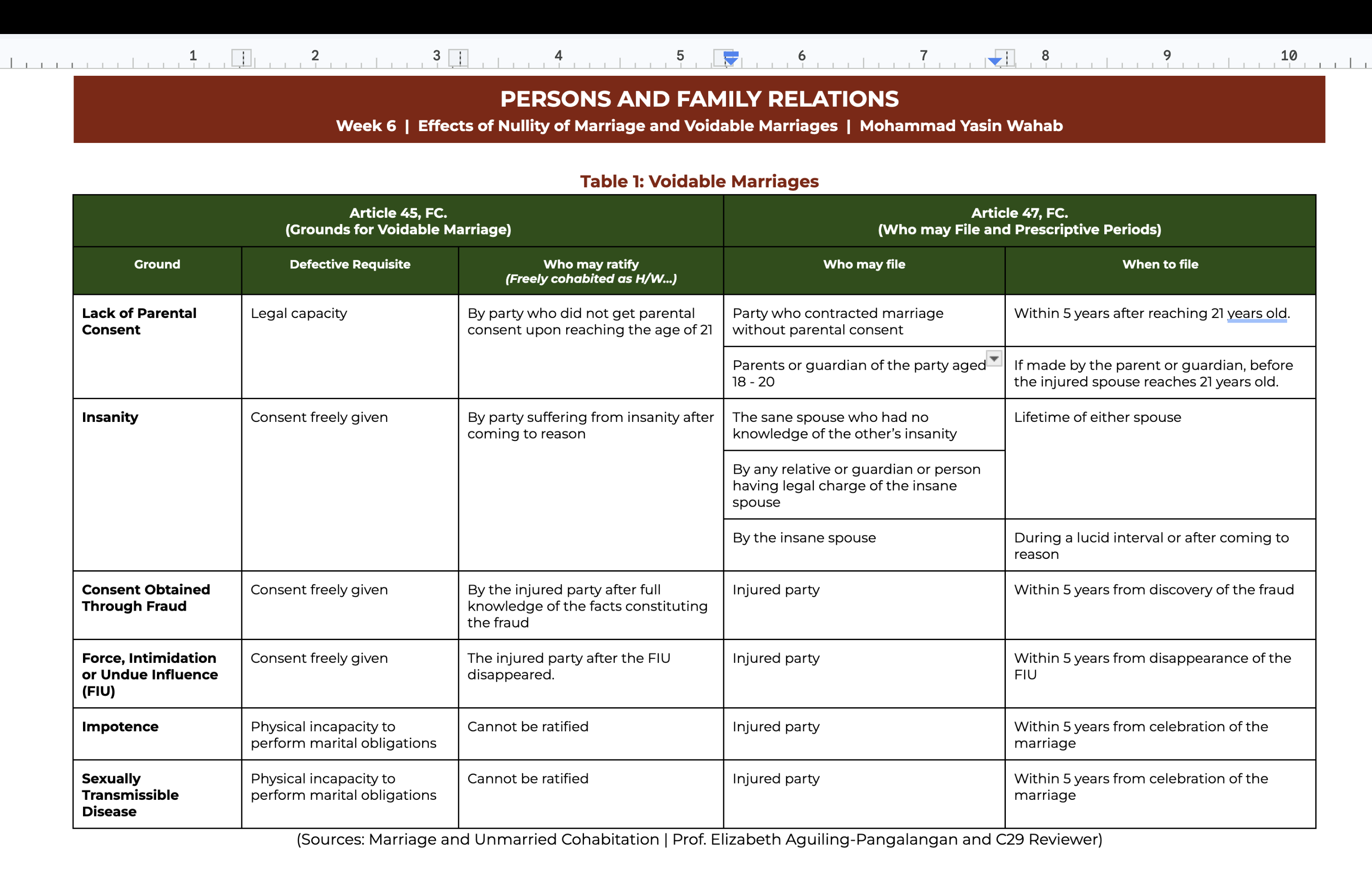
If you’re gonna compare all of these, what standards should be used?
What is the defective requisite?
Who can ratify these and when?
Who may file for a voidability of marriage (Found in Art 47)
When must you file (Found in Art 47)
What — Who — Who — When (prescription)
Comparison table for voidable marriage grounds
Photo
Expound on Lack of parent consent as a standard
Art. 45 (1). That the party in whose behalf it is sought to have the marriage annulled was eighteen years of age or over but below twenty-one, and the marriage was solemnized without the consent of the parents, guardian or person having substitute parental authority over the party, in that order, unless after attaining the age of twenty-one, such party freely cohabited with the other and both lived together as husband and wife;
Notes:
Art. 14, FC provides the preference of father’s consent over the mother’s consent.
Order of consent then becomes:
Father
Mother
Guardian
Person having substitute parental authority
Reasons for requiring parental consent (Moe v Dickins):
The peculiar vulnerability of children;
Their inability to make critical decisions in an informed and mature manner;
The importance of parental role in child rearing
Age as a Criterion
Psychological testing is expensive, time-consuming, and inconvenient.
Studies show, as a rule, a person becomes more mature as he or she ages.
Give me Moe v. Dinkens
Moe v. Dickins 💼
Facts: An 18-year-old male wants to marry a 15-year-old female to cement their family unit and remove the stigma of their child being born out of wedlock, but they cannot marry because the female’s mother refuses to give the parental consent required by law. Issue: W/N the requirement of parental consent for minors seeking to marry is constitutional? Ruling: Yes. The court held that the parental consent requirement is constitutional because the State has legitimate interests in protecting minors from immature decision-making and in preventing unstable marriages. Doctrine:
|
Give me a bit more information on insanity
Art. 45 (2). That either party was of unsound mind, unless such party after coming to reason, freely cohabited with the other as husband and wife;
Notes:
Whether the party at the time of marriage was capable of understanding the nature and consequences of marriage itself.
Not a Ground:
Mental weakness is not sufficient as a ground so long as the party still understands the consequences of the step to be taken.
Mental disorder that does not deprive the contracting party of understanding.
Valid Ground: (such that person had no knowledge of what he or she is giving consent to)
Intoxication amounting to lack of mental capacity.
Somnabulismn
Capacity to act is presumed to continue so long as the contrary has not been proved.
The burden of proof is on the one alleging insanity.
Once general insanity is proved to exist, it is presumed to continue.
If a recovery or lucid interval is alleged, the person making the claim has the burden of proof.
“Insanity” is mere failure to understand as compared to “Psychological Incapacity” where there is incabaility to dispense fulfill marital obligations. (Santos v. Bedia Santos)
Give me case of Katipunan v. Tenorio
Katipunan v. Tenorio 💼
Facts: The husband sought annulment of their marriage on the ground that the wife was allegedly not of sound mind when they married, while the wife, through her guardian ad litem, denied the allegation and argued that annulment would adversely affect her and their four children. Issue: W/N the wife was mentally sound at the time of her marriage Ruling: Yes. The Court held that there was no ample showing in the record that before the marriage was celebrated, the wife was mentally unbalanced. Spouses lived together for years, had four children, and had admittedly had lucid intervals. Doctrine:
|
Give me case of Suntay v. Cojuanco Suntay
Facts: The spouses married in 1958 and had three children, including Isabel, but their marriage was later declared null and void by the lower court in its fallo due to the husband’s alleged unsoundness of mind; the husband predeceased his mother, who later died, raising questions regarding the order of succession, after which Isabel sought Letters of Administration as her grandmother’s legitimate grandchild while her grandfather contested her legitimacy based on the declaration of nullity. Issue: W/N the fallo declaring the marriage “null and void” should prevail over the ratio decidendi indicating that the marriage was merely voidable, thereby making Isabel illegitimate. Ruling: No. When there is ambiguity in the fallo, the judgment must be read in its entirety and harmonized to determine the court’s true intent. The Court held that the marriage was merely voidable on the ground of unsoundness of mind; hence, Isabel remained legitimate, having been born before the marriage was annulled. Doctrine:
|
Buccat v. Buccat 💼
Facts: The spouses wed each other and after living as husband and wife for 89 days, the wife gave birth to a baby boy. Issue: W/N their marriage can be annulled based on the fact that the wife lied about her virginity, thereby constituting consent obtained through fraud. Ruling: No. The Court held there is no fraud committed by the wife, the husband should have observed her advanced physical condition. To constitute a ground for annulment, there should be clear proof of fraud committed by the other party. Doctrine:
|
Aquino v. Delizo 💼
Facts: Four months after the marriage, the wife gave birth to a child fathered by another man, who turned out to be the husband’s brother; the husband thereafter sought annulment of the marriage on the ground of fraud through concealment of the wife’s pregnancy. Issue: W/N the wife concealed her pregnancy at the time of the marriage. Ruling: Yes. At four months of pregnancy, the wife’s condition was not yet readily apparent, and because she was naturally plump, the husband could not reasonably have discovered the pregnancy at the time of the marriage. Doctrine:
|
Republic of the Philippines v. Villacorta 💼
Facts:
After reconciling following a year-long separation, the wife denied having relations with another man; a child was conceived a month later, and the spouses married three years afterward, but the husband later discovered through DNA testing that he was not the child’s biological father.
Issue:
W/N there was concealment of fraud at the time of marriage warranting the annulment.
Ruling:
No. The concealment did not exist at the time of marriage because the pregnancy occurred three years before the marriage, and the wife believed in good faith that the husband was the child’s father.
Doctrine:
Concealment of a pregnancy by another man must exist at the time of marriage to constitute fraud warranting annulment.
Give me the case of Roldan v. Roldan
Roldan v. Roldan💼
Facts: After the marriage deteriorated, the husband admitted that he was homosexual after the wife discovered bundles of magazines containing images of male models who were half-naked or naked. Issue: W/N the marriage may be annulled on the ground of fraud through the husband’s deliberate concealment of his homosexuality at the time of marriage. Ruling: Yes. The totality of the evidence established that the husband concealed his homosexuality through his behavior and lack of intimacy with the wife, which continued to deprive her of the marital relationship she consented to until his homosexuality was discovered. Doctrine:
|
Give me Anaya v. Palaroan
Anaya v. Palaroan💼
Facts: The husband sought annulment of the marriage on the ground that his consent was obtained through force and intimidation, but the wife alleged that he had admitted to having pre-marital relations with a close relative, married her only to avoid marrying the relative, and had no intention of performing his marital obligations. Issue: W/N the non-disclosure of the husband’s pre-marital relations constitutes fraud that may be a ground for annulment. Ruling: No. The non-disclosure of pre-marital relations is not among the circumstances enumerated by law as constituting fraud that vitiates consent to marriage; hence, the marriage remained valid. Doctrine:
|
Are there any other types of fraud allowed to create a grounds for voidable marriages besides those,
No, explicily outlined in Art 40 is the fact that no other misrepresentation counts.
What is force, intimidation or undue influence even defined by?
Notes:
The test of force, intimidation and undue influence is subjective.
The person, taking into account his or her pecuniary circumstances, had no choice but to yield.
Violence (Art. 1335, CC.) - there is violence when serious or irresistible force is employed in order to extract acquiescence.
Intimidation (Art. 1335, CC.) - when one party is compelled by a reasonable and well-grounded fear of an imminent and grave evil upon his person or property, upon the person or property of his spouse, descendants or ascendants to consent to the marriage.
Ruiz v. Atienza💼
Facts:
After pre-maritally conceiving a child with the wife, the husband claims his consent to the marriage was obtained through force and intimidation through the group of the wife’s father.
Issue:
W/N there was sufficient evidence to prove that force or intimidation was employed in obtaining the husband’s consent.
Ruling:
No. There were many opportunities for the husband to have gotten out of the marriage. Evidence adduced were not able to sufficiently establish that consent was obtained through force or intimidation.
Doctrine:
For there to be a ground for annulment based on force or intimidation, the situation must be such that the person has no choice but to yield to having the marriage.
What are the standards of impotency as a grounds for a voidable marriage?
Requisites of Impotency:
Present at the time of marriage;
Incurable
Continuous
NOTE: It must be an total inability to have sexual intercourse with the other spoues, not barren-ness.
Sarao v. Guevara💼
Facts: When the husband attempted to have sexual intercourse with his wife, she would often complain of pains, and thus the carnal act would not occur. Eventually, it was found that the wife had a tumor in her uterus and ovaries, which she had surgically removed. This rendered her barren and unable to have children. However, she was still capable of having sexual intercourse. Issue: W/N the defendant can be considered as “physically incapable of entering into a married state”, thereby being a ground for annulment. Ruling: NO. The wife is still physically capable of being sexually intimate with her partner, even if she is rendered sterile after the removal of her uterus and ovaries. At no point was the defendant incapable of copulation, even in the existence of the tumor. She is still fit for sexual intercourse, and thus, NOT impotent. Doctrine:
|
Jimenez v. Republic💼
Facts: The husband filed for a decree of nullity of marriage on the ground of the wife’s impotency. He alleges that the orifice of his wife’s vagina was too small for penetration, thus they were unable to consummate their marriage. The lower court annulled the marriage solely on testimony of the husband. Issue: W/N the marriage in question may be annulled on the strength only of the lone testimony of the husband. Ruling: No. The State is deeply interested in marriage; its security and stability largely depends on it. In annulling a marriage, it requires more than the lone testimony of the requesting party to render such judgment. The testimony of the husband alone was insufficient to establish the wife’s impotency. In the case at bar, to compel the wife to undergo an examination was necessary to establish her impotency. The presumption is always in favor of potency. Doctrine:
|
TSOI v. CA
Facts: The spouses lived together and shared the same bed for ten months but never had sexual intercourse. The wife filed a complaint for annulment on the ground of psychological incapacity, claiming that her husband was impotent or a closet homosexual. The husband claims that it was the wife who refused to consummate the marriage. Issue: W/N the husband was able to disprove the wife’s petition for annulment on the basis of his impotency Ruling: Yes. The husband was able to establish that he was not impotent however the Court voided the marriage on the basis of psychological incapacity as confirmed by himself when he admitted that he did not have sex with his wife in the 10 months they were married. Doctrine:
|
Compare Jimenez v. Tsoi
Jimenez vis-a-vis Tsoi
In Tsoi, the husband’s refusal to have sexual relations with his wife is a manifestation of his psychological incapcity to fulfill his marital obligations.
In Jimenez, the wife’s refusal to have sexual relations with her husband was normal given the fact hat Filipino women “are by nature coy, bashful and shy.”
The Court was not consistent in the standard employed in deciding the effects of failure to consummate the marriage.
Requisites for subsection 6 of Art 45 on STDs
Notes:
The STD that must have been present at the time of the celebration of the marriage must be serious and incurable.
Cohabitation by the healthy spouse does not constitute ratification as a way of public health measure, offering a way out of the marriage in order to shield such spouse and any possible offspring from acquiring the disease.
Concealment is not a consideration for annulment.
Compare STDs in Fraud and STDs in subsection 6
1) The mere fact of having the STD, rather than the concealment, is what is considered in subsection 6
2) There’s no ability to ratify under subsection 6, because the state wishes them to separate to shield offspring from acquiring the disease
3) In both cases though, they need to exist at time of marriage
Give me the prescriptive periods under Art 47
Art. 47. The action for annulment of marriage must be filed by the following persons and within the periods indicated herein:
(1) For causes mentioned in number 1 of Article 45 by the party whose parent or guardian did not give his or her consent, within five years after attaining the age of twenty-one, or by the parent or guardian or person having legal charge of the minor, at any time before such party has reached the age of twenty-one;
(2) For causes mentioned in number 2 of Article 45, by the same spouse, who had no knowledge of the other's insanity; or by any relative or guardian or person having legal charge of the insane, at any time before the death of either party, or by the insane spouse during a lucid interval or after regaining sanity;
(3) For causes mentioned in number 3 of Articles 45, by the injured party, within five years after the discovery of the fraud;(4) For causes mentioned in number 4 of Article 45, by the injured party, within five years from the time the force, intimidation or undue influence disappeared or ceased;
(5) For causes mentioned in number 5 and 6 of Article 45, by the injured party, within five years after the marriage. (87a).
Under what article is the participation of the state found?
Art. 48. In all cases of annulment or declaration of absolute nullity of marriage, the Court shall order the prosecuting attorney or fiscal assigned to it to appear on behalf of the State to take steps to prevent collusion between the parties and to take care that evidence is not fabricated or suppressed.
In the cases referred to in the preceding paragraph, no judgment shall be based upon a stipulation of facts or confession of judgment. (88a)
Notes:
Stipulation of facts - agreement by both parties on the facts of the case, admitting them into evidence without needing any more proof.
Confession of judgment - written admission by a party that he has no legal defense to a cause of action that upon such default he authorizes judgement to be entered against him.
Please compare void and voidable marriages
Photo

Give me a comparison between the Civil Code and Family Code on when the spouse is pressumed dead.
Standard found in FC 41
Marriage contracted during the subsistence of a previous shall be null and void
Unless prior spouse has been:
Absent for four (4) consecutive years OR
Disappearance where there is danger of death; two (2) years (Civil Code Art. 391)
AND
Well-founded belief that the absent spouse is already dead
You must also
Institute a summary proceeding for the declaration of presumptive death — this is done without prejudice to the possibility of reappearance
Meanwhile:
Civil Code 83
First spouse absent for seven (7) consecutive years at the time of the second marriage
Without having news of the absentee being alive
Absentee is generally considered to be dead and believed so
Or presumed dead according to Articles 390 and 391
Marriage is valid in any of the three cases until declared null and void
In Addition Article 85 (2) has it xplicitly
Give me the presumption of death provisions in the Civil Code
ARTICLE 390. After an absence of seven years, it being unknown whether or not the absentee still lives, he shall be presumed dead for all purposes, except for those of succession.
The absentee shall not be presumed dead for the purpose of opening his succession till after an absence of ten years. If he disappeared after the age of seventy-five years, an absence of five years shall be sufficient in order that his succession may be opened. (n)
ARTICLE 391. The following shall be presumed dead for all purposes, including the division of the estate among the heirs: otiteo
(1) A person on board a vessel lost during a sea voyage, or an aeroplane which is missing, who has not been heard of for four years since the loss of the vessel or aeroplane;
(2) A person in the armed forces who has taken part in war, and has been missing for four years;
(3) A person who has been in danger of death under other circumstances and his existence has not been known for four years. (n)
ARTICLE 392. If the absentee appears, or without appearing his existence is proved, he shall recover his property in the condition in which it may be found, and the price of any property that may have been alienated or the property acquired therewith; but he cannot claim either fruits or rents. (194)
What happens to a subsequent marriage of an absent spouse?
Art. 42. The subsequent marriage referred to in the preceding Article shall be automatically terminated by the recording of the affidavit of reappearance of the absent spouse, unless there is a judgment annulling the previous marriage or declaring it void ab initio.
A sworn statement of the fact and circumstances of reappearance shall be recorded in the civil registry of the residence of the parties to the subsequent marriage at the instance of any interested person, with due notice to the spouses of the subsequent marriage and without prejudice to the fact of reappearance being judicially determined in case such fact is disputed. (n)
SSS v. Jarque 💼
Doctrine
Termination of subsequent marriage by affidavit does not preclude the filing of an action to prove reappearance and obtain declaration of termination
If absentee reappears but no step is taken, mere reappearance will not terminate the subsequent marriage
Subsequent marriage is based on the presumption of the former spouse being dead
Presumption continues
By fiction of law is considered an absentee until subsequent marriage is terminated
Marriages could only be assailed during the lifetime of the parties
Parties and children would be perfectly valid upon death of one of the spouses
Ruling
No step was taken to nullify Balion and Jarque’s marriage prior to Ballion’s Death
Jarque is the rightful spouse-beneficiary of the SSS benefits
Can you please give me what FC 213 is?
Art. 213. In case of separation of the parents, parental authority shall be exercised by the parent designated by the Court. The Court shall take into account all relevant considerations, especially the choice of the child over seven years of age, unless the parent chosen is unfit. (n)ChanRoblesVirtua
What happens to the surname after a marriage is annulled?
Outlined in CC Art 371
If an innocent spouse, you can continue using it
If a guilty spouse, you’re forced to go back to your maiden name
AND if the court rules as such or the husband remarry, you ‘ll akso be forced to go back to your maiden name
What is Republic Act 8369?
Also known as the Family Courts Act of 1997
Establishes family courts and causes of action under its jurisdiction
Section 5: Jurisdiction of Family Courts
Family courts shall have exclusive original jurisdiction to hear and decide:
Petitions for guardianship, custody, habeas corpus in relation to custody
Complaints of annulment, declaration of nullity, petitions for dissolution of conjugal partnership of gains, and those relating to marital status and property relations of:
Spouses
Those living together under different status and agreements
Petitions for support and/or acknowledgement
Tamano v. Ortiz 💼
Facts
Sen. Mamintal Tamano married Zorayda Tamano in civil rites in 1958
Married Estrelita Tamano in 1993
He died in 1994
Zorayda and her son Adib filed a declaration of nullity of marriage
Cited bigamy
Alleged Tamano never divorced Zorayda
Estrelita was not single
Her annulment with Rome Llave did not become final and executory
Estrelita filed a motion to dismiss
Said the RTC did not have jurisdiction
Estrelita filed a motion to dismiss
Said the RTC did not have jurisdiction
Ruling
Noted no mention that Estrelita and Tamao were married under Muslim laws
Only mentioned in motion for reconsideration
RTC was not divested of jurisdiction to hear and try the case
Court’s jurisdiction cannot be made to depend upon defenses set up in answer or motion to dismiss/reconsideration
Jurisdiction is determined from the allegations of the complaint
Comprises of statement of facts constituting cause of action
Give me the differences between void and voidable marriages
Basis | Void Marriage | Voidable Marriage |
Nature | No validity from the time of performance. | Valid until annulled. |
Susceptibility to Ratification | Cannot be ratified. | Can be ratified. |
Property Relations | Only co-ownership; no ACP or CPG despite having entered into a marriage settlement. | ACP or any other property regime in accordance with the marriage settlement. |
Status of Children | Illegitimate under Art. 165 (with Art. 36 and Art. 53 as exceptions). | Children are legitimate if conceived or born prior to the decree. |
How Impugned (a) | May be attacked directly or collaterally, but for the purpose of remarriage, a judicial declaration of nullity is required. | Cannot be attacked collaterally. |
How Impugned (b) | Can be impugned even after death of parties. | Cannot be impugned after the death of one of the parties. |
Who May Challenge Validity | A proper interested person (depending on dates of marriage and filing of proceeding). | A party to the marriage. |
Susceptibility to Prescription | Does not prescribe. | Prescribes. |
Naughty — Rabbits — Prefer — Sweet — Hot — Wings — Penis
Nature — Ratification — Property — Status of Children — How impugned (Collaterally-After death?) — Who may challenge validity — Prescription