Lesson 4 : Chemical Changes
 Call Kai
 Learn
 Practice Test
 Spaced Repetition
 Match
 Flashcards
 Knowt Play
1/48

There's no tags or description
Looks like no tags are added yet.
49 Terms
Ore
A sample of rock with enough mineral fur it to be worthwhile extracting
Extremely unreactive metals such as silver and gold are found in their _____
Native state
List the reactivity series, including non-metals
Potassium, sodium, lithium, calcium, magnesium, carbon, zinc, iron, hydrogen, copper
What is a displacement reaction?
A chemical reaction in which a more reactive element takes the place of a less reactive element in a compound
How are metals less reactive than carbon extracted from their ores?
Via reduction with carbon (as carbon can displace them)
How are metals more reactive then carbon extracted from their ores?
By electrolysis
Metals above _____ will react with acids
Hydrogen
Explain how the reactivity of metals with water or dilute acids is related to their tendency to lose electrons and form a positive ion
The lower the electrostatic attraction between the nucleus and the outer shell electrons, the easier it is to lose, resulting in the metal reacting much faster and more vigorously
Oxidation in terms of oxygen
Oxidation → gain of oxygen
Reduction in terms of oxygen
Reduction → loss of oxygen
Oxidation in terms of electrons
Oxidation → loss of electrons
Reduction in terms of electrons
Reduction → gain of electrons
Metal + acid →
Salt + hydrogen
Metal oxide + acid →
Salt + water
Metal hydroxide + acid →
Salt + water
Metal carbonate + acid →
Salt + water + carbon dioxide
Metal + water →
Metal hydroxide + hydrogen
When hydrochloric acid reacts with a metal what type of salt does it make?
Metal chlorides
When sulphuric acid reacts with a metal what type of salt does it make?
Metal sulphates
When Nitric acid reacts with a metal what type of salt does it make?
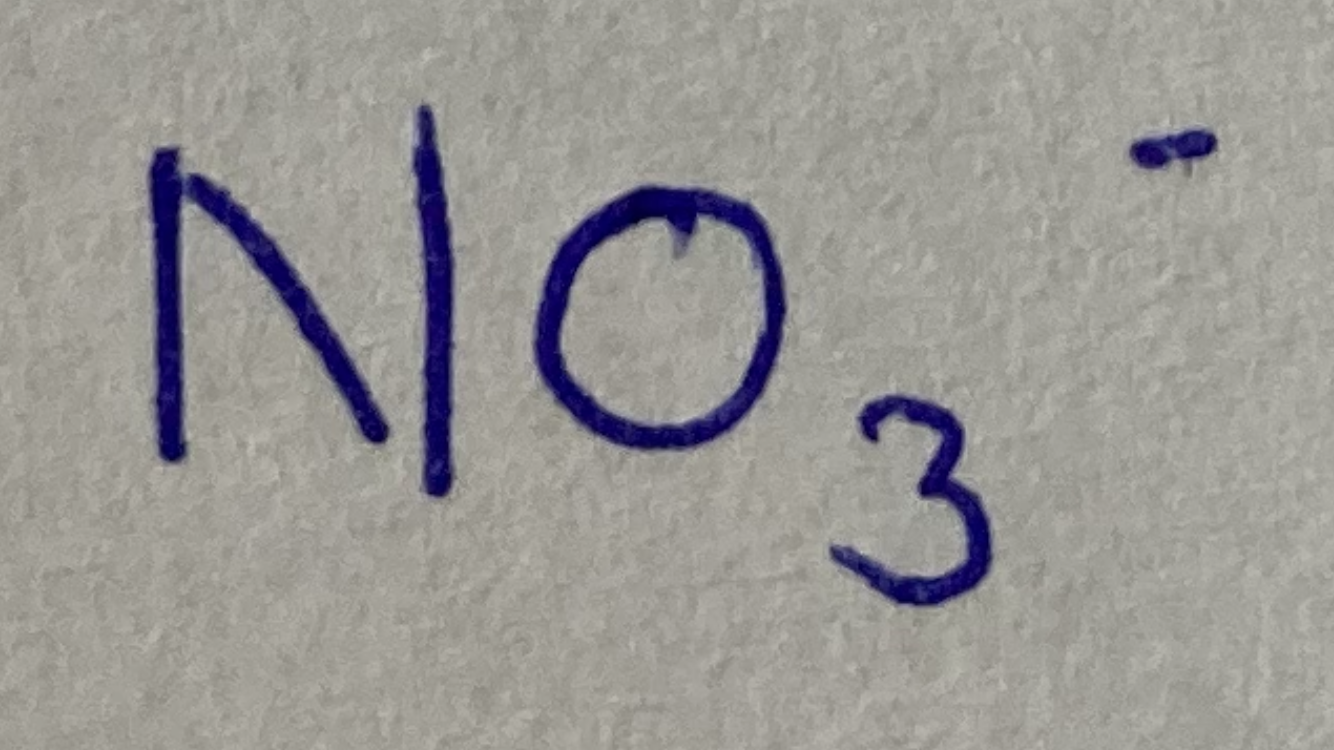
Metal nitrates
Give the formulae of a chloride ion

Give the formula of a sulphate ion

Give the formula of a nitrate ion
What is an acid?
A substance that dissolved in water and forms hydrogen (H+) ions
What is a base?
Any substance that reacts with an acid to form salt and water only during a neutralisation reaction
What is an alkali?
A base that dissolves in water to produce hydroxide (OH-) ions
What is the method of obtaining a salt from an insoluble base?
1.State the acid and base you are going to use.
Firstly, measure a known volume of acid and heat using a Bunsen burner.
Then, add the insoluble base, a spatula at a time, until it is in excess.
Filter out the excess solid so you are only left with the salt solution.
Evaporate the solution using an evaporating dish.
Leave it to cool and dry until crystals start to form.

What is the method of obtaining a salt from a soluble base?
Name the acid and base you will use.
Place the acid in a burette and record the starting volume.
Measure a known volume of base with a pipette and place in a conical flask.
Add a few drops of phenothalein indicator to the base.
Add acid until the solution turns neutral, record the final volume of acid used.
Repeat the titration without the indicator to get a pure solution of the salt.
Heat the solution in an evaporating basin until crystals form on the edges of the solution.
Leave to cool and crystallise, and then pat dry with filter paper.
Neutralisation reaction
A reaction where an acid and an alkali react to produce water.

What are the two ways that the pH of a solution can be measured in accordance to the pH scale?
pH probe
Universal indicator
Describe the method used for performing a titration
Add a known volume of alkali into a conical flask using a pipette and pipette filler.
Fill the burette with acid and record the original reading.
Add a few drops of phenophthalein indicator to the alkali in the flask.
Open the tap to add the acid to the flask, swirling regularly until the indicator changes colour. Make sure to go drop by drop at the end for accuracy.
Subtract the final reading from the initial reading to obtain the volume of acid.
What is a strong acid?
An acid that completely ionises/ dissociates in an aqueous solution/ dissolved in water
What is a weak acid?
An acid that only partially ionises/ dissociates in an aqueous solution/ dissolved in water
What is a concentrated solution?
A solution that has a high number of molecules dissolved per dm3 of solution. A concentration of H+ ions means a low pH.
What is a dilute solution?
A solution with a low number of molecules dissolved per dm3 of solution. A lower concentration of H+ ions means a higher (more neutral) pH
For every increase in pH____ (2 → 3)
The concentration decreases by a factor of 10
What is electrolysis?
The breaking down (decomposition) of a molten or aqueous ionic compound using electricity.
Give a short brief of how electrolysis works
When an ionic compound is melted or dissolved in water, the ions are free to move within the liquid or solution. These liquids or solutions are able to conduct electricity and are called electrolytes.
Passing an electric current through an electrolyte causes the ions to move to the electrodes. Positively charged ions move to the negative electrode (cathode) and negatively charged ions move to the positive electrode (anode). Ions are discharged at electrodes producing elements.
Name and give the charges of the two electrodes.
Anode - positive (+)
Cathode - negative (-)
What is an electrolyte?
A liquid/ solution that conducts electricity
Why must the positive electrode used during the electrolyisis and extraction of aluminium from aluminium oxide be continuously replaced?
The electrodes are made from carbon, and the oxygen gas produced reacts with the carbon anodes to produce carbon dioxide. This causes the carbon anodes to be slowly WORN AWAY and so need to be REPLACED regularly.
Why must a mixture be an electrolyte/ why must it be mixed with molten cryolite?
Aluminium oxide has a very high melting point and is therefore mixed with molten cryolite to lower it’s melting point, and reduce the amount of energy used and therfore energy costs
What is the anion?
The negative ion (attracted to the anode)
What is the cation?
Positive ion (attracted to the cathode)
Why are there multiple ions in an aqueous solution?
Aqueous means dissolved in water, and therefore the solution also consists of the ions present in water
In aqueous electrolysis, what forms at the cathode?
if the metal is more reactive than hydrogen hydrogen forms
What is the half equation for the formation of hydrogen at the electrode?

In aqueous electrolysis, what forms at the anode?
Oxygen and water is formed unless a halide ion is present
What is the half equation for the formation of oxygen and water at the anode?
