Midterm 5
 Call Kai
 Learn
 Practice Test
 Spaced Repetition
 Match
 Flashcards
 Knowt Play
1/22

There's no tags or description
Looks like no tags are added yet.
23 Terms
when the Earth first formed the surface was covered in
an ocean of magma

What is marked by the pink star in the map?
Acadia National Park
Tectonic terranes can be recognized because the rocks that comprise them record a distinct history (for example, rock ages and types, distinctive fossils, and structures) that they do not share with
adjacent terranes
Terranes are typically bounded by either
strike-slip or thrust faults
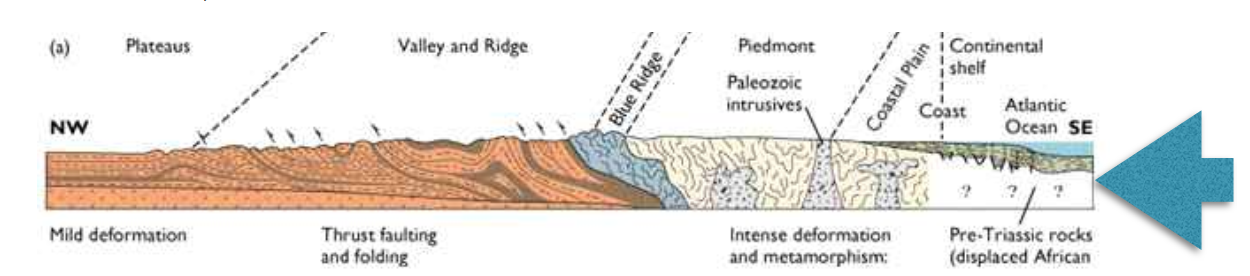
Key aspects of the Appalachian record are shown in the cross section below, and include:
-Thrust faults and folds that record shortening perpendicular to the Proterozoic continental margin (the direction of thrust faulting records a push from the right, shown by an arrow).
-Metamorphic and intrusive igneous rocks in highly deformed zones. Intrusive rocks locally cut key structures. Dating of these intrusions allows us to establish maximum ages of events.
-The development of large basins parallel to the orogen, which received sediment shed from growing mountains.

Taconic elements include blocks of deep sea floor that were thrust onto the
Laurentian margin
Terranes accreted during the Acadian orogeny locally include characteristic
trilobite fossils

What is India an example of?
growth of a continent by accretion
Mountains and structures (e.g., faults) record
plate motions
Why does Acadia’s coastline look so rugged?
Lots of wave action have battered it and the rocks along the Acadia coast are strong.
The amplitude of the tides (how high or low they are) depends on
how the sun and the moon are lined up
Spring Tide
when moon and sun are aligned
Neap Tide
when moon and sun are perpendicular
Fetch
is the length of water the wind is rubbing on the water in a constant direction
The _________ and __________ are both significant factors that contribute to how far the waves can erode inland.
Height of the wave, amplitude of the tide
As waves approach the shore, they eventually enter a water depth where the orbital motion at depth begins to interfere with the bed of the water body in which the waves shoal and then break. What is the main factor that determines what type of breakers might we expect to see?
slope of the beach approaching the shoreline
_________ occurs when the wave base contacts the ocean bottom, causing a reduction in wavelength and an increase in wave height.
Wave steepening
The prominent “shatter zone” comprised of brecciated country rock exposed around the perimeter of Cadillac Mountain at Acadia National Park likely supports evidence for:
the explosive intrusion of a felsic igneous pluton fracturing the existing rock around it
A/An________ is a unique sequence of rocks that records a geologic history independent of the continent of which it is now part of (e.g., much of India’s history was independent of the Eurasian continent).
Terrane
Outwash plain deposits are typically composed of
sorted sand and gravel deposits

What is the landform in the picture below?
a drumlin
The four primary factors that influence the intensity of a wave are:
Wind strength, fetch of area influenced by the wind, duration of the wind, and size and depth of the water body
___________ is the study of the alignment of magnetic minerals in a rock that can be used to determine the latitude at which they formed.
Paleomagnetism