Case 3: McFadden Family - IPV + Well-Child Visits
 Call Kai
 Learn
 Practice Test
 Spaced Repetition
 Match
 Flashcards
 Knowt Play
1/37

There's no tags or description
Looks like no tags are added yet.
38 Terms
Intimate Partner Violence (IPV): Risk Factors
Discord in relationship
Low SES
Low education
Substance misuse
Hx of abuse/IPV exposure
Pregnancy + post-partum
IPV: Screening
SAFE
S: Stress/Safety
How would you describe your relationship?
Do you feel safe?
A: Afraid/Abused
What happens when you argue?
Are you afraid?
F: Friends + Family
Do your friends/family know/want to help?
E: Emergency plan
HITS
H: Hurt you physically
I: Insult you
T: Threaten you
S: Scream at you
IPV: Resources
National Domestic Violence Hotline
iHEAL app
Social worker
IPV legal advocate
Develop safety plan
IPV: Physician Obligations
Ask/screen
Assess immediate danger
Develop safety plan
Refer to resources
Document
Mandatory Reporting:
Weapon wounds
Child at risk
IPV: Pregnancy + Post-Partum
Violence escalation risk = Repeat screening
Child Maltreatment: Types
Neglect
Psychological
Physical
Sexual
Medical
Child Maltreatment: Neglect
Failure to meet basic physical, emotional, medical, education needs
Clinical Presentation:
Growth faltering
Abnormal language, social, emotional development
Abnormal attachement
Socialization issues
Child Maltreatment: Psychological
Repeated caregiver actions negatively impacting development
Clinical Presentation:
Abnormal attachment
Disruptive behaviour
Aggression
Atypical tantrums
Depressed + anxious mood
Child Maltreatment: Physical
Nonaccidental injury to child
Clinical Presentation:
Bruising
Torso
Ear
Neck
Bite marks
Scalds + burns
Fractures
Head trauma
Child Maltreatment: Sexual
Involving child in sexual activity
Clinical Presentation:
Age-inappropriate behaviour + sexual insights
Gential, anal, oral injuries
Recurrent UTIs
STIs
Child Maltreatment: Medical
Caregiver fabricates/induces symptoms = Unneeded + potentially harmful medical care
Clinical Presentation:
Inappropriate drug therapy
Contaminating samples = Fabricate + exaggerate illness
Child Maltreatment: Risk Factors
Child:
Physical/developmental disabilities
Behavioral issues
Caregiver:
IPV
Hx of abuse
Unemployment
Low education level
SUD
Mental health issues
Unwanted pregnancy
Child Maltreatment: Management
Report to CAS
Hospitalization
Medical stabilization
Skeletal survey + Xray
Coagulation panel + CBC
Bruising
Intracranial hemorrhage
STI testing
Gonorrhea
Chlamydia
HSV
Treat injuries
Well Baby Exam: Timing
Neonatal:
3-5 days after birth
2 weeks - 1 month
Childhood:
2, 4, 6, 9, 12, 15, 18, 24, 30 months
3+ years: Annual
Well Baby Exam: Components
PMHx + ROS
Vitals
Growth charts
Head circumference
Length/height
Weight
Weight-for-length (BMI)
Screening
Physical exam
Immunizations
Well Baby Exam: PMHx + ROS
Constitutional symptoms
Sleep concerns
Dietary concerns
Elimination concerns
School + behavioural concerns
Adolescents:
SSHADESS
Menstrual cycles
Well Baby Exam: Head Circumference
Abnormal:
< 2 SDs below mean: Microcephaly
> SDs above mean: Macrocephaly
Well Baby Exam: Length/Height
Abnormal:
< SDs below mean: Short statue
> SDs above mean: Tall stature
Well Baby Exam: Weight
Lose 7-10% birthweight + regain by 2 weeks
Abnormal:
< SDs below mean: Failure to thrive
> SDs above mean: Compare to other parameters
Well Baby Exam: BMI
Possible percentile change: 2 years
Abnormal:
< 2 SDs below mean: Underweight
> 2 SDs above mean: Obesity
Well Baby Exam: Hearing Screening
Method: Pure tone audiometry
Ages:
Neonate
4-6 years
8-10 years
Well Baby Exam: Vision Screening
Method:
Inspection
Red reflex
Fixation + tracking
Instruments
Photoscreeners
Autorefractors
Visual acuity
Ages:
Inspection: Birth - 4 years
Instrument: 1-3 years
Visual Acuity: 3+ years annually
Well Baby Exam: Scoliosis Screening
Method:
Visual inspection
Adam forward bend test
Ages:
Girls: 10 + 12 years
Boys: 13-14 years
Well Baby Exam: HTN
Method: BP measurement
Ages: 3+ years annually
Well Baby Exam: Labs Screening
Anemia
Hep B
Dyslipidemia
TB risk
Sudden cardiac death
Well Baby Exam: Developmental Screening
Method: Screening tools
Well Baby Exam: Autism Screening
Method: DSM-5
Well Baby Exam: Mental Health + Social Screening
Postpartum depression
SDH
Behavioural + social + emotional disorders
Anxiety
Depression
Well Baby Exam: Neonatal Physical
Verify:
Newborn assessment
Newborn screening
Red reflex
Head
Fontanelles
Palpation
Ears
Heart + lungs
Auscultation
Abdomen
Soft
Non-distended
Non-tender
Hip exam
Barlow + Ortolani
Well Baby Exam: Infant Physical
Head
Fontanelles
Sutures
Red reflex
Pulses
Brachial
Femoral
Heart + lungs
Auscultation
Abdomen
Soft
Non-distended
Non-tender
Hip exam
Barlow + Ortolani
GU
Testicular distention
Neuro
Tone
Resolved primitive reflexes
Skin
Lesions
Redness
Well Baby Exam: Toddler Physical
Head
Pulses
Brachial
Femoral
Heart + lungs
Auscultation
Abdomen
Soft
Non-distended
Masses
MSK
Standing + gait evaluation
Galeazzi Test

Well Baby Exam: School-Age +Adolescent Physical
Adult physical exam
Tanner stages
Pubertal development
Well Baby Exam: Rourke Baby Record
Guide for well-baby/child visits
Birth - 5 years
Categories:
Growth
Nutrition
Parental education
Development
Physical exam
Vaccination Schedule
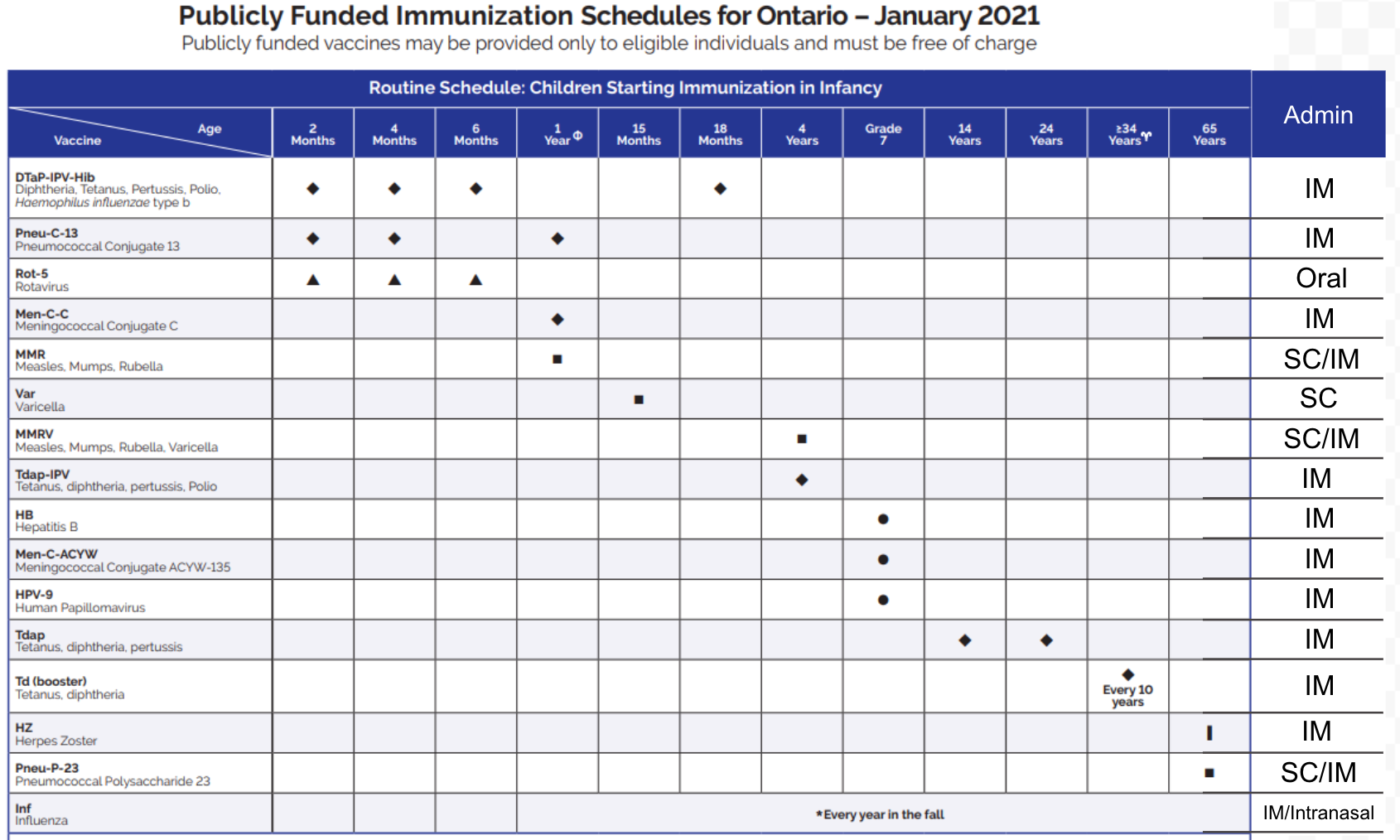
Vaccine: Risks
Onset: 48-72h after
Duration: 1-2 days
Common:
Local swelling, redness, pain
Low-grade fever
Headaches
Fatigue
Flu-like symptoms
Rare:
Serious allergic reaction
Disease
Live-attenuated vaccine
Cardiovascular:
Pericarditis
Myocarditis
Myocardial ischemia
Neurological:
Encephalopathy
Seizures
Brachial neuritis
Vaccine: Contraindications
Previous adverse reaction (anaphylaxis)
Severe allergy to vaccine component
Egg protein
Yellow fever
Influenza
Measles
Mumps
Yeast
Hep B
HPV
To live vaccines:
Rotavirus:
SCID
Intussuception Hx
Pertussis:
Previous adverse reaction
Seizure
Decreased LOC
Coma
All:
Pregnant
Immunodeficiency
Difficulty Feeding: Maternal Factors
Positional and latching problems
Nipple trauma
Delayed lactogenesis
Obesity
PCOS
DM
HTN
Anatomical
Plugged ducts
Flat/inverted nipples
Psychosocial
Postpartum depression
Anxiety
Food insecurity
Difficulty Feeding: Infant Factors
Ankyloglossia: Restrictive frenulum
Oral/Craniofacial anomalies
Cleft lip + palate
Micrognathia
Retrognathia
Preterm + early term
Sleepiness
Congenital heart diseases + metabolism errors