Prokaryotic Transcription II
 Call Kai
 Learn
Learn Practice Test
 Spaced Repetition
 Match
Match Flashcards
 Knowt Play
1/37

There's no tags or description
Looks like no tags are added yet.
Name | Mastery | Learn | Test | Matching | Spaced | Call with Kai | Chat |
|---|
No analytics yet
Send a link to your students to track their progress
38 Terms
What are the 3 steps in transcription?
initiation, elongation and termination
initiation
setting up. RNA polymerase holoenzyme locates and binds to promoter DNA to begin the synthesis of RNA.
elongation
actual synthesis of RNA. RNA polymerase moves along the DNA template, unwinding the DNA ahead of it and adding RNA nucleotides one at a time to the 3’-OH end of the growing RNA strand.
As RNA polymerase moves along the DNA template, unwinding the DNA ahead of it and adding RNA nucleotides one at a time to the 3’-OH end of the growing RNA strand. What is happening behind the RNA polymerase?
the DNA template is rewound, displacing the newly made RNA from its template strand
termination
ending transcription. terminator sequences are recognized, the separation of the RNA molecule from the DNA template occurs, and the RNA polymerase dissociates from the DNA.
What are the 4 stages of transcription initiation?
promoter recognition
unwinding of dsDNA (double-stranded DNA) and creation of a transcription bubble
abortive initiation
promoter escape

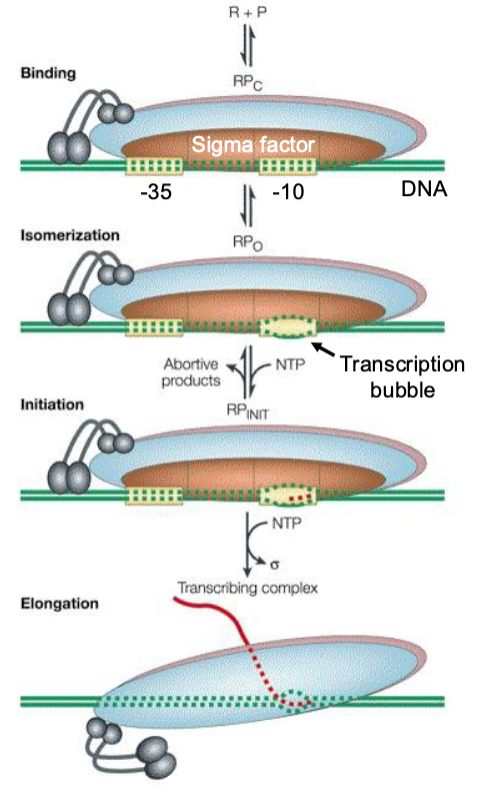
promoter recognition (transcription initiation)
RNA polymerase (R) interacts with promoter DNA (P) to form the closed complex (RPc)

Unwinding of dsDNA and creation of a transcription bubble (transcription initiation)
the duplex DNA around the transcription start site is unwound to create a transcription bubble about 12-14 bp long and form the open complex (RPo)
the transcription bubble is very similar to…
DNA replication bubble

The conversion of RPc to RPo requires the presence of what?
the sigma factor
Initial specific binding to sigma factors to the promoter triggers conformational changes that result in the separation of the 2 strands of DNA and expose a portion of the template strand.
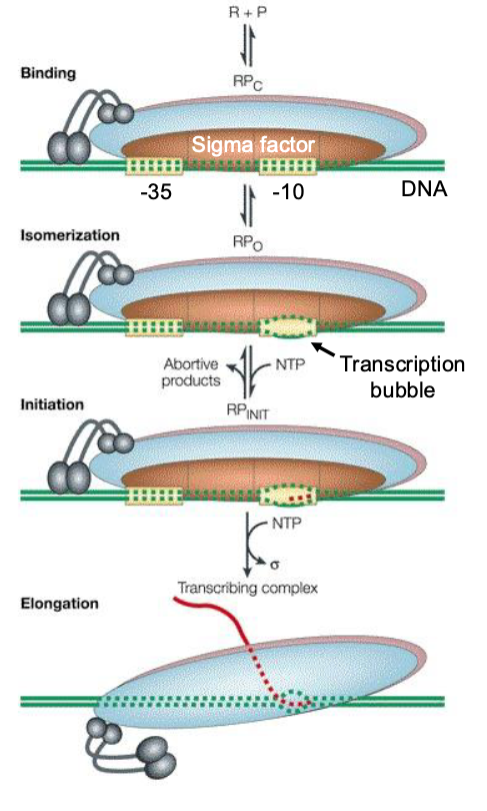
What is the difference between the open complex (RPo) vs the closed complex (RPc)
(RPc) is an initial state where the enzyme binds to double-stranded promoter DNA, while a (RPo) is an active state where the DNA strands separate to expose the template strand.

abortive initiation (transcription initiation)
RNA polymerase begins synthesizing RNA complementary to the DNA template by adding several nucleotides while remaining bound to the promoter and without moving along the DNA template

True or False: Short pieces of RNA with a few nucleotides long may be repeatedly synthesized and released, without the polymerase leaving the promoter.
True. This is due in part to interactions between the sigma factor and promoter.
True or False: All initiation events are productive.
False

promoter escape (transcription initiation)
After several abortive initiation attempts, the polymerase synthesizes an RNA molecule from 9-12 nucleotides in length.
This allows RNA polymerase to break its interactions with the promoter and begin moving along the DNA, transitioning into the elongation stage.

When does the sigma subunit dissociate from the core enzyme?
shortly after transcription initiation when the growing RNA chain reaches about 9 to 12 nucleotides in length

When does transcription elongation begin?
After the sigma subunit dissociates from the core enzyme
Transcription elongation (2nd stage of transcription)
the core polymerase moves along the template strand, unwinding the DNA ahead if it to maintain a transcription bubble of 12-15 base pairs and synthesizing RNA complementary to the template strand of the DNA
Is RNA polymerase highly or slightly processive?
highly. It adds 100s or 1000s of bases to the growing RNA at about 20-50 nucleotides per second without requiring additional apparatus (molecules or proteins)
RNA polymerase vs DNA polymerase
RNA polymerase:
does not require additional molecules or proteins
highly processive
proofreads on its own
performs limited form of proofreading
less accurate (higher error rate, 10-6)
DNA polymerase
requires multiple proteins (ex. a sliding clamp and clamp loader is needed to keep DNA polymerase on the strand)
slightly processive
needs other molecules to proofread
way more accurate (lower error rate, 10-8)
Unlike DNA polymerase, RNA polymerase does not have an elaborate proofreading mechanism. However, RNA polymerase can perform a limited form of proofreading during transcription. How does it do this?
When RNA polymerase incorporates a nucleotide that does not match the DNA template, it backtracks along the DNA and cleaves the last 2 nucleotides to remove the error. RNA polymerase resumes RNA synthesis after it cleaves and removes the wrong nucleotides.
Terminator
the signal to the RNA polymerase to stop transcription and dissociate from the template
True or False: The terminator is part of the end sequence that is transcribed.
True, and the promoter is not.
What are the 2 types of terminators in prokaryotes?
intrinsic terminators and rho-dependent terminators
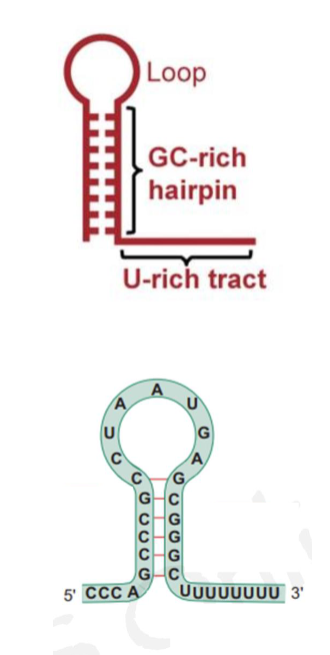
intrinsic terminators
allow termination by RNA polymerase without the help of any additional factors
rho-dependent terminators
requires the assistance of a protein factor called rho (ρ) to terminate transcription
Intrinsic terminators account for approximately what percent of prokaryotic terminators? What about rho-dependent terminators?
50%. ~20%.
What 2 common features do intrinsic terminators have?
they contain inverted repeats
a stretch of ~7-9 adenines (A’s)

inverted repeats
Sequences of nucleotides on the same strand that inverted and complementary. This sequence when transcribed into RNA can base-pair with each other to form a hairpin.

What is the stretch of ~7-9 adenines (A’s) adjacent to the inverted repeat in the DNA for?
These are transcribed into a stretch of uracils (U’s) in the RNA (or U-rich tract). This permits the RNA-DNA hybrid in this region to come apart, because the base-pairing between A’s in the DNA templates and U’s in the RNA is relatively weak (2 hydrogen bonds). This allows the transcript to be released from the DNA template and from the RNA polymerase

As RNA polymerase transcribes the terminator region, what happens to the newly synthesized RNA?
It folds into a stem-loop (hairpin) structure. This secondary structure causes the RNA polymerase to pause.

What happens after the transcript is released from the DNA template and from the RNA polymerase?
The template strand bases the flip back and base pair with the non-template strand, rewinding the transcription bubble. (becomes double-stranded DNA again)
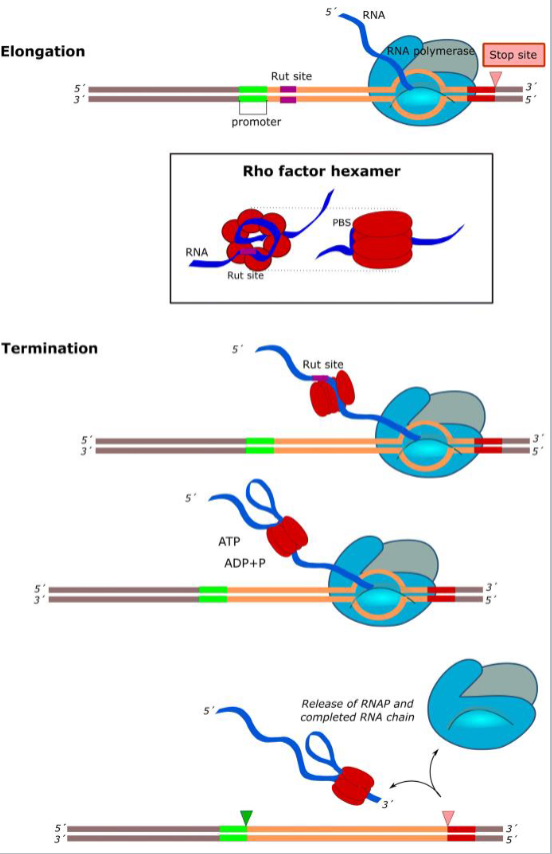
protein factor rho (ρ)
a helices consisting of 6 identical monomers arranged in an open circle

Rho-dependent termination requires the formation of what structure and why?
a hairpin structure that causes pausing of the RNA polymerase (RNAP)

rho utilization site (rut)
A region of the transcript where rho binds. It is C-rich and poorly structured RNA sequence.

Rho couples with what mechanic to translocate along the RNA until it catches up with the paused RNAP?
NTP hydrolysis
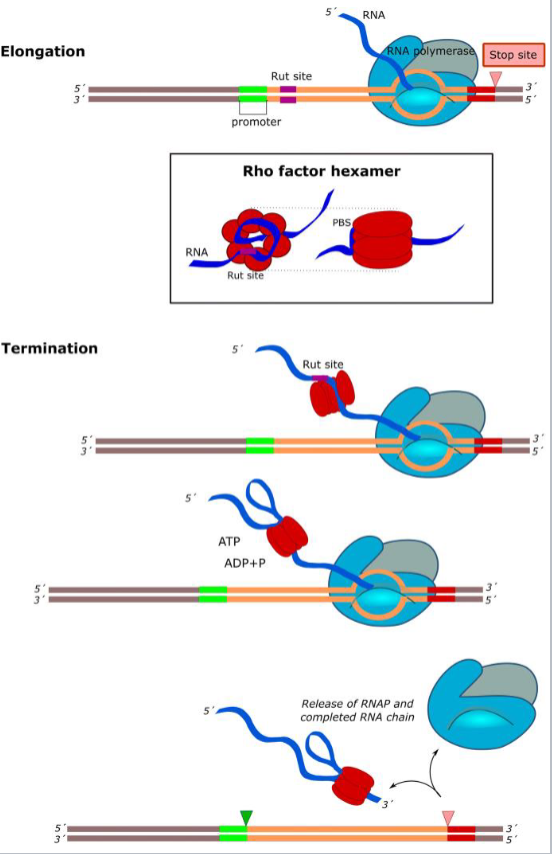
Rho uses helicase activity to do what?
to break the RNA-DNA helix, ejecting the RNAP and RNA from the template
DNA replication vs RNA transcription
DNA replication
replication bubble opens at the origin and proceeds bidirectionally
RNA primer required, because DNA polymerase can only extend an existing strand
DNA polymerase synthesizes DNA in the 5’ to 3’ direction
RNA transcription
transcription bubble opens at the promoter and proceeds unidirectionally
No primer required, because RNA polymerase can initiate synthesis from scratch
RNA polymerase synthesizes RNA in the 5’ to 3’ direction