ensuring quality in PACS
 Call Kai
 Learn
 Practice Test
 Spaced Repetition
 Match
 Flashcards
 Knowt Play
1/52

There's no tags or description
Looks like no tags are added yet.
53 Terms
1968
radiation control for health and safety act
1981
consumer-patient radiation health and safety act
1990
safe medical devices act
1992
mammography quality standards act
HIPAA
1996
the Health Insurance Portability and Accountability Act
failure to comply with this law can result in significant legal penalties (up to $250,000 and 10 years in prison)
sets standards for:
electronic record security
electronic formats for record keeping
electronic identifiers and codes
requirements for confidentiality and privacy rules
regulations and accreditation
there are also relevant voluntary accreditation procedures
most health care institutions are accredited by The Joint Commission (TJC), formerly known as the Joint Commission on the Accreditation of Healthcare organizations (JCAHO)
accreditation is voluntary but necessary to
obtain medicaid certification
hold certain licenses
obtain state/Fed reimbursement from insurance companies
receive malpractice insurance
establish quality standards
assess them
provide certification that individual facilities have met quality standards
earlier in TJC history, quality measures were based on quality control (QC) and quality assurance (QA)
today, TJC uses a more all-encompassing term of continuous quality improvement (CQI) or total quality management (TQM)
quality assurance
a plan for the systematic observation and assessment of the different aspects of a project, service, or facility to make certain that standards of quality are being met
activities are focused around people and service
most activities produce quantitative data that can be analyzed
quality control
a comprehensive set of activities designed to monitor and maintain systems that produce a product
aspect of QA concerned with equipment’s technical standards
activities are the first line of defense in preventing, recognizing, and reporting issues
required by law to maintain the license for the room or department
to ensure that procedures are
performed safely
appropriate for the patient
performed efficiently
produce a high-quality image to be read
example:
tests are performed in the radiographic room to make sure that all of the parts are functioning properly, such as the collimator, generator, and focal spots
all of these parts make up the whole of the room, and if one part is off, it can cause harm to the patient or reduce the quality of the exam
3 major categories of tests:
acceptance testing
routine maintenance
error maintenance
acceptance testing
is performed:
before newly installed OR equipment with major repairs is accepted by the department
testing may be performed by:
a designated technologist, a radiation physicist, service personnel employed by the hospital
testing is used to determine whether the equipment is performing within the vendor’s specifications and as promised
provides baseline to reference with future QC testing
routine maintenance
monitor quality of image processing systems
measure quality of external radiation beam
specify faults within these systems to allow corrective measure to be taken
may be performed by:
a designated technologist, a radiation physicist, service personnel employed by the vender
error maintenance
when errors occur in equipment performance, corrective action must occur
errors are detected by poor equipment performance or poor-quality outcomes
corrections generally are made by service personnel employed by the vendor
continuous quality improvement (CQI)
a systematic approach to the management of all aspects of the organization
tends to focus on the process rather than the people or the service. “if the process is good, the people will follow it and the service will then be good”
based on customer’s feedback
does not replace the QA or QC programs but comes alongside as a higher level of thinking
QA and QC programs focus on maintaining a certain level of quality, not necessarily improving to a higher quality
focuses on improving the process or system in which the people function as team members rather than focusing on the individual’s work
personnel at all levels within the organization must be involved in the improvement process
bottom-up, team-driven
total quality management (TQM)
the measurement philosophy and system that promotes positive organizational change, as well as an effective cultural environment, for continuous improvement of all aspects of the organization
based on company’s vision
top-down, leadership-drive cultural transformation
documentation
very important to any QC activity
note all variables so that the activity can be repeated without harm to the process
must be kept up to date to make a valid performance measure
most difficult part of the process and the easiest part to not complete
necessary to prove need for repair or update of the system
external beam evaluation
monitoring types of tests should be performed by knowledgeable radiographer
special equipment required
corrective action by authorized service person
diagnostic radiographic systems
semi-annual schedule
tests on x-ray tube:
focal spot size estimation
half-value layer
collimator, central ray, and bucky tray accuracy
distance and centering indicators’ accuracy
angulator or protractor accuracy
tests on generator:
kilovoltage accuracy
timer accuracy
mR/mAs and milliamperage linearity
exposure reproducibility
focal spot size estimation
important for proper recorded detail
three types of tools:
star test patterns, pinhole cameras, line pair resolution tools
half-value layer
measured by using dosimetry equipment to determine amount of filtration that will reduce beam intensity to one-half of its original value
collimator, central ray, and bucky tray accuracy
light field and x-ray beam congruence
SID allowance of ± 2%
central ray and centering mark of the light field
SID allowance of ±1%
distance and centering indicators
distance indicator (a tape measure from focus spot)
±10%
centering indicator
± 2%
angulator or protractor accuracy
can be evaluated using large protractor
±1%
kilovoltage accuracy
computerized dosimeter for digital readout of kVp
± 5% of the label setting
timer accuracy
computerized dosimeters
or using:
a spinning top
single phase generator
motorized synchronous top
three phase generator
± 5% of the label setting
mR/mAs and milliamperage linearity
mA station accuracy confirmed by mR/mAs measurement
computerized dosimeter
at same mAs, compare different mA and time setting to evaluate the linearity of the mAs stations
± 10% between mA stations
other recommend ±15% between high and low mA stations
exposure reproducibility
computerized dosimeter for readout of mR/mAs
measuring several exposure at the same setting
±5%
fluoroscopic systems
exposure reproducibility, exposure rate, field size accuracy and beam alignment, source-to-skin distance limits, intensifier viewing system resolution/contrast, image display systems, automatic brightness control
tomographic systems
uniformity and completeness of motion, section depth indicator accuracy, section thickness accuracy, resolution
automatic exposure controls
exposure reproducibility, ion chamber sensitivity, image receptor exposure variation control accuracy, response capability, backup timer verification
digital radiography detectors
QC test tools available from vendors
maintenance (detector calibration)
primary QA parameter:
QC tests (detector uniformity, spatial resolution, contrast resolution, DQE)
scheduled quality control tests
all imaging equipment are scheduled for QC — daily, weekly, monthly, quarterly, semiannually, annually
such as monitor:
the weakest link in the digital imaging chain
PACS quality
American College of Radiology (ACR) suggests that tests be carried out with the Society of Motion Picture and Television Engineers (SMPTE) test patterns to ensure continuity of measurements
a test pattern developed by the American Association of Physicists in Medicine (AAPM) Task Group 18 is also being widely accepted for use in these QC activities
follow department policy on equipment maintenance procedures
daily monitor quality control
turn on the monitor and allow it ample time to warm up
make sure components are dust free
retrieve a QC monitor test pattern (SMPTE or AAPM TG18-QC), the retrieval time may also be noted for a later test to be discussed
check for: more about visual inspection for operational safety and image artifacts
general image quality and appearance
geometric distortion
luminance, reflection, noise, and glare
resolution
luminance
the rate of light emitted from a source such as a monitor
glare and ambient light
can be evaluated by turning off the monitor and observing any areas of glare on the monitor’s surface
SMPTE test pattern

AAPM TG18-QC test pattern
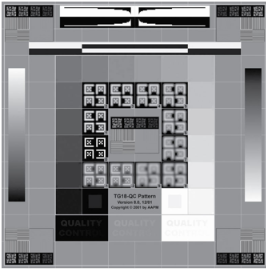
monthly or quarterly monitor quality control
turn on the monitor and allow it ample time to warm up
make sure monitor is dust free on viewing surface and near airflow areas
retrieve a QC monitor test pattern
check for: cleanliness and basic technical/performance calibration
geometric distortion
reflection
luminance response
luminance dependencies
resolution
speed
always a concern: how fast patients are brought back for their x-rays or the speed of signed radiologists reports
in the digital department, other considerations: workstation processing speed and the image retrieval or transfer rate
workstation processing speed
practical way to monitor:
determine a test study, use the same study each time to minimize variables; study needs several images and a patient who has several studies
open the initial test study and note the loading speed, page through the images and note the loading speed of each image
choose an image processing function appropriate for the test images, perform the function and note the processing speed, use the same tool each time you perform the test to maintain consistency
open the patient’s next study and note the loading speed of the images
image transfer speed
should be monitored from the modality to PACS from the archive to a workstation
after acceptance of the system, the procedure should be followed weekly to establish a pattern
if no changes are seen, the procedure can then be done monthly
any time the software or equipment is updated, the procedure should be done weekly until a pattern is established again
the following steps are an easy way to monitor these transfer speeds:
determine a study to be used for the test, use the same study each time to ensure that there are no variables
consider using the test patterns saved on the archive, the procedure should be done on the same day of the week and at approximately the same time to reduce network traffic variables
retrieve the study from the workstation, note the amount of time it took the entire study to arrive at the workstation
to test the transfer speed from the modalities, have each modality send QC images to the archive and note the amount of time the transfer took
make sure that the modality sends the same image set each time you test
data quality control — data integrity
measures whether all images completely at the modality makes it to the PACS
after initial installation, check daily to make sure that all images sent to the PACS arrives at the PACS
after several weeks of no missing images, practice can be scaled back to once a week
randomly choose several studies that were sent during the week and determine whether all of the images made it to PACS
periodically pull up images from the archive to make sure the same images sent initially are still in the study after archiving, this should be done weekly
if no changes are seen, this procedure can be done weekly and then monthly
any time the software or equipment is updated, the procedure should be done daily until a pattern is established again
compression recall
used to reduce the size of the image files and increase the speed of the network transfer of the image
protocols need to be established by the radiologists and radiation physicist
they determine the level of compression that will be acceptable for the institution
the following steps are a practical way of observing:
same several versions of the AAPM TG18-QC test pattern on your archive using different compression ratios as follows:
no compression
lossless compression
lossy compression
recall all test patterns and compare the results of no compression, lossless, and lossy
determine whether there is any loss of information on the compressed image
note any changes in image quality, if any
lossless compression
a data compression method that reduces file size while allowing the exact original data to be reconstructed with zero loss of information
2:1 compression ratio
lossy compression
permanently removes data and uses approximations to shrink file sizes, trading exact fidelity for much smaller files. Once compressed this way, the original data cannot be fully restored
variable compression ratios; use the ratio that your department uses, if any
PACS continuous quality improvement
there are many processes used each day in a PACS environment, and each should be monitored to ensure the PACS is functioning up to its capabilities
each PACS vendor may have different activities that they recommend
these should be adhered to ensure that the PACS will run up to its potential
problems can be found before they cause major system downtime
several simple QCI activities need to be monitored in a radiology department
recognition of undiagnostic images
system up time
system training
recognition of undiagnostic images
if a poor quality image is detected, the study and performing technologist needs to be notified
information must be gathered by the lead technologist or the PACS administrator and followed up with the performing technologist
the radiologist may note the areas and reasons for the poor-quality image
if the poor-quality image was caused by equipment malfunction, the appropriate service protocol followed
if the poor-quality image was an operation error, additional training may be required or counseling by the supervisor may also be appropriate
system up time
monitor how often the system is down for any reason
downtime
online service is not available
planned downtime maintenance
unplanned downtime maintenance
a log should be kept to note any time that the system is down
note the reason, how long, what had to be done, and who fixed the problem
if a problem is recurrent, the log can be used to prove that the piece of equipment needs to be replaced or that additional service is needed
system training
an important activity that must never stop
vendor application personnel are usually onsite for 1-2 weeks during initial installment
vendor application training is supposed to train several super users and help set up systems to site applications
super users and the PACS administrator need to set up an ongoing training program
the training program needs to have several levels of skills training from the radiologist to the technologist to the ancillary personnel
training should happen each time a new employee is hired and each time a new version of the software is installed
PACS training should be added to annual skills training requirements
the role/responsibility for radiographers
documenting and maintaining records for the QC program in accordance with applicable regulations, legal requirements, accrediting agencies, and recommendations from equipment manufacturers
technologist responsibilities
daily QC duties
general system inspection: IR, monitor, and keyboard
weekly QC duties
beside daily QC duties
cleaning and inspecting receptors
clean display screen
clean computer keyboard and mouse
some performance/technical calibration tests
monthly QC duties
daily/week duties
deeper performance/calibration tests
reject analysis
equipment manufacturers should provide lists of appropriate systems tests
this type of testing may be performed by a designated QC technologist rather than by each individual technologist
all problems must be recorded and reported immediately (log book for documentation)
reject analysis
it is critical that repeat exposures be identified so that data concerning repeat reason, number of repeats, and the technologist responsible for the repeat can be analyzed
strongly recommended that a personal repeat rate log be kept by each technologist
allows technologists to see possible trends in exposure errors
identification of this trend allows the technologist to improve imaging procedures and better protect the patient
analysis can be accomplished to a certain extent with a software program
venders have software that automatically keeps repeats in a folder for the QC technologists to review, eliminating the issue of technologists deleting repeat exposure images
service personnel responsibilities
have a duty to the patient to ensure that equipment is being maintained properly
this is accomplished through a program of preventive maintenance (PM)
typically takes place semiannually
consists of series of equipment tests that are performed by a service engineer
engineer may be employed by the hospital or the equipment manufacturer
physicist responsibilities
schedules may vary depending on availability
typically responsibilities include:
semiannual or annual review of departmental images to do the following:
reestablish baseline values
check exposure indicators accuracy with calibrated ion chamber
determine exposure trends
analyze repeat rates
review QC records
analyze service history
standard QC tests for filtration, collimation, focal-spot size, kilovoltage peak calibration, exposure timer accuracy, exposure linearity, exposure reproducibility, and protective apparel remain the same
AAPM has established a set of QC parameters to be followed for photostimulable phosphor systems in AAPM report #93