PSYCH 223 - Chapter 7: Early Adulthood
 Call Kai
 Learn
 Practice Test
 Spaced Repetition
 Match
 Flashcards
 Knowt Play
1/137

Earn XP
Description and Tags
lectures from Prof. Vrushali Rao Gumnur
138 Terms
What does physical development look like in early adulthood?
Most body systems have reached full maturity
Healthy, vigorous, energetic
How do sensory capabilities develop in early adulthood?
Peak visual and auditory acuity
Maximum psychomotor abilities
What is health-adjusted life expectancy (HALE)?
Number of years that a newborn can expect to live at full health, given the morbidity and mortality conditions
What are social determinants?
Life expectancy increases with income, education level and high occupational status
What are the two types of aging?
Primary aging/senescence
Secondary aging
What is senescence?
Primary aging - the natural physical decline brought on by aging
What is secondary aging?
The physical decline because of behavioural choices, environmental factors and disease
What does brain and nervous system development look like in early adulthood?
Continued synaptogenesis and pruning from adolescence; focus on frontal lobes
Strengthening of response inhibition
PFC begins to properly integrate and regulate function from other regions
What is response inhibition?
The skill of suppressing a prepotent or impulsive response
What does heart and lung development look like in early adulthood?
Peak cardiovascular capacity in the initial years of early adulthood
VO2 max during exercise peaks in early adulthood and declines with age after 35 yrs
Blood vessels lose elasticity, face calcification
What is VO2 max?
Maximum oxygen uptake - a measure of the ability to take in and transport oxygen to body parts
What does reproductive capacity look like in early adulthood?
Fertility drops steadily after 30 years in both sexes
Men - reproductive capacity drops more slowly - sperm count and quality declines
Women - higher chance of miscarriage, sporadic ovulation
Risk of passing on genetic abnormalities
What does immune system development look like in early adulthood?
Aging deteriorates thymus gland and bone marrow functioning; weaker antibodies
Bone marrow ➝ B cells fight against external threats
Thymus ➝ T cells that fight against internal threats
Body becomes susceptible to disease
What does motor functioning look like in early adulthood?
Declines in motor functioning not visible in early adulthood; maximum bone calcium
Most early adults have the strength to meet the demands of everyday functioning
What is a disability? How does having a disability impact an individual’s ability to function?
A condition that substantially limits a major life activity
Laws may require logistic accommodations to be made for individuals with physical disabilities
What does activity/fitness look like in early adulthood?
CDC recommends a daily minimum of 150 minutes of moderate-intense activity
What are some benefits of physical exercise?
Better cardiovascular functioning
Fluidity in muscle, ligament and bone movement
Reduced risk of osteoporosis
Optimal immune response
Aids in stress relief
What does nutrition look like in early adulthood?
Adults need lesser calories than adolescents
Busy sedentary work life can contribute to higher obesity rates, cardiovascular diseases and predisposes individuals to other life threatening conditions
Lifestyle choices and adequate social support can have major effects on health outcomes

How are self-efficacy and health related?
Higher self-efficacy is likely to lead people to follow health advice
What is the locus of control?
Individual’s set of beliefs about the causes of events
Divided into internal and external control:
Internal - believe that they have the control over their own lives
External - believe that they their lives are governed by uncontrollable forces
How does optimism impact health?
An optimistic outlook linked to better health, enhancing effect on medications, and positive effects on immune system
What is stress?
The physical and emotional response to events that are threatening or challenging
What is psychoimmunology?
The study of the relationship among the brain, the immune system, and psychological factors
How does stress impact health?
High exposure to stress (acute or chronic) can be detrimental to everyday functioning – high concentration of stress hormones
What are the two stages of processing stress?
Primary appraisal
Secondary appraisal
What is the primary appraisal stage of processing stress?
An individual’s assessment of the stressful event and it’s outcome
What is the secondary appraisal stage of processing stress?
An individual’s assessment of their capabilities to cope with the stressor
What is coping?
The effort to control, reduce or learn to tolerate the threats that lead to stress
What are some different kinds of coping?
Problem focused coping
Emotion focused coping
Defensive coping
What is problem focused coping?
Remedying the problematic situation directly
What is emotion focused coping?
Regulating the reactions to the stressful event
What is defensive coping?
Unconscious strategies that distort the true nature of the situation
What does stress and coping look like in early adulthood?
The state and effectiveness of appraisal can vary among individuals
Social support can provide solutions to problems or give the encouragement to face it
What do mental health issues look like in early adulthood?
Highest levels of role expectation and strain
What are some mental health disorders that can occur in early adulthood?
Anxiety disorders
Mood disorders
Personality disorders
What are some anxiety disorders that can occur in early adulthood?
Generalized Anxiety Disorder (GAD)
Panic disorder
Obsessive compulsive disorders
Phobias
What do mood disorders look like in early adulthood?
Depression is the most frequent
Comes from feelings of loneliness and social/romantic failure
What are personality disorders?
Inflexible pattern of behaviour that leads to difficulty in educational, occupational and social functioning
What do personality disorders look like in early adulthood?
Personality disorders may show up only under circumstances that force these behaviours out
Diagnosis also needs a history of these symptoms
What are protetive factors?
Personal characteristics can help reduce the risk or aggravate mental health problems arising from emotional difficulties
What are some personality disorders than appear in early adulthood?
Antisocial
Paranoid
Histrionic
Narcissistic
Borderline
What are some characteristic of antisocial personality disorder?
Difficulty forming emotional attachments
Lack of empathy
Little regard for the rights of others
Self-centeredness
Willingness to violate the law or social rules to achieve a desired objective
What are some characteristics of paranoid personality disorder?
Suspicious of others’ behaviour and motives
Emotionally guarded
Highly sensitive to minor violations of personal space or perceived rights
What are some characteristics of histrionic personality disorder?
Irrational attention-seeking behaviour
Inappropriate emotional responses
Sexually seductive behaviour and clothing
What are some characteristics of narcissistic personality disorder?
Exaggerated sense of self-importance
Craves attention and approval
Exploits others
Lack of empathy
What are some characteristics of borderline personality disorder?
Unstable moods and relationships
Fear of abandonment
Tendency to self-injury
Highly dependent on others
Impulsive and reckless behaviour
What stage of cognitive development occurs during early adulthood?
Post formal thought: thinking that acknowledges that adult predicaments must sometimes be solved in relativistic terms
What was Gisela Labouvie-Vief’s view on post formal thought?
Thinking during adulthood is based on multiple criteria including logic, morality, comparison and personal values
What was William Perry’s view on post formal thought?
Dualistic thinking → Relativistic thinking
Possible with the ability to examine multiple perspectives and grey areas
What is dualistic thinking?
Binary thought in terms of right and wrong
What is relativistic thinking?
Considering socio-cultural contexts
What were King and Kitchner’s views on post formal thinking?
Reflective judgement: the capacity to identify the underlying assumptions of differing perspectives on controversial issues
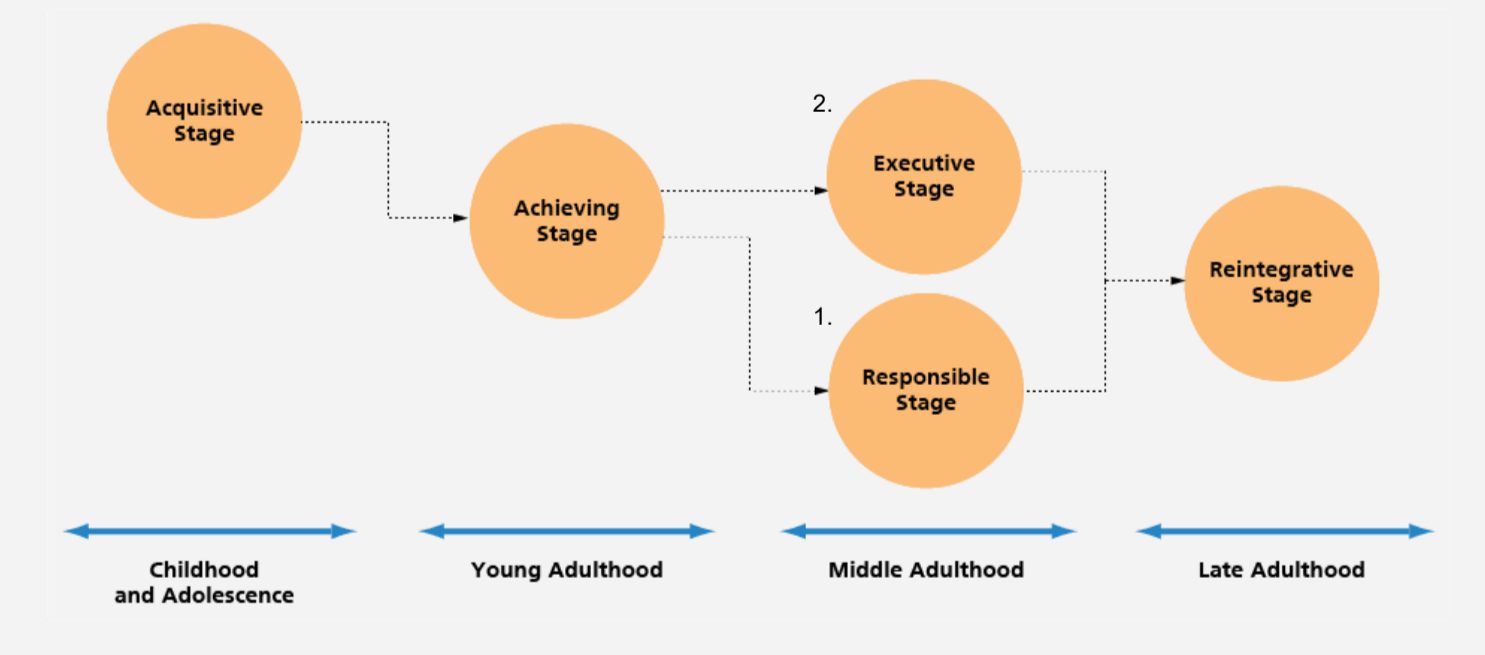
What are Schaie’s stages of development?
Focuses on how information is used rather than understanding it
What are some aspects of post formal thought in early adulthood?
Influence from life events
Comparing different theories
What does influence from life events look like in early adulthood relating to post formal thought?
Early adulthood is accompanied by new beginnings and changes
New circumstances give rise to cognitive advancements
Can critically judge patterns, trends and personalities
What does comparing different theories look like in early adulthood relating to post formal thought?
Theories are not mutually exclusive
Most focus on multi-dimensional thinking
Thinking continues to advance in both quantitative and qualitative ways
What is the triarchic theory of intelligence?
Componential - using mental abilities to consider parts of a problem
Experiential - problem solving with prior knowledge
Contextual - problem solving in everyday environments
What are some different types of intelligence?
Fluid
Crystallized
Practical
Emotional
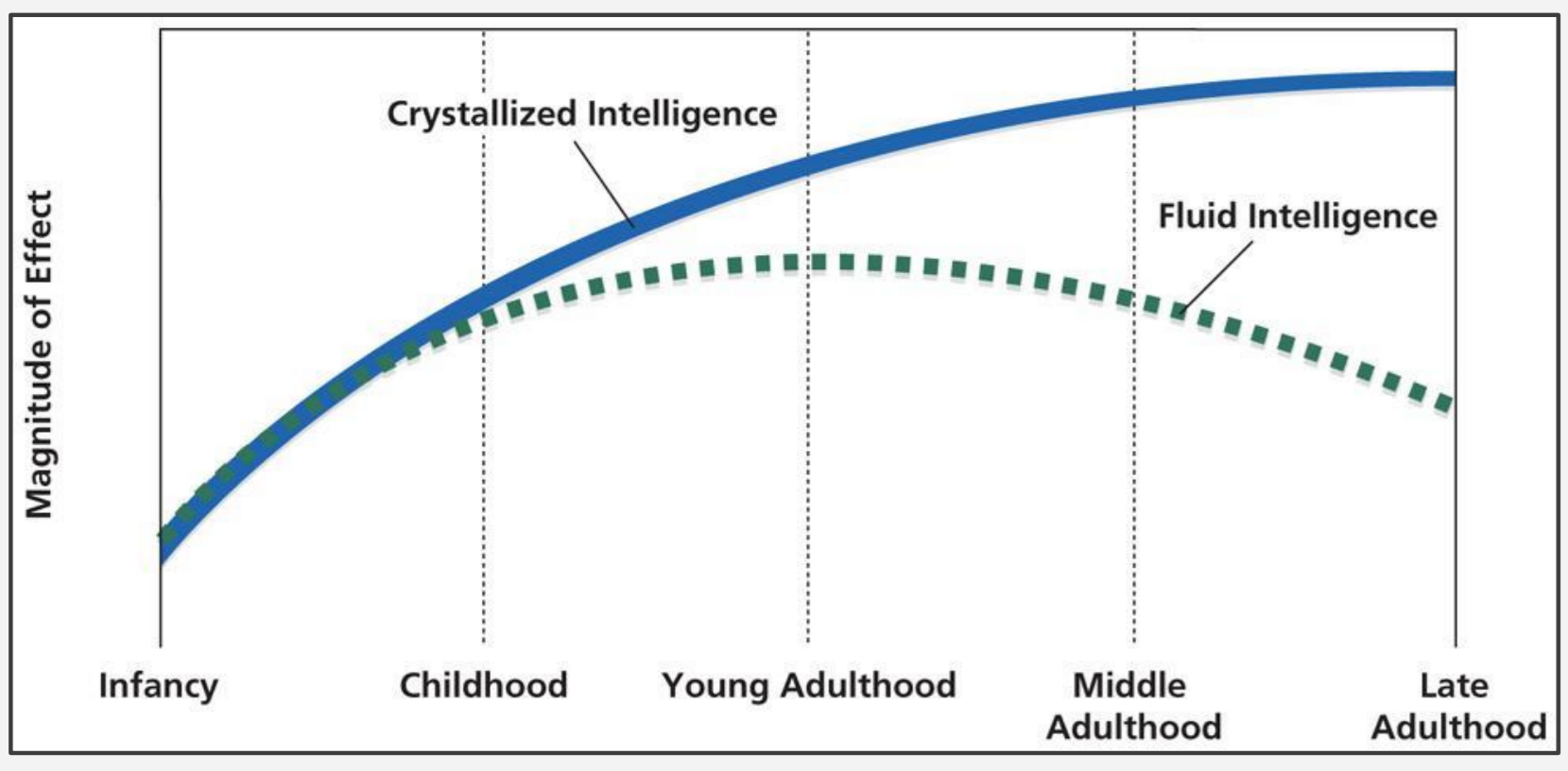
What is fluid vs crystallized intelligence?
Fluid intelligence - intelligence resulting from mental processing of logic, thought and reasoning (independent of experience)
Crystallized intelligence - knowledge and judgement acquired through experience and education
What is practical intelligence?
Intelligence that is learned by primarily observing others and modelling their behaviour
What is emotional intelligence?
The set of skills that underlie the accurate assessment, evaluation, expression, and regulation of emotions
What are some signs of low emotionail intelligence?
Being argumentative
Not listening
Blaming others
Emotional outbursts
What is creativity?
The combination of ideas in novel ways
What does creativity look like in early adulthood?
Creativity seems to peak during 30s-40s
Higher creativity in early adulthood can arise from exposure the situations
Cognitive flexibility
Many legendary musicians produced their best work during early adulthood
Still no fixed way to define creativity
What is cognitive flexibility?
The ability to shift between frameworks of thought and action, might underlie creativity
What are some stats on higher education in early adulthood?
65% of Canada’s population between ages 25-64 possess a graduate degree (OECD, 2018)
What are some demographics of higher education in early adulthood?
Women are more likely to attend college than men
Gender gap - more variety of employment opportunities for men or family obligation
Increasing trend of continuing education during young adulthood could stem from:
Job requirements
Maturation reform
What are some biases/stereotypes that are seen in higher education during early adulthood?
Some subjects might be dominated by one gender → influence of gender stereotypes
Students could receive different gender-based feedback
Hostile and and benevolent sexism
What is hostile sexism?
Overtly harmful treatment of one sex over another
What is benevolent sexism?
Stereotypical and restrictive treatment of one sex over the other
What is the first-year adjustment reaction?
Psychological symptoms that a first-year college student suffers from like loneliness, anxiety and withdrawal
Can adjustment to higher education look like in early adulthood?
Lower academic performance and a pressure to do well can lead to:
Academic disidentification
Stereotype threat
What is academic disidentification?
A lack of personal identification with an academic domain
What is stereotype threat?
Obstacles to performance that come from awareness of the stereotypes about academic abilities
What is emerging adulthood?
Neural pathways still solidifying - rational decision making, impulse control, self regulation mature
Period is driven by economic trends ➙ Eg. shift towards technology; Higher age of marriage and children
What are the features of emerging adulthood?
Identity exploration
Instability
Self-focus
Feeling in-between
Optimism
Which of Erikson’s psychosocial stages occurs during early adulthood?
Intimacy vs isolation stage: period of post-adolescence into early 30s that focuses on developing close, intimate relationships with others
What does development of Erikson’s intimacy vs isolation stage look like?
If successful → can form deep connections who can provide support during conflicts
If unsuccessful → develop fear of relationships, stay isolated, could lead to social frustration
Back to identity vs role confusion stage
What is intimacy?
The capacity to engage in a supportive, affectionate relationship without losing one’s own sense of self
What is career consolidation?
Stage that young adults enter between ages 20-40 yrs and become centered on their careers
What was Valliant’s longitudinal study on work and identity? What were the findings?
Valliant suggested that career consolidation bridges two of Erikson’s stages - shift from self
Early adults from study displayed lesser autonomy when starting work
What was a criticism of Valliant’s longitudinal study on work and identity in early adulthood?
Not generalizable → doesn’t include women or a more liberal view of work
Study is from the 1930s
What are reasons for people to work?
Intrinsic motivation - working for personal enjoyment and well-being
Extrinsic motivation - working for tangible rewards like money
Work can determine social status, correlated with job satisfaction (includes interest, freedom, variety)
What is Ginzberg’s career choice theory?
Consists of 3 periods:
Fantasy period
Tentative period
Realistic period
What is Ginzberg’s fantasy period of career choice?
Choice made without considering skill or opportunity
What is Ginzberg’s tentative period of career choice?
People think about variety in options fitting their abilities
What is Ginzberg’s realistic period of career choice?
Explore options through experience or training
What is Holland’s personality type theory?
Higher correspondence between an individual’s personality and career type will lead to higher job satisfaction
Though exceptions do exist
What are the different personality types in Holland’s theory?
Realistic
Intellectual
Social
Conventional
Enterprising
Artistic
What realistic personality type according to Holland?
Practical problem solvers
What is intellectual personality type according to Holland?
Thinkers, oriented towards the theoretical and abstract
What is social personality type according to Holland?
Verbal skills, interpersonal communication
What is conventional personality type according to Holland?
Do well in structured places, prefer clear instructions
What is enterprising personality type acording to Holland?
Risk taking, make good leaders
What is artistic personality type according to Holland?
Creative, expressive, original and independent
What are the main social developments that occur in early adulthood?
Intimacy and parenting
What do friendships look like in early adulthood?
Forming friendships can provide a sense of belonging in society
New friendships based on:
Proximity
Similarity
Mutual openness and closeness
Personal traits matter
Both same-sex and cross-sex friendships dominate
What is passionate love vs companionate love?
Passionate love - a state of powerful absorption in someone
Companionate love - strong affection for those involved deeply in our llives
What is the labelling theory of passionate love?
Romantic love occurs when:
Intense physiological arousal
Situational cues to indicate the feeling as ‘love’
Negative emotions could strengthen the feeling of love!
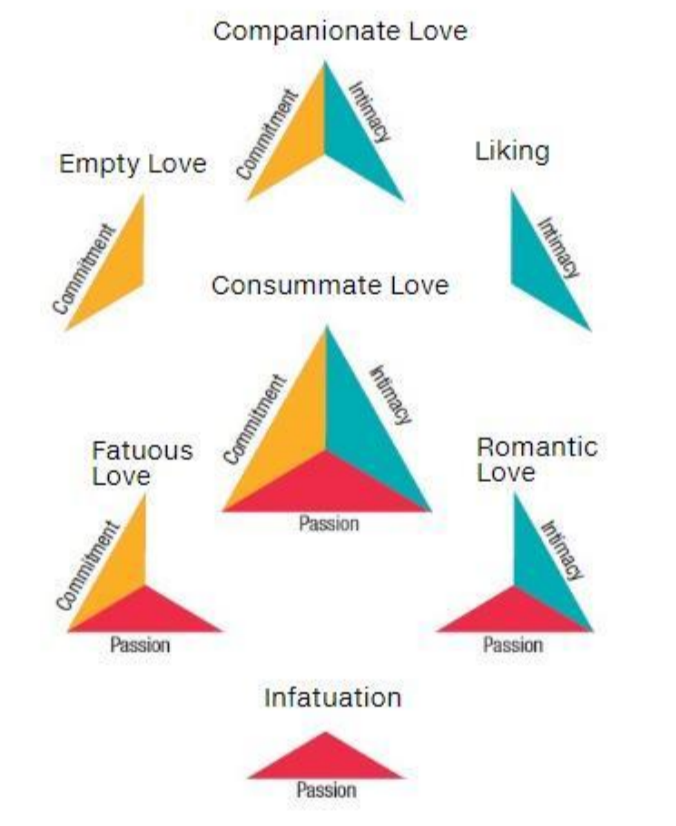
What is Robert Sternberg’s triangular theory?
3 basic units of a relationship:
Intimacy
Passion
Decision/commitment
These units combine to form different forms of love