OCR Gateway GCSE Physics: Practical Activity Groups: 1: Density, 5: Specific heat capacity, 6: IV Characteristics and 7: Series and Parallel Circuits
 Call Kai
 Learn
 Practice Test
 Spaced Repetition
 Match
 Flashcards
 Knowt Play
1/71

Earn XP
Description and Tags
From PMT
72 Terms
What is density?
Density is the mass per unit volume of an object/material.
What is the equation for density, including all SI units?
density (kg/m³) = mass (kg) / volume (m³) 𝜌 = m/V
How is weight measured?
Using a calibrated spring balance or Newton-meter.
How can you measure the volume of a regular solid?
Take appropriate length measurements (e.g., height, diameter) and apply an appropriate formula to calculate the volume.
What are examples of regular solids?
Cube, Prism (triangular, cylindrical, rectangular), Pyramid, Cone, Sphere.
What is the formula for the volume of a cube?
Volume = length³, V = x³.
What is the formula for the volume of a prism?
Volume = area of face x height.
What is the formula for the area of a square?
Area = length², A = x².
What is the formula for the area of a circle?
Area = 𝜋 x radius², A = 𝜋r².
What is the formula for the area of a triangle?
Area = ½ x base x height, A = ½ab.
What is the formula for the volume of a sphere?
Volume = 4/3 x 𝜋 x radius³, V = 4/3𝜋r³.
How do you work out the density of a regular solid object?
- Measure its mass using a scale/balance. 2. Take appropriate length measurements. 3. Calculate the volume. 4. Use 𝜌 = m/V to calculate the density.
How do you find the volume of an irregular solid?
By submersion.
How is submersion used to work out volume?
- Fill a beaker with water and read off the volume. 2. Submerge the object in the water. 3. Read off the new volume. 4. The change in volume equals the volume of the object.
What precaution must be taken when using submersion?
No water may leave the beaker, so avoid splashing/spilling.
How can submersion be used if the object floats?
Hold the object down so it is just submerged, ensuring fingers don't enter the water.
How do you work out the density of an irregular solid object?
- Measure its mass using a scale/balance. 2. Use submersion in a beaker of water to calculate its volume. 3. Use 𝜌 = m/V to calculate the density.
How do you work out the mass of a liquid?
Place a beaker on a balance and zero the device. Pour the liquid into the beaker and read off its mass.
How do you work out the volume of a liquid?
Pour it into a beaker/measuring cylinder and read off the volume.
How do you calculate the density of a liquid?
- Measure its mass using a scale/balance. 2. Read off the volume of liquid. 3. Use 𝜌 = m/V to calculate the density.
What is specific heat capacity?
The energy needed to produce a temperature increase of 1℃ in 1kg of a material.
What measurements must be taken to work out the specific heat capacity of a material?
Mass, temperature change, energy supplied.
What equation is used to calculate specific heat capacity?
E = mcΔθ, where Energy (J) = mass (kg) x specific heat capacity (J/kg℃) x change in temperature (℃).
How is the mass of an object measured?
Using a calibrated mass balance.
Describe the apparatus required for the specific heat capacity experiment.
Metal block with two slots (one for an electric heater with voltmeter and ammeter, one for a thermometer), insulating container, heatproof mat.
What can be done to improve the reading given by the thermometer?
Add a few drops of water in the hole with the thermometer to improve thermal contact and ensure even heating.
How is the energy transfer worked out when the power of the heater is given?
Multiply the power by the time the heater was used for: Energy (J) = Power (W) x time (s).
How is the energy transfer worked out using voltmeters and ammeters?
Record the current and voltage of the heater and run the experiment for a set period of time: Energy (J) = current (A) x voltage (V) x time (s).
What readings are taken during the experiment?
Temperature readings at 1 minute intervals.
What graph do you plot with the data from the experiment?
A graph of temperature against work done by the heater.
Why might the graph of temperature against work done be non-linear?
Thermal inertia means the block will initially heat up more slowly.
How can you overcome the error which causes the graph to be non-linear?
Heat the apparatus for 5 minutes to acclimatise before you start timing.
Describe the method used to determine the specific heat capacity of a metal.
Measure the mass of the metal, record the initial temperature, heat for 5 minutes, take voltage and current readings, then start stopwatch. Take temperature readings every minute for 10 minutes, plot a graph of temperature against energy supplied, and find the gradient. The gradient = 1/c, so use the reciprocal to find c.
What safety precautions must be taken with this method?
Be careful when handling the metal after heating; it may be hot. Allow it to cool for at least 10 minutes before touching. Ensure all electrical equipment is safe.
What does a high specific heat capacity indicate?
That a material can store a lot of thermal energy (per kg).
What are the units of specific heat capacity?
J/kg℃.
What is a series circuit?
A series circuit is one in which the same charge passes through all components. This means the current through each component is the same.
What is a parallel circuit?
A circuit in which the charge is split between branches.
Describe the current across a series circuit.
Current is the same at all points in a series circuit.
Describe potential difference in a series circuit.
Potential difference is split between components, according to the ratio of their resistances.
Describe current across a parallel circuit.
Current is split between the branches of the circuit.
Describe the potential difference across a parallel circuit.
Each branch has a potential difference equal to the potential difference of the supply.
What is the total resistance in a series circuit?
The sum of the individual resistances of each component.
What is the total resistance in a parallel circuit?
The total resistance will be lower than that of the branch with the lowest resistance. This is because the charge is split. Decreasing the charge to each component decreases its resistance.
Draw the circuit symbol for a lamp.
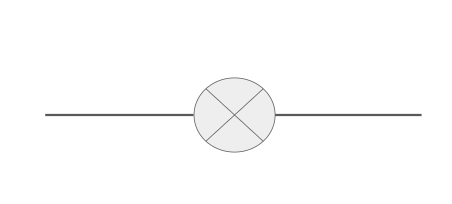
Draw a circuit diagram for one lamp in series.

Draw a circuit diagram for two lamps in series.

Draw a circuit diagram for two lamps in parallel.

Draw a circuit diagram for three lamps in parallel.

Give 6 possible circuits for this investigation.( PAG 07 - Investigating the brightness of bulbs in series and parallel)

Describe a method for investigating the brightness of bulbs in these circuits.
● Set up each circuit ● Record a description of the brightness of each bulb ● Compare the brightness of each bulb in each circuit
What kind of data does this method produce?
Qualitative data.
How can the method be adapted so quantitative data can be collected?
Attach a voltmeter to each bulb and record the voltage (the higher the voltage, the brighter the bulb will be).
What kind of power supply should be used for this practical?
A variable voltage supply.
How else can voltage be varied?
Using a variable resistor.
How is current measured?
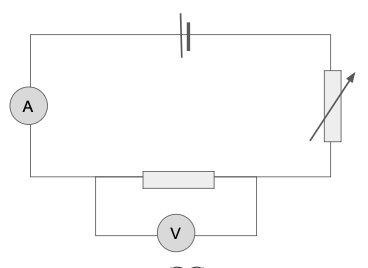
Using an ammeter wired in series.
How is voltage measured?
Using a voltmeter wired in parallel.
What would a circuit diagram for this procedure (Investigating the IV characteristics of circuit elements.) look like?
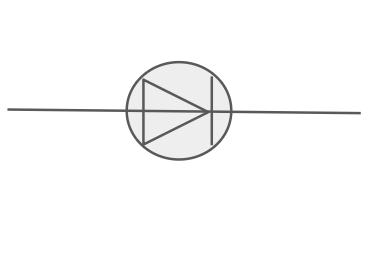
Draw the circuit symbol for a diode.
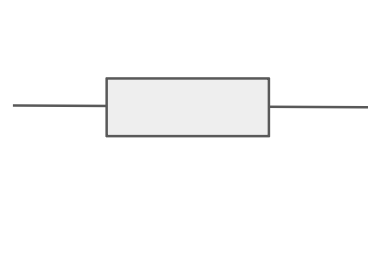
Draw the circuit symbol for a resistor.
Draw the circuit symbol for a thermistor.
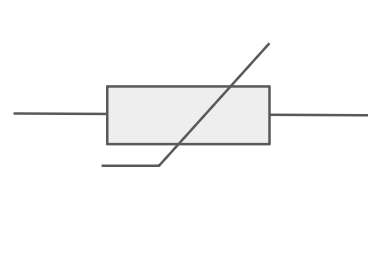
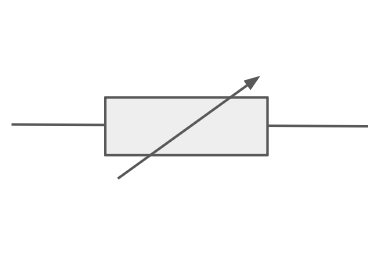
Draw the circuit symbol for a variable resistor.
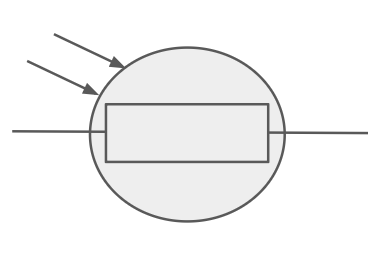
Draw the circuit symbol for an LDR.
What is an ohmic conductor?
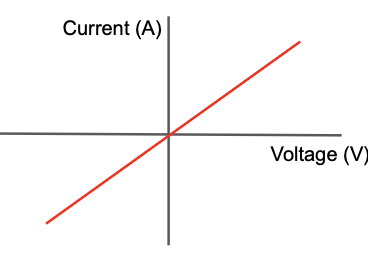
A conductor for which resistance is constant, meaning the conductor’s IV characteristic (graph of current against voltage) has a linear (straight line) gradient.
Draw the IV characteristic of an ohmic conductor.
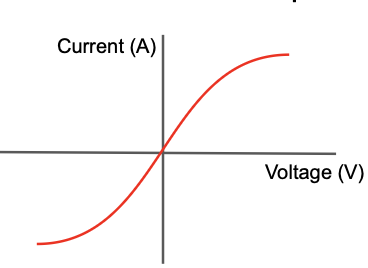
What would you expect the IV characteristic of a filament lamp to look like? Why?
When current flows, the filament produces heat. This increases the resistance of the filament (R=V/I).
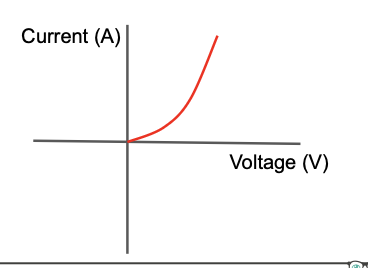
What would you expect the IV characteristic of a diode to look like? Why?
Current through a diode flows in one direction only, as it has a very high resistance in the opposite direction.
How does resistance change with temperature?
As temperature increases, ions and electrons have more kinetic energy. This results in more collisions between the stationary metal ions, making it more difficult for electrons to move through the wire and carry a charge. Therefore resistance increases with temperature.
How does increased resistance affect an IV characteristic?
The gradient becomes shallower (less steep).
How do you obtain negative current values?
Reverse the connections to the power supply.
Describe a method for this experiment (IV Characteristics)
● Set up the circuit with a variable voltage supply ● Set the EMF at 1V intervals from 0V to 6V and measure current and p.d. at every interval ● Reverse the connections and repeat for negative values ● Repeat three times and calculate mean current and p.d. ● Plot a graph of I against V ● Repeat for a range of components
What are the safety risks of this procedure?
● Risk of electrocution - ensure equipment is properly insulated and safe ● Some components (eg. filament lamp) may heat up so allow cooling time before handling