Nematoda and Nematomorpha
 Call Kai
 Learn
 Practice Test
 Spaced Repetition
 Match
 Flashcards
 Knowt Play
1/92

There's no tags or description
Looks like no tags are added yet.
93 Terms
Ecdysozoa
A clade that includes animals that molt (ecdysis)
Body plan of Ecdysozoa
Three-layered, nonliving cuticle
What do Ecdysozoa lack?
Locomotory cilia
How many clades does Ecdysozoa have?
Eight clades
Comprises 83% of all known animal species
Clade Nematoida
Consists of phyla Nematoda and Nematomorpha
Clade Scalidophora
Consists of three minor phyla
Clade Panarthropoda
Phyla Arthropoda, Onychophora, and Tardigrada
Nematoida - Body plan
Vermiform bodies that are long and thin
Threadworms
Nematoida - Cuticle Composition
Adult cuticle of collagen, mostly without chitin
Do Nematoida have specialized respiratory or circulatory system/structures
No specialized respiratory or circulatory system/structures
What type of muscles do Nematoida lack?
Lack circular muscles
Nematoda - Roundworms
Few millimeters thick
Few millimeters to several meters long
Typical nematode length
1-2 mm long
Hapalomus minutus - Nematoda
0.08 mm long
Found in sandy beaches and coral reefs
Placentanema gigantissma - Nematoda
Longest known parasitic nematode
Females up to 8.4m long
Found in uterus and placenta of female sperm whales
Nematoda are parasitic or free-living?
Ubiquitous - free-living and parasitic species
Do nematoda have metamerism?
No metamerism (unsegmented)
Nematoda - Body plan
Vermiform and blastocoelomate
Pseudocoelomate/hemocoelomate
Nematoda - Cross-section
Round
Covered by layered cuticle of collagen
How many species of Nematoda?
27,000 species
Nematoda have a complete __ system?
Gut/alimentary system
Renette cells in Nematoda
Gladular excretory structures connected to excretory pore
Characteristic movement of Nematoda
Only longitudinal muscles, no circular muscles
Move by alternating contractions of dorsal and ventral muscles
Are the movements of nematodes efficient or inefficient?
Inefficient
Why do nematodes need a pharynx?
Due to being under high pressure from environment
Are Nematoda dioecious or monoecious?
Mostly gonochoristic
What do male nematoda have?
Cloaca - common exit point for digestive waste and sperm
Females have separate what?
Gonopore and anus
Reproductive opening
Most show degree of sexual what?
Sexual dimorphism
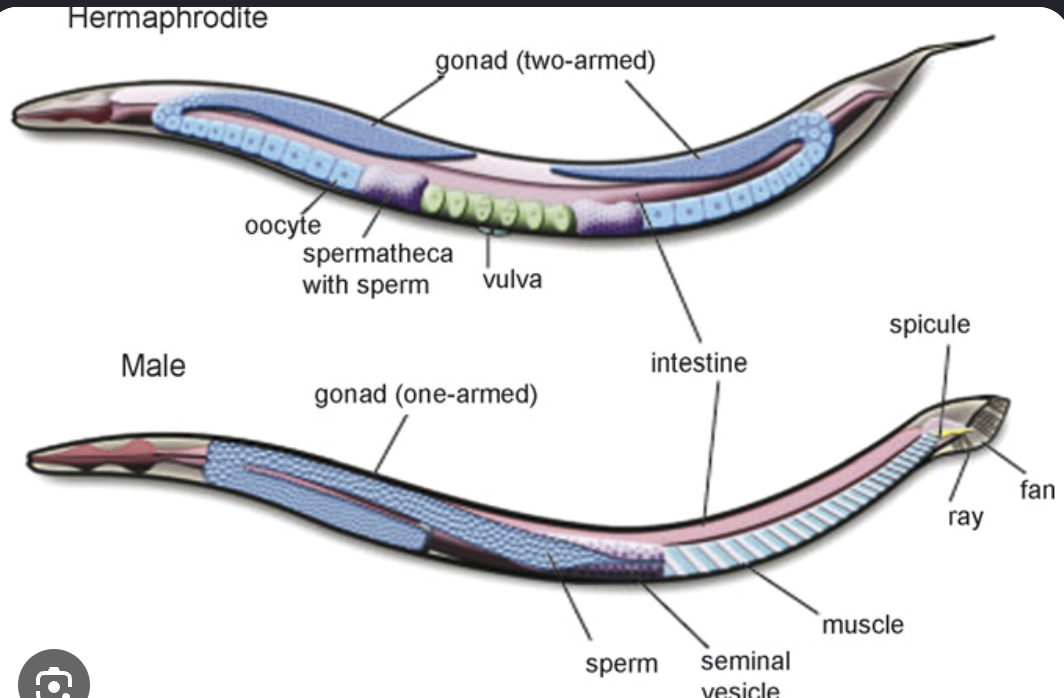
What type of cleavage pattern in Nematoda?
Unique - not distinctly spiral or radial?
Growth occurs in () stages through ()
Juvenile (larval) through ecdysis
4 stages
Ecological importance of Nematoda
Tremendously abundant decomposers
Most diverse metazoans in marine sediments
Economic importance of Nematoda
Plant and livestock pathogens
Medical importance of Nematoda
Cuticle - Resist host immune system
Endoparasites
Parasites can cause diseases in humans and pets
Human-Parasitic Nematodes
Ascariasis - Ascaris lumbrioides
Pinworms - Enterobius vermicularis
Whipworms - Trichuris trichiura
Hookworms - Ancylostoma
Trichinosis - Trichinella spiralis
River Blindness - Onchocerca volvulus
Guinea worm - Dracunculus medinesis
Heartworm - Dirofilaria immitis
Filarial worms - Wucheria
Ascaris lumbricoides
Most ubiquitious nematode parasite of humans
Largest intestinal nematode

Ascaris lumbricoides - Infections
Second most common helminth infection in the U.S.
Ascaris lumbricoides - Prevalence
Highest prevalence in tropical and subtropical regions (Neglected Tropica Disease)
Is Ascaris lumbricoides symptomatic?
Not symptomatic until high parasite load
Ascaris lumbricoides - Egg-laying
Each female produces 200,000 eggs per day
27 million during lifespan
Ascaris lumbricoides - Transmission
Passed in feces and transmitted by contamination water or food
Ascaris lumbricoides - Durability
Highly resistant to adverse environmental conditions
Ascaris lumbricoides - Diagnosis
Presence of eggs in feces is used to diagnose infection
Symptoms of ascariasis
A few adult worms usually cause no symptoms.
• Large numbers can cause abdominal pain and intestinal obstruction
• Migrating adult worms can occlude the bile tract, causing jaundice and malnutrition
• Larvae wondering through body – larval migrans – can cause more serious damage
• During the lung phase of larval migration, lung damage can occur
Trichinella spiralis
Causes trichinosis
Trichinosis
One of the most serious diseases caused by nematodes in the US
Where does T. spiralis live?
Intestines of pig hosts and other vertebrates
Pregnant T. spiralis females
Burrow into intestinal wall of their host and produce around 1,500 live young
T. spiralis young
Enter lymph channels and migrate to muscle tissue, forming highly resistant cysts that may remain alive and dormant for several years
T. spiralis - Infection
Eating undercooked pork or wild meat containing cysts
T. spiralis - Infective stage
Ingested in meat products
What occurs after T. spiralis young are ingested?
Larva feed in intestine and mature, encysting in striated muscle
Larval migrans
Cause disease when larvae are confused and move to other parts of the body like the brain that are not part of the normal migration.

Ancylostoma caninum
Hookworm
Hatching of hookworm
Eggs shed in soil hatch within 48 hours.
Molting of hookworm
After ~ 7 days, worms stop feeding and molt
When do hookworm infections occur?
Infections are acquired when larvae penetrate the skin of a human.
Course of hookworms
• Larvae enter lymphatic system or bloodstream, and travel to the lungs. After maturating in lungs, they migrate up trachea to be swallowed and reach small intestine, where they mature to adults.
• Adults attach to intestinal mucosa and suck blood and tissue juices of host.

Sexual maturation of hookworms
~5 weeks after infection, worms undergo final molt to become sexually mature. Fertilization occurs, and females release eggs (life span is ~1 yr).
Enterobius vermicularis
Causes enterobiasis
Enterobius vermicularis
Pinworm, threadworm, or seatworm
Enterobius vermicularis - infection
Most common helminth infection in the US
Enterobius vermicularis - Transmission
direct, person-to-person
Enterobius vermicularis - Infective stage
Egg is infective immediately or within hours of being shed by the female
Enterobius vermicularis - Prevalence
Common worldwide but more prevalent in temperate climates
Common in children
Enterobius vermicularis - Host
Humans
Enterobius vermicularis - Life cycle
Eggs are ingested, hatch in intestine, larvae mature to adults.
Gravid females migrate to the perianal area at night to lay eggs; cause intense itching.
Eggs develop to infective stage within 4-6 hours. Eggs can survive for extended periods in cool, moist environment.

Enterobius vermicularis - Diagnosis
Recovery and identification of eggs or adults from the perianal region utilizing the Scotch tape preparation.
Filarial nematodes - Transmission
Transmitted by biting insects like mosquitoes
Where do filarial nematodes live?
Live in tissues, blood vessels, or lymphatic ducts of vertebrate host
Wuchereria bancrofti
Can cause a condition called elephantiasis by blocking lymphatic return and causing chronic edema and fibrosis (formation of scar tissue)
Onchocerca volvulus
causes river blindness
– affects ~30 million people
Dirofilaria
Dog and cat heartworm

Dracunculus medinensis - Guinea worm
The disease is caused by the large female nematode of D. medinensis, which is among the longest nematodes infecting humans.
Adult female vs male Dracunculus medinensis
Females are much larger than the males
Longest female Dracunculus medinensis found
Found in 2009
Was 800 mm (31 in), while the largest adult male was only 40 mm (1.6 in)
Infective stage of Dracunculus medinensis
Exists in a water flea (copepod – the intermediate host).
Human Infection - Dracunculus medinensis
Infected by drinking water containing the infected copepod.
Where do Larvae go after entering host? Dracunculus medinensis
Larvae penetrate the digestive tract to enter the deep connective tissues where they mature in about 1 year.
Where do adult mature females go in host? Dracunculus medinensis
Females migrate to the subcutaneous tissue (usually the skin of the extremities)
How do larvae get released with Dracunculus medinensis
Females release larvae which leave the human through ruptured blisters on the skin.
How do larvae enter copepods? Dracunculus medinensis
The larvae enter the water and are ingested by copepods.
Onchocerca volvulus
Causes blinding filariasis
Where does blinding filariasis occur (Onchocerca volvulus)
38 countries worldwide with an estimated 18 million people infect4ed
Blinding filariasis - (Onchocerca volvulus)
Infections involve the dermis and subcutaneous tissues, where adults gather within nodules.
Neglected Tropical Disease
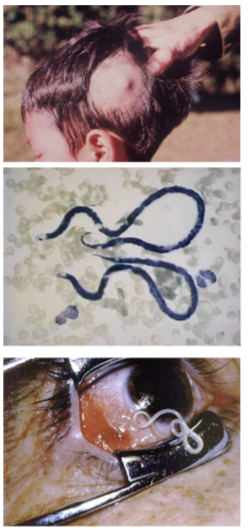
Vector: Blinding filariasis - (Onchocerca volvulus)
Simulium flies (black fly)
Avoiding parasitic nematodes
Be a savvy traveler – know the risks before going somewhere unfamiliar (especially in the tropics)
Cook meat thoroughly (never eat sushi made from freshwater fish!)
Don’t drink unpurified water (or get water in your mouth while swimming, esp. in the tropics)
Don’t swim in polluted water (i.e., downstream of a sewage treatment plant or where untreated sewage may enter the water)
Wear shoes when outside in the tropics
Pets that spend time outdoors should be given prophylactic heartworm treatment
Plant parasitic nematodes
• Economically important- estimate 80 billion dollars of crop loss worldwide annually
• Several hundred of species affecting all types of crops
• Plant parasitic nematodes have a stylet to puncture cells

Treatment for plant parasitic nematodes
Many commercially available pesticides and “organic” treatments are available
What can insect parasitizing nematodes be used for?
Biological control of pests instead of chemicals
Popular for organic gardening
Nematomorpha larvae
Parasites of beetles, cockroaches, mantids, orthopterans, and other arthropods
How are larvae ingested?
When insects drink water and penetrate gut to body cavity
Free-living Nematomorpha
Long and narrow (30-40 cm in length; about 1 mm in diameter)