Learn: Reformation
 Call Kai
 Learn
Learn Practice Test
 Spaced Repetition
 Match
Match Flashcards
 Knowt Play
1/33

There's no tags or description
Looks like no tags are added yet.
Name | Mastery | Learn | Test | Matching | Spaced | Call with Kai | Chat |
|---|
No analytics yet
Send a link to your students to track their progress
34 Terms
Protestant
A term applied to a Christian who belonged to non-Catholic churches.
16th century series of religious actions which led to establishment of the Protestant churches. Led by Martin Luther

Reformation
A movement for religious reform of the Catholic Church
Indulgence
A way to remove sin by paying the Catholic church money. Payments took the place of acts or deeds. This practice began to be seen as a corrupt way for the church to raise money.

Martin Luther
16th century German monk and professor who is considered to be the person who started the Protestant Reformation; he began by criticizing Church practices (mainly indulgences) and ultimately broke with the Catholic Church to form his own new religious faith

95 Theses
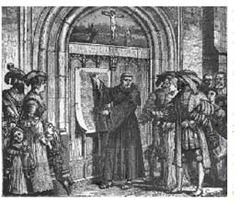
Martin Luther's ideas that he posted on the church door at Wittenburg which questioned the Roman Catholic Church, especially criticizing the practice of selling indulgences. This act began the Reformation.

Henry VIII
English King who broke away from Pope in order to divorce his wife Catherine of Aragon.

Anglican Church
Form of Protestantism set up in England after 1534; established by Henry VIII with himself as head, at least in part to obtain a divorce from his first wife.
Became the official church of England

John Calvin
A Protestant leader who called for strict rules and a theocratic government.

Council of Trent
A series of meetings between Catholic Bishops and Cardinals that set several Catholic doctrines.
Strengthened traditional Catholic practices and ideas in the face of rebellion by Luther and other protestants

Jesuits
Religious order devoted to teaching, converting, and defending the Catholic faith.

Inquisition
A Roman Catholic tribunal for investigating and prosecuting charges of heresy - especially the one active in Spain during the 1400s.

Cause of the Reformation
Corruption of the Catholic Church during the Renaissance: Sale of church offices (simony); nepotism (sale to family members of church offices) sale of indulgences, Decline of morality among the clergy, Printing Press, popularity of Martin Luther, popularity of Humanism
Peasants Revolt
a series of uprisings by German peasants against their landowners. over 130,000 peasants were killed

Predestination
Calvin's religious theory that God has already planned out a person's life.

Calvinism
A religion created by John Calvin

Erasmus
Dutch humanist and theologian who was the leading Renaissance scholar of northern Europe

Charles V
1500-1558. Holy Roman emperor (1519-1558) and king of Spain as Charles I (1516-1556). He summoned the Diet of Worms (1521) and the Council of Trent (1545-1563)

Counter-Reformation
A 16th century movement in which the Roman Catholic Church sought to make changes in response to the Protestant Reformation
Also known as the Catholic Reformation.

William Tyndale
first person to translate Latin to English of the bible

Diet of Worms
Assembly of the estates of the empire, called by Holy Roman Emperor Charles V in 1521. Luther was ordered to recant but he refused. Charles V declared Luther an outlaw.

Excommunication
Exclusion from Catholic Church as penalty for refusing to obey church laws. During this time, the punishment often came with the penalty of death
Heresy
(n.)an opinion different from accepted belief; the denial of an idea that is generally held sacred
Blasphemy
An act or statement that shows disrespect or irreverence toward something considered sacred.
Lutheranism
The religious doctrine that Martin Luther developed; it differed from Catholicism in the doctrine of salvation, which Luther believed could be achieved by faith alone, not by good works; Lutheranism was the first Protestant faith.
Also believed that anyone could interpret the Bible.

Printing Press
15th century invention which revolutionized the ability to print information which in turn affected the speed of the spread of information itself.

Johannes Gutenburg
German printer; in 1448 he invented a printing press that used movable type. The first book printed is called the "Gutenberg Bible."

Effects of the printing press
people questioned the church because now they could read scripture. People became literate and exploration was made possible (printing of maps). Propoganda becomes possible and books are cheaper and easier to find. Also laws became easier to follow and well known through the country. Caused ideas to spread more rapidly.

humanism
A Renaissance intellectual movement in which thinkers studied classical texts and focused on human potential and achievements.
humanities
Branches of knowledge concerned with human beings and their culture: philosophy, literature, and the fine arts, as distinguished from the sciences
Johann Tetzl
priest who offered indulgences to any Christian who contributed money to the construction of St. Peter's Basilica

The Index
The list of books prohibited by the Catholic Church (obviously Luther's and Calvin's works are included in the Index). The goal was to protect the faith and morals of Catholics by preventing people from being contaminated. It was created during the Counter-Reformation as a way of stopping the spread of Protestantism.

Ignatius Loyola
(1491-1556) Spanish churchman and founder of the Jesuits (1534); this order of Roman Catholic priests proved an effective force for reviving Catholicism during the Catholic Reformation.

sacraments
There are seven sacraments in the Church: Baptism, Confirmation, Eucharist, Penance, Anointing of the Sick, Matrimony, and Holy Orders. The purpose of the sacraments is to make people holy, to build up the body of Christ, and finally, to give worship to God; but being signs, they also have a teaching function.

free will
God's gift to human beings of the freedom and ability to choose what to do