Select OB/GYN Applications: Inhibition, Pelvic Diaphragm Release
 Call Kai
 Learn
 Practice Test
 Spaced Repetition
 Match
 Flashcards
 Knowt Play
1/6

There's no tags or description
Looks like no tags are added yet.
7 Terms
Supine Paraspinal Inhibition
Patient SUPINE; physician seated at either side, forearms on table (FULCRUM).
Assess TART at T1–L2.
Place BOTH hands/fists UNDER paraspinal muscles (thoracic/lumbar), palms near spinous processes. Palm is on same side TP while fingerpads are on opposite TP. Have forearems on table to create a fulcrum (anterior force).
Gently approximate muscles ANTEROMEDIALLY toward spine. Bring fingerpads towards me (fingerpads and heel of hand together).
HOLD 2–5 MINUTES until relaxation.
Gently release → REASSESS by palpating for hypertonicity of paraspinal muscles.
Memory: TART → Hands UNDER → SQUEEZE toward spine → HOLD 2–5 min → Retest

Seated Paraspinal Inhibition
Patient SEATED; physician positioned BEHIND, feet grounded.
Place BOTH FISTS or pressed palm (Cornick said in lab) on either side of spine at affected level (often thoracolumbar junction).
Apply firm, comfortable COUNTERPRESSURE (anterior force).
HOLD for 2-5 minutes.
REASSESS.
Memory: Behind → Fists beside spine → Press → Reassess

Sacral Inhibition
Patient SUPINE, arms crossed over chest; physician seated at side.
CEPHALAD hand: Under SACRAL BASE, above S2. (Locate iliac crest and tell pt you’re placing hands on tailbone)
CAUDAD hand: Under SACRAL APEX/ILAs, below S2.
Rest ELBOWS on table (FULCRUM).
Press elbows DOWN → gently lift sacrum ANTERIORLY (UP).
HOLD for 2-5 minutes until release.
REASSESS sacral restriction.
Memory: Base + Apex → Elbows DOWN → Sacrum UP → HOLD → Retest
Alternative: One hand with fingers spread above and below S2 (PSIS level).
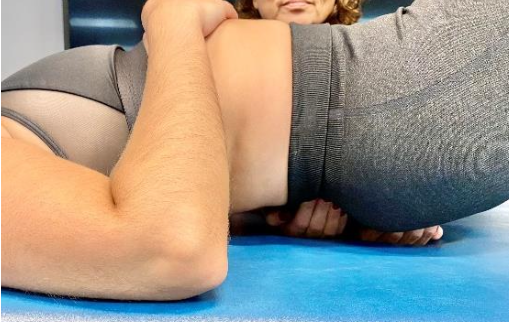
Gluteus Minimus Trigger Point Inhibition
Patient lies on AFFECTED SIDE; physician seated BEHIND.
Place FIST between table and tender gluteus minimus.
Locate greater trochanter. If you go posterior + superior = gluteus minimus,
Bend pt legs. Roll them back to apply LIGHT, SUSTAINED PRESSURE.
HOLD 2-5 minutes until release + pain decreases.
Gently release → REASSESS. Tell pt you’re going to palpate your gluteal/buttock muscles.
Memory: Affected side DOWN → FIST under tender spot → Gentle PRESS → Release → Retest
KEY: Pressure should be mildly uncomfortable, NOT overly painful.

Piriformis Inhibition
Patient SIDE-LYING, affected piriformis UP; physician stands facing pelvis/pt (Tedjo prefers you standing behind pt, but either works).
Flex HIPS 45° + KNEES 90°.
Locate hypertonic piriformis near posterior + medial to greater trochanter.
Place OLECRANON (elbow) gently on hypertonic muscle.
Apply SLOW, GENTLE DOWNWARD PRESSURE toward table.
HOLD 2–5 MINUTES or until softening.
REASSESS tenderness, muscle tone, and/or hip internal rotation. Tell pt you’re going to palpate your gluteal/buttock muscles.
Memory: Affected side UP → Hip 45°/Knee 90° → ELBOW → PRESS DOWN → HOLD 2–5 min → Retest
KEY: Don't press too hard! Elbow is less sensitive than fingers.

Pelvic Diaphragm Release (Side-Lying)
Explain sensitive-area contact and obtain permission.
Patient SIDE-LYING, hips/knees flexed; physician BEHIND.
Palpate sit bone. Locate greater trochanter then heel of hand should land on sit bone.
CAUDAD fingertips, palm faces up: Contact MEDIAL to upper ischial tuberosity.
Advance gently into ISCHIORECTAL FOSSA, medial to sacrotuberous ligament.
During INHALATION: Gently RESIST DOWNWARD pelvic diaphragm movement.
During EXHALATION: Gently FOLLOW CEPHALAD (UP).
Repeat until MAXIMAL LIFT/RELEASE.
REASSESS with breathing → treat opposite side (verbalize “I would perform this on both sides”)
Memory: Consent → Sit bone MEDIAL → INHALE resist DOWN → EXHALE follow UP → Repeat → Retest!

Pelvic Diaphragm Release (Supine)
Explain contact and obtain permission.
Patient SUPINE, hips/knees FLEXED.
Physician sits OPPOSITE side of dysfunction. Cornick used caudad hand for the technique.
I'm going to palpate back of your thing until I reach your sit bone. Use heel of hand along hamstrings to find ischial tuberosity.
Roll your THUMBPAD MEDIAL to ischial tuberosity on affected side.
Apply gentle CEPHALAD (UP) pressure, then LATERAL force.
Patient INHALES/EXHALES deeply 5-7 times. I'm now reassessing by having the pt inhale/exhale. Observing the movement as there's cephalad movement during exhalation etc.
With each EXHALATION, increase CEPHALAD pressure until release.
Gently release → repeat opposite side as needed.
Memory: Opposite side → Thumb MEDIAL to sit bone → UP + OUT → EXHALE push UP → Release
