Limits & Continuity
 Call Kai
 Learn
 Practice Test
 Spaced Repetition
 Match
 Flashcards
 Knowt Play
1/10

There's no tags or description
Looks like no tags are added yet.
11 Terms
What does the limit of a function represent?
The value a function approaches as its input approaches a particular value.
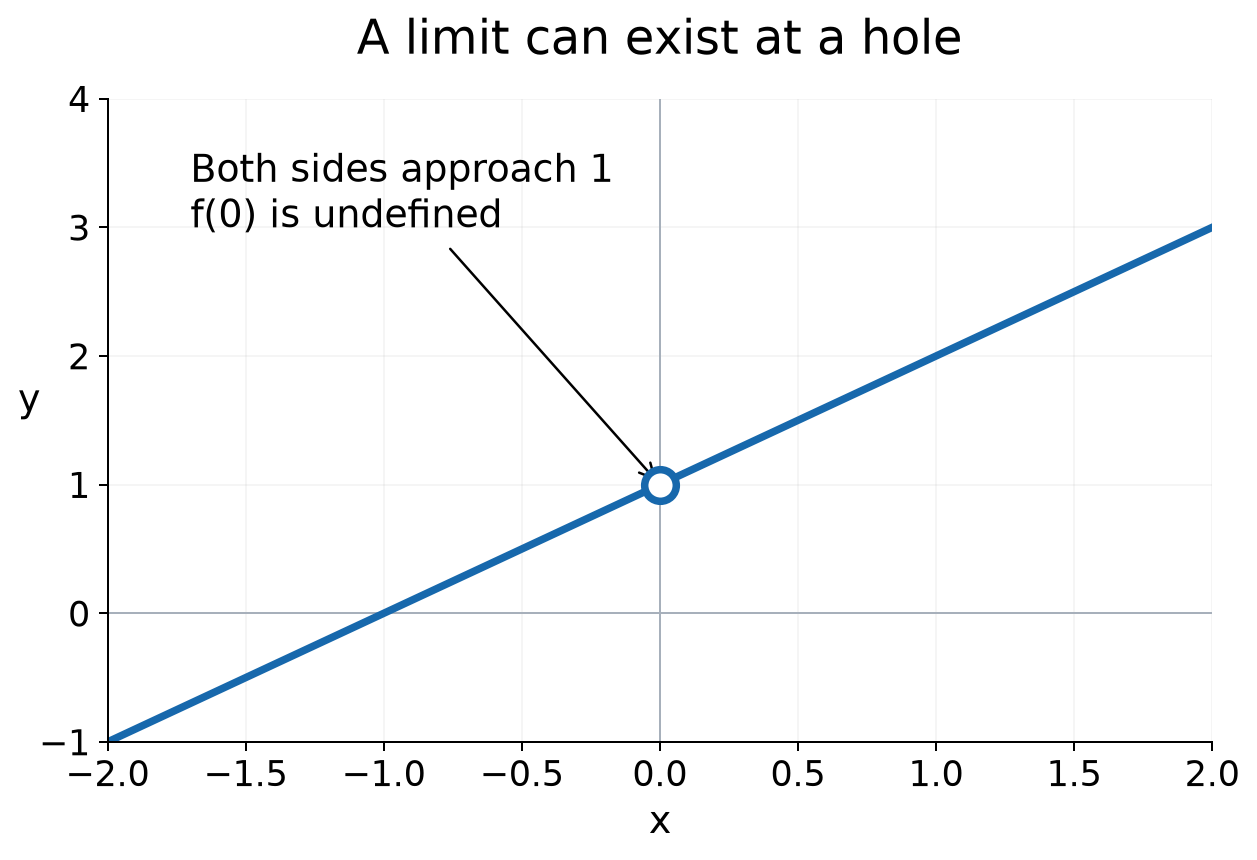
Can a limit exist when the function is undefined at that point?
Yes. A limit depends on the behaviour near the point, not necessarily the function's value at that point.
When does a two-sided limit exist?
When the left-hand and right-hand limits both exist and are equal.

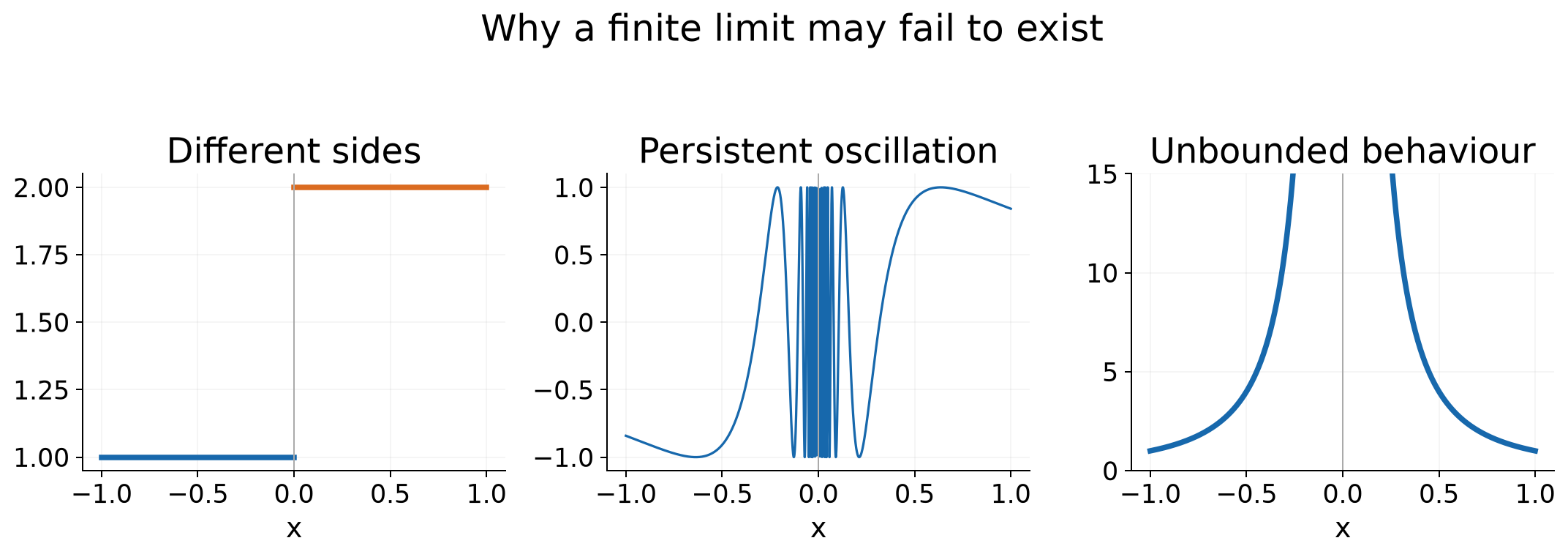
What can cause a limit not to exist?
Different left-hand and right-hand limits, oscillation without approaching a value, or unbounded behaviour when a finite limit is required.
What is the sum rule for limits?
If two finite limits exist, the limit of their sum equals the sum of their limits.
What is the product rule for limits?
If two finite limits exist, the limit of their product equals the product of their limits.
When can the quotient rule for limits be applied?
When the numerator and denominator have finite limits and the denominator's limit is nonzero.
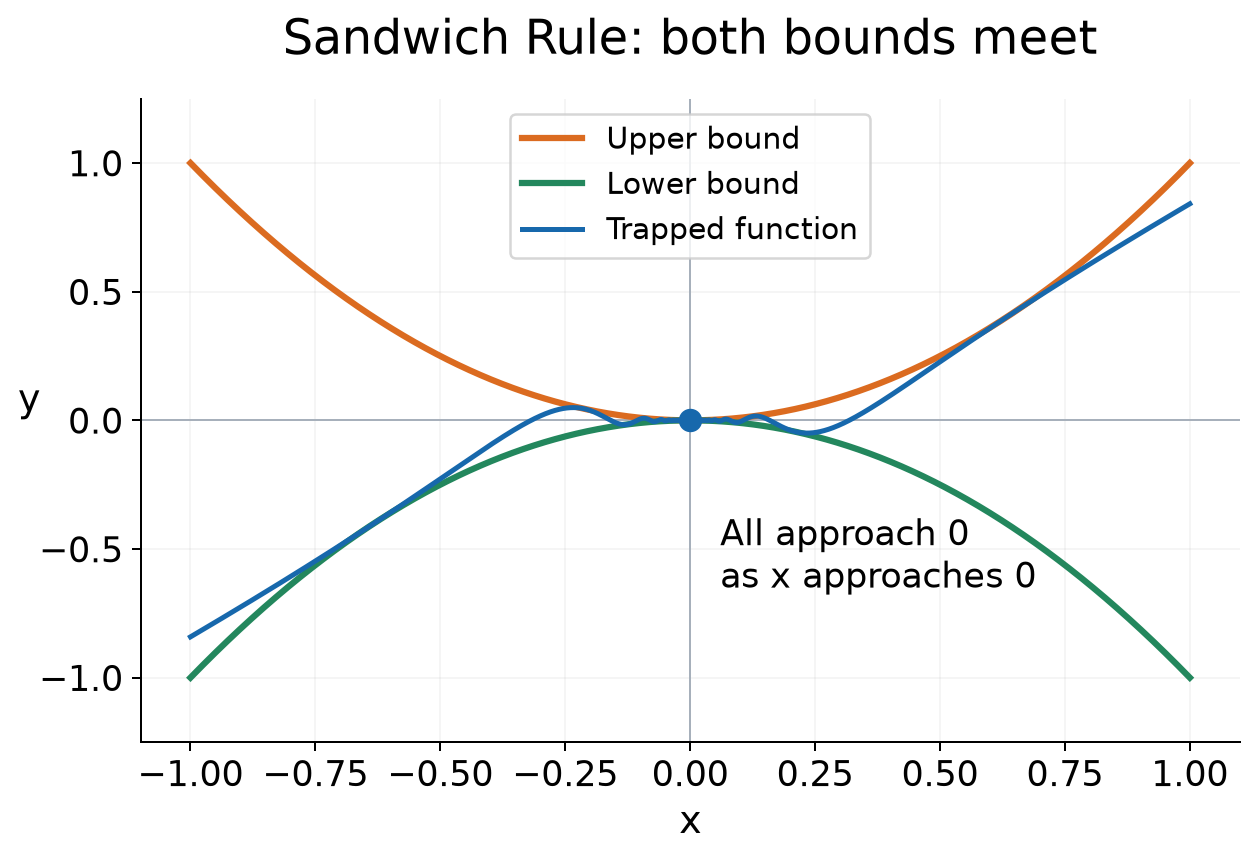
What is the Sandwich Rule?
If a function lies between two other functions that approach the same limit, the function must approach that limit too.
When can you pass a limit through a composition f(g(x))?
If g(x) → m as x → a and f is continuous at m, then f(g(x)) → f(m). More generally, if lim(t→m) f(t)=L and g(x) stays different from m for x sufficiently near a with x≠a, then f(g(x)) → L. If g(x) can equal m near a, continuity at m is a sufficient condition.
What three conditions establish continuity at x = a?
f(a) is defined, the limit as x approaches a exists, and that limit equals f(a).

Can a function have a limit at a point but still be discontinuous there?
Yes. If the function's value differs from the limit, it is discontinuous.