Phylogenetic tree basics
 Note
 Call Kai
 Learn
 Practice Test
 Spaced Repetition
 Match
 Flashcards
 Knowt Play
1/25

There's no tags or description
Looks like no tags are added yet.
26 Terms
Phylogenetics
aims to discover the pattern of evolutionary relatedness among groups of organisms by comparing their anatomical or molecular traits, and depicting these relationships as branching trees
Root ( base )
of the tree represents the ancestral lineage, and the tips of the branches represent the descendants of that ancestor
Taxa
The groups of interest, __ are listed at the tips of the branches. __ can be any group of organisms, including species, genera, or even domains. I
Node
The point on a phylogenetic tree where a branch splits is a __ .
Sister groups
Groups that are more closely related to each other than either is to any other group are called
Parsimony
The principle of _ , for example, states that the simplest explanation is the most likely.
Common ancestor
A node represents the _ from which the descendant species diverged
Phylogenetic trees
are built using data such as morphological traits and molecular sequences, and are visual representations or models about how organisms have changed over time.
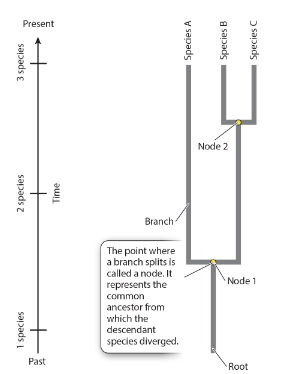
Phylogenetic trees are _ about the evolutionary history of organisms or groups of organisms. They are built using _ traits and molecular sequences of living and extinct organisms. As you move from the root of a phylogenetic tree to the tips, you are moving forward in _
facts; morphological; distance
models; morphological; time
facts; distance; time
models; distance; nodes
models; morphological; time
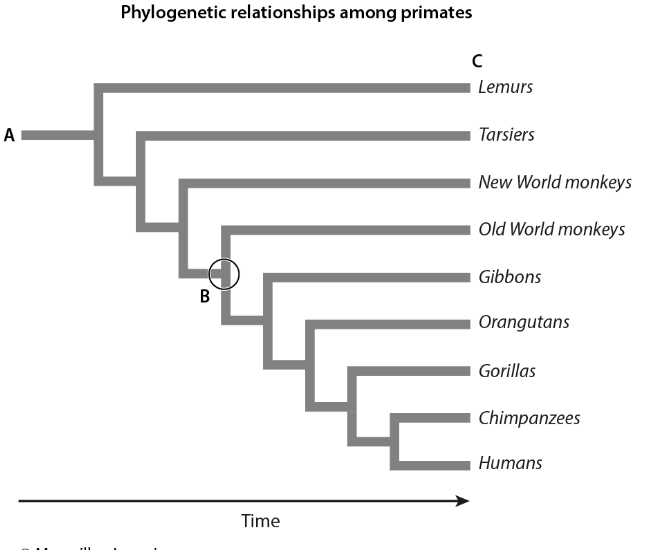
Phylogenetic trees illustrate evolutionary history. The first step when reading a tree is identifying the key parts. Which letter-A, B, or C-on this tree indicates the correct location of the root of the tree? Recall that the root is the base of the tree and it represents the ancestral lineage.
A
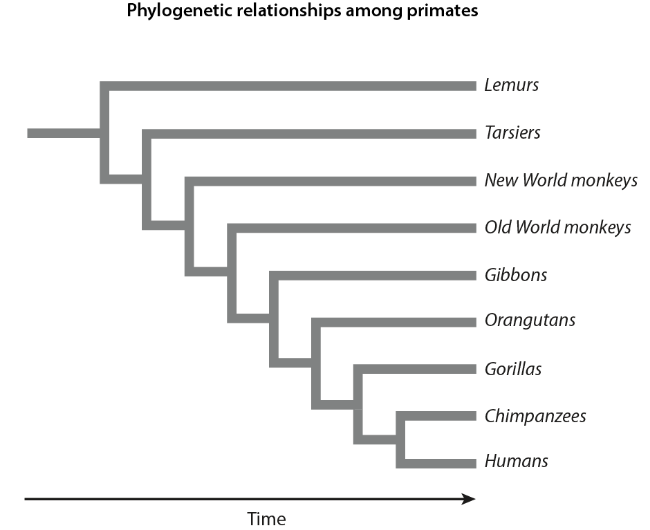
Phylogenetic trees illustrate evolutionary history. The first step when reading a tree is identifying the key parts. The groups of interest, called _ are listed at the tips of the branches. In group(s) of interest. this figure, there is (are) _
gibbons; one
taxa; nine
roots; five
nodes; eight
taxa; nine
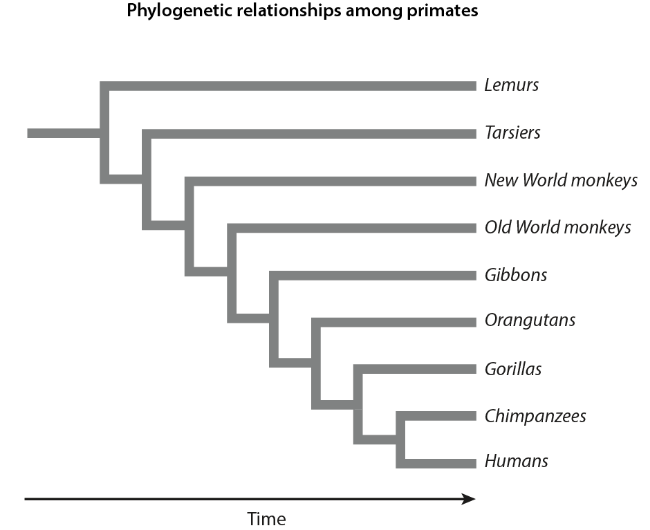
In a phylogenetic tree, the point where a branch splits is a node. A node represents the from which the descendant species is diverged. A node in this tree is located at the letter _
taxa; A
common ancestor; B
sister group; C
common ancestor; A
common ancestor; B
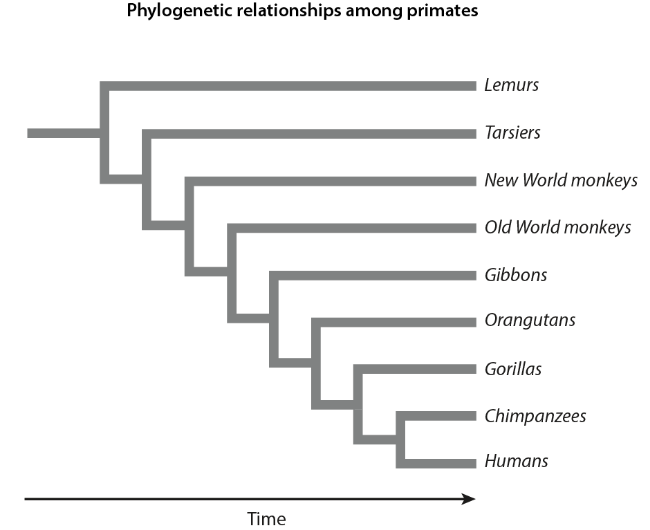
The root (base) of the tree represents the ancestral lineage, and the tips of the branches represent the descendants of the ancestor. As you move from the root of a phylogenetic tree to the tips, you are moving forward in time.
Select the true statement.
In a phylogenetic tree, time runs from the tips of the branches to the root of the tree.
In a phylogenetic tree, time runs from the root of the tree to the tips of the branches.
In a phylogenetic tree, time runs from the root of the tree to the tips of the branches.
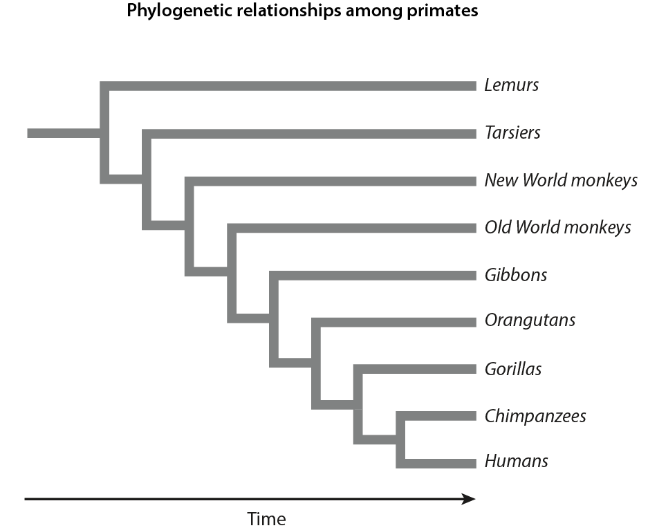
Which of the statements(s) are true about this phylogenetic tree of primates? Select all that apply.
This phylogenetic tree has nine nodes; a node represents a branch point.
At the root of this phylogenetic tree is a common ancestor for all nine groups of primates.
This phylogenetic tree is a hypothesis of the evolutionary history of nine groups of primates.
At the root of this phylogenetic tree is a common ancestor for all nine groups of primates.
This phylogenetic tree is a hypothesis of the evolutionary history of nine groups of primates.
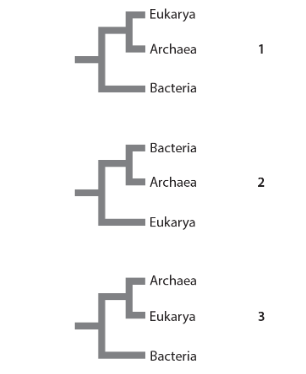
Trees 1, 2, and 3 illustrate possible hypotheses for the evolution of the three major branches of the tree of life. One of the trees is different from the other two. Which tree is not equivalent to the other two?
Tree 1
Tree 2
Tree 3
Tree 2
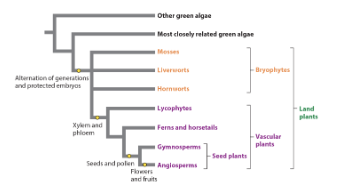
Evolutionary relatedness is determined by following the _ from the _ to the tips of the tree, rather than by following the order of the taxa from the top to the bottom of a page or across a page.
taxa; root
taxa; nodes
nodes; taxa
nodes; root
nodes; root
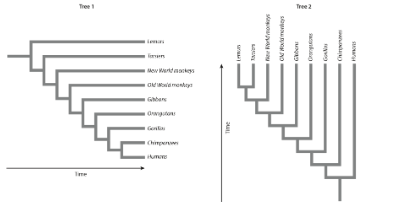
Are these two phylogenetic trees equivalent?
Yes, these two phylogenetic trees are equivalent.
No, they are not equivalent. In Tree 2, the chimpanzee and human lineages are the first to branch from the root of the tree, while in Tree 1, they branch close to the tips.
No, they are not equivalent. In Tree 2, chimpanzees and humans are sister groups, while in Tree 1, lemurs and tarsiers are sister groups.
No, they are not equivalent. In Tree 2, the chimpanzee and human lineages are the first to branch from the root of the tree, while in Tree 1, they branch close to the tips.
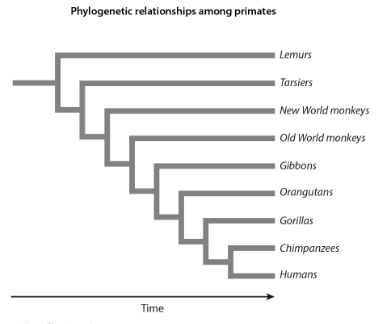
Groups that are more closely related to each other than earlier one is to any other group are _ groups. In this tree, chimpanzees and humans are most closely related to _.
sister; gibbons
node; gorillas
sister; gorillas
root; gibbons
node; lemurs
sister; gorillas
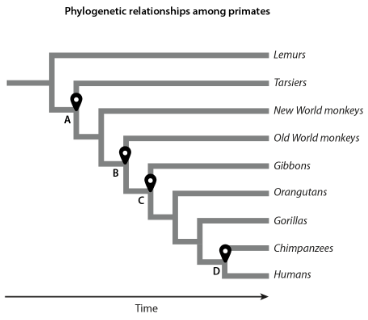
In a phylogenetic tree, a node represents a common ancestor of all the organisms that descended from that node. Trace back from the tips of the branches until you find the node for the most recent common ancestor of the Old World monkeys and chimpanzees. Which pin indicates the location of the common ancestor of Old World monkeys and chimpanzees?
A
B
C
D
B
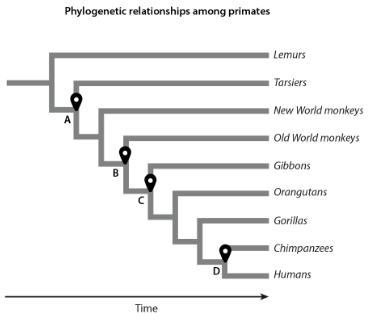
In a phylogenetic tree, a node represents a common ancestor of all the organisms that descended from that node. Trace back from the tips of the branches until you find the node for the most recent common ancestor of the gibbons and gorillas. Which pin indicates the location of the common ancestor of gibbons and gorillas?
A
B
C
D
C
Phylogenetic trees have several nodes, each representing a common ancestor. In this tree showing the evolutionary relationship of primates, how many are shared by all of the primates?
one
two
three
four
five
one
Phylogenetic trees contain nodes that represent the _ of two or more _. In this figure, _ represents the mosy recent common ancestor of species A, B and C.
common ancestors; taxa; node 1
common ancestors; nodes; node 2
taxa; taxa; node 2
taxa; nodes; node 1
common ancestors; taxa; node 1
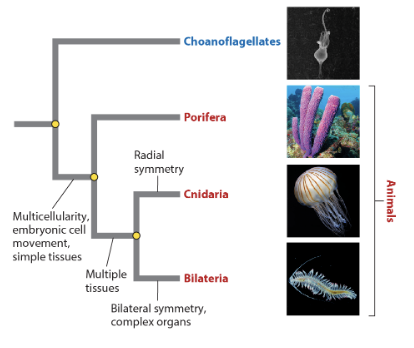
This phylogenetic tree illustrates the evolutionary history of animals. Counting from the root, how many common ancestors do bilaterians share with the other organisms on this tree? In other words, there are _ nodes in this phylogenetic tree.
one
two
three
four
five
three
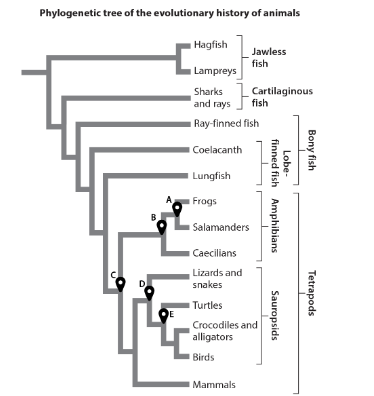
This is a phylogenetic tree of the evolutionary history of animals. Trace back from the tops of the branches until you find the most recent common ancestor of frogs and mammals. Which pin indicates the correct location for the most recent common ancestor of frogs and mammals?
A
B
C
D
E
C
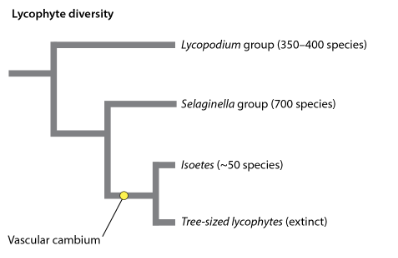
Phylogenetic trees can be drawn in different ways without changing the evolutionary relationships of organisms that they represent. In this phylogenetic tree, you can switch the location of Isoetes and _ and the evolutionary relationships in the tree stay the same.
Tree-sized lycophytes
Selaginella group
Lycopodium group
Tree-sized lycophytes
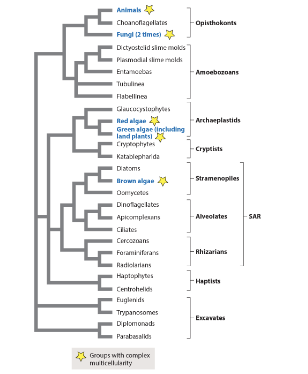
This phylogenetic tree illustrates a hypothesis about the evolution of complex multicellularity. Which statement is supported by the data in this tree?
Animals and fungi are more closely related to each other than either is to green algae.
Brown algae and red algae are more closely related to each other than either is to green algae.
Red algae is less closely related to fungi than green algae is related to fungi.
Animals and fungi are more closely related to each other than either is to green algae.