Propositional Logic
 Note
 Call Kai
 Learn
 Practice Test
 Spaced Repetition
 Match
 Flashcards
 Knowt Play
1/11

There's no tags or description
Looks like no tags are added yet.
12 Terms
What purposes does logic serve in AI
Logic is a representation language for knowledge — helps provide a formal way to express info and relationships
A theory of reasoning — allows AI systems to infer new knowledge from given facts
What types of logic are important for AI
Propositional Logic
Predicate Calculus
What is propositional logic?
Also known as boolean logic, it is a branch of logic that deals with propositions, which are statements that can be either true or false. It uses logical connectives to form compound statements and analyze their truth values.
Key Components of Propositional Logic
Syntax - defines valid sentence structures with an arrangement of symbols
Semantics - defines the meaning (truth values) of formulas
Inference Rules - rules that dictate how new statements can be derived from existing ones
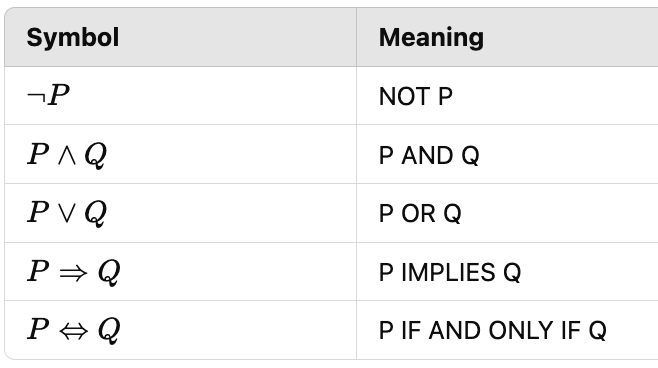
Logical Operators
Symbols used to connect propositions, such as AND, OR, NOT, and IMPLIES.
Atomic Sentences
Basic propositions that cannot be broken down further; single propositions (e.g. P,Q,R)
Compound Sentences
Sentences formed by combining atomic sentences using logical operators, such as AND, OR, and NOT.
Conjunctive Normal Form (CNF)
A set of clauses where each clause is a disjunction (OR) of literals combines used a comma as a conjunction (AND)
Example CNF Conversion
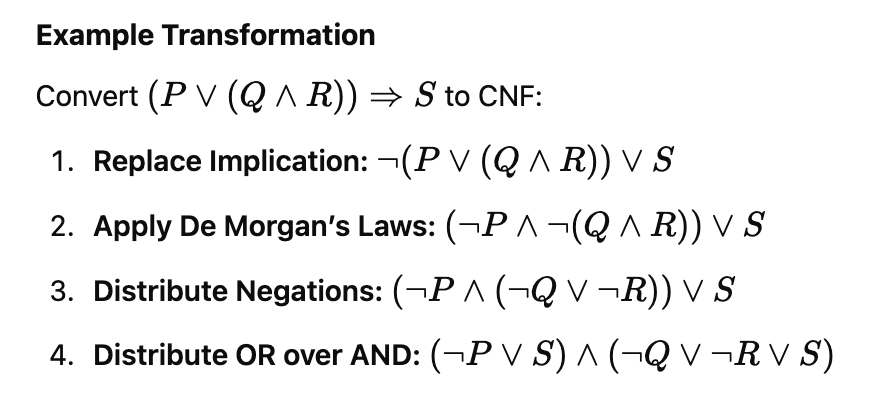
P => Q
Called Material Implication
Means that either p is false OR q is true
Davis-Puntman Algorithm (DPLL)
A backtracking algorithm used for solving the satisfiability problem of propositional logic, particularly in CNF. It systematically explores the possible assignments of truth values to variables.
Basically, it assigns a truth value to one variable at a time and recursively checks for satisfiability, backtracking when necessary.