nucleotides
 Call Kai
 Learn
 Practice Test
 Spaced Repetition
 Match
 Flashcards
 Knowt Play
1/34

There's no tags or description
Looks like no tags are added yet.
35 Terms
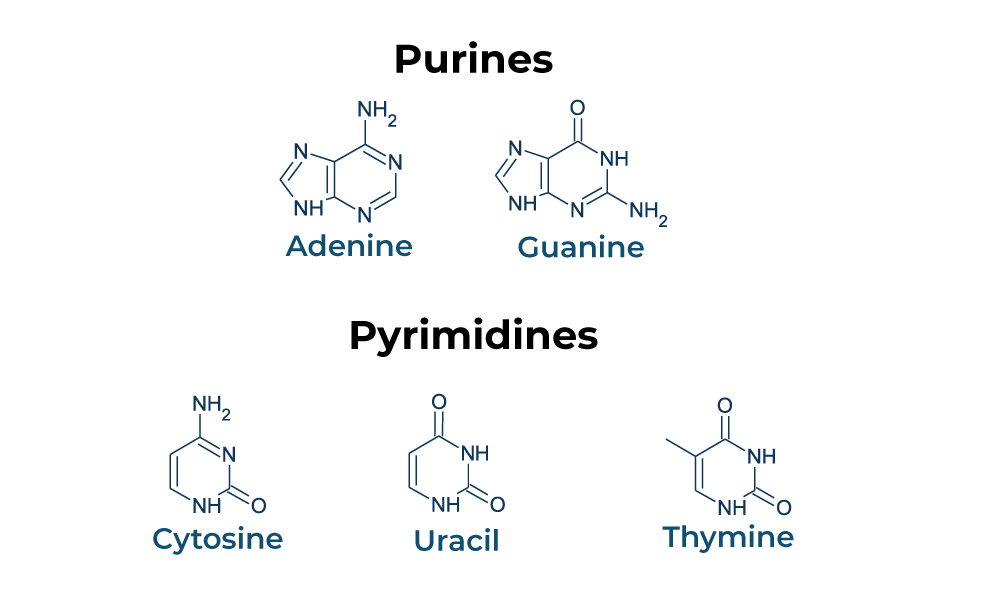
Purines
Adenine (A)
Guanine (G)
Both found in DNA and RNA

Pyrimidine
Cytosine (C): Found in both DNA and RNA; pairs with guanine.
Thymine (T): Found strictly in DNA; pairs with adenine.
Uracil (U): Found strictly in RNA, replacing thymine; pairs with adenine. [1]
de novo pathways
Nucleotides amino acids, sugar phosphates, and so forth.

salvage pathway
synthesize nucleotides from preformed nucleosides or nucleobases that become available either in the diet or from intracellular nucleic acid turnover
Degradation can occur intracellularly (through the turnover of unstable mRNA species or as a result of DNA damage), as a result of cell death or, in animals, through digestion of nucleic acids in the diet.
these enzymes can also catalyze the first reaction in a salvage biosynthetic pathway.


What is PRPP (5-phosphoribosyl-α-d-1-pyrophosphate (PRPP) and what are its main roles in nucleotide metabolism?
PRPP is an activated sugar-phosphate donor that acts as a central metabolic hub. It is required for building both purines and pyrimidines through both de novo synthesis and salvage pathways.
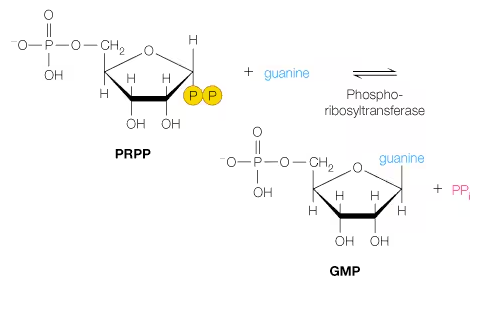

How is PRPP primarily synthesized from scratch in the cell?
PRPP is formed by the enzyme PRPP synthetase, which activates C-1 of ribose-5-phosphate by transferring a pyrophosphate (PPi) group directly from ATP (yielding AMP as a byproduct).
How do salvage pathways use PRPP to make nucleoside monophosphates?
Phosphoribosyltransferases combine PRPP with a free nitrogenous base (nucleobase), transferring the base onto the ribose ring, kicking off pyrophosphate (PPi), and producing a nucleoside monophosphate

Can phosphoribosyltransferases run in reverse to break down nucleotides and release PRPP? Why isn't this efficient or functional in living cells?
While the chemical reaction is technically reversible, cells keep pyrophosphate (PPi) levels extremely low because ubiquitous pyrophosphatases instantly hydrolyze PPi into orthophosphate. Because free PPi is not sitting around available to drive the reverse reaction, Le Chatelier's principle forcefully drives the reaction forward (consuming PRPP). This ensures PRPP is efficiently channeled into making nucleotides rather than being wasted on breakdown.
how are purines nucleotides formed?
Purine nucleotides are formed by a 10-step pathway leading from PRPP to a branch point, inosine 5′-monophosphate, or IMP, a nucleotide for which the purine base is hypoxanthine. Separate short pathways lead from IMP to the major purine nucleotides, adenosine 5′-monophosphate (AMP) and guanosine 5′-monophosphate (GMP)

Regulation of the Purine Pathway
At the Branch Points (Cross-Regulation):
GMP allosterically inhibits its own initial conversion from IMP (via XMP), while AMP allosterically inhibits its own initial pathway (to adenylosuccinate).
Reciprocal Energy: Building GMP requires ATP, whereas building AMP requires GTP. This cross-wiring ensures balanced production of adenine and guanine.
At the Top (Feedback Control):
AMP, GMP, ADP, and GDP allosterically inhibit the very beginning of the pathway specifically PRPP synthetase and PRPP amidotransferase (Reaction 1).
Conversely, PRPP acts as an allosteric activator for PRPP amidotransferase, signaling that raw materials are ready to go.
Starting Materials & PRPP Activation (Step 1)
The Reactants: PRPP and glutamine react together to form 5-phosphoribosylamine (PRA).
Why it Skips ATP: PRPP is already pre-activated with a pyrophosphate group, so the incoming weakly nucleophilic nitrogen from glutamine readily displaces it without needing an extra ATP.
Regulation by PRPP: PRPP acts as an allosteric activator for PRPP amidotransferase (E1), signaling that sugar-phosphate raw materials are ready to kick off the pathway.
Single-Carbon Contributions (Tetrahydrofolate / THF)
The Role of THF: The pathway relies heavily on 10-formyltetrahydrofolate (10-formyl-THF), which acts as a mobile single-carbon carrier to donate formyl groups during synthesis.
Why it Matters: Because steps 3 and 9 require formyltransferases to build the ring, purine biosynthesis is a major target for folate antagonists like methotrexate.
Aspartate Participation & The Urea Cycle Connection
The Reaction (Steps 7 & 8): Aspartate is condensed with the intermediate using ATP, and subsequent α,β-elimination releases the carbon skeleton as fumarate, leaving behind its amino nitrogen to become part of the ring.
Metabolic Parallel: This reaction sequence is strikingly similar to the urea cycle (where argininosuccinate splits into arginine and fumarate).
The Core Hub & Branching to GMP vs. AMP
The Core Hub: The 10-step de novo pathway culminates in IMP (Inosine Monophosphate).
GMP Pathway: IMP is oxidized to XMP (featuring a xanthine intermediate) and then aminated using ATP as the energy driver.
AMP Pathway: IMP condenses with aspartate to form adenylosuccinate and eliminates fumarate, using GTP as the energy driver.
Energy Cross-Regulation: ATP drives GMP production, and GTP drives AMP production, ensuring the cell maintains a balanced pool of purines for DNA base-pairing.
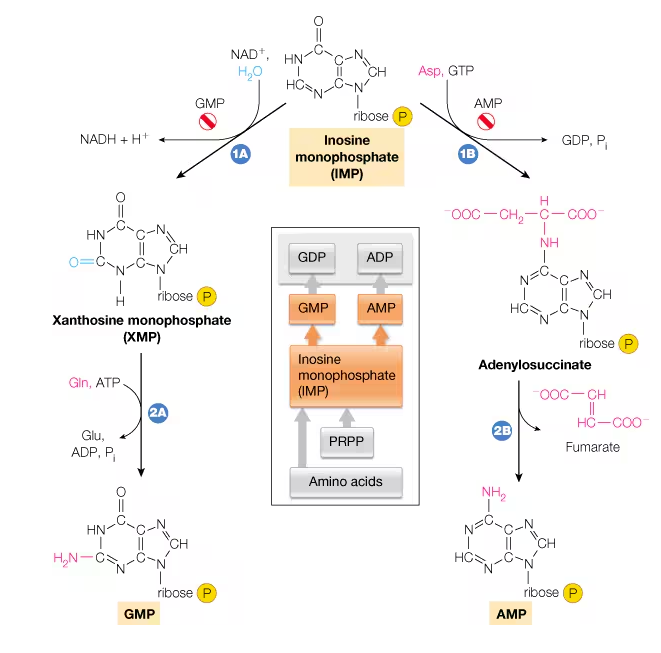
IMP Branching to GMP and AMP (The Big-Picture Idea)
The Core Hub: IMP (Inosine Monophosphate) is the central purine branch point, containing a hypoxanthine base.
The Path to GMP (Via Xanthine):
IMP is first oxidized to form XMP (xanthine monophosphate), which features a xanthine intermediate.
An amino group is then added to convert XMP into GMP.
Energy Rule: This pathway requires ATP to drive it.
The Path to AMP (Via Aspartate):
IMP reacts directly with aspartate to form adenylosuccinate, which then eliminates fumarate to yield AMP.
It bypasses xanthine because AMP needs its modification at a different position (C-6).
Energy Rule: This pathway requires GTP to drive it.
The Traffic Control (Cross-Regulation):
Because ATP drives GMP and GTP drives AMP, the cell cross-regulates its energy supplies.
Furthermore, feedback inhibition ensures the cell doesn't overproduce one over the other, keeping Adenine and Guanine balanced for DNA base-pairing.

how are pyrimidine nucleotides formed?
In a unbranched pathway six reactions leading to uridine 5′-monophosphate (UMP), followed by two phosphorylations yielding uridine triphosphate (UTP) and then a one-step conversion to cytidine triphosphate (CTP).

The Core Precursors & Assembly Strategy (Pyrimidines)
The Raw Materials: All six atoms in the pyrimidine ring come from just two precursors: aspartate and carbamoyl phosphate.
The Assembly Order: Unlike purines, the pyrimidine ring is built first as a free base (orotate). Only after the ring is fully formed does PRPP come in to donate the ribose-phosphate backbone.
The Final De Novo Product: The pathway is completely unbranched and culminates in UMP (uridine monophosphate), which then gets upgraded to UTP and CTP.
Step 1 and the Committing Step (Regulation)
Making Carbamoyl Phosphate (Step 1): Glutamine, bicarbonate, and 2 ATP are used to make carbamoyl phosphate.
The Committing Step (Step 2): Aspartate transcarbamoylase (ATCase) combines aspartate and carbamoyl phosphate.
Regulation of ATCase:
ATP (Activator): High ATP signals abundant purine/energy levels, pushing the cell to make matching pyrimidines.
CTP (Inhibitor): The final end-product of the entire pathway acts as a classic feedback inhibitor to stop production when levels are sufficient.


The Role of PRPP in Pyrimidines
The Free Base: By step 4, the pathway creates orotate, which is a fully formed pyrimidine nucleobase.
Adding the Sugar (Step 5): PRPP is finally added to orotate to create OMP (the first true nucleotide in the pathway).
Finishing the Core (Step 6): OMP undergoes decarboxylation (loses a CO2) to become UMP.
Making UTP and CTP
pgrading to UTP (Steps 7 & 8): UMP is phosphorylated twice using 2 ATP to become UTP.
Converting to CTP (Step 9): UTP reacts with glutamine (an ammonia donor) and 1 ATP. An oxygen on the UTP ring is swapped out for an amino group (−NH2) to create CTP.
Cross-Regulation (Step 9): GTP acts as an activator for CTP synthetase. This ensures pyrimidine production (CTP) keeps pace with the available pool of purines (GTP).
Purines vs. Pyrimidines
Energy Cost (ATP Consumption):
Purines: Consumes MORE ATP. Building the massive double-ring and charging it to a triphosphate (ATP/GTP) requires roughly 7-8 ATP equivalents from scratch.
Pyrimidines: Consumes LESS ATP. The smaller single-ring pathway is more energy-efficient, requiring only 5 ATP from scratch to reach fully charged CTP.
Assembly Strategy:
Purines: Built directly on top of the PRPP sugar backbone starting from step 1.
Pyrimidines: Built as a free nucleobase first; PRPP is only added near the end.
Role of Aspartate:
Purines: Aspartate drops off its nitrogen and leaves as fumarate (like a delivery truck).
Pyrimidines: The entire aspartate molecule is permanently incorporated into the ring.
Carbon Donors:
Purines: Require THF (folate) to deliver single carbons to build the large double-ring.
Pyrimidines: Do not use THF; all atoms come from just aspartate and carbamoyl phosphate.
Branching & End Products:
Purines: Branched pathway ending in the central hub IMP (which splits to AMP and GMP).
Pyrimidines: Unbranched pathway ending in UMP (which then sequentially upgrades to UTP, then CTP).
Shared Nitrogen Donor (Gln —> Glu):
Both pathways heavily use Glutamine as the primary nitrogen donor (via amidotransferases). After dropping off its nitrogen, it leaves as Glutamate.
Overview of Purine Catabolism (The Uric Acid Pathway)
The Starting Point: The breakdown process starts with the ribonucleotides (AMP, IMP, XMP, GMP) and their deoxy- counterparts.
The Funnel: All of these distinct purines are systematically stripped of their phosphates and sugars, funneling down into one central nucleobase: Xanthine.
The Final End Product: Xanthine is oxidized into Uric Acid, an insoluble waste product that is excreted from the body.
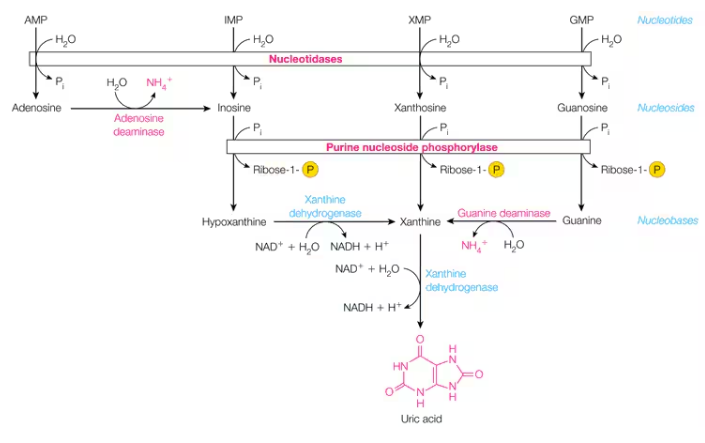

Nucleotidases & Purine Nucleoside Phosphorylase (PNP)
Nucleotidases (Step 1): These enzymes remove the phosphate group from the nucleotide (e.g., AMP —→ Adenosine).
PNP (Step 2): Purine Nucleoside Phosphorylase acts on the nucleosides. It cleaves off the sugar (releasing it as ribose-1-phosphate) to leave behind the free nucleobase (like guanine or hypoxanthine).
The Exception: Adenosine cannot be acted on by PNP directly; it must be deaminated into inosine first.

Guanine Deaminase & Xanthine Dehydrogenase
Guanine Deaminase: Catalyzes the hydrolytic deamination of Guanine, swapping its amino group for an oxygen to form Xanthine.
Xanthine Dehydrogenase: The heavy lifter of the pathway. It performs two major oxidations:
Hypoxanthine —> Xanthine
Xanthine —> Uric Acid
Adenosine Deaminase (ADA) & SCID
The Enzyme's Role: ADA deaminates adenosine (removes the -NH2 group), converting it into inosine so it can continue down the breakdown pathway.
If Mutated (ADA-SCID): Deoxyadenosine cannot be broken down. The salvage pathways mistakenly convert the buildup into dATP.
The Consequence ("Bubble Boy" Disease): Massive dATP levels allosterically inhibit Ribonucleotide Reductase (RNR), shutting down the production of dCTP, dGTP, and dTTP. Without these, DNA synthesis halts, and immune cells (T and B cells) cannot divide to fight infections.


HGPRT & The Salvage Pathway (Energy Savings)
The Enzyme's Role: HGPRT (Hypoxanthine-guanine phosphoribosyltransferase) is the master recycling enzyme. It takes free nucleobases (Guanine or Hypoxanthine) and attaches them to PRPP to regenerate GMP and IMP.
The Driving Force: The reaction releases pyrophosphate (PPI), and its rapid hydrolysis pulls the equilibrium completely to the right (forming the nucleotide).
The Energy Saved: Skipping the 10-step de novo assembly line saves massive energy. Salvaging AMP/GMP saves 5 ATP equivalents, while salvaging XMP saves 4 ATP equivalents.

HGPRT Mutations (Gout vs. Lesch-Nyhan Syndrome)
The "Double Whammy" of HGPRT Failure: If HGPRT fails, (1) hypoxanthine and guanine, to accumulate, and this stimulates their catabolism to uric acid, and (2) unused PRPP builds up, which hyper-activates the de novo pathway to make even more purines that just end up as waste.
Partial Loss —> Gout: A missense mutation leaving some HGPRT activity. Causes hyperuricemia where uric acid crystallizes in the joints, causing severe inflammatory arthritis.
Complete Loss —> Lesch-Nyhan Syndrome: A null mutation resulting in zero HGPRT activity. Causes extreme gout combined with severe neurological symptoms, famously characterized by aggressive behavior and compulsive self-mutilation (biting fingers and lips).
Reduction of Ribonucleotides to Deoxyribonucleotides (Making DNA Precursors)
The Big Idea: The cell must convert RNA building blocks into DNA building blocks by removing an oxygen atom.
The Specific Reaction: The hydroxyl group (-OH) at the C-2' position of the ribose sugar is replaced by a hydrogen atom (-H).
The Substrates: The reaction specifically uses ribonucleoside diphosphates (rNDPs) like ADP, GDP, CDP, and UDP.
The Products: Deoxyribonucleoside diphosphates (dNDPs).
The Enzyme & Its Macro-Structure of RNR
The Enzyme: Ribonucleotide Reductase (RNR)
The Structure: It is a heterodimer made of two completely different protein complexes joined together (specifically an alpha2/beta2 tetramer).
The Two Halves: It is divided into a Large Subunit (R1 / alpha2) and a Small Subunit (R2 / beta2).

The Large Subunit (R1) - The Catalytic Hub
Function: This subunit houses the actual active (catalytic) site where the substrate binds and the chemical reduction takes place. It also contains the allosteric control sites.
Key Amino Acids Located Here:
The redox-active Cysteines (Cys-439, Cys-462, Cys-225) that donate the hydrogens and form the disulfide bridge.
Glutamate 441 (Glu-441), which acts as the general acid/base during the reaction.

The Small Subunit (R2) - The Radical Generator
Function: It safely houses a stable radical that is used to initiate the chemistry in the other subunit.
Key Amino Acid Located Here: Tyrosine 122 (Tyr-122).
The Gap: Tyr-122 is located roughly 35 Å away from the active site. The radical must travel across this gap to the large subunit via a long-range proton-coupled electron transport process.

RNR Binding Sites
The Catalytic (C) Site: The actual "machine" where the work happens. It binds the substrates: Ribonucleotide Diphosphates (NDPs).
The Specificity (S) Site: The "steering wheel." It binds ATP, dATP, dTTP, and dGTP. Whatever binds here changes the shape of the active site to dictate which specific NDP gets reduced next (keeping the ratios of A, T, C, and G perfectly balanced).
The Activity (A) Site: The "master power switch." It acts as the ultimate on/off button for the entire enzyme.
RNR Regulation & The Activity Site
The On Switch: Binding ATP turns RNR on (signaling the cell has plenty of energy and is ready to replicate DNA).
The Off Switch: Binding dATP turns RNR off.
The Logic (Feedback Inhibition): dATP is the ultimate final product of the pathway. If the cell has built up a massive stockpile of dATP, it binds the Activity site to shut down the factory so the cell doesn't waste energy making building blocks it doesn't need. (This is also why ADA-SCID is so deadly—the toxic dATP buildup permanently trips this off switch).
Thymidine Synthesis (dUMP —→ dTMP)
The Funnel: CDP and UDP are reduced to dCDP and dUDP, but they eventually funnel down into a single monophosphate molecule: dUMP.
The Reaction: The enzyme thymidylate synthase converts dUMP into dTMP.
The Mechanism: It adds a methyl group (-CH3) to the uracil ring to turn it into thymine.
The Helper: 5,10-methylene THF is used as the carbon-unit transporter to donate that methyl group.

The dUTP "Quality Control" Mechanism
The Problem: DNA Polymerase cannot easily tell the difference between dUTP and dTTP. If dUTP floats around, it will mistakenly be inserted into DNA, causing catastrophic mutations.
The Solution: The cell aggressively converts any dUTP back down to dUMP to eliminate the threat of contamination.
The Safe Path: Once it is safely converted to dUMP, it is methylated into dTMP, and then safely phosphorylated back up to dTTP. This guarantees pristine, error-free DNA replication.
