Lecture 3: Changing Airline Business Models
 Call Kai
 Learn
 Practice Test
 Spaced Repetition
 Match
 Flashcards
 Knowt Play
1/21

There's no tags or description
Looks like no tags are added yet.
22 Terms
Aviation Developments
World passenger traffic grew massively from 1945 to 2019, interrupted by recurring shocks.
Aviation demand is structurally growing but highly shock-prone. This volatility is a key reason why the industry is barely profitable.
Competition forces airlines to pass cost savings to consumers. When costs fall (technology, deregulation, internet), fares fall too.
LCCs are generally more profitable than network carriers
The Chicago Convention (1944)
Article 1: Every state has complete and exclusive sovereignty over airspace above its territory.
Article 6: No scheduled international air service may be operated over or into the territory of a contracting State, except with the special permission or other authorization of that State.
Results of deregulation
• New entrants, mainly Low Cost • Cost reduction programmes at legacy carriers
• Decrease in pricing on competitive routes (LON-PAR, LON-AMS)
• Increased frequency and capacity numbers.
• Predatory pricing (KLM-easyJet case)
But international regulation remains:
International flights were unaffected by domestic deregulation.
A complex web of country-to-country bilateral agreements persists.
The basic rule: "everything is banned, unless expressly permitted."
Open Skies partially liberalised transatlantic markets (7th freedom) but did not eliminate cabotage restrictions.
Carrier types
FSC
LCC - (U)LCC
Charter

Full-Service Carriers (FSC)
• Erected from national interest
• National symbol • Low utilisation as a result of their operating model, generally hub and spoke
• In order to operate internationally, a strong feed and de-feed is required, as in hub & spoke operations
• Cover the complete set of required activities, such as Catering, Ground Handling and E&M
• High overhead as a result
Low-Cost Carriers
• Erected in the ‘90’ in Europe (‘70’in US)
• Initially operating in larger markets, under 2 hours flight time
• Point-to-point traffic, but with operational bases • Single aircraft type operation •
Gaining from shortened ground time, so better aircraft utilisation
• Sourcing many activities, such as Catering, Ground Handling and E&M
• Bought themselves into markets with very low fares
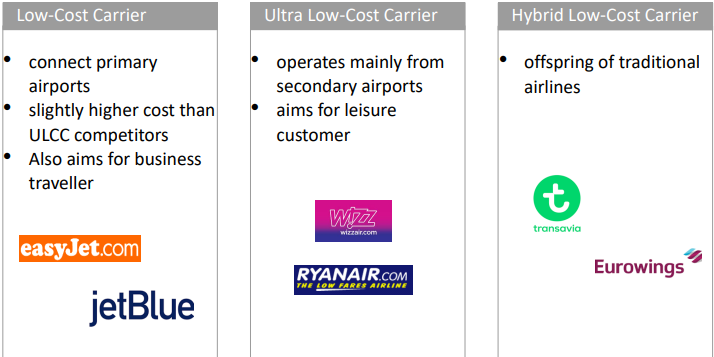
Transport Models
Ptp and H&S
Hub & Spoke: Primarily feeding Intercontinental routes with domestic routes. Driven by deregulation, amplified by the introduction of the Boeing 747. Not an ideal consumer model, but creating Productive Efficiency

While the commercial offer must be attractive
Flying direct is: Less travel time - More convenient And flying indirect: Time consuming - Chances on lost luggage
→ Direct flights have a higher value for the marketplace, compared to indirect flights, while cost of indirect flights are higher than direct flights
Airline Cost During Flight
• Fuel
• Staff (amongst others flight Crew)
• Maintenance
• Insurance
• Depreciation
• En Route charges
Airport Cost
• Landing charges
• Handling of baggage and passengers
• Catering Cost
• Terminal infrastructure utilisation
Other Cost
• Sales & Distribution Cost
• Organisational overhead Cost
Ancillary revenue
Revenue from non-ticket sources (bags, seat selection, food, priority). Key to LCC/ULCC profitability. Unbundling.
Hub-and-spoke
Consolidate flows via hub; more O-D markets; economies of density; higher connectivity; but higher CASK, transfer costs, hub dominance.
Point-to-point
Direct city-pair services; lower transfer costs; higher aircraft utilisation; typical LCC model.
Network carrier cost structure
High CASK: multiple fleet types, premium cabins, alliances, legacy labour costs, hub complexity.
LCC cost structure
Low CASK: single fleet, high seating density, secondary airports, high utilisation, direct distribution, ancillary revenue.
LCC welfare contribution
Lower fares, traffic stimulation, entry on underserved routes. But: service quality concerns, hidden fees, labour practices, airport subsidies.
Bilateralism
International air services governed by country-to-country agreements. "Everything is banned, unless expressly permitted." Contrast with WTO trade rules.
Low-cost carriers have positively contributed to the welfare of the larger public. Yes or No
Define: Welfare = consumer surplus + producer surplus + externalities. "Larger public" = broad population, not just frequent flyers.
Yes:
Lower fare.
Traffic stimulation: lower fares expanded the market, bringing new travellers (price-sensitive leisure passengers) into aviation.
Entry on underserved routes: LCCs opened point-to-point routes that network carriers ignored.
LCC competition forced legacy carriers to cut costs.
Productive efficiency: higher load factors, higher aircraft utilisation, single-fleet economies.
No:
Service quality: unbundling means the headline fare excludes bags, seat selection, food. Total cost may be higher than advertised..
Hidden costs / externalities: LCCs often use secondary airports with poor public transport access; the environmental cost of stimulated traffic is a negative externality.
Labour practices: lower wages, precarious contracts, union opposition.
Airport subsidies: some LCC routes are subsidized by regional airports (state aid concerns). This is a transfer, not necessarily a welfare gain.
Market power at secondary airports: LCCs can dominate secondary airports and raise fares over time.
Explain what predatory pricing is, why it is hard to prove, and what it implies for LCC competition
Define: Predation = below-cost pricing to drive out a rival, followed by recoupment (higher prices after exit). Legal test: (1) below-cost pricing, (2) intent, (3) recoupment feasibility.
Mechanism:
Incumbent (KLM) responds to LCC entry (easyJet) by cutting fares aggressively.
If fares are below cost and sustained until exit, and if the incumbent can recoup after exit, it is predatory.
Hard to prove because: (a) cost allocation is complex (marginal vs average vs avoidable cost), (b) intent is hard to establish, (c) recoupment is speculative, (d) aggressive competition benefits consumers in the short run.
Evidence: KLM–easyJet case (Netherlands/ACM) illustrates the tension. Goolsbee & Syverson (2008) show incumbents respond to entry threats; this is deterrence, not necessarily predation.
Apply: For LCC competition, predation risk is a barrier to entry. If incumbents can credibly threaten to predate, LCCs may not enter. This justifies antitrust enforcement (not fare regulation). But over-enforcement risks chilling legitimate competition.
Counterargument: Aggressive price cuts are normal competition. The burden of proof should be on the regulator; predation findings should be rare.