biopharmaceutics study guide
 Call Kai
 Learn
 Practice Test
 Spaced Repetition
 Match
 Flashcards
 Knowt Play
1/38

There's no tags or description
Looks like no tags are added yet.
39 Terms
physical pharmaceutics (basic pharm s1)
Physical pharmaceutics involves applying various physical and chemical principles to the
design and manufacture of dosage forms:
Physicochemical properties of the drug substance
• Dissolution and solubility :
– Solubility: Maximum amount of drug that can dissolve in a given solvent.
– Dissolution: The rate at which the drug goes into solution.
– These directly affect bioavailability (how much drug actually reaches systemic circulation).
– Example: Poorly soluble drugs (like BCS Class II) require solubility enhancement (salt formation, surfactants).
• Properties of solutions (rheology, thermodynamics, kinetics):
– Rheology: Flow behavior of liquids and semisolids (important for syrups, creams, gels).
– Thermodynamics: Helps predict stability ,solubility, and phase behavior.
– Kinetics: Explains degradation rates and reaction speeds → important for shelf life.
– Example: Thick syrups require rheological studies to ensure pourability but prevent crystallization.
• Surface and interfaces:
– Deals with surface tension, adsorption, and wetting properties.
– Important for emulsions (oil-water mixtures), suspensions, tablets (coating, wetting), and nanoparticles.
– Example: Surfactants reduce interfacial tension, stabilizing emulsions and improving wetting of hydrophobic drugs.
• Disperse systems:
– Systems where one phase is distributed in another
– Stability (preventing creaming, sedimentation, or coalescence) is a major concern.
– Example: Cough syrups with insoluble drugs are suspensions that need stabilizers.
• Solid state properties: Concerned with the physical form of the solid drug: crystalline vs. amorphous, polymorphism, particle morphology.
• Particle size analysis, reduction, and size separation:
• Mixing and powder flow: Ensures uniform distribution of active drug and excipients
Physical pharmaceutics involves applying various physical and chemical
principles to the design and manufacture of dosage forms:
Stability of the formulation
Rational selection of excipients
Formulation behavior
physical pharmaceutics in vitro assessment of dosage forms (basic pharm s1)
Physical pharmaceutics involves applying various physical and chemical
principles to the design and manufacture of dosage forms:
In vitro assessment of dosage forms
Dissolution testing of solid dosage forms
– Measures the rate and extent to which a drug is released from a solid form (tablet, capsule) into solution.
– Critical because dissolution often determines bioavailability for oral drugs.
– Example: If a tablet dissolves too slowly, the drug may not be absorbed effectively.
Rheological characteristics of products
– Viscosity: Resistance to flow (e.g., a thick cough syrup should pour easily but coat the throat).
– Elasticity: Ability to regain original shape after deformation (important for gels/ointments).
– Stiffness: Resistance to deformation (important for creams and suppositories).
Particle size distribution in formulation
– Refers to the range of particle sizes within a dosage form.
– Influences dissolution rate, absorption, stability, appearance, and texture
physical pharmaceutics involves applying various physical and chemical principles (3) (basic pharm s1)
Physical pharmaceutics involves applying various physical and chemical
principles to the design and manufacture of dosage forms:
Physicochemical properties of the drug substance
Stability of the formulation
In vitro assessment of dosage forms
Biopharmaceutics (basic pharm s1)
biopharmaceutics studies the effects of the physicochemical properties of
drugs and drug products on their ability to produce desired therapeutic effects.
DMPK-Distribution, Metabolism, and PharmacoKinetics.
ADME-Adsorption, Distribution, Metabolism and Excretion.
Tested in cell culture models and animal models initially.
Monitored in Non-human primate (NHP) and human studies too.
Drug factors in dosage form design (dosage form design s2)
(Physical Pharmaceutics)
• An understanding of basic physical chemistry is essential for effectively
designing dosage forms.
• Particle size and surface area
• Solubility
• Dissolution
• Partition coefficient and pKa
• Crystal properties: polymorphism
• Stability
• Physical Pharmaceutics affect biopharmaceutics, Drug development,
manufacturing, stability/shelf life.
routes of drug administration(dosage form design s2)
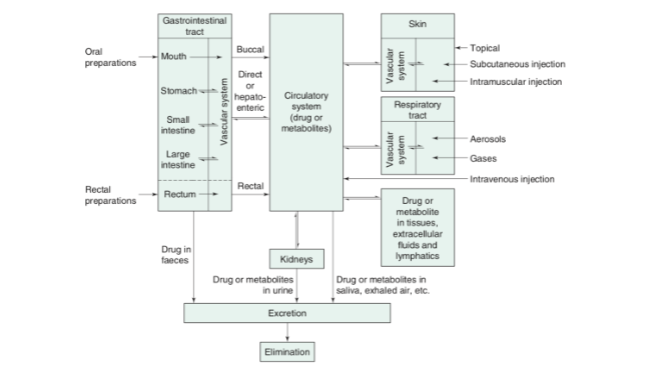
ROA (dosage form design s2)
Oral route → Rectal route → parenteral → topical → respiratory route
seconds - intravenous injection
minutes - intramuscular/subcutaneous injections, buccal tablets, aerosols, gases
minutes to hours - short-term depot injections, solutions, suspensions, powders, granules, capsules, tabletse, modified-release tablets
several hours - gastro-resistant coated formulations
days to weeks - depot injections, implants
varied - topical preparations
Drug factors in dosage form designs (dosage form design s2)
Solubility
• Dissolution
• Particle size and surface area
• Partition coefficient and pKa
• Crystal properties: polymorphism
• Stability
Solution, Solubility, and Dissolution (dosage form design s2)
A solution is a mixture of
two or more components
that form a single phase
which is homogeneous
down to the molecular level.
• The component that determines the phase of the solution is termed the solvent; it usually (but not necessarily) constitutes the largest proportion of the system.
• The other components are termed solutes, and these are dispersed as molecules or ions throughout the solvent, i.e. they are said to be dissolved in the solvent.
Dissolution (dosage form design s2)
The transfer of molecules
or ions from a solid state
into a solution is known
as dissolution.
• Fundamentally, this
process is controlled by
the relative affinity
between the molecules
of the solid substance
and those of the solvent.
Miscibility (dosage form design s2)
When the two components
forming a solution are either
both gases or both liquids,
then it is more usual to talk
in terms of miscibility rather
than solubility.
solubility (dosage form design s2)
Solubility is the maximum
concentration of a solute that
can dissolve in a solvent at a
given temperature.
pKa (dosage form design s2)
pKa: a number that describes the acidity of a particular
molecule.
• measures the strength of an acid by how tightly a proton is held by a
Bronsted acid.
pKa: a number that describes the acidity of a particular molecule.
• measures the strength of an acid by how tightly a proton is held by a
Bronsted acid.
The smaller the value of pKa,
the stronger the acid !!!
Partition Coefficient (dosage form design s2)
A partition coefficient is the
ratio of the concentration of
a substance in one medium
or phase (C1) to the
concentration in a second
phase (C2) when the two
concentrations are at
equilibrium;
Advantages of Solution Dosage forms (dosage form design s2)
Homogeneous – no problems of content
uniformity
• Easy to manufacture
• Good bioavailability
Components of solution dosage forms (dosage form design s2)
Active ingredient (= drug)
• Solvent
◦ Water, vegetable oils (for long-acting parenterals)
◦ Co-solvent (ethanol, glycerin, propylene glycol)
• Buffering agent
• Preservative
• Antioxidant, chelating agent
• Flavor and sweetener
◦ Sucrose, sorbitol
Buffer (dosage form design s2)
Buffer principle
◦ A solution of a weak acid and a salt of its
conjugate base
◦ Weak acid removes added base (OH-)
• HA + OH- <---------> H2O + A-
◦ Salt removes added acid (H+)
• A- + H3O+ <---------> HA + H2O
Handersen-Hasselbalch equation
◦ 𝑝𝐻 = 𝑝𝐾𝑎 + 𝑙𝑜𝑔 [𝐴−]
[𝐻𝐴]
• Buffering capacity
◦ Ability of a buffer to resist a change in pH due to
added OH- or H+
◦ 𝛽 = ∆ 𝑎𝑐𝑖𝑑 𝑜𝑟 𝑏𝑎𝑠𝑒 𝑎𝑑𝑑𝑒𝑑
∆ 𝑝𝐻
◦ Max when pH = pKa
Matching (dosage form design s2)
Sodium bisulfite _____
• Ethylenediaminetetraacetic
acid (EDTA) _____
• Butylated hydroxytoluene
_____
• Sorbitol solution _____
• Glycerin _____
• Methyl paraben _____
• Benzalkonium chloride
_____
1. Solvent
2. Co-solvent
3. Buffering agent
4. Free radical stabilizer
5. Antioxidant acting by
preferential oxidation
6. Preservative acting by
lipophilic adsorption
7. Preservative acting by
electrostatic adsorption
8. Sweetener
9. Chelates divalent metal
cations
5
9
4
8
2
6
7
Matching (dosage form design s2)
Ascorbic acid ____
• Benzoic acid ____
• Chlorpromazine ____
• Citric acid ____
• EDTA ____
• Propylene glycol ____
• Sodium bisulfite ____
• Sodium dihydrogen
citrate ____
• Sucrose ____
• Water ____
1. Active ingredient
2. Antioxidant
3. Buffering agent
4. Chelating agent
5. Co-solvent
6. Preservative
7. Solvent
8. Sweetener
2, 3
6
1
2, 3, 4
2, 4
5
2
2, 3, 4
8
7
rheological behavior and terminology (suspension and rheology s5)
Flow curves (rheograms) show the plot of the rate of shear (dv/dx) versus
the shear stress (f/A).
• Viscosity = shear stress/rate of shear
5
•Dilatant - An increase in shear stress leads to an increase in the viscosity of the
fluid. Examples include quicksand and mud slurry.
•Pseudoplastic - It is the opposite of dilatant i.e., an increase in shear decreases
the viscosity of the fluid. Examples include blood and ketchup.
•Bingham plastic - It is similar to Newtonian fluids i.e., have a linear relationship
between the rate of angular deformation and shear stress. The difference is that
they have internal yield stress making them a time-dependent relation.
Examples include oil paint.
•Rheopectic - It is very similar to dilatant in that when shear is applied, viscosity
increases. The difference here is that viscosity increase is time-dependent.
Examples include gypsum paste, whipping cream, and beaten egg white.
•Thixotropic - Fluids with thixotropic properties experience a decrease in
viscosity when shear is applied. This too is time-dependent. Examples include
paint and glue.
types of fluid (suspension and rheology s5)
Newtonian fluid:
• A fluid, whose viscosity does not change with the rate of deformation or
shear strain, is called Newtonian fluid. (water and alcohol)
• Non-Newtonian fluid:
• A fluid, whose viscosity changes with the rate of deformation or shear strain,
is called a Non-Newtonian fluid. (cornstarch +water, ketchup, blood)
newtonian fluids (suspension and rheology s5)
Viscosity is a constant at constant temperature and is independent of
shear stress or rate of shear.
non newtonian systems (suspension and rheology s5)
Shear Stress – Dependent Flow Properties
• Pseudoplastic flow
• Also known as shear thinning because stress can
cause decrease in viscosity.
• For polymeric solutions, the aggregation of strands at
low stress causes higher viscosity.
• For colloidal systems, the formation of
macromolecular structures accounts for higher
viscosity at low stress.
Shear Stress – Dependent Flow Properties
• Dilatant Flow
• Shear thickening
• Viscosity increases with increasing shear rate
• Rare but can be found in high concentration suspensions
• Plastic Flow
• Particles stick together forming 3-D networks
Time – Dependent Rheological
Behavior
• Thixotropy
• Refers to a decrease in viscosity with
time when flow is applied to a
sample previously at rest.
• Antithixotropy
• Time-dependent increase in
viscosity
rheological measurement (suspension and rheology s5)
Rheological Measurement
• Instruments are called viscometers and
rheometers
• Viscosity
• Yield stress
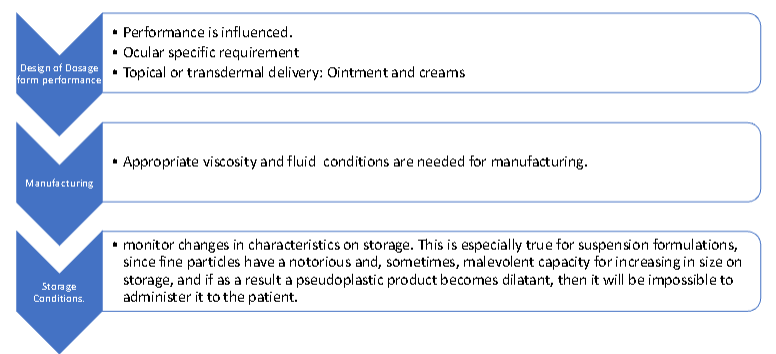
A proper understanding of the rheological properties of
pharmaceutical materials is essential for the preparation,
development, evaluation, and performance of
pharmaceutical dosage formsa
application of rheology (suspension and rheology s5)
Reasons for suspensions (suspension and rheology s5)
Suspensions vs. Solutions
◦ Solubility
◦ Chemical stability
• Solution: first order
• Suspension: zero order
◦ Palatability (taste)
◦ E.g.: Erythromycin estolate oral suspension (More palatable than Erythromycin solution)
• Suspensions vs. Tablets
◦ Flexibility of dose
◦ Ease of swallowing
◦ Dissolution rate
components of suspension (suspension and rheology s5)
Active ingredient (solid particles)
• Vehicle
• Buffer
• Preservative
• Flocculating agent
• Structured vehicle system
• Wetting agent
• Antifoaming agent
• Flavor and sweetener
suspension: desirable properties (suspension and rheology s5)
The suspended material should not settle rapidly.
• The particles that settle to the bottom of the container must not form
a hard cake but should be readily redispersed into a uniform mixture
when the container is shaken.
• Easy to administer:
◦ The suspension must not be too viscous to pour freely from the orifice of the
bottle or to flow through a syringe needle.
◦ In the case of an external lotion, the product must be fluid enough to spread
easily over the affected area and yet must not be so mobile that it runs off the
surface to which it is applied.
• Particle size remains constant during storage.
dispersion vs flocculation (suspension and rheology s5)
-
flocculating agents (suspension and rheology s5)
The choice depends on the type of drug and type of product desired.
• Clay (diluted bentonite magma)
◦ Oral suspension
• Alteration in the pH of the suspension (to the region of minimum
drug solubility)
◦ Parenteral solution
• Electrolytes
◦ Reduce the electrical barrier between the particles
• Non-ionic or ionic surface-active agents
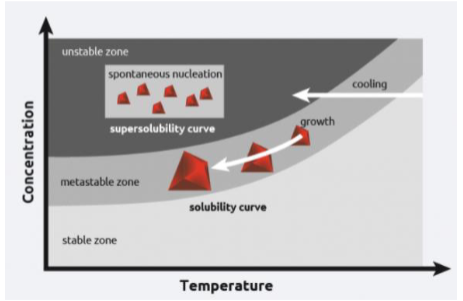
slow cooling process: cooling crystalization (solid-state properties s6)
In reality, when a saturated solution is
cooled, there is more solute in the
solution than predicted by the solubility
curve, and this is referred to as
“supersaturation”.
solvent-antisolvent method (solid-state properties s6)
Shows that the given material is
highly soluble in Solvent A,
meaning more material can be
crystallized from a given volume
of solvent. Conversely, the given
material has a low solubility in
Solvent C across all
temperatures, potentially
making it a good anti-solvent for
this material

Particle Size (particle size analysis s7)
Determination of Particle Size
➢ Electron microscopy
Nanoparticles/ Microparticles
➢ Dynamic light scattering method
Nanoparticles, 1 – 1000 nm
➢ Optical microscopy
➢0.2 – 100 um
➢ Sieving
➢37 - 9500 um
➢ Coulter counter
➢1 – 500 um
➢ Sedimentation
➢1 - 200 um
laser sizing diffraction analysis (particle size analysis s7)
Dispersing liquids for solid-state particles include (but not
limited to) the following:
❖ Methanol
❖ Ethanol
❖ Carbon tetrachloride
❖ Toluene
❖ Chloroform
❖ Surfactant mixture e.g. Span/Tween 80
❖ Water
dynamic light scattering method (particle size analysis s7)
Rapid (i.e. under 10 seconds), real-time, no chemical analysis necessary
•These diffraction patterns are sensed by an array of detectors and
sophisticated algorithms translate these diffraction patterns and diffracted
light intensities into particle sizes.
sieving method (particle size analysis s7)
Determination of Particle Size by the Sieving Method
limitations of microscope method (particle size analysis s7)
Only a few particles can be examined and sized in a reasonable time.
This risks the selection of an unrepresentative sample.
2. The possibility of alteration of particles in the process of sample
preparation.
Sedimentation methods (particle size analysis s7)
Particle size distributions can be
determined by examination of a
powder as it sediments in a liquid.
• If the powder is hydrophobic, it
may be necessary to add a
dispersing agent to aid wetting.
• In cases where the powder is
soluble in water, it will be
necessary to use nonaqueous
liquids or perform the analysis in a
gas.
