Module 9 Test 4 - Neurological System
 Call Kai
 Learn
 Practice Test
 Spaced Repetition
 Match
 Flashcards
 Knowt Play
1/76

There's no tags or description
Looks like no tags are added yet.
77 Terms
How do we measure cerebral function in children? A few basic assessments:
PERRLA
Meeting developmental milestones
Reflexes
Head circumference
Facial features - syndromes can impact this
Observing activities - are they withdrawn
Other considerations for neuro system - broad terms
family history
physical exam
past injuries or bug bites
health history
What might you include in a neuro exam?
Level of Consciousness
Cranial Nerves
Fontanels
Cognitive function: are verbal skills appropriate
Pupils - movement.
Vital Signs - meningitis or heat stroke. Changes on certain meds.
Neck Stiffness - if neck hurts while bending to chest, you are stretching your spinal cord. If you have meningitis, your nerves and meninges are swollen so it will hurt when you stretch them.
Pain
Motor function
Reflexes
Posturing
- Decorticate
- Decerebrate
What is the difference between decorticate and decerebrate rigidity?
- Decorticate - level of cerebral cortex. Everything goes in (to the core).
- Decerebrate - level of midbrain. Everything moves out.
What does a fixed and dilated pupil mean?
Not good. Brain herniating and intracranial pressure increasing.
Strabismus
Eyes vibrate
What is papilledema?
Swelling of the optic nerve due to increased intracranial pressure. May be indicative of a further serious condition.
hemorrhage

When do fontanelles close? Anterior and posterior? When do you stop doing head circumferences?
12-18 months for anterior
2-3 months for posterior (ATI)
check until 3 years, then switch to BP checks
Retinal hemorrhage
retina bleeds

Assessment findings for seizures
bitten tongue
lowered LOC
Purpura - purple spots. This shows up when either tiny capillaries break from the muscle activity of the seizure or possibly the seizure is due to meningitis which causes the purpura spots.
What are the 2 types of meningitis
Viral: not as bad! Monito
Bacterial: more severe!
Solution for meningitis. Pharm (5) and non-pharm (3):
head of bed up
padded bedrails for seizure
start an IV for doctors’ orders - may be treated with antibiotics
No bright lights! The lights are bothersome to the brain. Photophobia.
Anticipate a lumbar puncture. Get CSF fluid to test for WBC, glucose and proteins. Caution: high ICP —> may delay treatment due to risk of brain herniating.
Blood cultures drawn - gives the exact bacteria circulating in blood.
broad spectrum antibiotic
Initiate isolation precautions
Order of interventions for client with meningitis:(4)
Obtain labs
antibiotics
IV access
Foley insertion: done because meningitis may disrupt nerve pathways and voiding. Also just want to track fluid balance.
What color should CSF be? What color is meningitis CSF?
clear in normal
cloudy in meningitis (has a lot of WBC, and infection fighting proteins)
What happens to WBC, glucose, protein, and C-reactive protein?
WBC increase
Glucose decrease - bacteria need glucose to live. They eat it.
Protein increases - its the bacteria’s poop
C- reactive protein is a non-specific indicator of infection/inflammation
What happens if you don’t treat bacterial meningitis?
Bacteria takes over and client will die. Bacteria eats at brain.
Best scale for low LOC for meningitis?
Glasgow coma scale
Interventions or meningitis?
quiet room
elevate head of bed
padding side rails
limit visits
assess LOC
3 top causes for head injuries
falls
motor vehicle
bike
What is a linear skull fracture?
C. Single fracture, most common fracture
What is a depressed fracture
Bone fragments are pushed inward
What is a comminuted fracture?
More than one linear fracture and occurs following repeated head trauma
What is an open fracture?
A break in the mucosa of the scalp or respiratory track. Can get osteomyelitis.
Basilar fracture
Located at the posterior base of the skull and see raccoon eyes
Diagram

Concussion effects
Confusion and amnesia for 1-3 weeks. If it goes past 3 weeks, you are more at risk for depression and anxiety.
Mentally foggy
Drowsiness - sleep more or less than usual baseline
Troulbe sleeping
Irritable?
Nernous?
More emotional?

What is important to report for concussion?
change in LOC
lethargy
behavior changes- agitated or confused?
headache
vomiting
change in vision
seizures
change in mobility
seizure
Subdural hematoma: do arteries or veins bleed?
Vein
Guidelines for return to learn after head injury
gradual process
if you have symptoms with a new activity, you have to go back to the previous step
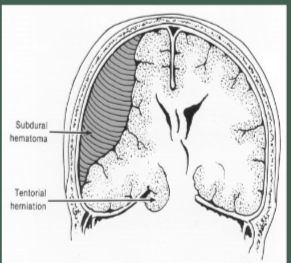
Epidural hematoma
Blood between dura and skull
Bleeding arterial
Hemorrhage forces brain contents downward and inward as brain expands
Uncommon in kids <4

Subdural hematoma
Bleeding between dura and cerebrum
Bleeding venous
Common in infants-maybe the result of birth trauma
What happens with intracranial pressure?
Limited amount of space in cranium so vulnerable to pressure
What is the danger if the pressure gets too high?
Monroe-Kellie Doctrine - If there is a change in one or more of the cranium contents, the other parts must compensate for the changes
Why do kids have more room in the cranium for imbalances?
S/S of increased ICP for infant: KNOW for ATI.
Infant
Poor feeding/vomiting
Irritability
Lethargy
Bulging fontanel
Increased HC
High pitched cry
Setting sun eyes
S/S of increased ICP for children. KNOW for ATI.
Children
Headache
Diplopia: double vision
Altered LOC
N&V nausea and vomiting
Slurred speech
Mood swings
Initial actions for head injury
Stabilize the spine
Perform a thorough assessment
Assess if drainage from ears or nose - CSF (glucuse in this). Or halo spot on pillowcase to indicate glucose.
What to do for increased intracranial pressure?
Elevate HOB 30º
Keep body midline and in neutral position
Limit suctioning. NO nasal suctioning
Stool softener - if you have to strain to have a BP, your intracranial pressure would increase
Urinary catheter - measure output. If brain isn’t working, it won’t tell your kidneys to produce urine.
General interventions for head injuries:
Padded siderails
Turn every 2 hours
May need splints to maintain good alignment: keep limbs in good position
Calm, non-stimulating environment
Conserve energy - do not overheat them or overstimulate them
Fluids and nutritional support
Glasgow Coma Scale
Glasgow coma scale

Meningitis
Encephalitis
Myelitis
Meningitis-Inflammation/infection of the meninges
Encephalitis-Inflammation/infection of the brain
Myelitis-Inflammation/infection of the spinal cord
How to treat if meningitis is viral?
Supportive care - soft foods, Tylenol, hydration, rest
What happens to the brain with bacterial meningitis?
Vascular dissemination of a pathogen from a focus infection (OM, pharyngitis, sinusitis) creating a toxic response.
Brain becomes edematous and the brain surface is covered with an exudate that destroys cells and increases ICP
What causes meningitis in kids?
GBS
>2 months-5 years
N. Meningitidis, Strep Pneumonia, haemophilus influenzae B (HIB)
Info for meningitis for school age kids
Easily spread by droplet contact
Have purpuric rash
Contacts treated with Rocephin
Kernig’s sign
When thigh is flexed toward abd, pain prevents complete extension of leg
Brudzinski’s sign
When child bends head toward the chest, there is involuntary hip and leg flexion
Nuchal rigidity
pain when toughing chin to chest
Does glucose go up or down with bacterial meningitis?
Down. Bacteria feeds on glucose. WBC will increase due to in infection.
Focal seizures. Start area, and body areas it affects. What are the 2 types?
Start at one side of the brain
Often start at temporal lobe
Mouth may twitch or pick at clothes
Focal seizure with impaired consciousness
Focal seizure without impaired consciousness.
Focal to bilateral tonic-clonic seizure
Start as a focal seizure and progresses to generalized.
5 Types of seizures and what they look like?
Abscence Seizure: Common 4-7 Kids will stare ahead and look blank breifly
Tonic Clonic Seizure
Myoclonic seizure: Jerking rhythmic motions. Like a conductor
Atonic seizure: lose all muscle tone.
Infantile Spasm: Legs jerk up to chest.
Post Ictal
After a seizure
Very tired
Sleep, headache
Diagnostic tests for seizure?
Lumbar Puncture
CT/MRI : structural reason?
CBC: Infection? Meningitis?
Glucose: Hyper or hypoglycemia.
Electrolytes, Ca, BUN: Metabolic disorder?
EEG: Snapshot of electrical activity of the brain.
History and situational factors for a seizure.
Family history
Developmental assessment
Triggering events
What do seizure meds do?
What organ are seizure drugs metabolized by?
Types of seizure meds and examples?
First line treatments, recue meds and diet?
Suppress neuronal activity in the brain. Meds are based on the seizure type and age of the child. You can increase to reach best effects.
Metabolizing meds through the liver with kids with seizures can be problematic.
First line treatment: Keppra. It is not metabolized through the liver
Rescue med:
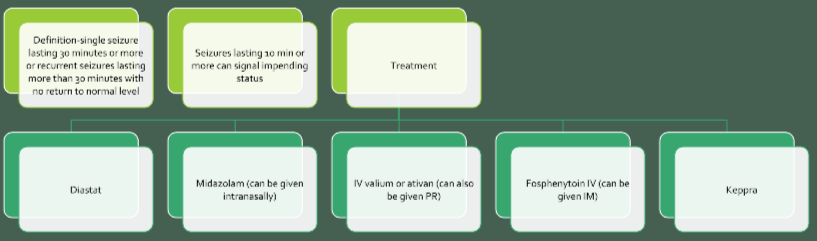
Buccal or intranasal Midazolam
Rectal Diazepam
IV Ativan
Ketogenic diet: not super palatable (2 years max often) Reevaluate
high fat
low carb
low protein
Keep them in ketosis: low sugar
Vagus nerve stimulator
Generates a stimulus to change the electrical current in the brain so you don’t have seizures.
Running a magnet over the head with this prevents/makes better seizures
Responsive neurostimulation
Implanted device into skull near the origin of the seizure.
Responds to seizures and sends a signal to help.
DBS
Deep brain stimulation. Helps with seizures.
Status epilepticus
Seizure that lasts 30 mins or more
Febrile seizures
Seizure following a rapid rise in temp (102-104)
Usually tonic-clonic and last <5 min
Associated with URI, OM, Tonsillitis
Occur most often in kids 6mo-5 years
33% of kids with febrile seizures will have seizure with subsequent infections
Treatment for febrile seizures.
give kid Tylenol so the fever wont get high
educate that parents know the child will likely not have seizures later
Educate on importance of antipyretics and protection if seizure does occur
Hydrocephalus
Abnormal increase in the CSF volume within the cranium.
Clinical manifestations of hydrocephalus:
General-Irritability, feeding difficulties, crying when moved but quiet when still
Early Infancy-Abnormally rapid head growth, bulging fontanelle
Later Infancy-Frontal enlargement, setting sun eyes (sclera visible above the iris)
Childhood-HA on wakening, better after emesis or upright posture, ataxia, confusion
Enlarged head
Diagnostics for hydrocephalus:
MRI
CT
HC
Cranial US
S&S
Treatment for hydrocephalus and post-op care.
Remove obstruction
VP shunt
Purpose
Shunt fluid from ventricle in brain to peritoneum
Post op care
Neural assessment
S&S infection: fever etc
Teaching regarding shunt failure: neural assessment will be abnormal
Spina bifida
Defect in the closure of the vertebral column
Occurs when the neural tube either fails to close or is split as a result of an abnormal increase in CSF during the first trimester
Neural tube development is completed by 4th week of gestation

Causes of spina bifida:
Medications
Maternal Diabetes
Maternal malnutrition and vitamin deficiency
Newer evidence links a genetic predisposition with folic acid deficiency
Present with various syndromes
Incidence-1-5 in 1000 live births
Quad test
looks at alpha fetal protein AFP
16-18 weeks gestation. High alpha fetal protein may mean you baby will have spina bifida or multiple births.
Assesses AFP, estriol, hCH and inhibin A. In down syndrome, AFP and estriol will be low as they come from the baby/placenta. HCG and inhibin A will be high as they come from the placenta. In neural tube defects like spina bifida, the AFP is often high as it leaks into the amniotic fluid.
Diagnostic test/therapeutic management for spina bifida
QUAD test-16-18 weeks of gestation
Alpha Fetoprotein
Manifestations
Neuro damage depends on level of defect and external nerves and fibers in sac
No latex: foods like bananas can contain latex
Care of the infant with spina bifida after birth:
After birth
Keep sac safe - donut ring
Prone position - on belly
Assess neuro involvement
Best outcome with surgical repair is 24-72 hours after birth
Some successful closures in the womb before 26 weeks of fetal life
What to assess for after repair of spina bifida:
Assess for infection
Assess surgical site
Assess for hydrocephalus: extra fluid has to go somewhere - goes to ventricles.
Assess neuro involvement: cannot empty bladder fully so they will be straight cathed.
Complications for spina bifida
Infection
Assess
Blood and urine cultures as needed
Antibiotics
Skin ulceration
Assess redness/breakdown
Reposition q 2 hours
Increased intracranial pressure
CNS tumors what are they? Theres different types you don’t need to know
Most common childhood cancer. High mortality rates.
Medulloblastoma
Astrocytoma
Ependymomas
Brainstem gliomas
Clinical manifestations for CNS tumors:
HA
Vomiting in AM
Seizures
Ataxia - poor coordination
Vision changes
Nystagmus - vibrating eyes
Diagnostic tests for CNS tumors
MRI
PET Scan
SPECT: where is blood going in brain and where is it being stopped
Functional MRI
Therapeutic management for brain CNS tumors:
Surgery
Radiation
Chemotherapy
Neuroblastoma; don’t need to know but in ATI
Tumors originate from the embryonic neural crest cells that give rise to the adrenal medulla and sympathetic nervous system
Genetic defect in many cases is deletion of short arm of chromosome 1
Oncogene MYCN identified in 25% of cases
Primary site-abdomen
Clinical manifestations and diagnostic tests for neuroblastoma: (know for ATI)
Manifestations
Abdominal mass that crosses the midline
Abdominal distention
Dyspnea
Urinary retention/frequency
Periorbital edema
Bone pain
Diagnostic
CT
Bone Marrow
“Silent tumor”