Ch 7: Citric Acid Cycle, the Electron Transport Chain, and ATP Biosynthesis
 Call Kai
 Learn
 Practice Test
 Spaced Repetition
 Match
 Flashcards
 Knowt Play
1/38

There's no tags or description
Looks like no tags are added yet.
39 Terms
What is the purpose of the pyruvate dehydrogenase complex?
The pyruvate dehydrogenase complex (PDC) is a large multi-enzyme assembly in the mitochondrial matrix (or cytoplasm in prokaryotes) that converts pyruvate into acetyl-CoA. It acts as the bridge linking glycolysis to the citric acid (TCA) cycle during aerobic cellular respiration. Remember:
Glycolysis breaks down glucose into pyruvate.
Pyruvate is converted into acetyl-CoA by the pyruvate dehydrogenase complex.
Acetyl-CoA then enters the TCA cycle.
The purpose of this complex is to produce:
Acetyl-CoA
NADH
CO₂
Location: Mitochondrial matrix.
Overall reaction: Pyruvate + CoA-SH + NAD+ —> Acetyl-CoA + CO2 + NADH + H+
• Produces acetyl-CoA: Supplies the 2-carbon fuel needed to enter the citric acid cycle.
• Releases carbon dioxide: Removes a carboxyl group from the 3-carbon pyruvate molecule.
• Generates NADH: Reduces NAD+ to NADH, carrying high-energy electrons toward ATP production.

Why is acetyl-CoA important?
Acetyl-CoA has two important possible fates:
Energy production: Its carbons can be further oxidized through the TCA cycle, producing NADH and FADH₂. These eventually help generate ATP.
Energy storage: Acetyl-CoA can be used to make fatty acids, which are stored as energy.
Acetyl-CoA can also come from the breakdown of fatty acids and certain amino acids, not just glucose.
Remember Cofactors
A cofactor is a non-protein chemical compound or metallic ion that an enzyme needs to catalyze a chemical reaction. Without its cofactor, an enzyme remains inactive (called an apoenzyme); once bound, it forms a complete, active holoenzyme.
Main Types of Cofactors
Inorganic cofactors: Metal ion or iron-sulfur clusters that stabilize structures, aid substrate binding, or help transfer electrons.
Organic cofactors (coenzymes): Small organic molecules—often vitamins or vitamin derivatives—that carry electrons or chemical groups during a reaction.
Binding Strength
Coenzymes / cosubstrates: Bind more loosely or transiently to the enzyme and are often chemically altered during the reaction.
Prosthetic groups: Bind tightly or permanently (sometimes covalently) to the enzyme.
Usage Examples
Magnesium: Acts as an inorganic cofactor for enzymes like hexokinase.
NAD+ and FAD: Act as organic coenzymes that transfer electrons and hydrogen in metabolic pathways.
Coenzyme A and ATP: Carry acyl or phosphate groups in cellular reactions.
Reduced Cofactors
Reduced cofactors are coenzymes or metal cofactors that have gained electrons (and often protons) during oxidation-reduction (redox) reactions, enabling them to donate electrons to drive metabolism and biosynthesis.
Major Reduced Cofactors
NADH (reduced form of NAD⁺): Generated during catabolism (such as glycolysis, beta-oxidation, and the citric acid cycle) and primarily donates electrons to the mitochondrial electron transport chain to power ATP synthesis.
NADPH (reduced form of NADP⁺): Produced mainly via the pentose phosphate pathway; supplies reducing power for anabolic reactions (such as fatty acid and nucleotide synthesis) and antioxidant defense.
FADH₂ and FMNH₂ (reduced forms of FAD and FMN): Flavin cofactors derived from riboflavin (vitamin B₂) that carry electrons in metabolic pathways and respiratory complexes.
Ubiquinol (QH₂) (reduced form of coenzyme Q): A lipid-soluble electron carrier in the electron transport chain.
Reduced metal ions (such as Fe²⁺): Serve as redox-active cofactors for enzymes like hydroxylases.
Regulation of the pyruvate dehydrogenase complex
The PDC is regulated through:
Allosteric regulation.
Phosphorylation and dephosphorylation.
Feedback inhibition.
A. Activators
AMP: Activates E1
High AMP means the cell has relatively low ATP.
This signals that the cell needs more energy.
Activating PDC helps produce acetyl-CoA and NADH, supporting ATP production.
Ca²⁺ (Calcium): Activates
Calcium is important for muscle contraction.
When muscles contract, they require ATP.
Increased calcium signals greater energy demand.
Therefore, calcium activates PDC to help increase energy production.
PEP (Phosphoenolpyruvate): Activates E1
PEP is an intermediate in glycolysis.
PEP is converted into pyruvate.
High PEP suggests that glycolysis is active.
This signals that the cell is processing fuel and may need more energy.
Insulin: Increases E1 activity
Insulin is released in the fed state, after eating.
When energy is abundant, the body can store excess energy.
PDC produces acetyl-CoA, which can be used for fatty acid synthesis.
Therefore, insulin increases PDC activity to support energy storage.
B. Inhibitors
NADH: Inhibits
NADH is a product of the reaction.
High NADH indicates that sufficient reduced cofactor has already been produced.
It signals that additional fuel oxidation may not be necessary.
Acetyl-CoA: Inhibits
Acetyl-CoA is also a product.
When enough acetyl-CoA is present, the enzyme is inhibited.
This is an example of feedback inhibition.
ATP: Signals reduced energy demand
High ATP indicates that the cell already has sufficient energy.
Additional fuel oxidation may be unnecessary.
Acetyl-CoA can instead be directed toward fatty acid synthesis and storage.
C. Phosphorylation and dephosphorylation
PDC is also regulated by enzymes that add or remove phosphate groups.
Kinase: Adds a phosphate group (phosphorylation).
Phosphatase: Removes a phosphate group (dephosphorylation).
These modifications change the activity of the complex. For the pyruvate dehydrogenase E1 component:
Phosphorylation = inactive.
Dephosphorylation = active.

What does lactate dehydrogenase do?
Lactate dehydrogenase converts pyruvate into lactate. During this reaction:
Pyruvate is reduced to lactate.
NADH is oxidized to NAD⁺.
The overall reaction is: Pyruvate + NADH + H+ —><>— Lactate + NAD+
Why is this reaction important?
The main purpose emphasized by your professor is to regenerate NAD⁺. Remember that glycolysis requires NAD⁺ during the glyceraldehyde-3-phosphate dehydrogenase step. If NAD⁺ is not available, glycolysis cannot continue through that step. Therefore:
NADH transfers electrons to pyruvate.
Pyruvate becomes lactate.
NADH becomes NAD⁺.
NAD⁺ is available again for glycolysis.
LDH regenerates NAD⁺ so glycolysis can continue.
Understanding hydride transfer
NADH transfers a hydride ion (H⁻) to pyruvate. A hydride contains:
One hydrogen atom.
Two electrons.
In other words: H- = 2e- + H+
NADH donates this hydride to pyruvate, allowing pyruvate to become reduced into lactate. Remember:
NADH donates a hydride.
NAD⁺ accepts a hydride.
This is important because NADH and NAD⁺ participate in oxidation-reduction reactions.
Amino acids in the active site of lactate dehydrogenase
There are three important amino acid residues discussed:
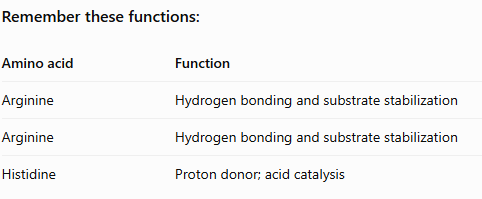
Arginine #1
Forms hydrogen bonds with pyruvate.
Helps stabilize pyruvate in the active site.
Arginine #2
Also forms hydrogen bonds.
Helps position and stabilize pyruvate.
Histidine
Donates a proton.
Acts as an acid catalyst.
Helps facilitate the conversion of pyruvate into lactate.
Quick summary: LDH
Pyruvate becomes lactate.
NADH becomes NAD⁺.
NAD⁺ is regenerated for glycolysis.
Two arginines stabilize pyruvate through hydrogen bonding.
Histidine donates a proton and acts as an acid catalyst.
What is the citric acid cycle?
The citric acid cycle has three common names:
Citric acid cycle.
Krebs cycle.
TCA cycle.
TCA stands for tricarboxylic acid. Why? Because some of the intermediates contain three carboxylate groups. Citrate, for example, has three carboxylate groups.
Location: The TCA cycle takes place primarily in the mitochondrial matrix.

Purpose of the TCA cycle
The TCA cycle breaks down the acetyl group from acetyl-CoA through a series of reactions.
Its major purposes are to:
Release CO₂.
Produce NADH.
Produce FADH₂.
Produce GTP or ATP.
Regenerate oxaloacetate so the cycle can continue.
NADH and FADH₂ are particularly important because they carry high-energy electrons to the electron transport chain, where their energy helps generate ATP.

The eight intermediates of the TCA cycle
TCA cycle sequence
Oxaloacetate (4 carbons): Combines with acetyl-CoA.
Citrate (6 carbons): Formed when acetyl-CoA combines with oxaloacetate.
Isocitrate (6 carbons): Citrate is rearranged.
Alpha-ketoglutarate (5 carbons): CO₂ is released and NADH is produced.
Succinyl-CoA (4 carbons): Another CO₂ and NADH are produced.
Succinate (4 carbons): ATP or GTP is produced.
Fumarate (4 carbons): FADH₂ is produced.
Malate (4 carbons): Water is added to fumarate.
Oxaloacetate (4 carbons): NADH is produced, and the cycle begins again.
Notice that oxaloacetate appears at both the beginning and end. It is regenerated, allowing another acetyl-CoA molecule to enter.
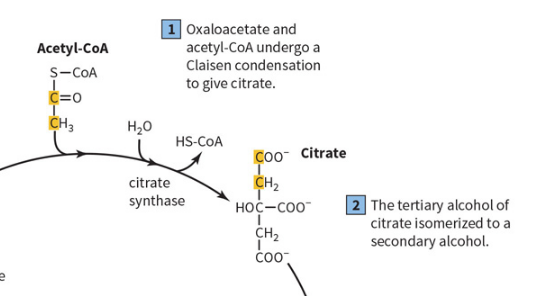
Reaction 1: Citrate formation
Enzyme: Citrate synthase
The first reaction combines:
Acetyl-CoA: 2 carbons.
Oxaloacetate: 4 carbons.
2C+4C=6C
The result is citrate, which contains six carbons.
What happens chemically?
The two-carbon acetyl group attaches to oxaloacetate.
A new carbon-carbon bond forms.
The thioester bond between the acetyl group and CoA is hydrolyzed.
CoA-SH is released.
Citrate is formed.
Important carbon-tracking concept:
The methyl carbon of acetyl-CoA forms a carbon-carbon bond with an oxaloacetate carbon.
Your professor emphasized knowing where the two acetyl-CoA carbons go throughout the cycle.
Reaction 2: Citrate becomes isocitrate
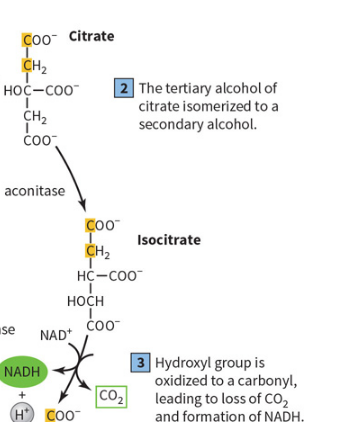
Enzyme: Aconitase
This reaction rearranges citrate into isocitrate. The main change:
Citrate has a tertiary alcohol.
Isocitrate has a secondary alcohol.
Remember from organic chemistry:
Primary: OH-bearing carbon attached to one other carbon
Secondary: OH-bearing carbon attached to two other carbons
Tertiary: OH-bearing carbon attached to three other carbons
Aconitase rearranges the position of the OH group.
Important: No carbon is removed in this reaction.
Reaction 3: Isocitrate becomes alpha-ketoglutarate
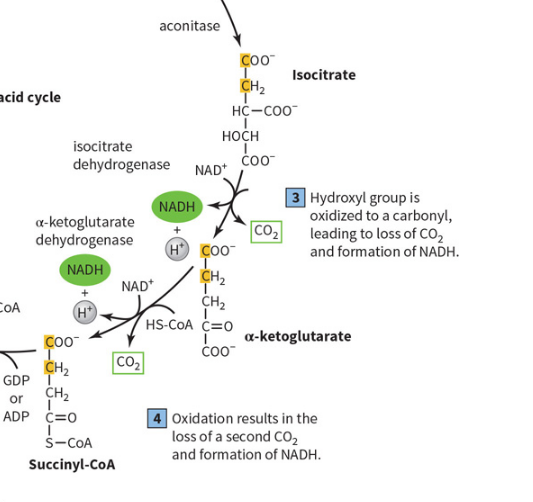
Enzyme: Isocitrate dehydrogenase
This is an important reaction because it produces both NADH and CO₂. Two things happen:
1. Oxidation
An alcohol is converted into a carbonyl group.
NAD⁺ accepts a hydride.
NAD⁺ becomes NADH.
2. Decarboxylation
A carboxylate group is removed.
It leaves as CO₂.
This reaction is called an oxidative decarboxylation because oxidation and CO₂ release happen together. Carbon count: 6C —> 5C+CO2
The product is alpha-ketoglutarate, which contains five carbons.
Important carbon tracking: The carbon released as CO₂ comes from the original oxaloacetate, NOT from the newly entered acetyl-CoA.
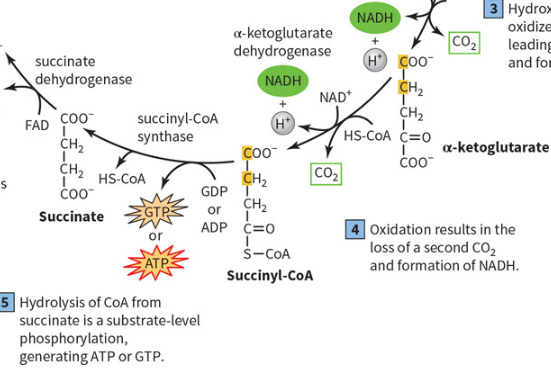
Reaction 4: Alpha-ketoglutarate becomes succinyl-CoA
Enzyme: Alpha-ketoglutarate dehydrogenase
This is another oxidative decarboxylation reaction. What happens?
A carboxylate group is removed as CO₂.
An alcohol-derived oxidation process is involved in the overall reaction.
NAD⁺ is reduced to NADH.
CoA attaches to the remaining carbon structure.
A thioester bond forms, producing succinyl-CoA.
Products
Succinyl-CoA.
CO₂.
NADH.
Carbon count:
5C —> 4C+CO2
Again, the acetyl-CoA carbons have not yet been released as CO₂.
Reaction 5: Succinyl-CoA becomes succinate
Enzyme: Succinyl-CoA synthetase
This reaction produces ATP or GTP. How?
Succinyl-CoA contains a high-energy thioester bond. When that bond is broken, the released energy helps drive the phosphorylation of:
GDP + inorganic phosphate → GTP.
OR ADP + inorganic phosphate → ATP.
This is an example of substrate-level phosphorylation.
Important concepts
Succinyl-CoA contains four carbons.
Succinate also contains four carbons.
CoA-SH is released.
ATP or GTP is produced.
Why does the professor stop highlighting the acetyl-CoA carbons here?
Because succinate is symmetrical. Its two ends are chemically equivalent. There is no longer a way to distinguish which two carbons originally entered through acetyl-CoA. Therefore, after this point, we lose track of the exact identities of those original two carbons.

Reaction 6: Succinate becomes fumarate
Enzyme: Succinate dehydrogenase
This reaction involves oxidation. Succinate contains two methylene groups that become alkene carbons. In simpler terms:
Hydrogens are removed from succinate.
A double bond forms.
Succinate becomes fumarate.
FAD accepts the electrons and hydrogen equivalents.
FAD becomes FADH₂.
Succinate + FAD—> Fumarate + FADH2
Important: Succinate dehydrogenase is also Complex II of the electron transport chain. We will return to this later.

Reaction 7: Fumarate becomes malate
Enzyme: Fumarase
This reaction adds water across the double bond of fumarate.
This process is called hydration.
What happens?
The double bond becomes a single bond.
An OH group attaches to one carbon.
An H attaches to the other carbon.
Malate is formed.
Your professor connected this to Markovnikov addition from organic chemistry. However, both carbons are equivalent in fumarate, so it does not matter which side receives the OH group.
Remember: Hydration means adding water.

Reaction 8: Malate becomes oxaloacetate
Enzyme: Malate dehydrogenase
This is the final reaction of the cycle. Malate is oxidized to oxaloacetate.
What happens?
Malate contains an alcohol group.
That alcohol is oxidized into a carbonyl group.
NAD⁺ accepts a hydride.
NAD⁺ becomes NADH.
Oxaloacetate is regenerated.
Malate + NAD+—> Oxaloacetate + NADH + H+
The oxaloacetate can now combine with another acetyl-CoA, beginning another cycle.

TCA cycle reaction summary
see image

Products per ONE turn of the TCA cycle
see image

Carbon tracking: Where do the carbons go?
When acetyl-CoA enters the TCA cycle, it contributes two carbons. The cycle then releases two CO₂ molecules during that turn. But here is the important detail: The two carbons that entered as acetyl-CoA do NOT leave as CO₂ during the first turn of the cycle. Instead, the CO₂ molecules released during the first turn originate from the original oxaloacetate. Why? Because the acetyl-CoA carbons remain within the intermediate structures during the first turn. Eventually, the carbon atoms become mixed within the symmetrical succinate molecule, making it impossible to distinguish the original acetyl-CoA carbons from the others. (see image)
Know the carbon count at every stage and remember that the first two CO₂ molecules released do not come from the newly entered acetyl-CoA.

How many times does the TCA cycle run per glucose?
One glucose molecule produces two pyruvate molecules during glycolysis. Each pyruvate is converted into one acetyl-CoA. Therefore:
One glucose → 2 pyruvate.
Two pyruvate → 2 acetyl-CoA.
Two acetyl-CoA → 2 turns of the TCA cycle.
The TCA cycle runs twice for every glucose molecule.
Products from glycolysis, PDC, and the TCA cycle
(see image) Remember:
Glycolysis produces 2 ATP and 2 NADH.
PDC produces 2 NADH because there are 2 pyruvate molecules.
The TCA cycle runs twice and produces 2 ATP/GTP, 6 NADH, and 2 FADH₂.

Converting NADH and FADH₂ into ATP
1 NADH = 2.5 ATP
1 FADH2 = 1.5 ATP
calculation:
NADH: 10 × 2.5 = 25 ATP
FADH2: 2 × 1.5 = 3 ATP
substrate-level ATP/GTP: 2 + 2 = 4 ATP equivalents
Everything added: 225 +3 + 4 = 32 ATP
Total ATP per Glucose = 32 ATP:
25 ATP from NADH
3 ATP from FADH₂
4 ATP from substrate-level phosphorylation

The three regulated steps of the TCA cycle
Reactions with large negative cellular ΔG values are generally effectively irreversible and are important regulatory points. There are three major reactions with large negative cellular ΔG values. These are reactions 1, 3, and 4. (see image). Why are these important?
They have large negative cellular ΔG values.
They are effectively irreversible.
They are major points of regulation.
The other reactions generally have cellular ΔG values close to zero. These reactions can proceed in either direction depending on the concentrations of reactants and products. This is called mass action.

Regulation of the TCA cycle
Citrate synthase
Inhibited by:
Citrate.
Succinyl-CoA.
NADH.
Why? These molecules indicate that products or downstream intermediates are already accumulating. This is feedback inhibition.
Isocitrate dehydrogenase
Inhibited by:
ATP.
NADH.
Activated by: Calcium (Ca²⁺).
Why?
High ATP means the cell has sufficient energy.
High NADH indicates that reduced cofactors are already abundant.
Calcium indicates muscle activity and increased ATP demand.

Why do ATP and NADH inhibit energy-producing pathways?
ATP and NADH inhibit energy-producing pathways to match fuel breakdown with cellular energy demand and prevent metabolic waste or redox imbalance. When a cell already has plenty of ATP and NADH, running catabolic pathways at full speed wastes fuel and can cause excess NADH to build up when the electron transport chain is not rapidly oxidizing it
Why They Act as Stop Signals
Energy abundance (ATP): High ATP signals that energy supply meets or exceeds demand. Slowing breakdown preserves fuels like glucose and fatty acids for when energy drops.
Redox & electron backup (NADH): NADH carries electrons to the electron transport chain. High NADH (a high NADH/NAD+ ratio) shows that electron carriers are full and NAD+ is limited for oxidation reactions, so slowing NADH-producing steps prevents excess NADH accumulation
Understanding the malate dehydrogenase reaction
The reaction: Malate —> Oxaloacetate
has a positive standard free-energy change: Delta G knot’= +28.5 to +28.7
Normally, a positive ΔG means that the reaction is not favorable in the forward direction under standard conditions. However, inside the cell, the actual ΔG is close to zero. Why? Because oxaloacetate is continuously consumed by citrate synthase. In other words, oxaloacetate does not accumulate.
Understanding the equation
Delta G= Delta G knot’ +RTlnQ
Where:
ΔG = actual free-energy change.
ΔG°′ = standard biochemical free-energy change.
R = gas constant.
T = temperature in Kelvin.
Q = reaction quotient.
The important part is: RTln Q
For this term to be negative, Q must be between 0 and 1. That means the concentration of products relative to reactants must be small. In this reaction, oxaloacetate is kept at a very low concentration because citrate synthase immediately uses it. Therefore:
Malate is converted into oxaloacetate.
Oxaloacetate is immediately consumed.
Oxaloacetate stays at a low concentration.
This helps pull the malate dehydrogenase reaction forward.
The main takeaway: The malate dehydrogenase reaction is driven forward because its product, oxaloacetate, is continuously removed by the next reaction.
What is anaplerosis?
Anaplerosis means replenishing or refilling the intermediates of the TCA cycle. Why is this necessary? TCA intermediates are not only used for energy production. They can also be removed and used for other metabolic pathways. For example:
Citrate can be used elsewhere.
Alpha-ketoglutarate can be used elsewhere.
Succinyl-CoA can be used elsewhere.
Oxaloacetate can be used elsewhere.
If too many intermediates are removed, the TCA cycle can slow down or stop. This would reduce production of:
NADH.
FADH₂.
ATP/GTP.
Therefore, the body needs reactions that replace these intermediates. These are called anaplerotic reactions. (see image)
What are odd-chain fatty acids?
These are fatty acids with an odd number of carbon atoms. Examples:
15 carbons.
17 carbons.
When broken down, their carbon skeletons can contribute to replenishing TCA cycle intermediates.
Quick summary: Anaplerosis
TCA intermediates can be removed for other metabolic processes.
Removing too many intermediates can slow the cycle.
Anaplerosis replaces the intermediates.
You need to understand the concept, but your professor said you do not need to memorize all the individual reactions.
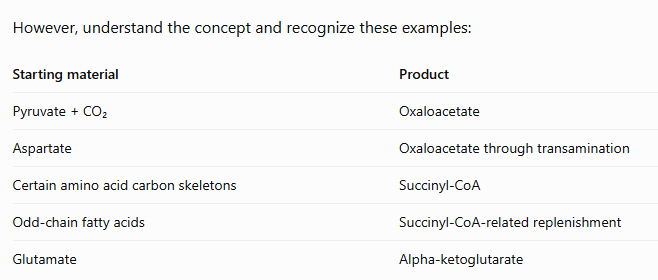
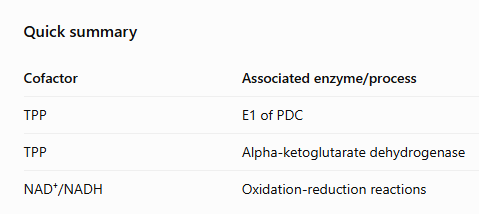
Thiamine pyrophosphate (TPP)
Thiamine pyrophosphate is a cofactor used by:
E1 of the pyruvate dehydrogenase complex.
Alpha-ketoglutarate dehydrogenase.
TPP is derived from vitamin B1 (thiamine). It helps these enzyme complexes carry out their reactions.

NAD⁺ and the nicotinamide ring
NAD⁺ stands for: Nicotinamide adenine dinucleotide.
The nicotinamide ring is derived from a vitamin. NAD⁺ and NADH are cofactors involved in oxidation-reduction reactions. Vitamins provide non-amino-acid components that allow enzymes to perform specialized chemical reactions.
What happens to NADH and FADH₂?
So far, we have learned that glycolysis, PDC, and the TCA cycle produce NADH and FADH₂. But what happens to these molecules? They carry high-energy electrons to the electron transport chain (ETC). The electron transport chain uses the energy from these electrons to help pump protons across the inner mitochondrial membrane. This creates a proton gradient that will eventually be used to produce ATP.
Where does electron transport happen?
Electron transport occurs in the inner mitochondrial membrane. The following are integral membrane proteins:
Complex I.
Complex II.
Complex III.
Complex IV.
ATP synthase.
What are integral membrane proteins? These are proteins embedded within the membrane. They interact with both sides of the inner mitochondrial membrane:
Matrix side.
Intermembrane-space side.

Proton pumping
As electrons move through the electron transport chain, they transfer energy between different redox centers. A redox center is a component that can participate in oxidation-reduction reactions. As electrons move from one redox center to another, they lose energy. That energy is used to drive conformational changes in proteins. These conformational changes allow certain complexes to pump protons.

Which complexes pump protons?
Complex I: Pumps H+
Complex II: Does NOT pump H+
Complex III: Pumps H+
Complex IV: Pumps H+
- Electrons move through the electron transport chain.
- Protons are pumped from the matrix into the intermembrane space.
They are not the same thing!

Electron transport starting with NADH
NADH enters the electron transport chain through Complex I. Remember that NADH donates a hydride ion containing two electrons. The sequence, NADH electron pathway: (see image)
What is ubiquinone (UQ)?
Ubiquinone is a lipid-soluble molecule located in the inner mitochondrial membrane. Its job is to:
Accept electrons from Complex I.
Become reduced.
Move through the membrane.
Deliver electrons to Complex III.
Because it is lipid-soluble, it can move around within the membrane.

Electron transport starting with FADH₂
Unlike NADH, FADH₂ enters electron transport through Complex II. Here is something important your professor revealed: Complex II is succinate dehydrogenase. Remember reaction 6 of the TCA cycle? Succinate was converted into fumarate, and FAD was reduced to FADH₂. That same enzyme is Complex II.
Why is this important?
Succinate dehydrogenase is located in the inner mitochondrial membrane, not freely in the mitochondrial matrix. The FAD associated with this enzyme is bound to the complex. The electrons from FADH₂ are transferred through redox centers and eventually to ubiquinone.
FADH₂ electron pathway (see image)

Comparing NADH and FADH₂
(see image)
Why does FADH₂ produce less ATP than NADH?
The lecture introduced the different ATP yields:
NADH = approximately 2.5 ATP.
FADH₂ = approximately 1.5 ATP.
The reason is connected to their different entry points. NADH enters at Complex I, while FADH₂ enters at Complex II, bypassing Complex I. Because Complex II does not pump protons, FADH₂ contributes less to the proton gradient. This is why its estimated ATP yield is lower.
