3301 Interdependence
 Call Kai
 Learn
Learn Practice Test
 Spaced Repetition
 Match
Match Flashcards
 Knowt Play
1/36

There's no tags or description
Looks like no tags are added yet.
Name | Mastery | Learn | Test | Matching | Spaced | Call with Kai | Chat |
|---|
No analytics yet
Send a link to your students to track their progress
37 Terms
What are the two types of power in IPE?
Relational and Structural
What is relational power?
ability of A to get B to do something B otherwise wouldn’t do
What is asymmetric interdependence? What power structure is it in?
occurs when two countries depend on each other, but one country depends on the relationship more than the other does
relational power
What is structural power?
the ability to shape the range of choices open to others without apparently putting pressure directly on them
What kind of things are examples of structural power?
controlling security, production, credit (capital), knowledge, beliefs, ideas (TECHNOLOGY)
What are the two types of interdependence in IPE?
mutual and asymmetric
What is mutual dependence?
when two countries depend on each other to meet their economic or political needs
are both countries equally relient on each other with mutual dependence?
no. Mutual dependence does not necessarily mean equal dependence
What are the two variables that measure how much power one state has over another during an external shock
Sensitivity (how much it hurts) and variability (how hard it is for you to do something about it)
What is high sensitivity and high vulnerability?
protracted pain
A state feels the economic shock immediately and intensely (high sensitivity), and it lacks the domestic resources or alternative partners to adapt (high vulnerability). This leads to long-term economic damage.
What is low sensitivity and high vulnerability?
No pain
The state is largely insulated from the initial external shock (low sensitivity). Even if it theoretically lacks long-term alternatives (high vulnerability), the absence of an immediate impact means it does not experience the acute pain of the event
What is high sensitivity and low vulnerability?
Short term pain
A state feels the initial shock quickly (high sensitivity), but because it has strong resources or alternative markets, it can quickly adapt its policies to recover (low vulnerability). The damage is only temporary
What is low sensitivity and low vulnerability?
No pain
The state is insulated from the initial shock and also has plenty of alternatives. It remains unaffected by the external disruption
What are the assumptions we have about cooperation between countries:
They care only about absolute gains. As long as they are better off then the reversion point then they are going to be happy with the agreement
Negotiations are win-win and both are better off than without cooperation
What is the reversion point?
The "reversion point" (or fallback position) is the status quo that countries return to if negotiations fail and no deal is reached. For cooperation to make sense, a state only needs to ensure that the proposed outcome is an improvement over this reversion point
What do we have to remember about international cooperation?
it is intentional, join action → it’s not harmony (they are working to solve a problem, they are not working together because they naturally agree on everything)
Cooperation doesn’t imply an absence of conflict
There are costs as well as benefits:
They might have to alter or forgo their normal behavior, like a tariff that they really like
And costs and benefits vary between and within states
Why do costs and benefits vary between and within states
Between states: One country might get a slightly better end of the deal than the other.
Within states: This is where domestic politics kicks in. If the US signs a free trade agreement to boost agricultural exports, livestock feedyards and grain producers might see massive profits, while domestic steel manufacturers might face harsh new competition and lose money. The state as a whole cooperated, but the benefits and costs were felt very differently internally.

What does C represent?
This space sits behind the reversion point, meaning any deal in this zone is worse than the status quo for at least one of the actors. Because no rational country will sign a deal that is worse than their Plan B, agreements simply do not happen here

What does SQ revision point mean?
This stands for the "Status Quo,” the baseline reality if everyone walks away from the table without a deal. You then choose BATNA, the best alternative to negotiated agreement (BATNA)
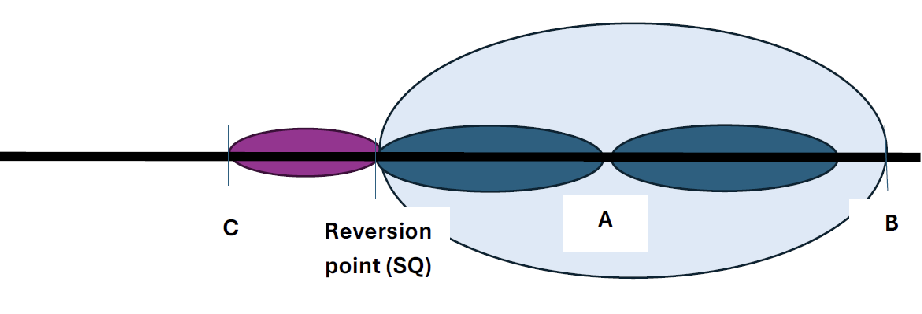
What does A represent?
This is the sweet spot where the two dark blue ovals overlap. It represents the actual negotiated agreement that satisfies both parties enough to sign, making both better off than their BATNA (best alternative to negotiated agreement)

What does B represent?
represents the extreme outer edge of the possible agreement zone. It is the absolute best-case scenario for one country, and the bare-minimum acceptable deal for the other country right before they refuse to sign and revert to their BATNA.
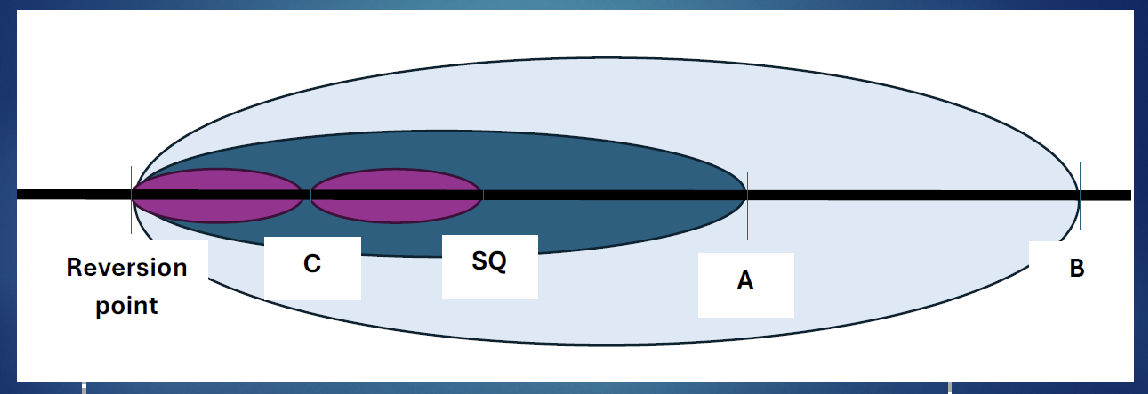
What does the revision point mean?
The Reversion point is located far to the left of the current SQ. This means a state's BATNA is very weak. If negotiations collapse, the fallback reality is worse than their current situation.

What does C represent?
It represents a deal that makes both countries worse off than they are right now, but keeps them safe from the absolute disaster of the Reversion point

What does SQ mean?
the exact situation both countries are in right now before a new deal is signed

What is point A?
The genuine win-win: Because Point A sits to the right of the SQ, it represents a negotiated agreement that actively improves the situation. If the countries reach a deal at Point A, they have not only avoided the disaster of the Reversion point, but they have actually made themselves better off than they are today.

What is point B?
It is the best-case scenario for one actor, and the absolute bare-minimum deal the other actor will accept before they give up and fall back to the Reversion point
What is the two-level game?
international negotiations are actually played at two different tables simultaneously: the international level and the domestic level
What are the different stances that a leader can have in negotiations?
the chief of gov’t (CoG) can be a hawk or a dove
What is the hawk stance?
aggressive, hardline during talks
What is the dove stance?
cooperative, accommodating during talks
what is a winset?
complete range of international deals that a leader's domestic constituents will actually accept and vote to ratify
What does the winset rely on?
the constellation of domestic interests
Difference between the typical and atypical barganing power?
The line is utility on both. Whihcever is happier with status quo is likely to get more of what they want.
Typical: A is the ideal point and B
Atypical:
What is the aspect of ratification/political institutions in
Ratification rules and political institutions are the domestic legal hurdles a leader must clear to make an international deal official at home
How can the chief of government shape winsets?
Own: at home
"A leader can manipulate their own country's winset using a "tacit veto" or "side payments”
Other: Abroad
A leader can also try to expand the other country's winset using "threats/inducements" to make the deal more appealing (or rejection more painful) to the foreign public
What is the required overlap in the two-level game?
The diagram illustrates that a final deal is only possible if it satisfies both domestic populations simultaneously. The bottom "Domestic level" shows Win set A and Win set B. The blue overlapping intersection is the only space where both domestic groups find the terms acceptable. That exact overlap projects up to the "International level" to form the "Area of possible agreement". If negotiators draft a treaty outside that blue circle, it will fail because one of the countries will refuse to ratify it at home
Why do veto players matter?
More veto players, smaller winset (harder to get people to agree)