🏋️ Lecture 10: Energy for Maintenance

0.0(0)
Studied by 1 person
call kaiCall Kai
learnLearn
examPractice Test
spaced repetitionSpaced Repetition
heart puzzleMatch
flashcardsFlashcards
GameKnowt Play
Card Sorting

1/16

encourage image

There's no tags or description

Looks like no tags are added yet.

17 Terms

1
New cards

Food Energy Requirements

Today’s Objectives

- Expand understanding of proximate analysis and metabolizable energy (ME) estimation

Uses of Food Energy

  • Maintenance → sustaining metabolism and essential body functions (today’s lecture)

  • Growth → building body tissues

  • Reproduction → supporting reproductive functions

  • Physical activity → providing energy for movement


<p>Today’s Objectives</p><p>- Expand understanding of proximate analysis and metabolizable energy (ME) estimation</p><p>Uses of Food Energy</p><ul><li><p>Maintenance → sustaining metabolism and essential body functions (today’s lecture)</p></li><li><p>Growth → building body tissues</p></li><li><p>Reproduction → supporting reproductive functions</p></li><li><p>Physical activity → providing energy for movement</p></li></ul><p></p>
2
New cards

Basal Metabolic Rate (BMR)

Definition

  • Minimal amount of energy required by an endothermic animal each day to maintain homeostasis

  • Measured in the absence of factors that affect energy expenditure (in kcal/day)

Essential Body Functions

  • Respiration

  • Circulation

  • Nerve function

  • Cellular maintenance

  • Kidney and liver function


<p>Definition</p><ul><li><p>Minimal amount of energy required by an endothermic animal each day to maintain homeostasis</p></li><li><p>Measured in the absence of factors that affect energy expenditure (in kcal/day)</p></li></ul><p>Essential Body Functions</p><ul><li><p>Respiration</p></li><li><p>Circulation</p></li><li><p>Nerve function</p></li><li><p>Cellular maintenance</p></li><li><p>Kidney and liver function</p></li></ul><p></p>
3
New cards

Thermoregulation: Endotherms vs. Ectotherms

Endotherms

- Body temperature primarily determined by heat generated through metabolic activity

Ectotherms

- Body temperature primarily determined by heat obtained from the environment

<p>Endotherms</p><p>- Body temperature primarily determined by heat generated through metabolic activity</p><p>Ectotherms</p><p>- Body temperature primarily determined by heat obtained from the environment</p>
4
New cards

Basal Metabolic Rate (BMR)

Conditions for Measuring BMR

  • At rest (but awake)

  • In a post-absorptive state

  • In a thermoneutral environment

  • Without physical or psychological stress


<p>Conditions for Measuring BMR</p><ul><li><p>At rest (but awake)</p></li><li><p>In a post-absorptive state</p></li><li><p>In a thermoneutral environment</p></li><li><p>Without physical or psychological stress</p></li></ul><p></p>
5
New cards

Thermoneutral Zone (TNZ)

Definition

- Environmental temperature range where endotherms do not need to actively warm or cool themselves

Heat Balance

  • Basal metabolic heat production = heat lost to the environment

  • The body releases heat at the same rate it produces it to maintain a stable internal temperature

  • Heat loss does not mean the animal loses all its warmth

  • If heat were retained instead of released, body temperature would continuously rise to dangerous levels
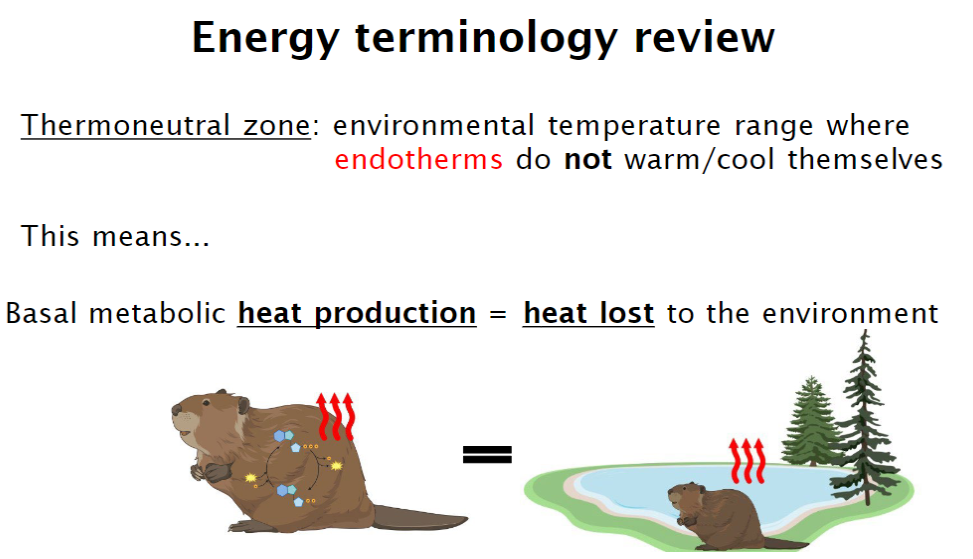

<p>Definition</p><p>- Environmental temperature range where endotherms do not need to actively warm or cool themselves</p><p>Heat Balance</p><ul><li><p>Basal metabolic heat production = heat lost to the environment</p></li><li><p>The body releases heat at the same rate it produces it to maintain a stable internal temperature</p></li><li><p>Heat loss does not mean the animal loses all its warmth</p></li><li><p>If heat were retained instead of released, body temperature would continuously rise to dangerous levels</p></li></ul><p></p>
6
New cards

Energy Expenditure: Basal Metabolic Rate (BMR)

Energy Expenditure

- Total energy an organism uses to maintain life, process food, and perform physical activity (represtented by BMR since BMR is the rate of metabolism, energy use)

Basal Metabolic Rate (BMR)

  • Applies specifically to endotherms

  • Minimum energy required to maintain vital, involuntary body functions under resting conditions

  • Supports functions such as respiration, circulation, nerve function, and cellular maintenance


<p>Energy Expenditure</p><p>- Total energy an organism uses to maintain life, process food, and perform physical activity (represtented by BMR since BMR is the rate of metabolism, energy use)</p><p>Basal Metabolic Rate (BMR)</p><ul><li><p>Applies specifically to endotherms</p></li><li><p>Minimum energy required to maintain vital, involuntary body functions under resting conditions</p></li><li><p>Supports functions such as respiration, circulation, nerve function, and cellular maintenance</p></li></ul><p></p>
7
New cards

Basal Metabolic Rate (BMR): Lowest Metabolic Rate

When Metabolic Rate Falls Below BMR

  • Sleeping → reduced energy expenditure

  • Prolonged starvation and/or dehydration → metabolic rate may decrease

  • Hibernation → reduced metabolism and body temperature

  • Torpor → temporary reduction in metabolic rate and body temperature


<p>When Metabolic Rate Falls Below BMR</p><ul><li><p>Sleeping → reduced energy expenditure</p></li><li><p>Prolonged starvation and/or dehydration → metabolic rate may decrease</p></li><li><p>Hibernation → reduced metabolism and body temperature</p></li><li><p>Torpor → temporary reduction in metabolic rate and body temperature</p></li></ul><p></p>
8
New cards

Kleiber’s Equation: Estimating BMR

Purpose

  • Developed by Kleiber (1947) to estimate BMR

  • Based on metabolic body weight

  • Used for mature (non-growing) endothermic mammals

Equation

- Y = 70 × BW0.75

Variables

  • Y = BMR (kcal/day)

  • 70 = constant

  • BW0.75 = metabolic body weight (body weight in kg raised to the 0.75 power)


<p>Purpose</p><ul><li><p>Developed by Kleiber (1947) to estimate BMR</p></li><li><p>Based on metabolic body weight</p></li><li><p>Used for mature (non-growing) endothermic mammals</p></li></ul><p>Equation</p><p>- Y = 70 × BW<sup>0.75</sup></p><p>Variables</p><ul><li><p>Y = BMR (kcal/day)</p></li><li><p>70 = constant</p></li><li><p>BW<sup>0.75</sup> = metabolic body weight (body weight in kg raised to the 0.75 power)</p></li></ul><p></p>
9
New cards

McNab’s Equations: Estimating Mammalian BMR

Purpose

- McNab (1988) introduced updated equations to estimate BMR in mammals

BMR Equations

  • Placental mammals: Y = 57.2 × BW^0.716

  • Marsupial mammals: Y = 46.6 × BW^0.737

Marsupial Characteristics

  • Certain feeding habits associated with lower metabolic rates

  • Less tolerant of cold temperatures

  • Short gestation time

Variables

  • Y = BMR (kcal/day)

  • BW = body weight (kg)


<p>Purpose</p><p>- McNab (1988) introduced updated equations to estimate BMR in mammals</p><p>BMR Equations</p><ul><li><p>Placental mammals: Y = 57.2 × BW^0.716</p></li><li><p>Marsupial mammals: Y = 46.6 × BW^0.737</p></li></ul><p>Marsupial Characteristics</p><ul><li><p>Certain feeding habits associated with lower metabolic rates</p></li><li><p>Less tolerant of cold temperatures</p></li><li><p>Short gestation time</p></li></ul><p>Variables</p><ul><li><p>Y = BMR (kcal/day)</p></li><li><p>BW = body weight (kg)</p></li></ul><p></p>
10
New cards

BMR Equations: Feeding Habits

Vertebrate Eaters

  • Equation: Y = 91.8 × BW^0.813

  • Weight range: 0.05–175.0 kg

Variables

  • Y = BMR (kcal/day)

  • BW = body weight (kg)


<p>Vertebrate Eaters</p><ul><li><p>Equation: Y = 91.8 × BW^0.813</p></li><li><p>Weight range: 0.05–175.0 kg</p></li></ul><p>Variables</p><ul><li><p>Y = BMR (kcal/day)</p></li><li><p>BW = body weight (kg)</p></li></ul><p></p>
11
New cards

BMR Equations: Mammalian Feeding Habits

Invertebrate Eaters

  • Flying: Y = 47.3 × BW^0.797

    • Weight range: 0.01–0.06 kg

  • Burrowing: Y = 31.7 × BW^0.738

    • Weight range: 0.40–4.00 kg

  • Small: Y = 44.1 × BW^0.597

    • Weight range: 0.01–0.12 kg

  • Large: Y = 43.5 × BW^0.719

    • Weight range: 0.20–7.70 kg

  • Anteaters: Y = 19.7 × BW^0.753

    • Weight range: 1.20–30.6 kg

Variables

  • Y = BMR (kcal/day)

  • BW = body weight (kg)


<p>Invertebrate Eaters</p><ul><li><p>Flying: Y = 47.3 × BW^0.797</p><ul><li><p>Weight range: 0.01–0.06 kg</p></li></ul></li><li><p>Burrowing: Y = 31.7 × BW^0.738</p><ul><li><p>Weight range: 0.40–4.00 kg</p></li></ul></li><li><p>Small: Y = 44.1 × BW^0.597</p><ul><li><p>Weight range: 0.01–0.12 kg</p></li></ul></li><li><p>Large: Y = 43.5 × BW^0.719</p><ul><li><p>Weight range: 0.20–7.70 kg</p></li></ul></li><li><p>Anteaters: Y = 19.7 × BW^0.753</p><ul><li><p>Weight range: 1.20–30.6 kg</p></li></ul></li></ul><p>Variables</p><ul><li><p>Y = BMR (kcal/day)</p></li><li><p>BW = body weight (kg)</p></li></ul><p></p>
12
New cards

BMR Equations: Frugivores

Flying Frugivores

  • Equation: Y = 56.6 × BW^0.691

  • Weight range: 0.01–0.60 kg

Arboreal Frugivores

  • Equation: Y = 50.1 × BW^0.603

  • Weight range: 0.30–14.30 kg

Terrestrial Frugivores

  • Equation: Y = 60.9 × BW^0.744

  • Weight range: 0.50–9.20 kg

Variables

  • Y = BMR (kcal/day)

  • BW = body weight (kg)


<p>Flying Frugivores</p><ul><li><p>Equation: Y = 56.6 × BW^0.691</p></li><li><p>Weight range: 0.01–0.60 kg</p></li></ul><p>Arboreal Frugivores</p><ul><li><p>Equation: Y = 50.1 × BW^0.603</p></li><li><p>Weight range: 0.30–14.30 kg</p></li></ul><p>Terrestrial Frugivores</p><ul><li><p>Equation: Y = 60.9 × BW^0.744</p></li><li><p>Weight range: 0.50–9.20 kg</p></li></ul><p>Variables</p><ul><li><p>Y = BMR (kcal/day)</p></li><li><p>BW = body weight (kg)</p></li></ul><p></p>
13
New cards

BMR Equation: Nectarivores

Nectarivores

  • Equation: Y = 23.3 × BW^0.451

  • Weight range: 0.01–0.05 kg

Variables

  • Y = BMR (kcal/day)

  • BW = body weight (kg)


<p>Nectarivores</p><ul><li><p>Equation: Y = 23.3 × BW^0.451</p></li><li><p>Weight range: 0.01–0.05 kg</p></li></ul><p>Variables</p><ul><li><p>Y = BMR (kcal/day)</p></li><li><p>BW = body weight (kg)</p></li></ul><p></p>
14
New cards

BMR Equations: Grazers

Small Grazers

  • Equation: Y = 62.5 × BW^0.617

  • Weight range: 0.03–0.11 kg

Large Grazers

  • Equation: Y = 69.1 × BW^0.808

  • Weight range: 0.14–150.00 kg

Burrowing Grazers

  • Equation: Y = 42.5 × BW^0.799

  • Weight range: 0.17–6.80 kg

Variables

  • Y = BMR (kcal/day)

  • BW = body weight (kg)


<p>Small Grazers</p><ul><li><p>Equation: Y = 62.5 × BW^0.617</p></li><li><p>Weight range: 0.03–0.11 kg</p></li></ul><p>Large Grazers</p><ul><li><p>Equation: Y = 69.1 × BW^0.808</p></li><li><p>Weight range: 0.14–150.00 kg</p></li></ul><p>Burrowing Grazers</p><ul><li><p>Equation: Y = 42.5 × BW^0.799</p></li><li><p>Weight range: 0.17–6.80 kg</p></li></ul><p>Variables</p><ul><li><p>Y = BMR (kcal/day)</p></li><li><p>BW = body weight (kg)</p></li></ul><p></p>
15
New cards

BMR Equations: Folivores

Small Folivores

  • Equation: Y = 42.7 × BW^0.545

  • Weight range: 0.05–0.32 kg

Arboreal Folivores

  • Equation: Y = 39.9 × BW^0.657

  • Weight range: 0.86–7.00 kg

Terrestrial Folivores

  • Equation: Y = 52.6 × BW^0.750

  • Weight range: 0.80–400.00 kg

Variables

  • Y = BMR (kcal/day)

  • BW = body weight (kg)


<p>Small Folivores</p><ul><li><p>Equation: Y = 42.7 × BW^0.545</p></li><li><p>Weight range: 0.05–0.32 kg</p></li></ul><p>Arboreal Folivores</p><ul><li><p>Equation: Y = 39.9 × BW^0.657</p></li><li><p>Weight range: 0.86–7.00 kg</p></li></ul><p>Terrestrial Folivores</p><ul><li><p>Equation: Y = 52.6 × BW^0.750</p></li><li><p>Weight range: 0.80–400.00 kg</p></li></ul><p>Variables</p><ul><li><p>Y = BMR (kcal/day)</p></li><li><p>BW = body weight (kg)</p></li></ul><p></p>
16
New cards

BMR Equations: Birds

Passerine Birds

- Equation: Y = 114.7 × BW^0.73

Non-Passerine Birds

- Equation: Y = 73.6 × BW^0.73

Variables

  • Y = BMR (kcal/day)

  • BW = body weight (kg)


<p>Passerine Birds</p><p>- Equation: Y = 114.7 × BW^0.73</p><p>Non-Passerine Birds</p><p>- Equation: Y = 73.6 × BW^0.73</p><p>Variables</p><ul><li><p>Y = BMR (kcal/day)</p></li><li><p>BW = body weight (kg)</p></li></ul><p></p>
17
New cards

Estimating BMR from Oxygen Consumption

Alternative Method

- Thompson and Nicoll (1986) → estimate BMR by converting resting oxygen consumption into kcal/day

Conversion Formula

- BMR (kcal/day) = resting O₂ consumption (mL/hr) × 0.0048 (kcal/mL O₂) × 24 hr

Unit Conversion

- 1 cm³ of O₂ = 1 mL of O₂

<p>Alternative Method</p><p>- Thompson and Nicoll (1986) → estimate BMR by converting resting oxygen consumption into kcal/day</p><p>Conversion Formula</p><p>- BMR (kcal/day) = resting O₂ consumption (mL/hr) × 0.0048 (kcal/mL O₂) × 24 hr</p><p>Unit Conversion</p><p>- 1 cm³ of O₂ = 1 mL of O₂</p>



