Nuclear Fuel Cycle
 Call Kai
 Learn
 Practice Test
 Spaced Repetition
 Match
 Flashcards
 Knowt Play
1/209

There's no tags or description
Looks like no tags are added yet.
210 Terms
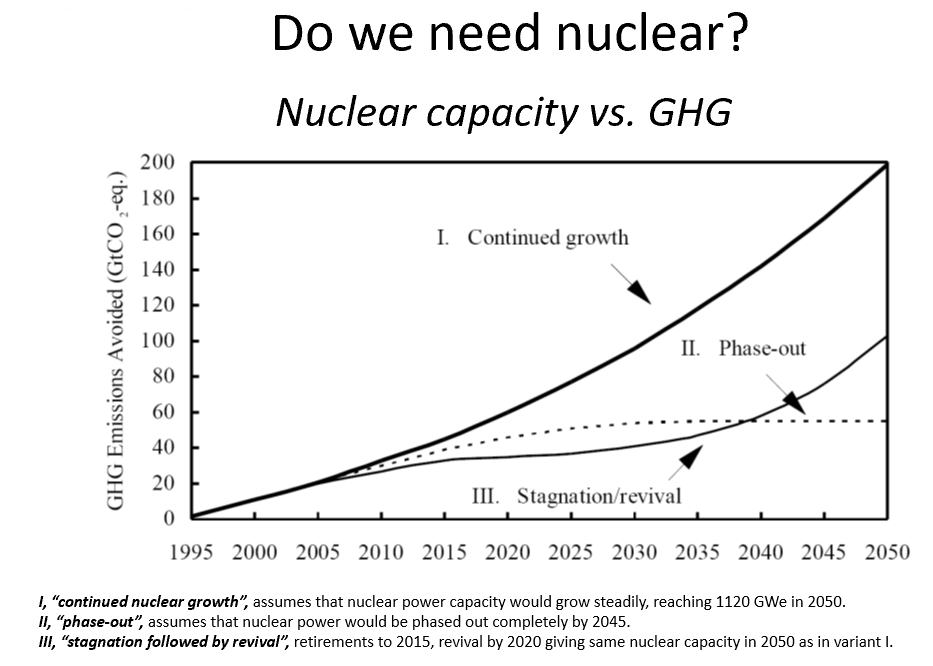
What does the “Nuclear capacity vs. GHG” graph show?
More nuclear capacity
more low-carbon electricity
more GHG emissions avoided

What is the nuclear fuel cycle ?
The sequence of processes involved in producing nuclear fuel, using it to generate energy, and reprocessing the resulting spent fuel and waste.
What are the main 6 processes involved in the nuclear fuel cycle ?
Mining and milling
Conversion and enrichment
Fuel fabrication
Power generation
Reprocessing
Waste management
What is the objective of mining and milling?
Uranium extraction as uranium ore concentrate (yellowcake)
What is the objective of conversion and enrichment ?
Produce fuel material via UF₆
Uranium is converted to UF₆ and enriched to increase its U-235 content
What is the objective of fuel fabrication?
Make fuel material into a form suitable for use as reactor fuel
Enriched ²³⁵UF₆ is converted to UO₂
UO₂ is made into pellets
Pellets are loaded into fuel pins
Fuel pins are bundled into assemblies


What is the objective of power generation?
Energy production by fission producing fission products, neutrons and energy
What is the purpose of a moderator in a nuclear reactor?
To slow fast neutrons to thermal neutrons so they can more effectively cause fission
What is the purpose of control rods?
To absorb neutrons and therefore control the rate of the chain reaction
How is fission energy converted into electricity?
Fission produces heat, which drives a coolant/steam cycle and generator to produce electricity

What is the objective of reprocessing ?
Pu and U recovery from spent fuel
What is spent fuel?
Fuel that has been used in the reactor

What is the objective of waste management ?
Storage, conditioning and disposal of waste
What is proliferation?
the unlawful diversion of fissile material for militiary purposes
What are the inputs of the nuclear fuel cycle?
Uranium ore
Process chemicals
Fabrication materials
What are the outputs of the nuclear fuel cycle ?
energy
plutonium
waste
What is a front end process?
Before reactor
What is a back end process?
After reactor
What is the difference between an open and closed nuclear fuel cycle?
Open - no recycling/reprocessing
spent fuel disposed as waste
Closed - Recycling/reprocessing
What are the isotopes of U?
U238
U235
U234
Which isotope of U is useful for fission ?
U235
What are isotopes?
Atoms with the same number of protons but different numbers of neutrons.
Why do hydrogen isotopes have similar chemical properties?
Chemical properties arise almost entirely from valence electrons, which are the same for hydrogen isotopes.
How do the nuclear properties of hydrogen isotopes differ?
Hydrogen (H) and deuterium (D) are stable, whereas tritium (T) is unstable (radioactive).
What is mass defect (ΔM)?
The difference between the mass of the product and the sum of the masses of its constituent nucleons.

What is an atomic mass unit (amu)?
A unit defined such that the mass of a neutral carbon-12 atom is exactly 12 amu.
What equation relates mass and energy?

What is the energy equivalent of 1 amu?
931.5 MeV.
What is nuclear binding energy?
The energy corresponding to the mass lost when nucleons combine to form a nucleus.
What is binding energy per nucleon (EB/A)?
The total binding energy divided by the number of nucleons.
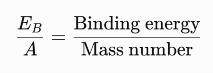
How is nuclear stability measured?
Using the binding energy per nucleon (EB/A)).
What is the relationship between binding energy per nucleon and nuclear stability?
The higher the binding energy per nucleon, the more stable the nucleus.

What is nuclear fusion?
The combination of light nuclei to form a heavier, more stable nucleus with a higher binding energy per nucleon.
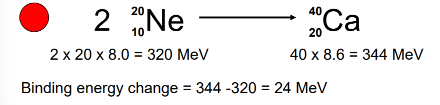
What is nuclear fission?
The splitting of a heavy nucleus into lighter, more stable nuclei with higher binding energy per nucleon.
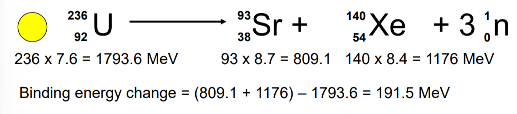
Why do nuclear fusion and fission release energy?
Both produce nuclei with higher binding energy per nucleon, making the products more stable.
What is radiation?
The propagation of energy through space in the form of waves or particles.
What are the two forms of radiation?
Electromagnetic radiation
Atomic or subatomic particle radiation
What is radioactivity?
The spontaneous emission of particles or electromagnetic radiation by materials.
What are the two types of nuclear reactions that produce radiation?
Radioactive decay
Nuclear bombardment
What is radioactive decay?
The spontaneous disintegration of an unstable nucleus into more stable products.
What is nuclear bombardment?
when a nucleus is struck by another nucleus or particle.
What happens to the energy of a nucleus during radioactive decay?
The nucleus changes from its original energy state to a lower energy state.
How is energy released during radioactive decay?
The difference in energy between the original and final states is released as:
Electromagnetic radiation (gamma rays or X-rays)
Kinetic energy of emitted particles (alpha, beta⁺ or beta⁻)
Why does radioactive decay release energy?
Because the final products have a lower energy than the original nucleus, and the energy difference is released as radiation.
What type of radioactive decay is predominant in nuclei with an atomic number greater than 83 (Z > 83)?
Alpha (α) decay.
What type of radioactive decay occurs nuclei with excess neutrons?
Beta-minus (β⁻) decay, where a neutron is converted into a proton.
What types of radioactive decay occur in nuclei with excess protons?
Beta-plus (β⁺) decay, where a proton is converted into a neutron.
Electron capture, where a proton captures an electron and is converted into a neutron.
What is an alpha (α) particle?
A helium nucleus consisting of 2 protons and 2 neutrons.
What happens during alpha decay?
An unstable heavy nucleus emits an alpha particle, reducing:
Mass number (A) by 4
Atomic number (Z) by 2
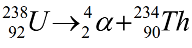
How do alpha particles lose energy when passing through matter?
Through excitation and ionisation of atoms.
What is nuclear fission?
The division of a heavy atomic nucleus into two lighter fragments, releasing neutrons and energy.

What are the three types of beta decay?
Beta-minus (β⁻) emission
Beta-plus (β⁺) emission
Electron capture
What happens during beta-minus (β⁻) decay?
A neutron is converted into a proton, and an electron (β⁻ particle) is emitted.
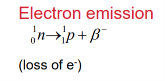
What happens during beta-plus (β⁺) decay?
A proton is converted into a neutron, and a positron (β⁺ particle) is emitted.

What happens during electron capture?
A nucleus captures an electron and proton is converted into a neutron.

What is the energy distribution of beta particles?
Beta particles have a continuous energy distribution, ranging from zero to a maximum energy (Emax).
What is gamma (γ) radiation?
High-energy, short-wavelength electromagnetic radiation emitted from excited nuclei.
What are the properties of gamma rays?
Electromagnetic radiation (photons)
High energy
Short wavelength
No mass
What is the differential equation for radioactive decay?
The rate of radioactive decay is proportional to the number of radioactive nuclei present.
N = Number of radioactive nuclei
t = Time
lambda = Decay constant

What is the exponential radioactive decay equation?

What is the half-life (t1/2) of a radioactive isotope?
The time required for the amount of radioactive material to decrease by 1/2

What is the relationship between half-life and the decay constant?
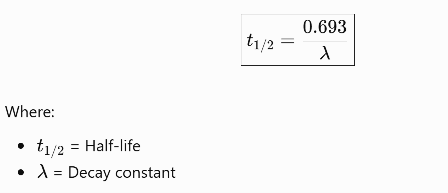
What is a natural radioactive decay series?
A sequence of successive radioactive decays in which an unstable nucleus transforms into other nuclei until a stable isotope is formed.
What is the SI unit of radioactivity?
Becquerel (Bq).
What is the conversion between electronvolts (eV) and Joules (J)?

What is absorbed dose?
The amount of energy deposited in a material by ionising radiation per unit mass.
What is the SI unit of absorbed dose?
Gray (Gy).
What does 1 Gray (Gy) represent?

Why does absorbed dose alone not fully describe the biological effects of radiation?
Because different types of radiation can cause different amounts of biological damage, even when the absorbed dose is the same.
What is equivalent dose?
The absorbed radiation dose adjusted to account for the different biological effects of different types of radiation.
What is the SI unit of equivalent dose?
Sievert (Sv).
How is equivalent dose calculated?
Equivalent Dose = Absorbed Dose x WR
WR is radiation weighting factor
What is effective dose?
The equivalent dose adjusted to account for the different sensitivities of organs and tissues to radiation.
How is effective dose calculated?
WT is radiosensitivity of a particular organ

What is dose rate?
The amount of radiation dose received per unit time.
How is radiation dose calculated from dose rate and exposure time
Gy and Sv express amount of radiation received over time

What equation is used to calculate the dose rate from a gamma radiation source?
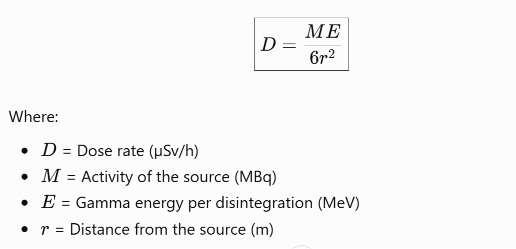
What is particle flux?
The number of particles passing through a unit area per unit time.

What are the two ways a person can be exposed to radiation?
External radiation exposure
Internal contamination
What are the two main biological effects of radiation mentioned in the lecture?
Cell death — deterministic effects
Hereditary or genetic damage — stochastic effects
What is the main difference between deterministic and stochastic effects?
Deterministic: The severity of the effect increases with dose.
Stochastic: The probability of the effect increases with dose.
What is the final product of the natural radioactive decay series?
Stable isotopes of lead (Pb).
How is gamma radiation produced?
When an excited nucleus transitions to a lower energy state, releasing excess energy as gamma radiation.
What happens when U-235 undergoes nuclear fission?
U-235 absorbs a neutron, forming an excited compound nucleus (U-236), which splits into fission fragments and releases neutrons and energy.
How much energy is released per U-235 fission compared with carbon combustion?
Approximately 200 MeV per U-235 fission, compared with 4 eV per carbon atom during C + O₂ → CO₂.
How many neutrons are produced on average during U or Pu fission?
2.5 neutrons.
What is a self-sustaining chain reaction?
A system where exactly one neutron promotes a further fission.
What happens if more than one neutron per fission promotes further fission?
The chain reaction increases rather than remaining steady.
What are the 4 nuclear reaction mechanisms ?
elastic scattering
inelastic scattering
radiative neutron capture
fission

What is elastic scattering?
A neutron collides with a nucleus and transfers kinetic energy without changing the nuclear structure.

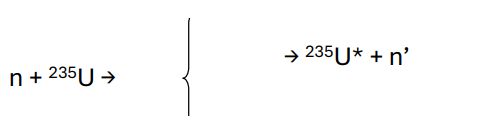
What is inelastic scattering?
A neutron collides with a nucleus, transfers energy without changing nuclear structure and leaving the nucleus in an excited state.
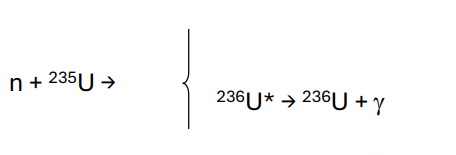
What is radiative capture?
A nucleus absorbs a neutron, forming a compound nucleus that becomes stabilised by emitting gamma radiation.
What happens during fission?
A nucleus absorbs a neutron and splits into fission fragments, releasing energy and additional neutrons.

What is a reaction cross-section (σ)?
the probability of a nuclear reaction occurring.
What is the equation for the geometrical cross-section of a nucleus?
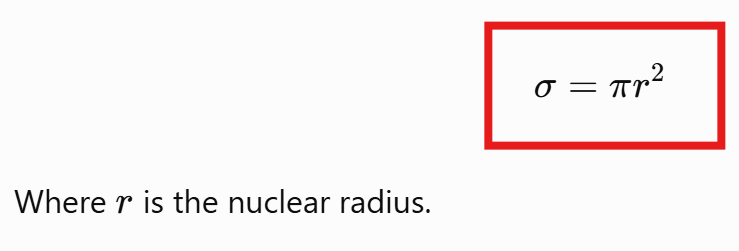
What is the unit of nuclear reaction cross-section?
The barn (b)

How does neutron flux change as neutrons pass through a material?

What is the equation for the total neutron reaction cross-section?

What is the equation for the radius of a nucleus?
A is Mass Number

Which combinations of proton and neutron numbers are generally the most stable?
Even numbers of both protons and neutrons (even-even nuclei).