Casting
 Call Kai
 Learn
 Practice Test
 Spaced Repetition
 Match
 Flashcards
 Knowt Play
1/26

There's no tags or description
Looks like no tags are added yet.
27 Terms
What is casting?
Casting is a deformative process whereby material such as metal or plastic in liquid form is poured into a mould and allowed to become hard to make a product
casting processes can have expendable moulds or reusable moulds
Advantages and disadvantages of casting in general
Advantages
Production of final shape in a single step
complex geometries possible
low cost per component
disadvantages
Rough surface finish
Poor dimensional accuracy (Due to heating up and cooling down)
Low strength
High setup and energy costs
Fundamental casting process stages
1) Creating the mould cavity (pattern needed)
2) Melting material
3) Pouring material
4) Material solidifies
5) mould removal
6) cleaning, finishing, inspection (possible repairs)
Material shrinkage
When casting you must take into consideration that as the material cools it will shrink. Also you may design the product slightly bigger to allow for machining, finishing operations
typical shrinkage
cast iron = 1%
steel = 2-2.5%
AI, Mg = 1-1/3%
Brass = 1.5%
A ruler with measurements slightly larger on one side can be used for measuring when materials are hot and on the other side of the ruler the normal measurements are seen. This allows you to allow for the shrinkage when measuring out dimensions for you pattern.
What is sand casting
Where a pattern is used to create a mould in compacted sand to which liquid metal is poured into it and let to solidify
most widely used casting process
Nearly all casting alloys can be sand casted and is suitable for metals with high melting points e.g. steel, nickel, titanium due to sands ability to withstand heat
sand casting requires a patten to duplicate the part
Patterns are usually made from wood (cheap), plastic (produced by 3d printers so can be more complex or metal which is expensive but most robust
must account for shrinkage
sand mould is created from the pattern
Different types of pattern
solid pattern (good for making limited amount of parts as its the cheapest and quickest to make)
split pattern
Match-plate pattern
Cope-and-drag Pattern (best for set up time as the whole system is set out but is more expensive and takes longer to make initially - good for batch production)

What are the different components of a casting mould
Cope and drag - Cope(the top half of the sand mould), drag (the bottom half) they hold the sand and form the mould cavity where molten metal is poured
pouring cup - collects the liquid metal as its poured and directs it into the sprue.
Runner - A horizontal channel that carries liquid metal from the sprue to the gate and mould cavity
Riser - A reservoir of molten metal that feeds the casting as it cools and shrinks. helps to prevent shrinkage cavities and defects
Gate - Opening that allows molten metal to flow from the runner directly into the mould cavity
core - A shaped piece that is placed inside the mould to create internal holes or cavities or passages in the finished casting and metal solidifies around it
Core print - An indentation or extension in the pattern that creates a seat for the core to be supported in the correct position

What is a draft angle in casting
a slight angle to vertical sides so it can be removed without damaging the part and it also helps to keep the sand mould from breaking as easily

What is pit moulding
It is a variation of sand casting for very large components where a pit is used to form a mould
What are the properties of the sand used in sand casting?
Sand typically
89% silica
8% clay to help bind sand together
3% water
requires compacting
refractoriness - withstand temperature (higher for steel)
Cohesiveness - bonds together
permeability - allows mould to breath to let out any gasses to avoid defects
Collapsibility - Breaks up easily after cooling
Availability - Cost
Green sand uses a resin to bind sand together
stronger but not as reusable as the resin has chemicals and once taken under a heat cycle chemicals break down
Casting design considerations
simplified designs improves castability by reducing need to cores and improves casting strength
sharp corners should be avoided as they are sources for stress concentrations
section thickness should be uniform or changes should be gradual. This is because thicker sections will cool more slowly than thinner sections which causes internal stresses whereby the cooler part pulls on the hotter part deforming the material
Machining allowances should be left as machining may be needed to create final part
Mould design - Cooling rate can be controlled by mould design. It can be decelerated by build in heaters into the mould or by casting additional heat sources into the casting similar to risers. Accelerating cooling can be done by inserting chills into the mould typically through pieces like cast iron that act as heat sinks
Expandable vs Reusable moulds
Expandable moulds
Mould created from pattern
Broken down to remove solidified cast component
Mould material sometimes reusable
Reusable moulds
Moulds usualy machined directly from metal (no pattern)
High cost, but can be reused after removing cast component
Types of expendable mould casting
Sand casting (already talked about)
Vacuum moulding “V process”
Freeze moulding “Eff-set process”
Shell moulding
Full moulding
Investment casting
Shaw process
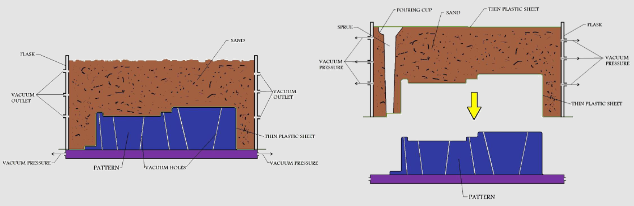
Vacuum moulding (expendable casting)
Where a plastic sheet and a vacuum used to maintain the shape of the mould during casting. This helps to reduce fumes and means that the sand is immediately reusable. No water being added means no moisture defects but it is a slow process and difficult to automate
What is Freeze moulding “Eff-set process”
The mould is made from sand, clay and water and the surface of the mould is sprayed with liquid nitrogen and ice forms and binds the mould. The frozen structure is rigid enough to use without support and castings have a good Finnish and the sand is immediately reusable. Not currently a commercial process
What is shell moulding (expendable casting)
uses a metal pattern
hot patten dipped into sand mixed with thermosetting resin to form a thin shell around metal pattern
pattern is then split or formed into two pieces
Shell is then baked to solidify it
Molten metal is then poured into mould
Advantages
Good tolerance (0.07-0.15mm)
Mould does not shrink
Better surface finish as it uses finer sand
Higher productivity as automation is possible
Thermosetting resin decomposes during pouring making it easy to shake out
disadvantages
High cost primarily due to labour involved
Can have visible parting line due to mould misalignment

What is Full moulding (expendable casting)
polystyrene foam pattern produced
ceramic coating prevents mould from collapsing and loose sand is packed around mould
During pouring the polystyrene pattern decomposes
pattern is directly machined, moulded from a metal die or additively manufactured
examples include, Engine block casting
Advantages
No parting line
No draft needed - high part complexity
high productivity
One-off castings viable
disadvantages
safety/ environment as fumes are produced when mould is decomposed
Poor surface finish but can be smoothened or sanded but still is not the best
Single use pattern

What is investment casting (expendable casting)
Uses a master metal die (a cavity creating the negative shape from where wax is poured into)
Wax pattern produced from die - positive shape
Assemble was patterns, sprue, runner, gate
coat wax pattern with investment material e.g. fine plaster
harden plaster
Brake mould - melt away wax and preheat mould
Pour metal
Due to slow cooling thin sections are possible (min thickness = 0.4mm)
examples include - turbine blades
advantages
high geometric complexity possible
good surface finish no machining required
good tolerance (0.075-0.25mm)
simple process automation
no parting line
disadvantages
Expensive (tooling cost and time consuming)
If not all the wax is melted out then poor casting quality may appear
Bad mould permeability therefore breathing holes are required

What is the Shaw process (expendable casting)
Similar to shell moulding but produces a rubbery slightly flexible mould. A master pattern is created and pattern is coated with plaster, gelling agent and cracking compound and hardened to form a semi-flexible mould. micro cracks appear in mould as it improved permeability and breathing
advantages
good tolerance (0.05-0.25mm)
Greater variety of shapes compared to investment casting or shell moulding - flexible mould allows slight undercuts
Good gas permeability
disadvantages
Expensive (high mould cost and labour cost)
Possible parting line

What are the reusable casting methods
rubber mould casting
gravity die casting
die casting
slush casting
centrifugal casting
centrifuge casting
Advantages and disadvantages of reusable mould casting

What is rubber mould casting (reusable casting)
Used to cast low melting point materials e.g. wax, plastic or wood metal (alloy which melts at 70 degrees Celsius

What is Gravity die casting (reusable casting)
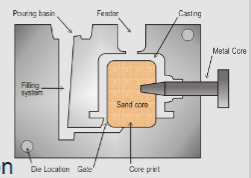
This casting uses a metal mould (die). grey cast iron dies used for casting Zn, Sn, Mg, Al, Cu and graphite die used for casting steel
Mould is pre heated and a riser is needed. sand or metal core may be used to create a hollow feature but venting is needed in this process. No mould collapsibility as part is removed immediately after solidification (aided by shrinkage)
advantages
Good finish and tolerance both better than sand casting
High productivity and process can be automated
Controlled cooling - defect free casting
disadvantages
Limited mould life due to molten metal attack and thermal fatigue
High tooling cost to make the mould

What is Die casting (reusable casting)
where high pressure forces molten metal into mould throughout solidification therefore no riser required. It uses hardened tool steel dies and metal cores and more detailed parts can be made due to high pressure and mould temperature can be lower.
Advantages
High process speed to due to high pressure delivering material quickly
High part complexity and detail possible
Low porosity due to pressure
Low mould temperature = improved tool life
shrinkage avoidable due to continued high pressure
disadvantages
very high tooling cost (design and manufacturing of dies)
High equipment cost
Uneconomical unless high volumes of parts need producing
leaves ejector pin marks on final piece

What is slush casting (reusable casting)
The molten metal is poured into mould and slushed about cooling creating and outside shell (similar to an chocolate egg). Metal is poured out once thin shell is made and process is repeated to make a thicker shell
advantages
simple process
good outer finish
disadvantages
Poor quality part
poor repeatability (hard to get shell thickness exactly the same for multiple parts)

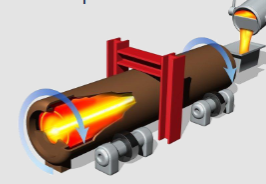
What is centrifugal casting (reusable casting)
Uses centrifugal force for hollow part production as molten metal is pushed evenly created a cylindrical shape e.g. a pipe
advantages
Consistent wall thickness
Dense structure
Non-metallic inclusions collect at inner surface so can be removed (this is because they tend to be less dense then metal and so collect on inner diameter)
Disadvantages
Limited to cylindrical components
possible disaster if the container breaks
What is centrifuge casting (reusable casting)
Uses centrifugal force to apply moderate liquid pressure
often used to create jewellery and dental implants
advantages
produces high quality castings (dense/ homogeneous)
high levels of detail possible
disadvantages
only suitable for small components