COMM1000 M5: Nonverbal Communication and Emotion
 Call Kai
 Learn
 Practice Test
 Spaced Repetition
 Match
 Flashcards
 Knowt Play
1/18

There's no tags or description
Looks like no tags are added yet.
19 Terms
What is nonverbal communication?
Nonverbal communication = use of objects, action, sounds, time, and space to convey meeting
What percentage of the meaning of an interaction does nonverbal communication convey?
65% of meaning
Nonverbal communication perceived as a gestalt (altogether)
Add meaning + context, but may contradict and win over verbal communication
What are 2 types of nonverbal communication?
Vocal = sounds that are not words (Ex. ermmm, uhhh, huhhh)
Non-vocal = movement, eye-contact, facial expressions, etc.
What are the 5 different ways that nonverbal communication relates to verbal communication?
Nonverbal _________ verbal
Complements = body language add to communication
Regulates = use nonverbal to organize communication
Substitutes for = facial expression means yes/no
Contradicts = may win over verbal
Illustrates = use body movements to illustrate communication

What are the 10 channels of nonverbal communications?
Oculesics
Kinesics
Paralanguage
Proxemics
Facial displays
Haptics
Physical appearance
Olfactics
Chronemics
Artifacts
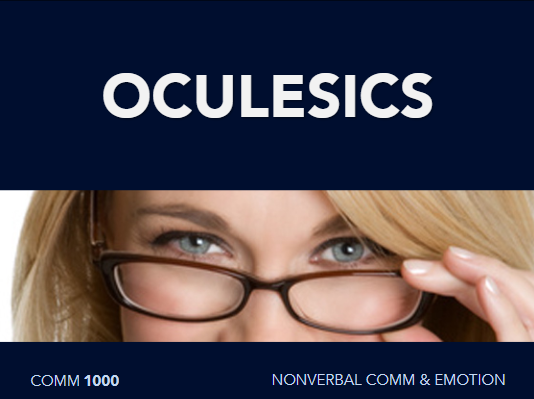
What is oculesics?
What are 4 ways that they are used?
Oculesics = art of eye contact
Attention
Attraction
Dominance
Way to transfer talking role to other person
What is kinesics?
What are its 5 components?
Kinesics = body movement & gesture (BUT meaning can differ)
Emblems = symbols like emojis
Illustrators =
Regulators = gestures to transfer talking role to another person
Adaptors = movements resulting from anxious feelings
Affect displays =
What is paralanguage?
“It’s not what you say it’s how you say it”
Paralanguage = how you say words can change the meaning
Ex. Sarcasm, which words are emphasized
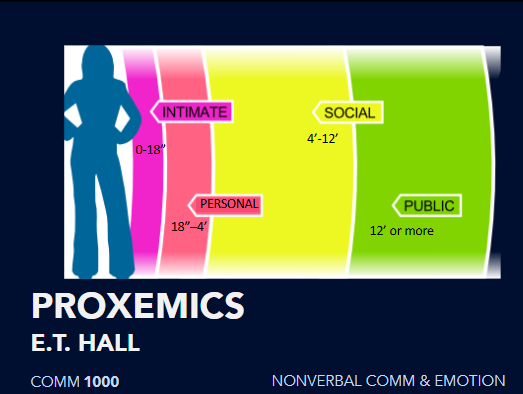
What is proxemics?
Proxemics = space, distance, and territory
People stay in agreed-upon places (social contract)
Ex. Professor moves into student’s area

What is the difference between public, social, personal, and intimate spaces in proxemics?
Public space = 12’ or more
Social space = 4-12’
Personal space = 18”-4’
Intimate space = 0-18”
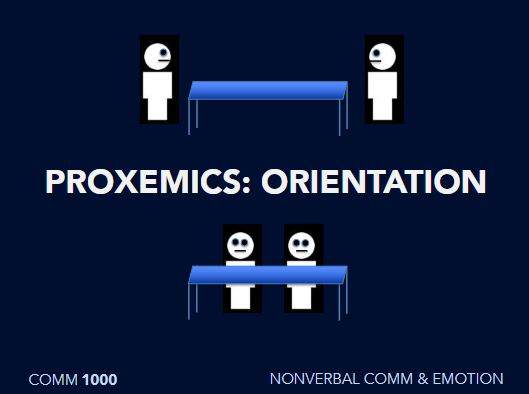
What is orientation in proxemics?
Opposite ends of table = competition
Side by side = affiliated
Open → Closed form = prevents others from joining conversation, preserves privacy
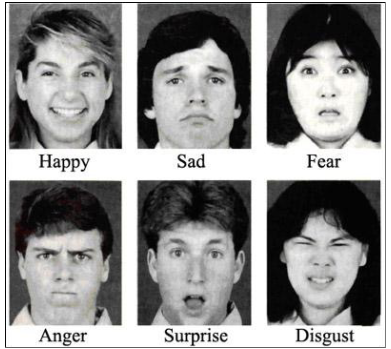
What are the 6 primary affects?
Happy
Sad
Far
Anger
Surprise
Disgust
What is emotion?
Emotion = minute signals of affect, attention, approach/avoidance, dominance/submission
Help shape social order
Study of individual within social system

What is the difference between internalizer and externalizer?
Internalizer = low emotional expression, higher physiological response
Externalizer = high emotional expression; lower physiological response
What are the 5 components of spontaneous communication?
Spontaneous communication
Basis on biologically-shared signal system
Nonvoluntary
Involves signs, not symbols
Nonpropositional (never false, always true)
Mainly right-brained → visuals + feelings
What are the 6 components of symbolic communication?
Symbolic communication
Socially-shared system
Voluntary
Involves symbols (arbitrary)
Propositional (can be false)
Mainly left-brained
Includes SOME nonverbal behaviors
What should be studied in COMM classes?
Study spontaneous vs symbolic communication
What is pseudospontaneous communication?
Pseudospontaneous communication = learned communication even when associated emotions are not felt (fake emotions)
Ex. Express loving a gift even if you do not like it
What is the developmental interactionist theory?
Developmental interactionist theory = emotion and spontaneous communication = foundation of human communication → exert reason and symbolic communication as we grow older
More emotional control
