Cell Bio Practical 2
 Call Kai
 Learn
 Practice Test
 Spaced Repetition
 Match
 Flashcards
 Knowt Play
1/138

There's no tags or description
Looks like no tags are added yet.
139 Terms
What is the primary function of a biological catalyst such as an enzyme?
It speeds up a chemical reaction without being consumed or permanently altered in the process.
How do enzymes increase the rate of a chemical reaction?
By lowering the activation energy (EA) required for the reaction to proceed.
In an enzymatic reaction, what is the specific region on the enzyme where the substrate binds called?
Active Site
What organism and tissue serve as the source for the acid phosphatase (APase) used in the laboratory assay?
Wheat germ
What reaction is catalyzed by the enzyme acid phosphatase (APase)?
It removes phosphate groups from its substrate under acidic conditions
What substrate is used in the APase assay, and what visual change indicates successful catalysis?
Nitrophenyl phosphate (NPP), which changes from colorless to yellow upon catalysis.
What is the dual purpose of adding 0.1 M NaOH to the APase collection tubes?
It denatures the enzyme to stop the reaction at a precise time and enhances the yellow color of the product.
What wavelength is selected on the spectrophotometer to measure yellow product absorbance in the APase assay?
405 nm
How do extreme high temperatures affect enzyme activity?
High temperatures denature the enzyme by disrupting its three-dimensional tertiary structure
What does standard deviation indicate about a dataset of experimental replicates?
It measures the amount of variation or dispersion among replicate values relative to the calculated mean.
In statistical hypothesis testing, what does a p-value<0.05 signify when comparing two experimental groups?
The difference between the two experimental groups is statistically significant.
Which Excel function performs a t-test between two data arrays to output a p-value?
TTEST (using Array1, Array2, Tails = 2, and Type = 1 for paired data).
Why are error bars included on bar graphs displaying mean experimental values?
To visually communicate the variance or standard deviation among replicates, showing data precision and reliability.
What is the primary biological source of restriction enzymes?
bacteria
What specific action do restriction enzymes perform on DNA?
They cleave double-stranded DNA at specific recognition sequences called restriction sites.
In what cellular compartment does glycolysis take place?
cytoplasm (cytosol)
What starting substrate is oxidized during glycolysis, and what three-carbon end product is formed?
Glucose is split into two molecules of pyruvate
What is the net yield of ATP per glucose molecule generated solely through glycolysis?
2 net ATP molecules
In anaerobic conditions, what pathway do yeast cells utilize to continue generating ATP?
Alcoholic fermentation
Why is fermentation less than 5% efficient compared to aerobic respiration's ∼50% efficiency?
Because fermentation end products (such as ethanol) retain most of the chemical energy originally present in glucose.
What term describes organisms like yeast that can generate ATP using both aerobic respiration and fermentation?
Facultative anaerobes
By what mechanism does sodium fluoride (NaF) inhibit cellular respiration?
Fluoride ions (F−) bind to Mg++ cofactors to form MgF2, inactivating enolase, an essential enzyme in glycolysis.
How do Go Direct Gas Pressure sensors measure respiration rate in closed yeast tube systems?
By recording the real-time increase in gas pressure over time caused by accumulating CO2 gas.
What carbohydrate acts as the primary metabolic fuel added to yeast in the cellular respiration experiment?
sucrose
Why does pre-boiling yeast eliminate pressure changes when sucrose is subsequently added?
Boiling denatures key metabolic enzymes, killing the yeast cells and preventing cellular respiration.
What three mitochondrial stages follow glycolysis during complete aerobic cellular respiration?
Pyruvate oxidation, the citric acid cycle (Krebs cycle), and oxidative phosphorylation.
Which stage of aerobic cellular respiration generates the majority of ATP molecules?
Oxidative phosphorylation (electron transport chain and chemiosmosis).
What aquatic plant sprig is used in laboratory volumeter setups to measure photosynthetic oxygen production?
elodea
What reagent solution is added to water in photosynthesis experiments to provide an abundant CO2 source?
Sodium bicarbonate (NaHCO3) solution
How does increasing light source distance from a plant affect the rate of photosynthesis?
It decreases the rate of photosynthesis by decreasing light intensity arriving at the chloroplasts.
What laboratory technique separates photosynthetic leaf pigments based on differential solubility?
Paper chromatography
Which cell layer in a dicot leaf cross-section contains column-like cells packed with chloroplasts to maximize light capture?
Palisade mesophyll layer
What epidermal leaf structures regulate photosynthetic gas exchange and transpiration?
Stomates (stomata), controlled by surrounding guard cells.
In what polymer form do green plants store excess glucose produced during photosynthesis?
starch
Which light spectrum wavelengths drive photosynthesis most effectively in chlorophyll?
blue and red light
Why is green light the least effective wavelength for driving photosynthesis in green plants?
Chlorophyll reflects green light rather than absorbing it.
How do the overall chemical equations of aerobic cellular respiration and photosynthesis compare?
They are complementary opposites
What structural model describes substrate binding to an enzyme's active site?
The enzyme-substrate complex, where substrate molecules fit into the specific active site region of the protein

How are the stages of eukaryotic cellular respiration compartmentalized across the cytosol and mitochondrion?
Glycolysis occurs in the cytosol, whereas pyruvate oxidation, the citric acid cycle, and oxidative phosphorylation occur inside the mitochondria
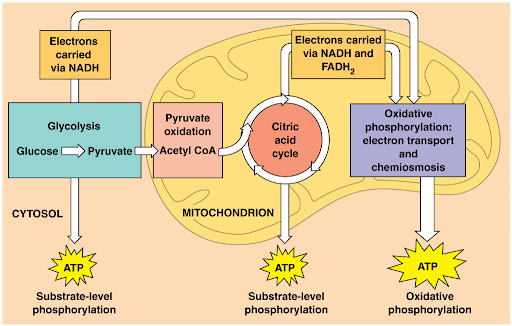
What specific enzyme is isolated from wheat germ for use in the Week 6 laboratory experiment?
Acid phosphatase (APase)
What substrate is acted upon by acid phosphatase (APase) in the enzyme assay?
Nitrophenyl phosphate (NPP)
What visual change indicates that acid phosphatase has catalyzed the conversion of nitrophenyl phosphate (NPP)?
The solution turns yellow.
Which buffer solution is used to maintain a constant pH 4.8 during the APase enzyme assay?
Citrate Buffer
Which buffer solution is used to test APase enzyme activity under neutral conditions at pH 7.0?
phosphate buffer
How long are reaction mixtures incubated before stopping the APase enzymatic reaction?
15 minutes
Why are enzyme additions staggered by 1 minute intervals across reaction tubes in the APase assay?
To ensure each individual reaction incubates for precisely 15 minutes before stopping it with NaOH.
What components constitute the positive control (PC) in the APase enzyme assay?
APase enzyme, NPP substrate, and citrate buffer incubated at 37∘C (pH 4.8).
Which experimental temperature conditions are tested in the APase lab experiment?
Room temperature (25∘C), 50∘C, and 65∘C
At what specific wavelength is the spectrophotometer set to quantify APase product formation?
405 nm
What mixture is used as the baseline blank (NC-0) to zero the spectrophotometer in the APase assay?
A 1.0 mL sample from the negative control tube added to 5.0 mL of 0.1 M NaOH.
Why are APase reaction mixtures prepared in triplicates (RM1, RM2, RM3) for each experimental condition?
To enable statistical analysis, including calculating means, standard deviations, and running t-tests.
How does increasing temperature from 37∘C to 50∘C affect APase enzymatic activity?
APase activity increases, yielding higher absorbance at 405 nm.
Why does APase enzymatic activity drop to near zero when incubated at 65∘C?
High heat causes thermal denaturation of the APase protein, disrupting its active site.
How does shifting the buffer from pH 4.8 to pH 7.0 affect wheat germ APase activity?
APase activity drops significantly because APase is an acid phosphatase optimized for acidic environments.
What absorbance value at 405 nm is expected for negative control (NC) tubes containing no APase?
Near-zero absorbance (0.0)
How does substrate concentration vary across reaction tubes RM1, RM2, and RM3 in the APase assay?
Substrate (NPP) volume increases progressively from RM1 (0.1 mL) to RM2 (0.2 mL) to RM3 (0.4 mL).
What reagent is added to maintain equal total liquid volumes across all APase reaction tubes?
Deionized water (dH2O)
Why must APase reaction tubes be kept on ice prior to starting the timed assay?
Cold temperatures prevent premature enzymatic reactions before official timing begins.
Where in the cell does the process of glycolysis take place?
in the cytoplasm
What carbohydrate is supplied as the respiratory fuel for yeast in the respiration lab?
sucrose
What chemical compound acts as a metabolic inhibitor of cellular respiration in the yeast experiment?
Sodium fluoride (NaF)
By what biochemical mechanism do fluoride ions (F−) inhibit glycolysis?
Fluoride ions combine with Mg2+ ions to form insoluble MgF2, removing essential cofactors required by the enzyme enolase.
Which glycolytic enzyme is inactivated when sodium fluoride (NaF) deprives it of Mg2+ cofactors?
Enolase
What organism is used to examine respiration and fermentation rates in the Week 7 lab?
yeast
Why is yeast classified metabolic-wise as a facultative anaerobe?
It carries out aerobic respiration when oxygen is present and switches to fermentation when oxygen is absent.
What gas byproduct released during yeast respiration creates measurable pressure in closed test tubes?
Carbon dioxide (CO2)
How is total pressure change (ΔP) over 10 minutes calculated in the respiration lab?
ΔP=Pfinal−Pinitial (Pressure at 10 minutes minus starting pressure at 0 minutes).
What electronic sensor is used to measure CO2 pressure buildup during yeast respiration?
Gas Pressure sensor
What setting in Vernier Graphical Analysis must be changed prior to collecting yeast respiration data?
The collection end-time must be adjusted from 300 seconds (5 min) to 600 seconds (10 min).
Why are sucrose and NaF added to yeast 5 minutes before connecting pressure sensors?
To allow yeast cells adequate time to interact with the fuel or inhibitor before logging pressure.
In Experiment 1 (Yeast + Water), what gas pressure change is observed over 10 minutes?
Minimal to zero pressure change due to the absence of a carbohydrate fuel source.
In Experiment 2, how does mixing active yeast with sucrose impact test tube pressure over 10 minutes?
Pressure increases significantly as active respiration releases CO2 gas.
In Experiment 3, why does boiled yeast mixed with sucrose produce no gas pressure buildup?
Boiling denatures key metabolic enzymes, halting glycolysis and cellular respiration.
In Experiment 4, how does adding NaF affect the gas pressure generated by yeast and sucrose?
Pressure buildup is severely reduced or blocked because NaF inhibits enolase in glycolysis.
What mixture serves as the control tube in Experiment 2 (Yeast + Sucrose)?
Yeast (17.5 mL) + Water (2.5 mL)
What mixture serves as the control tube in Experiment 4 (Yeast + Sucrose + NaF)?
Yeast (15 mL) + Sucrose (2.5 mL) + Water (2.5 mL)
What chemical end products are produced when yeast cells undergo anaerobic fermentation?
Ethanol (C2H5OH) and carbon dioxide (CO2)
How does energy efficiency in aerobic respiration compare to anaerobic fermentation?
Aerobic respiration extracts approx. 50% of glucose energy into ATP, whereas fermentation extracts <5%.
What is the balanced chemical equation representing photosynthesis?
6CO2+6H2O+light→C6H12O6+6O2
How is the photosynthesis equation stoichiometrically related to aerobic respiration?
Photosynthesis is the exact chemical reverse of aerobic cellular respiration.
Which aquatic plant organism is used to measure oxygen production rates in the photosynthesis lab?
Elodea
What chemical solution is added to Elodea test tubes to provide inorganic carbon dioxide?
3% Sodium bicarbonate (NaHCO3) solution
Which gas produced during photosynthesis causes gas pressure to rise in sealed volumeter tubes?
Oxygen (O2)
What three light source distances from the Elodea volumeter are evaluated in Week 8?
30 cm, 20 cm, and 10 cm
What serves as the dark control setup in the Elodea photosynthesis experiment?
An Elodea test tube completely wrapped in aluminum foil.
What is the specific purpose of placing a water beaker between the lamp and plant tube?
It acts as a heat sink to absorb thermal radiation from the light bulb, preventing heat from confounding oxygen pressure readings.
How does decreasing light distance from 30 cm to 10 cm alter oxygen pressure generation in Elodea?
Oxygen production increases due to higher light intensity driving faster light-dependent reactions.
What analytical technique separates plant pigments based on differential solubility in a moving solvent?
Paper chromatography
What serves as the polar stationary phase during paper chromatography of spinach leaf extract?
Cellulose paper strip
What solvent mixture acts as the nonpolar mobile phase in paper chromatography of spinach pigments?
Petroleum ether and acetone in a 15:1 volume ratio.
How is spinach extract transferred onto chromatography paper in the lab protocol?
By pressing and rolling a coin over a fresh spinach leaf placed near the pointed bottom of the strip.
Why must the loading line of spinach extract be placed above the solvent surface in the chromatography tube?
To prevent pigments from dissolving into the liquid reservoir rather than ascending the paper.
Which spinach pigment migrates closest to the top solvent front on chromatography paper?
Carotene
Why does beta-carotene migrate furthest up the paper strip during chromatography?
It is the most nonpolar pigment, making it highly soluble in the nonpolar developing solvent.
Which spinach pigment remains closest to the bottom loading line after paper chromatography?
Chlorophyll b
Why does Chlorophyll b exhibit the lowest migration distance on paper chromatograms?
It is the most polar pigment, causing it to adhere strongly to the polar cellulose paper.
What is the correct order of spinach pigments separated on paper chromatography from top to bottom?
Carotene (top)
Xanthophyll
Chlorophyll a
Chlorophyll b (bottom)
Across what wavelength range is the absorption spectrum of spinach extract recorded in the spectrophotometer?
350 nm to 750 nm in 20 nm increments.
What liquid serves as the zeroing blank when analyzing acetone-extracted spinach pigments in spectrophotometry?
Pure acetone
Why must glass cuvettes be used instead of plastic cuvettes when measuring spinach extracts?
Acetone solvent dissolves plastic cuvettes