Persuasion
 Call Kai
 Learn
 Practice Test
 Spaced Repetition
 Match
 Flashcards
 Knowt Play
1/54

Earn XP
Description and Tags
Factors causing attitude change/persuasion, responses to the content of messages, techniques to create compliance via requests, people in natural settings constructing talk and conduct as persuasive
55 Terms
What is attitude change/persuasion?
Any significant modification of an individual's attitude
Involves:
Communicator
Communication
Medium used
Audience characteristics
Can also occur by inducing someone to perform an act that runs counter to an existing attitude
What are the 2 general orientations of persuasion?
Concentrates on people's use of arguments to convince others that a change of mind/behaviour is needed
Research focuses on the nature of the message (the persuasive communication that will be effective) + considers a number of variables that may determine what will do the job in changing another person's POV
Application:
Political propaganda
Ads
Focuses on active participation of the person (by getting people to carry out certain activities, we may be trying to change their underlying attitudes)
Cognitive dissonance = state of psych tension, produced by simultaneously having 2 opposing cognitions
People are motivated to reduce the tension, often y changing/rejecting one of the cognitions
Festinger -> we seek harmony in our attitudes, beliefs + behaviours + try to reduce tension from inconsistency among these elements
What is reactance?
Brehm's theory that people try to protect their freedom to act →when they perceive that this freedom has been curtailed, they will act to regain it
Silvia (2006) -> when we feel this way we can engage in covert counter-argument + attempts to undermine source credibility + go on to shift more overtly in the opposite direction (negative attitude change)
Bushman + Stack (1996) -> tainted vs forbidden fruit labels (lowkey warning vs overt censorship) -> more people watched violent films
What is forewarning?
Prior knowledge of persuasive intent (telling someone you are going to influence them) → special case of inoculation
Cialdini + Petty, 1979; Johnson, 1994) -> persuasion is less effective when you know in advance (e.g. have time to rehearse counter-arguments)
Wood + Quinn (2003) -> forewarning produces resistance (boomerang effect) among people who are highly involved in the issue, but slight agreement with the persuasive message among those who are less involved
What is persuasive communication?
Message intended to change an attitude + related behaviours or an audience → applied to ads + marketing
What was the Yale communication and attitude change programme?
Hovland et al (1949):
Measure attitudes towards war before/after presenting propaganda films/radio programmes to military trainees
1-sided, 2-sided arguments, control
Commissioned by the US gov
Political background /motivation behind study (after WW2, cold war)
Convince the troops that the war might continue for a long time
Hovland et al (1950s+)
Identification of general variables involved/that cause persuasion
According to Hovland (1953), what are the steps involved in the persuasion process?
Attention
Comprehension
Acceptance
Retention
What is the third-person effect
Most people think that they are less influenced than others by ads
Duck, Hogg + Terry (2000) -> has application to political ads + AIDS prevention
What source factors influence persuasion?
Popular, attractive, similar to audience (Kiesler + Kiesler, 1969; Chaiken, 1979)
Via identification (Kelman + Hovland, 1953)
People who we feel familiar, close + attracted to are able to influence us more than others
Experts/knowledgeable source (Howland + Weiss, 1952)
Via internalisation (Kelman + Hovland, 1953)
Triandis (1971) -> an expert, with knowledge, ability + skill, demands more of our respect
Valued source (credibility + trustworthiness) more effective especially if arguing against own interest (Hovland + Weiss, 1952)
How does a valued source influence persuasion?
Bochner + Insko (1966) → more opinion change occurred at moderate levels of difference between the students + the source (extreme discrepancy isn't a good tactic in influencing a target → others may attempt to discredit communicator) BUT change was greatest when the highly credible source advocated 1 hour of sleep + students had suggested 8 hours (large discrepancy)
Simple message (not much elaboration/thought processing) → source credibility acts as a heuristic
Complex message requires more elaboration + thought processing
Tormala, Brinol + Petty (2007) → people's thinking became more confident when the identity of the source followed the message, but their thinking became more favourable when the identity of the source preceded the message
How are source factors used in advertising?
Use of rock stars, medical experts etc
What does the likelihood of a message achieving is goal determined by?
A trade-off between the perception of danger (threat appraisal) + whether people believe they can carry out the corrective behaviour (coping appraisal)
Consistent with Blascovich's biopsychosocial model of challenge + threat = a demand can be perceived as a threat if one feels one doesn't have the resources to cope + a challenge if one feels one does have the resources to cope
Das, de Wit + Stroebe (2003) -> impactful messages about risky health practices should pinpoint the matter of vulnerability to a greater degree than simply severity
What message factors influence persuasion?
Strong arguments (based on facts) (Axsom, Yates + Chaiken, 1987)
Fear
1-side vs 2-sided
Repetition
Facts vs feelings
The medium + the message
Re-framing the message
The sleeper effect
How does fear influence persuasion?
Low-fear more effective than high-fear in changing dental hygiene practices (Janis + Feshback, 1953; Leventhal, 1970)
High-fear can be more effective than low-fear in wishing to give up smoking (Levantal, 1967)
Low-fear + high-fear better than moderate-fear (Janis, 1967; McGuire, 1969) → inverted U-curve hypothesis
What is protection motivation theory?
Fear appeals should work to eliminate danger health practices if they include an effective presentation of how to cope with the danger
How do using 1-side vs 2-sided arguments influence persuasion?
2-sided for educated audience (Hovland, 1949)
2-sided for mixed/non-agreeable audience (with message presented) (Hovland, 1957)
1-sided for agreeable audience (with message presented) (Hovland, 1957)
Applied to ads where rival product is presented as inferior
BUT not effective if loyalty to rival bran is high (Nye, Roth + Shimp, 2008)
How do repeated messages influence persuasion?
Tellis (1987) -> tv ad exposure reinforces preferences more than it motivates brand choices + optimum rate is 2-3x per week
Increases familiarity (+ interpersonal liking)
Repeated statement -> given ring of truth (Arkes, Boehm + Xu, 1991; Moons, Mackie + Garcia-Marques, 2009)
Repetition of a name makes them seem famous (Jacoby, Kelly, Brown + Jasechko, 1989)
BUT may not work very well with a new product + may be decreasingly effective
Campell + Keller (2003) -> even a little brand familiarity helps
How do using messages based on facts vs feelings influence persuasion?
Edwards (1990) -> if the underlying attitude is emotional (affect-based) then the appeal should be aswell BUT if the attitude is centred on beliefs (cognition-based) then a factual appeal should work better
Millar + MIllar (1990) -> mismatch (e.g. using a factual appeal when the attitude is emotional)
E.g. ads → evaluative vs factual
Evaluation = instead of conveying facts/objective claims, the message is couched in such a way that it makes the consumer feel generally good about the produce
E.g. capitalise on the transfer of affect (based on learning by association)
Can feel that one product is superior to another by subtle associations with music or colour or through use of attractive models BUT can be led to believe that the product is a getter buy because it is better value for money
How does the medium and the message influence persuasion?
Chaiken + Eagly (1983)
If the points of a message require considerable processing by the target, a written medium is likely to be best (can go back + mull over)
If the material is easy to comprehend, a videotaped presentation brings about most opinion change
How does re-framing a message influence persuasion?
Has subtle effects of meaning → acceptance
Rothman + Salovey (1997) → if the behaviour relates to detecting an illness, the message should be framed in terms of preventing loss BUT if the behaviour leads to a positive outcome, the message should be framed in terms of gain
Bosveld, Koomen + Vogelaar (1997) → if the issue or affirmative action is presented as equal opportunity rather than reverse discrimination, people will view it more favourably
What is the sleeper effect?
The impact of persuasive message can increase over time when a discounting cue (such as an invalid source) can no longer be recalled
Hovland, Lumsdaine + Sheffield (1949) -> film promoting more positive attitudes among US soldiers towards their British allies in WW2 became more effective well after they had been viewed
This is because we initially associate the conclusion of the message with:
The quality of its argument
Other cues (e.g. credibility of its source)
Question of reliability BUT has been replicated under quite strict conditions
What audience factors influence persuasion?
Education
BUT conflicting results about relationship between education + persuaded
Self esteem
BUT conflicting results about relationship between self-esteem + persuasion
Low + high-esteem are less susceptible than moderate (McGuire, 1968; Rhodes + Wood, 1992)
Age → younger more susceptible, reflecting accumulation of experience (Krosnick + Alwin, 1989)
Gender
Individual differences
Prior beliefs
How does self-esteem influence persuasion?
Hovland (1950s) -> a distracted audience is more easily persuaded than one that is paying full attention, provided that the message is simple + people with low self-esteem are more susceptible to persuasion than higher
McGuire (1968) -> curvilinear (U-curve) relationship between persuasability + self-esteem
People with either low or high self-esteem are less persuasible than those with moderate self-esteem
Low -> either less attentive or more anxious when processing the message
High -> less susceptible to influence (generally more self-assured)
Supported by Rhodes + Wood (1992)
How does age influence persuasion?
Visser + Brosnick (1998) + Tyler + Schuller (1991)
Increasing persistence → susceptibility to attitude change is high in early adulthood but decreases gradually across the lifespan; attitudes reflect the accumulation of relevant experiences (a negative linear line)
Impressionable years → core attitudes, values and beliefs are crystallised during a period of great plasticity in early adulthood (an S-curve)
Life stages → there is a high susceptibility during early adulthood and later life, but a lower susceptibility throughout middle adulthood (a U-curve)
Lifelong openness →individuals are to some extent susceptible to attitude change throughout their lives
Persistence → most of an individual’s fundamental orientations are established firmly during pre- adult socialisation; susceptibility to attitude change thereafter is low
How does gender influence persuasion?
Women are more easily persuaded than men BUT may be because women are socialised to be cooperative + non-assertive -> less resistant than men to attempts to influence them
Sistrunk + McDavid (1971) -> women are more easily influenced than men BUT only when the subject discussed is one with which men are more familiar (inverse is also true)
Consistency in results are due to a methodological bias (male-oriented topics)
Carli (1990) -> gender-related persuasiveness is a complex interaction of who is speaking, who is listening + whether the message is delivered in a sex-stereotyped way
Covell, Dion + Dion (1994) -> when ads target adolescents + feature alcohol + tobacco, young women might be particularly attentive to image-oriented messaged + judge drinking + smoking to be more desirable
What individual differences influence persuasion?
Need for cognition, need for closure, attitude importance, need to evaluate + preference for consistency
Less likely to be persuaded when rated highly on these
BUT moderator factor = a variable that qualifies an otherwise simple hypothesis with a view to improving its predictive power (A caused B but only when C is present)
E.g. social contextual factors influence the personality-persuasibility relationship
How do prior beliefs affect persuasion?
Evidence for a disconfirmation bias in argument evaluation
Arguments that are incompatible with prior beliefs are scrutinised longer, subjected to more extensive refutational analyses + judged weaker than arguments compatible with prior beliefs
Magnitude and form of a disconfirmation bias is higher if prior beliefs are accompanied by emotional conviction (Edwards and Smith, 1996)
Affect whether factual information is considered at all
E.g. political controversy over the stranding of a Soviet submarine near a Swedish naval base in 1981
Contending sides were most unwilling to accept facts introduced by each other into the debate, querying whether they were relevant and reliable (Lindstrom, 1997)
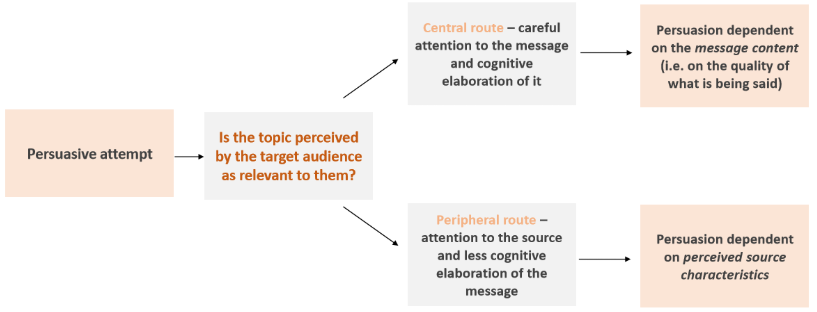
What are Petty et al’s (1981) elaboration-likelihood model (dual-model of persuasion)?
Wwhen people attend to a message carefully, they use a central route to process it, otherwise they use a peripheral route
Central route -> digest arguments in a message, extract a point that meets our needs + even indulge mentally in counter-arguments if we disagree with some of them
Points in the message need to be put convincingly as we will be required to expend more considerable cognitive effort on them
Arguments aren't well attended -> peripheral route
Act in a less diligent fashion
Prefer a consumer product on a superficial whim (e.g. product because ad had attractive person in it)
What is Chaiken’s (1980) heuristic-systematic model?
When people attend to a message carefully, they use systematic processing; otherwise they process info by using heuristics (mental shortcuts)
Systematic processing occurs when people scan + consider available arguments
Heuristic processing uses cognitive heuristics (e.g. thinking that longer arguments are stronger)
Can be used to simplify the task of handling info
When judging the reliability of a message, we may result to truisms (e.g. stats don't lie) as an easy way of making up our minds
Petty + Wegner (1998) -> sufficiency threshold
Heuristics will be used as long as they satisfy our need to be confident in the attitude that we adopt
When we lack sufficient confidence, we resort to the more effortful systematic mode of processing
What are McGuire’s (1964) types of defence?
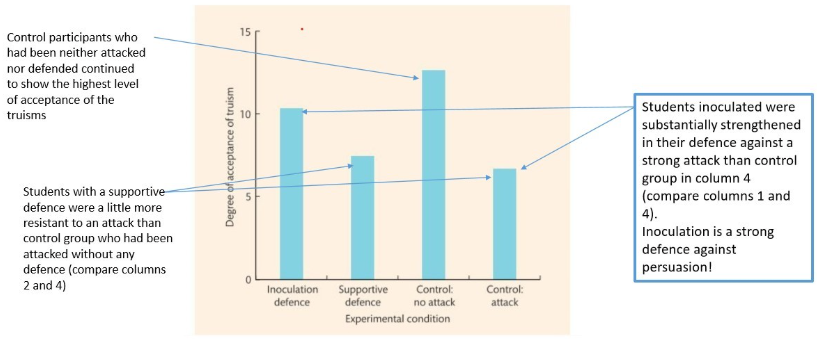
Supportive defence
Based on attitude bolstering → resistance could be strengthened by providing additional arguments that back up the og beliefs
Is most effective when attack's upon one's position are well-understood so that established + rehearsed supportive arguments can be called up
McGuire + Papageorgis (1961) → students equipped with a supportive defence were a little more resistant to an attack when compared with the control group who had been attacked without any defence
Inoculation defence
Resistance to persuasion by providing people with a diluted counter-argument
Building up effective refutations to a later, stronger argument
People become motivated to defend their belief/position + acquire some skill in doing this
Analogous to vaccines
McGuire + Papageorgis (1961) → tudents who had been inoculated were substantially strengthened in their defence against a strong attack compared with the same control group
Based on investigation into American men wanting to remain in China/being 'brainwashed' by communists
How is inoculation used in ads?
Issue/advocacy ads where company protects consumer loyalty from attitude slippage by issuing media releases on controversial issues (e.g. fashion compony supporting protection of wildlife)
What did Mackie and Worth (1989) conclude about mood and persuasion?
Merely being in a good mood changes the way we attend to info → makes it difficult for us to process a message systematically
How can the relationship between mood and persuasion be used in advertising?
E.g. use of feel-good music
Belch and Belch (2012) -> through classical conditioning, a product repeatedly associated with a good mood can become evaluated positively + (in time) in the absence of music or other positive contextual cues
Wegner, Petty + Smith (1995) -> if the message content is in line with our attitudes (congruent with our already good mood) then being happy as well leads to more extensive processing
Interaction between a supportive message + a happy audience
Bohner, Chaiken + Hunyadi (1994) -> when the message was unambiguous, sad PPTs were more easily influenced when they used heuristic processing
Semmler + Brewer (2002) -> when jurors feel sad, their accuracy/systematic processing in detecting witness inconsistencies + their perceptions of witness reliability + a defendant's culpability is improved
What are Jones and Puttman’s (1982) tactics to enhance compliance
Intimidation
Exemplification
Supplication (attempt to elicit pity)
Self-promotion
Ingratiation (attempt to get others to like you in order to secure compliance with a subsequent request)
Ingratiator's dilemma = the more obvious it is than an integrator will profit by impressing the target person, the less likely it is that the tactic will succeed
Most common goals of social interaction
How can compliance be enhanced by the reciprocity principle?
Based on treating others the way they treat us
Regan (1971) → greater compliance was obtained from people who had previously received a favour than from those who had received none
Guilt arousal also produces more compliance (more likely to comply with a later request)
What 3 techniques can be used to enhance compliance (Hogg and Vaughan, 2011)?
Foot-in-the-door
Door-in-the-face
Low-ball
Multiple requestions → 2-step procedure (1st functions as a set-up for the 2nd, real request)
What is the foot-in-the-door technique?
Freedman + Fraser (1966) -> 53% complied when they had been softened up by initial qs about soap (vs 22%)
BUT if the initial request appears too small or the 2nd too large, the link between the requests break down -> graded requests
Bem's self-perception theory
By complying with a small request, people become committed to their behaviour + develop a picture of themselves as giving -> subsequent large request compels them to appear consistent
Cialdini + Trost's (1998) principle of self-consistency
We try to manage our self-concept in such a way that if we're charitable on one occasion then we should be charitable again on the 2nd
Gorassini + Olson (1995)
Alter's people's interpretations of situations that activate attitudes enhancing compliance

What is the door-in-the-face technique?
Due to contrast effect → 2nd request seems more acceptable when contrasted with larger request
Cialdini (1975) → PPTs perceive the scaled-down request as a concession by the influencer → feel pressure to reciprocate

What is the low-ball technique?
Due to tendency to stick with our decisions → once committed to a course of action, we’re more likely to accept a slight increase in the cost of the action
Fox + Hoffman (2002) sunk costs -> once a course of action is decided on, people will continue to invest in it even if the costs increase dramatically
Cialdini, Bassett + Miller (1978) -> 56% complied vs 31% (control)

What did Langer, Blank and Chanowitz (1978) conclude about compliance?
Much compliance is due to mindlessness
In their study, as long as the request was small, people were likely to agree (even for a spurious reason) -> lower compliance for no reason
What has research into persuasion so-far focused on?
Treating social actors as passive recipients of messages + whose positions/attitudes can be changed by external influences
Seeking to identify context-independent variables
What could future research into persuasion focus on?
How people engage in persuasive conduct in natural settings:
Use of methodologies from conversation analysis, discursive psych + rhetorical theory/analysis
Shown that:
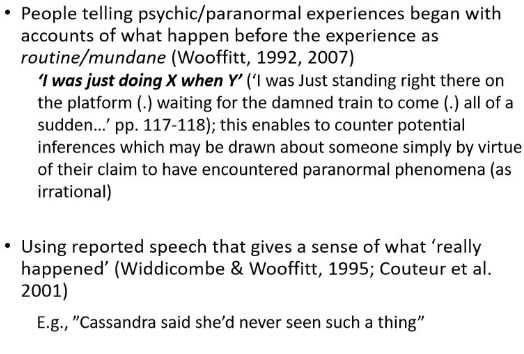
People construct own views as factual/truth or strong through language used in interactions (often seen as justifications)
Practices of interaction used to make other people do things
Such conduct is context-dependent
How can talk be constructed as factual and reasonable?
Empiricist constructions (Gilbert + Mulkay, 1984)
Research/data shows …
Citing neutral positions (Abell, 2000; Dickerson, 1997)
E.g. politicians citing independent scientists
3-part-lists in political discourse (Atkinson, 1984; Grady + Potter, 1985), courts (Drew, 1990) + everyday talk (Jefferson, 1990)
Use of common-place values (Billig)
Often used in political controversy to counter potential inferences
E.g. I’m not racist but …
Constructing logical arguments (Billig, 1987) + enthymemes (Marinho, 2012)
According to studies by Atkinson (1984) and Heritage and Greatbach (1986), how is persuasion demonstrated in practices of interaction?
Analysis of British politicians giving speeches at annual part conferences (simple/agreeable audience)
Analysis of turns → talk + respective reactions from audience
Results:
Use of rhetorical devises (as 3-part-list, contrast, puzzle solutions etc) to communicate to audience that they have come to a completion point, marked with appropriate timing, intonation + gestures which produce immediate, coordinate applause
Identified in creation of applause from multi-party audience (Marinho + Billig, 2013 + 14)
According to studies by Humǎ (2019, 20), how is persuasion demonstrated in practices of interaction?
Analysis of 150 audio-recordings of ‘cold calls’ between salespeople + prospective customers
Results:
Use of practices that don’t give P opportunity to refuse to meet → by bypassing the slot where the prospect could accept/refuse to meet
Formulating the request in terms or ‘I want’ → makes refusal an inappropriate next time
Claiming the prospective client initiated the meeting request → refusal irrelevant or difficult
According to studies by Hepburn and Potter (2011), how is persuasion demonstrated in practices of interaction?
Video recordings of a family during 16 mealtimes with pre-school children
Results: parents using threats to get children to eat
Threat structure → if the child continues problem action/doesn’t initiate required action then negative consequences will be produced by the parents
Triggered defiance, compliance + a mixture of resistance/compliance
According to studies by Gibson (2013, 14, 15, 17, 19), how is persuasion demonstrated in practices of interaction?
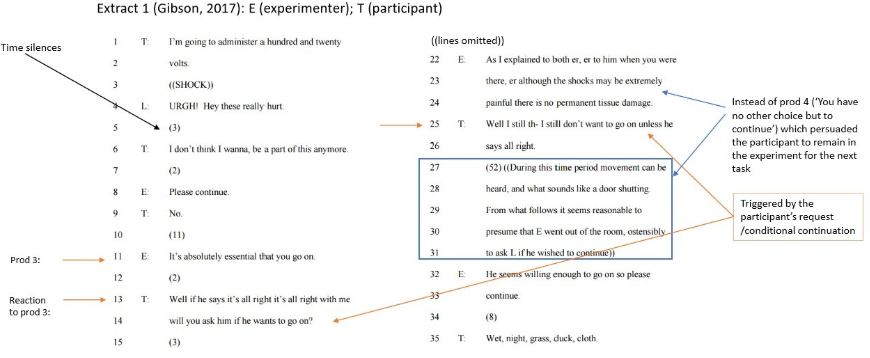
Yale uni archives of Milgram’s experiments → audio recordings of experimental sessions
Results:
PPTs used arguments to remove themselves form the experiment
Experimenter attempted to persuade PPTs to continue
Departure from standardised procedures
E.g. use of prods in different orders + not the one described in the procedure
General observations:
Experimenter tried very hard to get PPTs to continue
Experimenter didn’t typically issue orders → when orders were used, PPTs stopped (also in Burger, 2011)
How does Dickerson (1997) criticise traditional social-psychological research on persuasion (such as Hovland and Eagly)?
Treats source characteristics as relatively stable/fixed psychological objects that causally influence persuasion
Argues they’re constructed in context to serve rhetorical purposes (manage scepticism, stake attribution + credibility)
Selectively invoked
Strategically highlighted
Contested
Context-sensitive
Persuasion is embedded in interaction
Source characteristics are discursively accomplished
Classic experiments typically:
Manipulate source attributes (e.g., “expert” vs. “non-expert”)
Present message and source in written form
Measure attitude change as an outcome
BUT this approach:
Abstracts persuasion away from real-life interaction
Treats source qualities (expertise, neutrality, credibility) as fixed traits
Neglects how speakers actively construct + deploy source characteristics in discourse
How does Dickerson (1997) investigate persuasion?
'How do politicians rhetorically construct and use cited others in real argumentative contexts?'
Study analyses:
52 segments of televised political discourse
Focuses specifically on instances where politicians cite other people or institutions (particularly when citation functions as a warranting device—to endorse, corroborate, or strengthen claims)
Excludes:
Citations used to show opponents’ inconsistency
Citations of studio audience members
Broadcast in the UK and USA (1992–1995)
The approach is discourse analytic and influenced by conversation analysis (e.g., Erving Goffman; Michael Billig; Jonathan Potter)
What does Dickerson (1997) conclude about persuasion in politics?
Politicians do not simply position themselves as sole authors of their claims. Instead, they:
Cite others to share authorship
Use cited others to pre-empt accusations of bias or self-interest.
Construct cited sources as:
Apolitical
Expert
Counter-interested
What can political claims be dismissed as being?
Biased
Self-serving
Motivated by electoral interest
E.g “he would say that, wouldn’t he?”, “he had to say that”
Challenge identity of cited other
E.g. contested political identity of Dick Marsh
labour minister vs a tory
Demonstrates:
Source identity is not fixed
Even political affiliation can be rhetorically reconstructed
Source characteristics are to-be-achieved constructions, not objective facts
Aligns with discursive psychology (e.g. Edwards + Potter) +rhetorical psychology (Billig)→ PPTs treat claims as potentially “stake-driven" + citing others becomes a resource for managing this problem
What are Dickerson’s (1997) major types of warranting citation?
Apolitical endorsement
Expert endorsement
Counter-interest endorsement
What is apolitical endorsement?
Politicians construct cited sources as:
Independent
Neutral
Free from party-political bias
E.g:
Referring to “independent bodies”
Invoking consensus (“everyone relies on…”)
Emphasising objectivity (“honest statistics”)
E.g. Organisation for Economic Co-operation + Development
The OECD is constructed as:
Investigative
Analytical
Initially sceptical (disconfirmed expectations)
Therefore unbiased
The rhetorical move:
If even neutral investigators reached this conclusion, it must be true
Disconfirmed expectations (“they expected to find X but discovered Y”) strengthen the appearance of objectivity
What is expert endorsement?
Politicians selectively construct others as experts by foregrounding:
Credentials
Titles
Institutional authority
Large numbers
E.g. Bill Clinton cites:
“Nine Nobel Prize winners”
“Over five hundred economists”
“Hundreds of business people”
This mirrors (but discursively reconstructs) the logic of experimental research on expertise BUT instead of being manipulated variables, “expert” qualities are rhetorically highlighted in real-time argument
Large numbers imply that agreement must stem from the merits of the policy rather than shared bias → consensus constructed
What is counter-interest endoresement?
Particularly powerful
Cited source is constructed as:
Normally opposed to the speaker’s interests
Therefore unlikely to support them out of bias
E.g.
A Conservative politician citing a Socialist opponent.
Clinton citing Republicans who support his economic plans.
Implies → if even my opponents agree with me, the evidence must be compelling
Differs from neutrality:
Neutral sources lack stake
Counter-interest sources have stake—but in the opposite direction