NU 330 - E3 - PP4 - Unit I high risk newborn
 Call Kai
 Learn
 Practice Test
 Spaced Repetition
 Match
 Flashcards
 Knowt Play
1/39

There's no tags or description
Looks like no tags are added yet.
40 Terms
Neonatal mortality risk:
Defined as chance of death within neonatal period (first 28 days of life)
Neonatal morbidity risk:
Specific conditions can be anticipated (cerebral palsy)
Identification of the At-Risk Newborn
• Risk factors
– Gestational age (preterm, postterm)
– Birth weight (SGA, IUGR, LGA vs. AGA)
– Limited access to healthcare, no or little prenatal care
– Low socioeconomic level of the mother
– Environmental and genetic factors
– Preexisting maternal conditions (diabetes, HTN, etc.)
– Conditions related to pregnancy, labor, and birth, and associated complications (perinatal asphyxia, placental abruption, chorioamnionitis, etc.)
– Type and length of newborn illness
• Apgar score can be helpful tool. However, assessment values, interventions required, and lab results are more predictive of NICU admission
*Gestational age less than 35.0 weeks (depending upon facility policy) is an automatic admission to the NICU
Care of the At-Risk Newborn
• Nursing care management
– Decreasing physiologically & neurologically stressful situations (maintain neutral thermal environment, regulate feedings, decrease lights, lower noise level, etc.)
– Monitoring, observing for subtle signs of change
– Interpreting laboratory data
– Cluster cares
– Conserving neonate's energy
– Maintenance of sleep cycles
– Providing for appropriate developmental stimulation
– Assisting family in developing attachment behaviors
– Involving family in planning and providing care
Types of NICU Warmers and Beds
-Assisting the at-risk, ill, or preterm neonate by maintaining a neutral thermal environment
-NICU patients are cared for within different types of beds ranging from high acuity beds to open crib
Birth Weight as a Risk Factor
• Small-for-gestational-age (SGA)
– Below 10th percentile growth curve
– At risk for perinatal asphyxia, polycythemia (ruddy red appearance), temp instability, and hypoglycemia
– Differs from Intrauterine Growth Restriction (IUGR)
• Large-for-gestational-age (LGA)
– Above 90th percentile growth curve
– At risk for perinatal asphyxia, birth injury, polycythemia (ruddy red appearance), and hypoglycemia
*Neonatal polycythemia: Body produces more red blood cells under hypoxic states
Intrauterine Growth Restriction (IUGR) Newborn
• Appears malnourished, head larger than body, dry and loose skin
• Maternal factors
• Chronic or gestational hypertension
• Poorly controlled diabetes
• Smoker, limited prenatal care
• Placental factors
• Infarctions, chorioamnionitis, hemorrhage
• Fetal factors
• Congenital anomalies
• TORCH infections
-Noticed during prenatal care if fundal height discrepancy and ultrasound measurements support diagnosis

Oxygen reduction + Restricted placental blood flow = Decreased fetal growth rate
Pregnancy management with the IUGR fetus:
• Increased frequency of prenatal visits
• Weekly or bi-weekly NSTs
• Frequent ultrasounds for growth measurements and Biophysical Profiles
• Anticipate need for early delivery
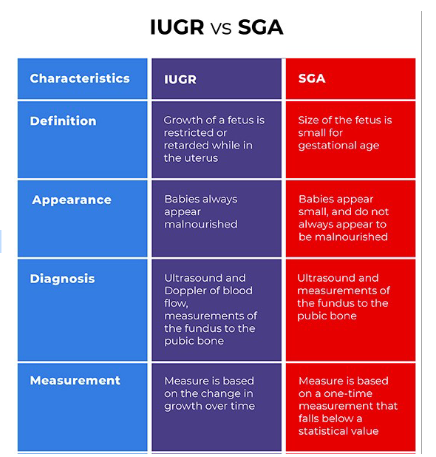
Care of the IUGR/SGA Newborn
-Evaluation and goals
• Free from respiratory compromise
• Maintains stable temperature
Increased risk for hypothermia due to limited amount of brown fat
Brown fat creates more heat when blood flows through it and it is metabolized
-Free from hypoglycemic episodes
• Maintains glucose homeostasis on their own
-Factors contributing to poor long-term outcomes
• Continued growth and feeding difficulties
• Cognitive difficulties
• Learning disabilities
• Possible behavior difficulties and diagnose
The LGA Newborn
-Correlating factors
• Maternal diabetes
• Multiparous women
• Hispanic women
• Male neonate
-Tend to be more difficult to arouse throughout first 24 hours of life
-Birth trauma (bruising, edema, clavicle fracture, etc.) due to:
• Cephalopelvic disproportion (CPD)
• Macrosomia
-Hypoglycemia, polycythemia, hyperbilirubinemia
Nursing Care of the LGA Newborn
• Obtain and relate perinatal history to current status
• Gestational age assessment and plot on growth chart
• Cares similar to that of infant of diabetic mother
• Early identification of symptoms, glucose monitoring, interventions
• Vital signs monitoring and assess for other complications
• Address parental concerns
Care of the Infant of a Diabetic Mother (IDM)
• Exposure to high levels of maternal glucose in utero
• At risk for respiratory distress syndrome (RDS) and other complications due to immature physiological even when born at term
High levels of maternal glucose slows normal fetal physiological maturity
• Macrosomic, can have excess adipose tissue
• Polycythemia (ruddy red appearance), hyperviscosity (blood is thicker than normal)
-Hypocalcemia
• Serum calcium less than 7 mg/dL
• Signs/symptoms; tremors, seizure
Possible Complications of the Infant of Diabetic Mother (IDM)
--Hyperbilirubinemia
• Perform transcutaneous bilirubin prior to 24 hours of age if skin appears jaundiced
--Cardiac malformations
• Ventricular septal defect (VSD), transposition of the great arteries, aortic stenosis, pulmonary atresia, tetralogy of Fallot
-Congenital malformations
• Neural tube defects
-Nurse can provide parental education
• Decrease impact of maternal diabetes on subsequent pregnancies
• Decrease risk for childhood obesity
Neonatal Hypoglycemia Care
Treat blood sugar less than 45 mg/dL per protocol/order:
• Feeding, oral dextrose gel, or IV infusion of D10W
• Admit to NICU if blood sugar less than 25 mg/dL

The Preterm Newborn
-Preterm birth
• Under 37.0 weeks gestation
• Late preterm: 34.0–36.6 weeks
• 12-18% of all births
-Alteration in respiratory, cardiovascular physiology
• Unable to produce enough surfactant
• Respiratory distress syndrome (RDS)
• Ductus arteriosus may remain open
• Patent ductus arteriosus (PDA): Ductus arteriosus remains open after transition to extrauterine life due to neonatal hypoxia and/or severe prematurity
Preterm Newborn Characteristics
• Abundant vernix covering whole body
• Lanugo present and cover back, shoulders, legs and cheeks
• Skin thin with visible vessels
• Head size appears large compared to body; skull bones pliable, fontanels smooth and flat
• Ears have minimal cartilage
• Nails short and soft
• Genitals are small, testes may be undescended
• Frog-like extended flaccid position
• Weak, feeble cry
• Poor reflexes
• Activity is jerky, generalized movements
Altered Thermoregulation
-Factors that increase heat loss in the preterm neonate
• High ratio of body surface to body weight
• Very little subcutaneous fat, little to no brown fat
• Thinner, more permeable skin
• Posture less flexed
• Decreased ability to vasoconstrict superficial blood vessels
-Maintain neutral thermal environment (NTE) with radiant warmer
• Remember concepts of neonatal heat loss
• Convection, radiation, evaporation, conduction
• Newborns cannot shiver to generate heat
Premature Organ System Complications
• Missed most of the rapid growth and development that occurs in third trimester of pregnancy/gestation
• Bowel; risk for necrotizing enterocolitis
• Inflammation of the intestine leading to tissue death
Increased residuals, abdominal distension, lethargy, bloody stools, yellow or green emesis
• Higher risk when fed formula vs. breast milk
• Kidneys; limited ability to concentrate urine, excrete excess amounts of fluid
• Decreased glomerular filtration rate
• Ability to excrete drugs affected
• Bilirubin accumulates at faster rate = jaundice
Care of the Newborn with Jaundice
-Pathophysiology of hyperbilirubinemia
• Decreased binding affinity of bilirubin to albumin
• Bilirubin free to cross blood–brain barrier
• Can damage cells of CNS
• Very high amounts causes kernicterus (acute bilirubin encephalopathy)
-Clinical therapy
• Transcutaneous bilirubin (TcB)
• Laboratory and diagnostic assessments
• Rh or ABO incompatibility, Coombs test
• Positive Coombs indicates high risk for neonatal hyperbilirubinemia
• Serum bilirubin levels
Premature Organ System Complications
• Immunity from maternal IgG immunoglobulins in last trimester of pregnancy
• Preterm infant has few antibodies
• Skin surface easily excoriated (diaper rash, tape wounds)
• Disorganized sleep-wake cycles
• Periods of reactivity may not be observed in very ill infant for several days after birth
• Intraventricular hemorrhage (IVH)
• Fragile vessels in the brain may bleed
• Hydrocephalus may develop due to obstruction (clots or blood), malabsorption, or CSF fluid overproduction
• Increased head circumference, full or bulging fontanelles, vomiting, seizures, high-pitched cry, apnea, lethargy
*MRI of IVH + hydrocephalus: Left = Symptomatic Right = 2 weeks after VP shunt placement, no longer having symptoms
Management of Nutritional Requirements
-Nutritional requirements
• Oral intake 110–140 k cal/kg/day
• Supplemental multivitamins
• Consistent weight gain of 20–30 g per day indicates adequate intake
-Feeding Methods
• Breast and bottle feeding
• Needs to exhibit coordinated suck-swallow breathing pattern and feed without significant or extended O2 desaturations
• Start small; stomach is the size of a marble at term
• Observe for tachypnea, respiratory distress
• Prematurity = poor gag reflex; risk for aspiration, reflux
• Total parenteral nutrition (TPN)
Management of Nutritional Requirements
-Feeding methods (continued)
• Gavage feeding
• Nasogastric or orogastric tube feeding
• Given if poorly coordinated suck-swallow- breathing pattern or ventilator dependent, ill
• Intermittent bolus or continuous per pump
• Trophic feedings given in small boluses starting with 1-3 mL/kg per feed
Common Complications of Preterm Newborns
-Apnea
• Cessation of breathing 20 seconds or longer, or with cyanosis, pallor, bradycardia
• Onset often random, frequent
• Gentle stimulation may be sufficient to resolve the apnea spell
• If upper airway obstruction, treated with CPAP
• If decreased central respiratory drive, treated with caffeine citrate
• Use of caffeine decreases risk for BPD and CP
-Pulmonary interstitial emphysema (PIE)
• Accumulation of air in lung tissues
• May precede pneumothorax
-Anemia of prematurity
• Excessive blood sampling, Vitamin E deficiency
• Place newborn on constant cardiac and respiratory monitorin
The Newborn with Respiratory Distress Syndrome (RDS)
• Clinical therapy
• Prenatal: Steroids (Betamethasone) to enhance fetal lung development if risk for preterm delivery
• Postnatal
• Surfactant replacement (placed via ET tube)
• Supportive management, ventilator therapy
• Also called “hyaline membrane disease”
• Primary absence/deficiency of pulmonary surfactant
• Prematurity
• Surfactant deficiency disease (genetic disorder)
• Physiologic alterations produce complications
• Hypoxia
• Respiratory acidosis
• Metabolic acidosis
*Any of the following signs/symptoms: tachypnea, Retractions, Grunting, Nasal flaring, Cyanosis
Transient Tachypnea of the Newborn (TTN)
• More time needed to transition to extra-uterine life
• Persistent or intermittent grunting, mild symptoms
• Oral feeding contraindicated until no longer requiring supplemental O2
• Nursing care similar as for newborn with RDS
Meconium Aspiration Syndrome
• Body’s physiologic response to asphyxia in utero = increased relaxation of anal sphincter = meconium fluid
• Risk for presence of meconium in lungs-- Suctioning meconium from oropharynx at time of birth is necessary if tone is limp and neonate is not vigorous
• Similar signs, symptoms, and treatment as RDS and pneumonia
Bronchopulmonary dysplasia (BPD)
• Chronic lung disease
• Caused by high oxygen therapy, positive pressure
• Prevention: Use lowest amount oxygen necessary and wean as soon as able
Other Complications of Preterm Newborns
-Patent ductus arteriosus (PDA)
• Tachypnea
• Respiratory difficulty
• Heart murmur
• Difficulty with feedings and weight gain
• May need to be surgically litigated if medical, pharmacologic management unsuccessful
*Remember the three shunts that begin to close during the transition to extra-uterine life
Persistent Pulmonary Hypertension of the Newborn (PPHN)
-Persistent fetal circulation
• Right to left shunting of blood
• Hypoxemia, acidosis in the extrauterine environment
-Clinical therapy
• Echocardiogram
• Lower the pulmonary vascular resistance (with medication) and reverse shunting
-Onset of symptoms
• First 12 to 24 hours; exhibits signs/symptoms of respiratory distress
• Quickly becomes critically ill
• Often medically paralyzed for ventilation
Risks for Long-Term Complications of Preterm Birth
-Neurologic deficits
• Cerebral palsy, hydrocephalus, seizures, lower IQ scores, learning disabilities
• Risk does not equal injury, injury does not equal damage
-Auditory defects
• 1–4% incidence of moderate to profound hearing loss
-Speech defects
• Delayed receptive, expressive ability
-Respiratory infections
-Sudden infant death syndrome (SIDS)
-Retinopathy of prematurity (ROP)
• Disorder of the developing retinal blood vessels
• Can lead to impaired vision, blindness
• Exposure to increased pressure of oxygen therapy and ambient air prevents further vascularization of retinal capillaries
• Prevented by careful use of supplemental oxygen therapy
• Candidates for screening: Gestational age (GA) of 30.6 weeks or less (regardless of birth weight); AND birth weights of 1250 grams or less
SIDS and Accidental Suffocation and Strangulation in Bed (ASSB)

Additional Nursing Cares for the Preterm Newborn
-Maintenance of respiratory function and NTE
• Increased danger of obstruction, apnea, RDS
• Clothe once medically stable
-Provision of adequate nutrition and prevention of fatigue during feeding
-Prevention of infection
• Strict handwashing, use of individual equipment
-Promotion of developmentally supportive care
-Promotion of parent–newborn attachment
• Early involvement, rooming in prior to discharge
• Kangaroo (skin-to-skin) care
• Cuddle program (volunteer cuddlers when parents not available
Care of the Newborn with Infection
-Also known as sepsis neonatorum
• Risk is 10x higher for very-low-birth-weight (VLBW)
• Bacteremia/sepsis, urinary tract infection (UTI), pneumonia, and meningitis can lead to developmental disabilities, death
-Nursing assessment; signs and symptoms
• Subtle behavioral changes (lethargy, poor tone)
• Temperature instability
• Feeding intolerance (spitty, gaggy)
• Could have tachycardia initially, then apnea episodes, bradycardia episodes
• Respiratory symptoms (see next slide)
-Clinical therapy
• Start broad spectrum antibiotics while awaiting results of blood culture (preliminary results available at 24 hours)
Neonatal Sepsis
-Signs of Neonatal Sepsis: Tachypnea, grunting, cyanosis, oxygen requirement, apnea, persistent temperature <97.7 or >99.4ºF, hypotonia, poor feeding, or persistent unexplained hypoglycemia
-Risk Factors: < 37.0 weeks GA, maternal T>100.4ºF, ROM >18 hours, previous infant w/GBS, or current GBS bacteriuria
-CBC, CRP, Blood Culture, CXR and possible lumbar puncture (LP)
• Elevated CRP = treat newborn (normal CRP is < 0.5 mg/dL)
• + blood culture = at least 10 days of IV antibiotics
-Antibiotics for Suspected Sepsis
• Ampicillin 100 mg/kg IV q 12 hours
• Gentamicin 4 mg/kg IV q 24 hours
Congenital Anomalies: Identification and Care (Cleft Lip, Cleft Palate, Tracheoesophageal Fistula)
-Cleft Lip
Unilateral or bilateral visible defect
-Cleft Palate
Fissure connecting oral and nasal cavity
May involve upper lip only or may involve external nares, nasal cartilage, and nasal septum. May involve uvula and soft palate. May extend forward to nostril involving hard palate and maxillary alveolar ridge.
Difficulty in sucking, expulsion of formula through nose. Feed with special (Haberman) nipple and bottle. Burp frequently (increased tendency to swallow air and have reflex vomiting).
Obtain craniofacial/ENT consult.
-Tracheoesophageal Fistula (TEF)
Lower esophageal segment connects to the lower trachea with upper esophageal segment ending blindly (atresia)
History of maternal polyhydramnios, excessive oral secretions, constant drooling, abdominal distention, periodic choking and cyanotic episodes.
Rapid regurgitation during feeding.
Signs/symptoms: Tachypnea, retractions, rhonchi, decreased breath sounds, cyanotic spells. Reflux of gastric contents into trachea leading to aspiration pneumonia. Inability to pass nasogastric tube (will not pass beyond 10– 15 cm from nares).
Obtain a surgical consult.
Congenital Anomalies: Identification and Care (Gastroschisis, Myelomeningocele)
-Gastroschisis
Full-thickness defect in abdominal wall allowing viscera outside the body to the right of an intact umbilical cord
Associated with intestinal atresia, malrotation. Bowel loops have escaped the abdominal cavity. Large amount of evaporative fluid losses from exposed bowel.
Maintain hydration and temperature. Place baby in sterile bag up to axilla and in a side-lying position. Initiate gastric decompression by insertion of NG tube.
Broad-spectrum IV antibiotics and surgical consult.
-Myelomeningocele
Type of Spina Bifida Saclike cyst containing meninges, spinal cord, and nerve roots in thoracic and/or lumbar area
May have constant dribbling of urine Incontinence or retention of stool, anal area may or may not be present. Prevent trauma and infection. Position on abdomen or on side and restrain (to prevent pressure and trauma to sac). Obtain neurosurgery and urology consult. Cover with protective plastic wrap over sac (to prevent trauma, rupture, and drying).
Assess amount of sensation and movement below defect. Assess for s/s hydrocephalus The risk for this neural tube defect is greatly lowered by daily FOLIC ACID (400mcg) supplementation
Care of the Newborn with Congenital Heart Defect
-Congenital heart defect
• Occurs in 3–8% live births
-Seen in first 6 days of life
• Left ventricular outflow obstructions
• Mitral stenosis, aortic stenosis, atresia
• Hypoplastic left heart
• Coarctation of the aorta
• Patent ductus arteriosus
• Transposition of the great vessels
• Tetralogy of Fallot
• Large ventricular septal defect
• Atrial septal defect
*With Transposition of the Great Vessels, other defects such as an Atrial Septal Defect can promote blood flow and lessen symptoms prior to surgical correction. Prostaglandins can also be given to keep the ductus arteriosus open
Care of the Newborn with a Congenital Heart Defect
-Nursing assessment
• Cyanosis
• Detectable heart murmur
• Signs of congestive heart failure
-Initial, early repair becoming more common
• Stabilize
• Decisions about ongoing needs, future surgical and medical interventions
-Emotional support of parents
• Careful and complete explanations
• Allow parents to verbalize concern
* • Tachypnea
• Tires easily with feeds
• Low urinary output
• Lower body, facial edema
• Mottling
• Pale, cool skin
More Common Inborn Errors of Metabolism (Detected on Newborn Screen
-Newborn screening; can detect more than 50 inborn errors
• Hereditary disorders transmitted by mutant genes
-Phenylketonuria (PKU)
• Most common of amino acid disorders
• Lacks ability to convert phenylalanine to tyrosine
• PKU accumulates in blood and brain tissue
• By 3-4 months, failure to thrive, vomiting, rash
• By 6 months, CNS involvement
• Progressive intellectual disability, mood, behavior disorder
-Special formulas low in phenylalanine, such as Phenyl-Free 1 and Phenex-1, are available
-Do not give food or drink containing phenylalanine
• Maintain low protein diet
• Avoid aspartame (artificial sweetener) as it converts into phenylalanine in the body
-Congenital hypothyroidism
• Elevated TSH, low T4 in premature infant
• Jaundice, lethargy, floppy tone, large (swollen) tongue
• Treat with dose of Levothyroxine daily
-Galactosemia
• Enzyme deficiency that prevents proper metabolism and utilization of galactose, or milk sugar
• Vomiting, diarrhea, hypoglycemia, jaundice, elevated LFTs
• Continued exposure; cataracts, brain damage, kidney dysfunction, liver failure
• Change to a soy-based formula ASAP
Hypoxic Ischemic Encephalopathy (HIE)
-Hypoxic-ischemic injury to brain cells prenatally
• Occurred some time during pregnancy, or at or near time of birth (acute)
• Placental abruption, cord prolapse, severe FHR abnormalities, severe variable or late decelerations
• Cord blood gas or ABG pH < 7.0 (first hour of life)
• 10 minute Apgar score < 5
• Requires mechanical ventilation past 10 min of age
• Seizure activity
-Induced hypothermia or Whole Body Cooling
• Reduces the incidence of death and disability following an acute perinatal hypoxic-ischemic even