PSYC 203 - Chapter 2: Neural Basis for Cognition
 Call Kai
 Learn
 Practice Test
 Spaced Repetition
 Match
 Flashcards
 Knowt Play
1/66

There's no tags or description
Looks like no tags are added yet.
67 Terms
Hindbrain
One of the three main structures (along with the forebrain and the midbrain) of the brain; the hindbrain sits atop the spinal cord and includes several structures crucial for controlling key life functions.
Cerebellum
The largest area of the hindbrain, crucial for many functions, including the coordination of bodily movements and balance.
Midbrain
One of the three main structures (along with the forebrain and the hindbrain) of the brain; the midbrain plays an important role in coordinating movements, and it contains structures that serve as “relay” stations for information arriving from the sensory organs.
Forebrain
One of the three main structures (along with the hindbrain and the midbrain) of the brain; the forebrain plays a crucial role in supporting intellectual functioning.
Cortex
The outermost surface of an organ in the body; psychologists are most commonly interested in the brain’s cortex and, specifically, the cerebral cortex
Convolutions
The wrinkles visible in the cerebral cortex that allow the enormous surface area of the human brain to fit into the relatively small volume of the skull.
Cerebral hemisphere
One of the two hemispherical brain structures—one on the left side, one on the right—that constitute the major part of the forebrain in mammals.
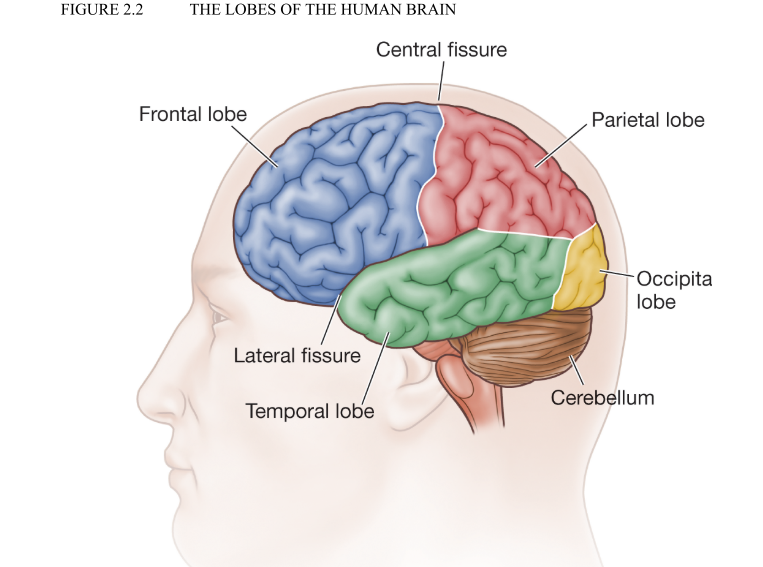
Frontal lobe
The lobe of the brain in each cerebral hemisphere that includes the prefrontal area and the primary motor projection area.
Parietal lobe
The lobe in each cerebral hemisphere that lies between the occipital and frontal lobes and that includes some of the primary sensory projection areas, as well as circuits that are crucial for the control of attention.
Temporal lobe
The lobe of the cortex lying inward and down from the temples. The temporal lobe in each cerebral hemisphere includes the primary auditory projection area, Wernicke’s area [left side - speaking & writing area], and, subcortically, the amygdala and hippocampus.
Occipital lobe
The rearmost lobe in each cerebral hemisphere, and the one that includes the primary visual projection area.
Location of Lobes
Subcortical structures
Identified pieces of the brain that are underneath the cortex and therefore are hidden from view in drawings of an intact brain. These structures include the thalamus, the hypothalamus, and the various components of the limbic system.
Thalamus
A part of the lower portion of the forebrain that serves as a major relay and integration center for sensory information.
Hypothalamus
A small structure at the base of the forebrain that plays a vital role in the control of motivated behaviors such as eating, drinking, and sexual activity.
Limbic system
A set of brain structures including the amygdala, hippocampus, and parts of the thalamus. The limbic system is believed to be involved in the control of emotional behavior and motivation, and it also plays a key role in learning and memory.
Amygdala
An almond-shaped structure in the limbic system that plays a central role in emotion and the evaluation of stimuli.
Hippocampus
A structure in the temporal lobe that is involved in the creation of long-term memories and spatial memory.
Location of Limbic System & Hippocampus

Corpus callosum
The largest of the commissures linking the left and right cerebral hemispheres.
Lesion
a specific area of tissue damage
Neuroimaging techniques
non-invasive methods for examining either the structure or the activation pattern within a living brain
Computerized axial tomography (CT scans)
a neuroimaging technique that uses X-rays to construct a precise 3-D image of the brain’s anatomy
Positron emission tomography (PET scans)
A neuroimaging technique that determines how much glucose (the brain’s fuel) is being used by specific areas of the brain at a particular moment in time and therefore provides precise information about activity levels in each part of the brain.
Magnetic resonance imaging (MRI scans)
A neuroimaging technique that uses magnetic fields (created by radio waves) to construct a detailed 3-D representation of brain tissue. Like CT scans, MRI scans reveal the brain’s anatomy, but they are much more precise than CT scans.
Functional magnetic resonance imaging (fMRI scans)
A neuroimaging technique that uses magnetic fields to construct a detailed 3-D representation of the activity levels in different areas of the brain at a particular moment in time.
Electroencephalogram (EEG)
A recording of voltage changes occurring at the scalp that reflect activity in the brain underneath.
Event-related potentials (ERP)
Changes in an electroencephalogram (EEG) in the brief period just before, during, and after an explicitly defined event, usually measured by averaging together many trials in which this event has occurred.
Fusiform face area (FFA)
A brain area apparently specialized for the perception of faces but likely involved in other functions as well.
Transcranial magnetic stimulation (TMS)
A technique in which a series of strong magnetic pulses at a specific location on the scalp causes activation in the brain region directly underneath this scalp area. Because of this external activation, that brain region is (temporarily) unable to perform its usual function and so the usual function is briefly disrupted.
Localization of function
The research endeavor of determining what specific job is performed by a particular region of the brain.
Primary motor projection area
The strip of tissue, located at the rear of the frontal lobe, is the departure point for nerve cells that send their signals to lower portions of the brain and spinal cord, and that ultimately result in muscle movement.
Primary sensory projection area
The main point of arrival in the cortex for information arriving from the eyes, ears, and other sense organs.
Contralateral control
A pattern in which the left half of the brain controls the right half of the body, and the right half of the brain controls the left half of the body.
Association cortex
The traditional name for the portion of the human cortex outside the motor and sensory projection areas
Apraxia
A disturbance in the capacity to initiate or organize voluntary action, often caused by brain damage.
Agnosia
A disturbance in a person’s ability to identify familiar objects.
Unilateral neglect syndrome
A pattern of symptoms in which affected individuals ignore all inputs coming from one side of space. Individuals with this syndrome put only one of their arms into their jackets, eat food from only half of their plates, read only half of words (e.g., they might read “blouse” as “use”), and so on. Typically the damage is in the right hemisphere, and so the person neglects all inputs on the left.
Aphasia
A disruption to language capacities, often caused by brain damage. [fluent aphasia produces smooth speech that lacks meaning, while non-fluent aphasia causes slow, halting, and effortful speech]
Neuron
an individual cell within the nervous system
Glia
A type of cell found (along with neurons) in the central nervous system. Glial cells have many functions, including the support of neurons, the repair of neural connections in case of damage, and a key role in guiding the initial development of neural connections. A specialized type of glia also provides electrical insulation for some neurons, allowing much faster transmission of neuronal signals.
Cell body
The area of a biological cell containing the nucleus and the metabolic machinery that sustains the cell.
Dendrite
The part of a neuron that usually detects the incoming signal.
Axon
The part of a neuron that typically transmits a signal away from the neuron’s cell body and carries the signal to another location.
Neurotransmitter
One of the chemicals released by neurons to stimulate adjacent neurons.
Synapse
The area that includes the presynaptic membrane of one neuron, the postsynaptic membrane of another neuron, and the tiny gap between them. The presynaptic membrane releases a small amount of neurotransmitter that drifts across the gap and stimulates the postsynaptic membrane.
Presynaptic membrane
The cell membrane of the neuron “sending” information across the synapse. Often contrasted with postsynaptic membranes.
Postsynaptic membrane
The cell membrane of the neuron “receiving” information across the synapse. Often contrasted with presynaptic membrane.
Threshold
The activity level at which a cell or detector responds, or fires.
Action potential
A brief change in the electrical potential of an axon. The action potential is the physical basis of the signal sent from one end of a neuron to the other; it usually triggers a further (chemical) signal to other neurons.
Myelin sheath
The layer of tissue, formed by specialized glial cells, that provides insulation around the axons of many neurons. There are, however, gaps in this insulation, and the neuronal signal essentially has to “jump” from one gap to the next, dramatically increasing the speed of neurotransmission.
All-or-none law
The principle stating that a neuron or detector either fires completely or does not fire at all; no intermediate responses are possible. (Graded responses are possible, however, by virtue of the fact that a neuron or detector can fire more or less frequently, and for a longer or shorter time.)
Coding
The system through which one type of information stands for, or represents, a different type of information. In the context of the nervous system, this term refers to the way in which activity in neurons manages to stand for, or represent, particular ideas or thoughts.
Split-Brain Patient
A person whose corpus callosum has been surgically severed, allowing researchers to study how the left and right hemispheres function independently.
Split-Brain Experiment
An experiment demonstrating that the two hemispheres can process information separately after the corpus callosum is severed. The left hemisphere is associated with speaking/language. When a fork is shown in the right visual field, the information goes to the left hemisphere, so the patient can say “fork” out loud. When the fork is shown in the left visual field, the information goes to the right hemisphere, so the patient cannot say “fork” out loud, but can identify or pick up the fork using the left hand. This demonstrates lateralization and the different functions of the two hemispheres.
Capgras Syndrome
A condition in which a person believes that someone they know, often a close family member, has been replaced by an identical-looking impostor.
Phineas Gage
A famous case study of a railroad worker who survived severe damage to his frontal lobe, providing early evidence that specific brain regions are related to particular aspects of behavior and personality.
Patient Studies
The study of individuals with brain damage or neurological conditions to determine how damage to particular brain areas affects cognition and behavior.
Plasticity
The brain’s ability to change and reorganize its structure or functioning in response to experience, learning, or brain damage.
Cochlear Implant
A device that provides electrical stimulation to the auditory nerve, allowing some people with severe hearing loss to perceive sound; it illustrates the relationship between physical brain activity and conscious perception.
Lateralization
The specialization of the two cerebral hemispheres for different cognitive functions.
Mental Operations
The internal cognitive processes or procedures used to perform a task, such as recognizing, remembering, deciding, or solving a problem.
Importance of Constraining Measurements
The idea that measurements of brain activity should be interpreted carefully because a brain measurement alone does not necessarily tell us exactly what cognitive process is occurring.
Patient H.M.
A famous patient who underwent brain surgery that damaged parts of his medial temporal lobes, including the hippocampus, resulting in severe difficulty forming new long-term memories while some other abilities remained intact.
Computational Models
Models that use computational processes to represent and explain how cognitive functions, such as memory, might operate.
Basal Ganglia
A group of subcortical brain structures involved in movement, learning, action selection, and other cognitive processes.
Tight Coupling
The close interaction between learning, action selection, and working memory, in which these processes influence and support one another.