Brain and Cranial Nerves
 Call Kai
 Learn
 Practice Test
 Spaced Repetition
 Match
 Flashcards
 Knowt Play
1/86

There's no tags or description
Looks like no tags are added yet.
87 Terms
what are the 4 major brain regions?
cerebrum
brain stem
cerebellum
diencephalon
What are the two subdivisions of the cerebrum?
left and right hemispheres
What separates the two cerebral hemispheres?
Longitudinal fissure
What structure allows the cerebral hemispheres to communicate?
Corpus callosum
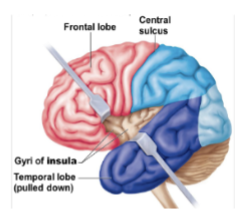
what are the 5 lobes of the cerebrum?
frontal
parietal
temporal
occipital
insula
What separates the lobes of the cerebrum?
sulci
What are the main functions of the frontal lobe?
Voluntary movement
planning
decision-making
personality
speech production
What is the cerebral cortex?
Thin (2–4 mm) superficial layer of gray matter
What are the three subdivisions of the diencephalon?
thalamus
hypothalamus
epithalamus
What is the main function of the diencephalon?
sensory and motor processing between higher and lower brain centers
What is the function of the thalamus?
relay station for sensory impulses
What functions does the hypothalamus regulate?
ANS
pituitary gland
emotional and behavioral patterns
eating/drinking
body temperature
circadian rhythm and state of consciousness
What structures are found in the epithalamus?
pineal gland and habenular nuclei
What is the function of the pineal gland?
Secretes melatonin and helps regulate circadian rhythm
What is the function of the habenular nuclei?
Relay signals from the limbic system to the midbrain
visceral and emotional responses to odors
What are the three subdivisions of the brain stem?
midbrain
pons
medulla oblongata
What is the main function of the brain stem?
Relay centers for processing
controlling involuntary reflexes
governing vital functions
What are the functions of the midbrain?
Carries voluntary motor commands
Movement, emotions, pleasure and pain response
Visual reflexes and visual tracking
Auditory reflexes
Wakefulness and alertness
What are the functions of the pons?
Pontine respiratory center
Sound localization
REM sleep
Facial sensations
What are the functions of the medulla oblongata?
Proprioception
Heart rate and contraction force
Diameter of blood vessels
Respiratory rate
Cough, sneeze, swallow, gag and vomit
Sensory information to thalamus
What structure is involved in visual tracking and coordinating eye movements?
superior colliculi
What are the functions of the cerebellum?
Coordinate movements
Regulate posture and balance
Language
Learning/processing
Behavior/expression
What part of the brain produces smooth, coordinated body movements?
cerebellum
What are the functions of the parietal lobe?
Touch and spatial awareness
What are the functions of the temporal lobe?
Hearing, language and memory
What is the function of the occipital lobe?
vision
What are the functions of the insula?
taste and memory
What are the two structures labeled within the cerebellum?
arbor vitae and cerebellar cortex
What structure of the midbrain is involved in auditory reflexes?
inferior colliculi
What structure is involved in waking up to an alarm clock?
reticular activating system
What structure is involved in forming memories?
hippocampus
What is gray matter made of?
Dendrites, cell bodies, unmyelinated axons
What is white matter made of?
Myelinated axons
Where is gray matter found in the brain (cerebrum)?
Cerebral cortex and cerebral nuclei
Where is white matter found in the brain (cerebrum)?
Inner white matter, corpus callosum, internal capsule
Where is gray matter found in the spinal cord?
inside
Where is white matter found in the spinal cord?
outside
what are the three meningeal layers from deep to superficial?
pia mater
arachnoid mater
dura mater
What are the functions of the meninges?
Support and protect nervous tissue and blood vessels
contain and circulate CSF.
What is the structure of the pia mater?
inner layer thats made up of areolar connective tissue
What is the function of the pia mater?
Covers and supports small blood vessels
What is the structure of the arachnoid mater?
middle layer containing collagen and elastic fibers
What is the function of the arachnoid mater?
Supports blood vessels and helps contain CSF in the subarachnoid space
What is the structure of the dura mater?
outer layer made of dense irregular connective tissue
What is the function of the dura mater?
Protects and supports the brain and spinal cord
What happens in meningitis?
The meninges become inflamed, commonly due to bacterial or viral infection.
What are the two layers of the dura mater in the brain?
periosteal and meningeal layer
What layer of the dura mater is found in the spinal cord?
Meningeal layer only
meningeal layer
deeper layer
periosteal layer
superficial layer
subarachnoid space contains what?
cerebrospinal fluid
What are dural venous sinuses?
Modified veins that form large, blood-filled spaces and collect blood draining from the brain.
Where are dural venous sinuses found?
Between the meningeal and periosteal layers of the dura mater.
What are ventricles?
cavities within the brain
What are the four ventricles of the brain?
Two lateral ventricles
Third ventricle
Fourth ventricle
What fluid fills the ventricles?
cerebrospinal fluid
Where is CSF formed?
choroid plexus
Where are the lateral ventricles located?
One in each cerebral hemisphere
Where is the third ventricle located?
Within the diencephalon, between the thalami
Where is the fourth ventricle located?
Between the brainstem (pons and medulla oblongata) and the cerebellum
What is the function of the blood-brain barrier?
Regulates which substances enter the brain’s interstitial fluid.
Helps prevent neuron exposure to harmful substances.
What are the three elements that make up the blood-brain barrier?
Capillary endothelial cells connected by tight junctions.
Thick basement membrane.
Perivascular feet of astrocytes.
what is the function of the primary somatosensory area?
Receives sensory information such as touch, pressure, pain and temperature.
what is the location of the primary somatosensory area?
Postcentral gyrus, parietal lobe.
What is the function of the primary visual area?
Receives visual information.
What is the location of the primary visual area?
Occipital lobe.
What is the function of the primary auditory area?
receives auditory information
What is the location of the primary auditory area?
temporal lobe
What is the function of the primary gustatory area?
taste
What is the function of the primary olfactory area?
smell
What is the location of the primary olfactory area?
medial temporal lobe
What is the function of the somatosensory association area?
Interprets somatosensory information, allowing recognition of objects by touch.
What is the function of the visual association area?
Interprets visual information and recognizes objects.
What is the function of the auditory association area?
Interprets and recognizes sounds.
What is the function of Wernicke's area?
Comprehension of written and spoken language.
What is the function of the common integrative area?
Integrates sensory information from different association areas.
What is the function of the facial recognition area?
recognizes faces
What is the location of the facial recognition area?
inferior temporal lobe
What is the function of the prefrontal cortex?
thinking
planning
judgement
decision making
appropriate behavior
What is the function of the premotor area?
Plans and coordinates learned motor movements.
What is the function of the frontal eye field area?
Controls voluntary eye movements.
What is the function of the primary motor area?
Initiates voluntary skeletal muscle movements.
What is the location of the primary motor area?
Precentral gyrus, frontal lobe.
What is the function of Broca's speech area?
Controls the motor activities necessary for speech production.
What separates the primary motor cortex from the primary somatosensory cortex?
central sulcus